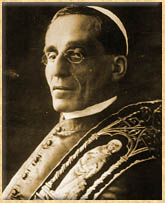
 Pope Benedict XV reigned during the 1914-1918 World War.
"His formal peace proposal was made on Aug 1, 1917. Its main provisions were: (1) substitution of the 'moral force of right' for military force, (2) reciprocal decrease in armaments, (3) arbitration of international disputes, (4) freedom of the seas, (5) renunciation of war indemnities, (6) restoration of all occupied territories, (7) examination 'in a conciliatory spirit' of rival territorial claims. . . . Woodrow Wilson's Fourteen Points . . . resembled Benedict's own plan," says The New Catholic Encyclopedia, 2d ed, Vol 2 (Thomson-Gale, 2003), p 250.
"The sincerity of Benedict's humanitarianism was demonstrated in his untiring efforts to relieve the sufferings of the war . . . . He established an international missing-persons bureau, [arranged] refuge to soldiers suffering from tuberculosis, assigned priests to visit the wounded and prisoners, and established relief agencies. So generous was he in such activites that at his death the Holy See was virtually bankrupt. . . . [When he died] The Holy See had to borrow money to pay for the funeral, the conclave, and the coronation of Pius XI," New Catholic Encyclopedia, supra, p 250. Pope Benedict XV reigned during the 1914-1918 World War.
"His formal peace proposal was made on Aug 1, 1917. Its main provisions were: (1) substitution of the 'moral force of right' for military force, (2) reciprocal decrease in armaments, (3) arbitration of international disputes, (4) freedom of the seas, (5) renunciation of war indemnities, (6) restoration of all occupied territories, (7) examination 'in a conciliatory spirit' of rival territorial claims. . . . Woodrow Wilson's Fourteen Points . . . resembled Benedict's own plan," says The New Catholic Encyclopedia, 2d ed, Vol 2 (Thomson-Gale, 2003), p 250.
"The sincerity of Benedict's humanitarianism was demonstrated in his untiring efforts to relieve the sufferings of the war . . . . He established an international missing-persons bureau, [arranged] refuge to soldiers suffering from tuberculosis, assigned priests to visit the wounded and prisoners, and established relief agencies. So generous was he in such activites that at his death the Holy See was virtually bankrupt. . . . [When he died] The Holy See had to borrow money to pay for the funeral, the conclave, and the coronation of Pius XI," New Catholic Encyclopedia, supra, p 250.
For well-reasoned analyses of causes of the 1914-1918 World War, see, e.g.,
Prof. Christopher Clark (Cambridge), The Sleepwalkers: How Europe Went to War in 1914 (shows "that Germany's role in the conflict was no
greater than the other belligerents . . . Germany's vibrant social democracy with
its workers' rights and concern for the poor posed a threat
to the capitalists of Britain and France," quoted from review by Eric S. Margolis)
Seumas Milne,
"First world war: an imperial bloodbath that's a warning, not a noble cause" (The Guardian, Wednesday, 8 January 2014), and
Konne Zilliacus [1894-1967], M.P. (Great Britain), Mirror of the Past: A History of Secret Diplomacy (New York: A. A. Wyn, 1946). This British Member of Parliament, Konne Zilliacus, M.P., cites the bottom-line, politician contempt for the public: “As for the peoples, they were nothing at all . . . except cannon fodder. No government ever . . . hesitated to deceive them [; each government] took it for granted that they [average citizenry] would let themselves be butchered in unlimited quantities when the game of power politics [included] war.”
Prof. Michael Parenti, Ph.D., "1918: On When a War Ended (Though Others Would Follow)" (27 October 2014) ("It is the few, who together constitute a bloc of industrialists and landlords, who think war will bring bigger markets abroad and civic discipline at home. One of [them] in 1914 saw war as a way of promoting compliance and obedience on the labor front and—as he himself said—war 'would permit the hierarchal reorganization of class relations.'")
An earlier analysis had said, "The decades of imperialism have been prolific in wars . . . Every one of the steps of expansion in Africa, Asia, and the Pacific has been accompanied by bloodshed . . . The pax Britannica, always an impudent falsehood, has become of recent years a grotesque monster of hypocrisy," says John A. Hobson (1858-1940), Imperialism (London: Nisbet & Co, Ltd.; New York: James Pott & Co, 1902), Part II, Chapter I, paragraph II.I.35, p 132 [Book Excerpt].
And "war would be impossible if the individuals [the 'cannon fodder'] who waged it did not . . . cooperate by fighting against other [people]," says Prof. Michael P. Ghiglieri, Ph.D., Dark Side of Man (Reading, MA.: Perseus Books, 1999), p 184.
The article "Impeach Bush, Nation of Islam chief demands" has a 25 February 2007 speech "urging the black community to avoid military service at all costs." "Mr Farrakhan urged his almost exclusively black audience to resist the calls of US military recruiters, who he said targeted young people lacking education and opportunity. 'I'm here to tell you, brothers and sisters, [enlisting] that's the worst decision you can ever make.'"
For examples on how the "cannon fodder" is treated, see Herman Wouk, The Caine Mutiny: A Novel of World War II (Garden City: Doubleday & Co, Inc., 1951). The material on "the deposed captain [Queeg] was contrived from a study of psychoneurotic case histories. . . . The author [Wouk] served under two captains of the regular Navy in three years aboard destroyer-minesweepers. . . . The general [common] obscenity and blasphemy of shipboard talk have gone almost wholly unrecorded [as] largely monotonous . . . mere verbal punctuation of a sort . . . . " Examples include officers as "harsh, ill-tempered, nasty, oppressive, and often showed bad judgment," p 409. "They're as cunning as acrobats at treading that fine line between being a bastard and being a lunatic," p 269.
"You assist an evil system most effectively by obeying its orders and decrees.
An evil system never deserves such allegiance.
Allegiance to it means partaking of the evil.
A good person will resist an evil system with his or her whole soul."
—Gandhi
"The West won the world not by the superiority of its ideas or values or religion but rather by its superiority in applying organized violence. Westerners often forget this fact, non-Westerners never do."—Samuel P. Huntington.
"I suspected I was just part of a racket at the time. Now I am sure of it. Like all members of the military profession I never had an original thought until I left the service. My mental faculties remained in suspended animation while I obeyed the orders of the higher-ups. This is typical with everyone in the military service."—Major General Smedley Butler.
Danish analyst Dr. Georg Brandes (1842-1927), The World at War (New York: The Macmillan Co., 1917), p 170, said: “The sound sense of the masses and their intuitive conception of right have never been anything but a democratic legend. For the masses believe, as a rule, every lie that is cleverly presented to them.”—Later cited with approval by Historian Clinton H. Grattan (1902-1980), Why We Fought (New York: Vanguard Press, 1929, 1957), 71, adding, “. . . propagandists counted heavily on the naiveté of the civil populations of all countries and of the American public in particular. It can hardly be said that their [propagandists'] confidence [in public gullibility] was misplaced.” As British leader
Sir Winston Churchill (1874-1965) said concerning ability to deceive voters: “The best argument against democracy is a five-minute conversation with the average voter.” [For more on public gullibility, click here. See also Herman Goering's famous quote].
Like wars generally, the 1914-1918 war had economic underpinnings. "Follow the money." “The [First] World War is on all fours with [typical of, like, the same as] every other war in having an economic foundation. Every reputable historian . . . no matter how great his proccupation with the diplomacy of its precipitation, regards the diplomacy, the propaganda, the alleged aims and objects for fighting, as mere secondary structures reared on the foundation of money and trade [economics]. The flag follows trade, the politicians follow the flag, the propagandists follow the politicians, and the people follow the propagandists.”—Grattan, p 127. (And see "Secrets of World War I" (Video, Part 1 of 5)).
“Economics provides the dynamics of history. . . . [But politicians invent other reasons for starting war pursuant to] the capacity of mankind to rationalize its conduct in ways more flattering to its self-esteem than a frank [honest] admission that dollars and goods [lusts] rule. Economics [lust] provides the ground to walk on, while the rationalizations [politician lies] give the excuse for walking.”—Grattan, p 127.
The “cannon fodder” seem to instinctively know this. "Many ordinary white southerners opposed United States entry into the Great War. They thought that the war was being fought for economic interest not their own, and they struggled against being forced to serve in it," says Prof. Jeanette Keith, "The Politics of Southern Draft Resistance, 1917-1918: Class, Race, and Conscription in the Rural South," 87 Journal of Am History (#4) 1335-1361 at 1338 (March 2001). "The result was widespread evasion, desertion, and (in places) armed resistance." "Consider the standard book on the World War I draft, John Whiteclay Chambers II's To Raise an Army . . . . Chambers acknowledges that the draft was unpopular with the American people. He estimates that between 2.4 and 3.6 million men avoided service by refusing to register," p 1336. And "Chambers notes that 337,649 men 'deserted' . . . about 12 percent of the 2.8 million men drafted thus 'deserted,'" p 1336. See also Prof. Keith's book Rich Man's War, Poor Man's Fight (Univ of North Carolina Press, 2004).
And note this additional data on the instinctive reaction of the "cannon fodder," from the 1939-1945 World War:
“the biggest problem American officers encountered in the field was getting their men to fire at other human beings. The infantryman did not have the psychological prop of the fighter pilot, who could tell himself he was only trying to bring down an enemy aircraft; or of the sailor, who could tell himself he was attacking another ship rather than the people aboard it; or the bomber crewman who was attacking a factory and not factory hands [employees]. The infantryman had to face the bleak reality that he was there to kill another human being, sometimes close enough to see his face. Only about one rifleman in four could bring himself to fire his weapon in combat. 'The American soldier is willing to die,' Patton discovered, 'but not to kill.'”—Geoffrey Perret, A Country Made by War (New York: Random House, 1989), p 436.
Another analyst says likewise: “'On average . . . no more than 15 percent of the men [and, adding in casualties who could not be interviewed but did likely fight, no more than 25 percent] had actually fired at the enemy positions or personnel with the weapons during the entire course of an engagement,'” quoting Army interviewer and historian Colonel S. L. A. Marshall, says Prof. Michael P. Ghiglieri, Ph.D., Dark Side of Man (Reading, MA.: Perseus Books, 1999), p 185.
Kevin Barrett, Ph.D., in "Twilight of the Psychopaths" (11 June 2008), says "Marshall’s discovery and subsequent research, proved that in all previous wars, a tiny minority of soldiers — the 5% who are natural-born psychopaths, and perhaps a few temporarily-insane imitators—did almost all the killing. Normal men just went through the motions and, if at all possible, refused to take the life of an enemy soldier, even if that meant giving up their own. The implication: Wars are ritualized mass murders by psychopaths of non-psychopaths. Marshall’s work brought a Copernican revolution to military science. In the past, everyone believed that the soldier willing to kill for his country was the (heroic) norm, while one who refused to fight was a (cowardly) aberration. The truth, as it turned out, was that the normative soldier hailed from the psychopathic five percent. The sane majority would rather die than fight. The implication . . . was that the norms for soldiers’ behaviour in battle had been set by psychopaths. That meant that psychopaths were in control of the military as an institution. Worse, it meant that psychopaths were in control of society’s perception of military affairs. Evidently, psychopaths exercised an enormous amount of power in seemingly sane, normal society."
See also Howard Zinn, "A Violent Cartography: Bomb After Bomb" (Counterpunch, 17 December 2007) (analysis by "a bombardier who flew bombing missions for the U.S. Air Corps in the second World War")
Prof. Paul Fussell, Wartime (debunks myths about World War II)
Kelly Kennedy, Army Times Medical Reporter, with Interviewer Amy Goodman, "U.S. Soldiers Stage Mutiny, Refuse Orders in Iraq Fearing They Would Commit Massacre in Revenge for IED Attack" (21 December 2007) (“When the IED, the roadside bomb, went off, it was so close to one of the Iraqi police stations that they should have been able to see somebody burying that. It was right in front of somebody’s house, and nobody said anything. Nobody said to these guys, 'Listen, there’s a bomb here. We’re worried about you,' even though they had been going out and patrolling and doing what they were supposed to be doing, in their minds. So when that IED went off and killed their five friends . . . when they lost their five men, they—I think they gave up on the Iraqi people. If the Iraqi people weren’t willing to fight for them, then what was the point?”)
Robert C. Koehler, "The Scapegoat's Apology" (CommonDreams.org, 26 August 2009) Re evils, "when you show the people from the CIA, the FBI and the MI (military intelligence) the [torture] pictures and they say, ‘Hey, this is a great job. Keep it up,' you think it must be right." Thus: "I did not sit down and think in terms of men, women and children. They were all classified the same, and that was the classification that we dealt with, just as enemy soldiers." Thus, the soldier could "lead a raid on a village that slaughters 500 or more defenseless people."
And note the electric shock experiments conducted by Stanley
Milgram, reported in his book Obedience to Authority: An Experimental View (1974) (summary). See also his Obedience to Authority (HarperCollins, 1983), on "the elusive and sometimes shocking conditions under which men obey authority regardless of the morality involved."
“Killing a stranger without malice or satisfaction,
other than the craftsman’s pride in a job well done,
is such a rare talent that armies spend months
trying to instill it into their young soldiers.”
—Terry Pratchett, THE FIFTH ELEPHANT
And see the article by Azmi Bishara, "When the skies rain death: The culture of the fighter plane is the culture of annihilation"
(Al-Ahram, Issue No.06, 3 - 9 August 2006). See also data on "killology," by Vicki Haddock, "The Science Of Creating Killers: Human reluctance to take a life can be reversed through training in the method known as killology" (San Francisco Chronicle, 13 August 2006).
“Almost 600,000 of America's 1 million active and reserve soldiers enlisted as teens. The military lures these physiologically immature kids with a PR machine that would make Joe Camel proud. . . . But the prefrontal cortex, 'important for controlling impulses, is among the last brain regions to mature' . . . and doesn’t reach 'adult dimensions until the early 20s.' Teenagers’ brains simply lack the impulse control that can prevent a lifetime of regret, psychological and physical disability, and preventable deaths—their own, their fellow soldiers’ and those of civilians. . . . Chiefs of warfare reach out to children precisely because they are innocent, malleable, impressionable,” says Terry J. Allen, “America's Child Soldier Problem" (15 May 2007).
Propaganda example: “We don't seek empires. We're not imperialistic. We never have been. I can't imagine why you'd even ask the question,” said U.S. Secretary of Defense Donald Rumsfeld when questioned by an al-Jazeera correspondent 29 April 2003.
“It is part of the general pattern of misguided policy that our country is now geared to an arms economy which was bred in an artificially induced psychosis of war hysteria and nurtured upon an incessant propaganda of fear.”—General Douglas MacArthur, Speech, 15 May 1951.
“The pioneers of a warless world are the youth that refuse military service.”—Albert Einstein.
"It is my conviction that killing under the cloak of war is nothing but an act of murder.”—Albert Einstein [See legal terms used in murder, i.e., weapon, intentional, premeditated, malice, Element of Illegality, foreseeable, natural and probable consequences, universal malice, non-accidental, all of course applicable to war.]
“Strike against war, for without you [workers] no battles can be fought! Strike against manufacturing shrapnel and gas bombs and all other tools of murder! Strike against preparedness that means death and misery to millions of human beings! Be not dumb, obedient slaves in an army of destruction! Be heroes in an army of construction!”—Helen Keller. (Told to an audience at Carnegie Hall one year before the United States entered World War I. From 'Declarations of Independence,' by Prof. Howard Zinn, page 75).
“They wrote in the old days that it is sweet and fitting to die for one's country. But in modern war, there is nothing sweet nor fitting in your dying. You will die like a dog for no good reason.”—Ernest Hemmingway
"[I]t is a sobering thought that better evidence is required to prosecute a shoplifter than is needed to commence a world war."--Anthony Scrivener QC: (Times, 5 October 2001, p. 7)
“What difference does it make to the dead, the orphans, and the homeless, whether the mad destruction is wrought under the name of totalitarianism or the holy name of liberty and democracy?”—Mohandas Gandhi
Current activism by www.leavemychildalone.org effectuates this view. It aids parents to 'opt-out' of military recruiters contacting their child / children.
To 'opt-out' is especially crucial when the war itself is illegal, e.g., an unlawful preventive war of aggression. Every participant from the aggressor nation in such a war is in essence a war criminal.
See, e.g., Prof. Gabriel Kolko, Richard A. Falk, and Robert Jay Lifton (eds), Crimes of War: A Legal, Political-Documentary, and Psychological Inquiry into the Responsibility of Leaders, Citizens, and Soldiers for Criminal Acts in Wars (New York: Random House, 1971).
David Wilson, “The secret war” (The Guardian, 27 March 2007) (on “the estimated 14,000 rapes committed by American soldiers in England, France and Germany between 1942 and 1945.” “We know that conflict creates conditions in which soldiers commit rape and murder. Why should American GIs in the 1940s be an exception?” Note “that young men—soldiers—who are given power over others, and have a structure surrounding them that closes ranks at the first sign of criticism, a structure which is, in turn, enclosed within a popular and political culture where members of the public want to invest in their father's or their brother's or their husband's decision to become a soldier and go to war with nobility and sacrifice are, in fact, the preconditions for abuse, torture and totalitarianism.” See details by Prof. J. Robert Lilly, N. Ky. Univ., Taken by Force: Rape and American GIs in Europe in WWII (France, 2003; and Palgrave Macmillan, August 2007)
Compare with Anthony Marchant, The Mark of Cain (5 April 2007) ("about British soldiers torturing and humiliating Iraqi prisoners in Basra in 2003" and on "the dilemmas [troops] face as the war forces them to choose between loyalty to their regiment and their own morals. Marchant said: 'It's a rites-of-passage film about these two 18-year-olds who go on this journey. What's interesting about soldiering is this thing called moral courage. If you're asked to become involved with something you think is wrong, when the rest of the group is doing it and you don't do it, you can be ostracised by your section and your life becomes at risk in a very real way.")
And see also Biderman and Zimmerman, The Manipulation of Human Behavior (John Wiley, 1961) aka "The Torture Bible" (based on government-sponsored research in the 1950's).
|
Why are politicians thus? In addition to their willingness to lie, they also act on “whims, fancy, and sudden childish notions.” Awareness is at ignorant level, typically “does not know about” key factors. They listen with “little attention,” react with “remarkable irrelevancy” to reality due to “ignorance.” There is “a special failure of communication in dealing with heads of state.” “It is a feature of government that the more important the problem, the further [up the political structure] it tends to be removed from handling from anyone well acquainted with the subject.”—Barbara W. Tuchman, Stilwell and the American Experience in China (New York: Macmillan Co, 1970), pp 241, 404, 405, 464, respectively.
For politicians, content is a mere 10%!! Non-verbal communication is 60%! with vocal tonality, pitch, and pauses 30%. Recall is a mere 25%. Reference: Stanley Zareff, “Literally Speaking,” 14 Worth (#1) 46-48 (January 2005). This low level of mental performance and memory does not meet the requirements of passing exams even in grade school! Children are required to do far better than paying attention to facts merely 10%, recalling merely 25%! the below "F" (failure) level, indeed, indicative of mental retardation.
This data is long known. For example, “The trade of governing has always been monopolized by the most ignorant and the most rascally individuals of mankind.”—Thomas Paine (1737-1809).
“We hang the petty thieves and appoint the great ones to office,” says Aesop, c. 550 B.C. And, “none but unprincipled and beastly men in society assume the mastery over their fellows, as it is among bulls, bears, and cocks,” says ancient historian Polybius (205 B.C. - 125 B.C.), lib. 4.
Another ancient source says likewise: leaders are typically the “basest of men,” says Daniel 4:17.
Ancient King Nebuchadnezzar was the best world leader, the “head of gold,” Daniel 2:32 and 38. Politicians and rulers thereafter would be “inferior” to Nebuchadnezzar, says Daniel 2:39-43. Nebuchadnezzar was mentally ill for seven years, with lycanthropic symptoms, living and eating grass like an animal, hair long as feathers, fingernails and toenails like birds' claws, Daniel 2:32-33. This went on for some seven years, Daniel 2:34-36, until his “understanding” and “reason returned.” Politicians after him would be even worse, “inferior,” Daniel 2:39. Bottom line: The scum rises to the top, Jeremiah 17:9; Daniel 4:17 in context of, e.g., Luke 4:5-6, Matthew 4:8 and Hosea 8:4.
Modern political leaders are disproportionately smokers. The significance of this fact used to be known, that smokers are disproportionately mentally ill and damaged. After decades of observations of such leaders, Tolstoy had warned against having smokers as leaders: “The brain becomes numbed by the nicotine.” What Tolstoy called “conscience” thus expires, as impulse control is impaired (abulia, anomie, psychopathy). Tolstoy cited an example, a smoker who began assaulting an aged woman with a knife, wounding her badly. He then shrank from killing her, but after smoking two cigars, dazing his brain, he then completed the knife-murder.—Count Leo Tolstoy (1828-1910), Why Do People Intoxicate Themselves? (10 June 1890), p 10 [Excerpt].
Note pertinent medical / analytical findings on politicians' widespread mental abnormality:
World Health Organization, “Wide research needed to solve the problems of mental illness,” World Mental Health, Vol 12, pages 138-141 (WHO Press Release, October 1960) says that “people with psychopathic make-up often become leaders” / “les postes de commandement sont souvent assumés par des personnes à tendances psychopathiques”
Robert Payne, The Life and Death of Adolf Hitler (New York: Praeger Pub, 1975), says at p xi, “The psychopath in a position of supreme power is almost a common-place.”
Abnormal Psychology and Modern Life, 5th ed (Scott, Foresman & Co, 1976), p 10, by James Covington Coleman, Ph.D., summarizes the 1960 WHO data thus: “individuals with psychopathic personality makeup, who tend to exploit power for selfish purposes and have little concern for ethical values or social progress, often become leaders”;
Prof. Michael P. Ghiglieri, Ph.D., Dark Side of Man (Reading, MA.: Perseus Books, 1999), says at p 230, “. . . madmen—and slightly mad men—still rise to lead nations”; and
“Political Conservatism as Motivated Social Cognition,” by John T. Jost, Jack Glaser, Arie W. Kruglanski, Frank J. Sulloway, 129 Psychological Bulletin (#2) 339-375 (July 2003), cites politician symptoms. Note also: “the Conservative [pro-war] Party was . . the stupidest party. . . . I did not . . . say that . . . Conservatives are generally stupid. I meant to say that stupid people are generally Conservative. I believe that is so obviously and universally admitted a principle that I hardly think any gentleman will deny it.” (Public and Parliamentary Speeches, 31 May 1866, pp. 85-86.) “Stupidity is much the same the world over. A stupid person's notions and feelings may confidently be inferred from those which prevail in the circle by which the person is surrounded. Not so those whose opinions and feelings are emanations from their own nature and faculties.” (Subjection of Women, Chapter I, p. 273)—John Stuart Mill (1806-1873).
"The Power of Political Misinformation" (Washington Post, 15 Sept. 2008, p A6), shows that conservatives are more prone to believing falsehoods, with this proneness increasing after being told the truth. Said another way, "No need to tell the neocons facts, they just get dumber, and dumber." Such conservatives are "utterly immune to the truth -- and indeed, the truth only makes them dig deeper into their fantasy world," says Allen L. Roland, Ph.D., "Dealing with Right Wing Conservatives" (18 October 2008). They are in medical terms, unresponsive to stimuli.
“The Authoritarians," by Robert Altemeyer (Univ of Manitoba, 2006) (concerns such individuals as "very aggressive . . . hostile . . . almost totally uninfluenced by reasoning and evidence . . . dogmatic . . . hypocrites, from top to bottom . . . two-faced, and . . . one face never notices the other [and] give the flimsiest of excuses and even outright lies about things they’ve done wrong [and] the rank-and-file believe them.")
Kurt Vonnegut, "Custodians of chaos" (The Guardian, 21 January 2006) "There is a tragic flaw in our precious Constitution, and I don't know what can be done to fix it. This is it: only nut cases want to be president. This was true even in high school. Only clearly disturbed people ran for class president." See confirmatory data by Jonathan R. T. Davidson, MD; Kathryn M. Connor, MD; and Marvin Swartz, MD, "Mental Illness In U.S. Presidents Between 1776 and 1974: A Review of Biographical Sources," Journal of Nervous & Mental Disease 194 (#1): 47-51, January 2006.
H. L. Mencken (1880-1956) says, “People constantly speak of 'the government' doing this or that, as they might speak of God doing it. But the government is really nothing but a group of men, and usually they are very inferior men.” (Details, 1922: "shallow fellows, ignorant of the grave matters they deal with and too stupid to learn. . . . incompetent and imbecile, and not only incompetent and imbecile, but also incurably dishonest . . . in the hands of small groups of narrow, ignorant, and unconscionable manipulators . . .” And: "Every election is a sort of advance auction sale of stolen goods.")
Robert LeFevre, in his essay, Aggression is Wrong, says “Government, when it is examined, turns out to be nothing more nor less than a group of fallible men with the political force to act as though they were infallible.”
James Bovard, in Freedom in Chains, says “Governments and citizens blend together only in the imagination of political theorists. Government is, and always will be, an alien power over private citizens.”
Kevin Barrett, Ph.D., in "Twilight of the Psychopaths" (11 June 2008), says "Civilization, as we know it, is largely the creation of psychopaths. All civilizations, our own included, have been based on slavery and 'warfare.' Incidentally, the latter term is a euphemism for mass murder."
Aspects of politican mental disorder include but are not limited to abulia,
dyscalculia and acalculia,
dyslexia,
fragmentation,
confabulation,
delusions including of grandeur,
psychopathology,
time disorientation,
unresponsiveness to normal stimuli,
and
anosognosia.
Symptoms such as “inability to think on higher conceptual levels,” “Impairment of inner reality and ethical controls,” “concrete and impoverished” “ideation,” “a tendency to confabulate,” fragmentation, disconnection from reality, etc., are often conspicuous. Reference James C. Coleman, Abnormal Psychology and Modern Life, supra pp. 460-461. Symptoms can also include "Impairment of learning, comprehension, and judgment—with ideation tending to be concrete and impoverished—and with inability to think on higher conceptual levels and to plan.” The mental "inability . . . to plan" can typically lead to crises, forcing last minute panic-style efforts to deal with such politicians-created crises.
Note also that when politicians' “ideation” is “concrete and impoverished,” showing "inability to think on higher conceptual levels," they then “do not respond to and are not motivated by normal stimuli” such as abstract concepts and principles, but passively behave “like cattle, sitting around until someone tells them what to do next,” e.g., by providing specific concrete examples such as arise when some problem receives widespread media coverage, reference Lyle Tussing, Ph.D., Psychology for Better Living, 5th edition (New York: John Wiley, 1959), pp. 361-2.
This problem is compounded by the media, which censors such data, prevents, obstructs public awareness. The media has a record of a long-term widespread preference, like Editor-Publisher Julius Streicher, to print disinformation. Click here for a pertinent analysis, "The Crushing of Fallujah" by Prof. James Petras (Counterpunch, 19 November 2004).
See also "The Incredible Blight of TV Punditry" by Norman Solomon (5 August 2005), and his book War Made Easy: How Presidents and Pundits Keep Spinning Us to Death (Wiley, 2005).
This problem is further compounded by clergymen pretending to be Christian, who regularly support war, for ANY cause. Examples:
the U.S. war against Mexico—a war of aggression!—but preached-for anyway, exposed by Rev. Parker Pillsbury, Forlorn Church (1847), pp 58-68
the 1914-1918 War!!!—a war of aggression! "The chauvinistic cant that poured from [the] pulpit was meant to rouse flagging spirits to new sacrifices. . . . it started with the theme 'love your country and defend it' and gradually turned to 'hate your enemy and kill him.' . . . The guardians of God's word led the martial chorus. Total war came to mean total hatred," says Fritz Stern (Hist. Prof., Columbia), in The Columbia History of the World (New York: Harper & Row, 1972), p 988.
"Since trade ignores national boundaries and the manufacturer insists on having the
world as a market, the flag of his nation must follow him, and the doors of the
nations which are closed against him must be battered down. Concessions obtained
by financiers must be safeguarded by ministers of state, even if the sovereignty
of unwilling nations be outraged in the process. Colonies must be obtained or planted,
in order that no useful corner of the world may be overlooked or left unused," said Pres. Woodrow Wilson, 1919.
Re the underlying 1914-1918 "national patriotism, religion [churches, clergy] sanctioned it," says Carlton J. H. Hayes (Hist. Prof, Columbia), A Brief History of the Great War (New York: Macmillan Co, 1920), p 3. (Such 'emperor-worship' religions (masquerading as Christian) reject basic Christian doctrine that "our citizenship is in heaven," Philippians 3:20. See also Sen. Charles Sumner's analysis [1845]), and troops' defiance of leaders, to adopt a 1914 "Christmas Truce 1" and 2.
Such wicked churches put their members who became troops into what was called a "devil's trap." Here are characteristics of the "devil's trap":
"Loyalty to their own side, discipline, with the death penalty behind it, spell [constitute] words of old tradition, obedience to the laws of war [vs. the laws of God], or to the [ruling] caste which ruled them, all the moral [immoral] and spiritual [demonized] propaganda handed out by [demonized church] pastors, newspapers, generals, staff officers, old men at home, exalted women, female furies, a deep and simple love for England, and Germany, pride of manhood, fear of cowardice—a thousand complexities of thought and sentiment prevented men, on both sides, from breaking the net of fate in which they were entangled, and revolting against that mutual, unceasing massacre," says Sir Philip Gibbs [1877-1962], Realities of War (London: William Heineman Pub, 1920), p 173, cited by Sir Martin Gilbert, The First World War: A Complete History ( New York: Henry Holt and Co, 1994), p 219.
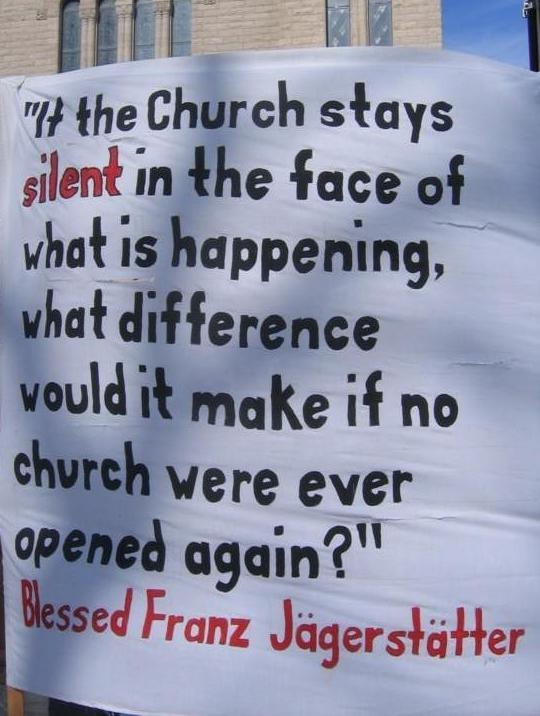 Troops asked, "What have the Churches done to stop war or preach the Gospel of Christ? The Bishop of London, the Archbishop of Canterbury, all those conventional, patriotic, cannon-blessing, banner-baptizing humbugs. God! They make me tired!" (page 225). Note that "bishops and clergy . . . praised God as the Commander-in-Chief of the Allied Armies and had never said a word before the war to make it less inevitable" (page 32)
Said one troop, "I don't like butcher's work. Christian service, that's what the padre calls it. I wonder if Christ would have stuck a bayonet into a [fellow human's] stomach . . . That's what we are asked to do. Oh, Christianity is out of business, my child. Why mention it?" (page 82)
Said one troop, "I've no quarrel with those poor blighters [enemy soldiers] over there by Hooge [battlefield]. They are in the same bloody mess as we are. They [the enemy troops] hate it [war] just as much [as we do]. We're all under a spell together which some Devils have put on us. I wonder if there's a God anywhere." (p 116)
"our spirit was stricken by the thought of this world-tragedy, and cried out in anguish against this bloody crime in which all humanity was involved. The senselessness of it! The futility! The waste! The mockery of men's faith in God!" (p 253)
the battlefield "is a place where the Devil goes about like a roaring lion seeking whom he may devour; where he leaves his victims' entrails hanging on to barbed wire; and where the [unburied] bodies of your friends and mine lie decomposing in muddy holes" (p 257)
Said one officer, Christ's "whole teaching was love and forgiveness. 'Thou shalt not kill.' 'Little children, love one another!' 'Turn the other cheek.' . . . Is it all sheer tosh? If so, why go on pretending? . . . Take chaplains in khaki [uniform]—these lieutenant-colonels with black crosses. They make me 263sick It's either one thing or the other. Brute force or Christianity. . . . I'm not going to say, 'God is love,' one day and then prod [bayonet] a man in the stomach the next. Let's be consistent.'" (pp 262-263)
War "on the edge of Hell . . . quite close and near, was Hell, of man's making, produced by chemists and scientists, after centuries in search of knowledge. There were the fires of hate, produced out of the passion of humanity after a thousand years of Christendom, and of progress. . . . There was the Devil-worship of our poor, damned, human race, where the most civilized nations of the world were one each side of the bonfires" (p 297)
Said one troop, "there will be a lot of murder after this bloody war. What's human life? What's the value of one man's throat? We're trained up as murderers—I don't dislike it, mind you—and after the war we shan't get out of the habit of it. It'll come nat'ral, like!" (p 331)
Troops on both sides had "the same loathing 333of war, the same bewilderment as to its causes, the same sense of being driven by evil powers above them" (pp 332-333)
"Modern civilization was wrecked on those fire-blasted fields. . . . More died there [in the Somme battles] than the flower of our youth. . . . The old order of the world died there, because many men who came alive out of that conflict were changed, and vowed not to tolerate a system of thought which had led to such a monstrous massacre of human beings who prayed to the same God, loved the same joys of life, and had no hatred of each other except as it had been lighted and inflamed by their governors, their philosophers, and their newspapers." (p 364)
"After the Somme battles there were many other battles as bloody and terrible, but they only confirmed greater numbers of men 365in the faith that the Old World had been wrong in its 'make-up,' and wrong in its religion of life. Lip-service to Christian ethics was not good enough as an argument for this. Either the heart of the world must be changed by a real obedience to the gospel of Christ, or Christianity must be abandoned for a new creed which could give better results between men and nations. There could be no reconciling of bayonet drill and high-explosives with the words 'Love one another.'" (pp 364-365).
"The devotion of military chaplains . . . would not bridge the gulf the in the minds of many soldiers, between a gospel of love and this argument by bayonet and bomb, gas-shell and high-velocity [shells], blunder-buss, club, and trench-shovel. . . . there must be a new order of things . . . inspired by an ideal higher higher than this beast-like rivalry of nations." (pp 364-365).
in view of the mass slaughter and total 'scorched earth' devastation allowed, "our laws of war are not justified by any code of humanity" (p 371)
Cites "the belief of many [in] the guilt of the whole political society of Europe . . . based upon hatred and fear and rivalry, in play for Imperial power and the world's markets. . . . Imperial prestige, the personal vanity of politicians, and vast private gain of Trusts and Profiteers" (p 423)
"To keep the living counters [cannon fodder] quiet, to make them jump into [war] at the word 'Go!' the statesmen, diplomats, Trusts, and Profiteers, debauch the name of Patriotism, raise the watch-word of Liberty, and play upon the ignorance of the mob, easily, skilfully, by inciting them to race hatred, by inflaming the brute passion in them, and by concocting a terrible mixture of false idealism and self-interest, so that simple minds, quick to respond to sentiment, as well as those quick to hear the call of the beast, rally shoulder to shoulder and march to the battle-grounds under the spell of that potion. Some go with a noble sense of sacrifice, some with blood-lust in their hearts, most with the herd instinct following the lead, little knowing that they are but the pawns of a game . . . being played beyind closed doors by the great gamblers in the Courts and Foreign Offices, and Committee Rooms, and Counting Houses, of the political casinos in Europe" (p 423).
But "do not divorce all peoples from their Governments . . . see the Evil which led to the crime of war . . . with deep-spread roots in the very foundation of human society. . . . statesmen knew that their diplomacy was supported by the majority of the people by their ignorance as well as by their knowledge . . . fear and envy . . . to fulfill the high destiny marked out for [the nation]. The greed of the 'bloated aristocrats' was only on a bigger scale than the greed of the small shopkeepers. The desire to capture new markets belonged not only to statesmen but to commercial travelers. The . . . peasant believed as much in the might of the . . . Armies as [generals]. The brutality of . . . 425generals was not worse than that of the 'Unteroffizier,' or the foreman of works [factories]" (pp 424-425).
"The official propaganda, the words and actions of. . . statesmen, did actually express the conscious and subconscious psychology of the multitude. The call to the old watchwords of national pride and Imperial might thrilled the soul of the people of proud tradition in sea battles and land battles. . . . Base passions, as well as noble instincts, were stirred easily. Greedy was the appetite of the mob for atrocity tales. The more revolting they were the quicker they were swallowed. . . . Preachers and confessors denied any quality of virtue or genius to [enemy] poets, philosophers, scientists, or scholars. A critical weighing of evidence was regarded as Pro[-enemy] and lack of patriotism." (p 425)
"Truth was delivered bound to Passion. Hatred at home, inspired alrgely by . . . hysteria and official propaganda, reached such heights that when fighting men came back on leave their refusal to say much against their enemy, their straightforward assertions that [the enemy] was not so black [evil] as he was painted, that he fought bravely, died gamely, and, in the prison camps, was well-mannered, 426decent, industrious, good-natured, were heard with shocked silence by mothers and sisters who could only excuse this absence of hate on the score of war-weariness." (pp 425-426)
"The people of all countries were deeply involved in the general blood-guiltiness of Europe. they made no passionate appeal in the name of Christ, or in the name of humanity, for the cessation of the slaughter of boys and the suicide of nations, and for a reconcilation of peoples . . . Peace proposals from the Pope [etc.] were rejected with fierce denunciation, most passionate scorn, as 'Peace Plots' and 'Peace Traps,' not without the terrible logic of the vicious circle, becuase, indeed, there was no sincerity of renunciation in some of those offers of peace and the powers hostile to us were simply trying our strength and our weakness in order to make their own kind of peace, which should be that of conquest. The gamblers [leaders] . . . were upheld generally by the peoples who would not abate one point of pride, one fraction of hate, one claim of vengaeance, though all Europe should fall in ruin and the last legions of boys be massacred. . . . There was no forgiveness, no generous instinct, no larger-hearted common sense in any combatant nations of Europe. Like wolves they had their teeth in each other's throasts, and would not let go, though all bloody and exhausted, until one should fall at the last gasp to be mangled by the others." (p 426).
"Yet in each nation . . . there were men and women who saw the folly of the war and the crime of it, and desired to end it by some act of renunciation and repentance, and by some uplifting of the people's spirit to vault the frontiers of hatred, and the barbed wire which hedged in patriotism. Some of them were put in prison. Most of them saw the impossibility of counteracting the forces of insanity which had made the world mad, and kept silent, hiding their thoughts, and brooding over them." (p 426)
"The leaders of the nations continued to use mob passion as their argument and justification, excited it 427anew when its fires burned low, focussed it upon definite objectives, and gave it a sense of righteousness by high-sounding watch-words of Liberty, Justice, Honour, and Retribution." (p 426)
"Each side proclaimed Christ as their Captain, and invoked the blessing and aid of the God of Christendom . . . The peoples shared the blame of their rulers, because they were not nobler than their rulers. They cannot now plead ignorance or betrayal by false ideals which duped them, because character does not depend on knowledge, and it was the [bad] character of European peoples which failed in the crisis of the world's fate, so that they followed the call-back of the Beast in the Jungle reather than the voice of the Crucified One, whom they pretended to adore." (p 427)
"The character of European peoples failed in common sense and in Christian charity" (p 427)
"If patriotism were enough as the gospel of life [the] nation was perfect in that faiths" (p 428)
"their [national] hatred of the [enemy], their desire for vengeance, complete and terrible, at all cost of life, even though [the nation] should bleed to death and die after victory, is to be understood in the heights and depths of its [patriotic] hatred, and in the passion of its [idolatrous] love for [one's own nation] and liberty. . . . I am tempted to see no greater thing than such patriotism as that, to justify the gospel of hate against such an enemy, to upheld vengeance as a sweet virture. . . . if civilization may [is to] continue, patriotism is 'not enough'; that international hatred will produce other wars, worse than this." {429)
"vengeance, even for dreadful crimes, cannot be taken of a nation without punishing the innocent more than the guilty, so that out of the cruelty and injustice new fires of hatred are lighted, the demand for vengeance passes to the other side, and the Devil finds another vicious circle in wihich to trap the souls of men." (p 429)
"Henri Barbusse [1873-1935] . . . has the courage to say that all peoples in Europe were involved in the guilt of that war 430because of their adherence to that old barbaric creed of brute force [not Christianity] and the superstitious servitude . . . to symbols of national pride based upon military tradition. He . . . denounces the salute to the Flag . . . as a [heathen] fetish worship in which the narrow bigotry of national arrogance is raised above the rights of the common masses of men [raised above Bible law] . . . all peoples who go to war dupe themselves into the belief that they do so in defense of their liberties, and rights, and power, and property" (pp 429-430)
"The deliberate falsification of news . . . made them [troops on leave] discredit the whole presentation of our case and state [condition]. They said 'Propaganda!' with a sharp note of scorn. The breezy optimism of public men, preachers, and journalists, never downcast by bad news, never agonized over the slaughter in these fields, minimizing horrors and loss and misery, crowing over the enemy, prophesying early victory . . . accepting all the destruction of manhood (while they stayed safe) as a necessary and inevitable 'misfortune,' had a depressing effect on men who knew they were doomed to die, by the law of averages, if the war went on" (p 436)
"The frightful suspicion entered the heads of some of our men (some of those I knew) that at home people liked the war and were not anxious to end it, and did not care a jot for the sufferings of the soldiers" (p 436).
"The people did not want to hear the tragic side of things" (p 438)
"'What are we fighting for?' asked officers back from leave, turning over the pages [of the news including of profiteers]. 'Are we going to die for these swine? These parasites and prostitutes? Is this the war for noble ideals, Liberty, Christianity, and Civilization? To Hell with all this filth! The world has gone mad, and we [troops] are the victims of insanity.'" (p 438)
One "chaplain, an Anglican, found it hard to reconcile Christianity with such a war as this, but he did not camoflage the teachings of the Master he tried to serve. He preached to his men the Gospel of Love, and forgiveness of enemies. It was reported to the general who sent for him. 'Look here, I can't let you go preaching 'soft stuff' to my men. I can't allow all that nonsense about love. My job is to teach them to hate. You must either co-operate with me, or go.' The chaplain refused to change his faith or his teaching . . . " (p 439)
"For all chaplains it was difficult. Simple souls were bewildered by the conflict between the spirit of Christianity and the spirit of war. Many of them—officers as well as men—were blasphemous in their scorn of 'parson stuff,' some of them frightfully ironical. A friend of mine watched two chaplains passing by. One of them was a tall man with a crown and star [insignia of rank] on his shoulder-strap. 'I wonder,' said my friend, with false simplicity, 'whether Jesus Christ would have been a lieutenant-colonel'?" (p 439)
"the Catholic Church, certain of its faith, and all other Churches claiming that they teach the Gospel of Christ, have been challenged to explain their [pro-war] attitude during the
war, and the relation of their teaching to the world tragedy, the Great Crime, which has happened. It will not be easy for them to do so. They will have to explain how it is that German bishops, priests, pastors, and flocks, undoubtedly 441sincere in their professions of faith, deeply pious . . . and fervent in their devotion to the
Sacraments . . . were able to reconcile this piety with their war of aggression." (p 441)
"The faith of the Austrian Catholics must be explained in relation to their crimes, if they were crimes, as we [English] say they were, in leading the way to this war by their ultimatum to Serbia" (p 441)
"If Christianity has no restraining influence upon the brutal instincts of those who profess and follow its faith, then surely it is time the world abandoned so ineffective a creed and turned to other laws [religions] likely to have more influence on human relationships. That, brutally, is the argument of the thinking world against the clergy of all nations who all claimed to be acting according to the justice of God and the spirit of Christ. It is a powerful argument, for the simple mind, rejecting casuistry, cuts straight to the appalling contrast between Christian profession and Christian practice, and says Troops asked, "What have the Churches done to stop war or preach the Gospel of Christ? The Bishop of London, the Archbishop of Canterbury, all those conventional, patriotic, cannon-blessing, banner-baptizing humbugs. God! They make me tired!" (page 225). Note that "bishops and clergy . . . praised God as the Commander-in-Chief of the Allied Armies and had never said a word before the war to make it less inevitable" (page 32)
Said one troop, "I don't like butcher's work. Christian service, that's what the padre calls it. I wonder if Christ would have stuck a bayonet into a [fellow human's] stomach . . . That's what we are asked to do. Oh, Christianity is out of business, my child. Why mention it?" (page 82)
Said one troop, "I've no quarrel with those poor blighters [enemy soldiers] over there by Hooge [battlefield]. They are in the same bloody mess as we are. They [the enemy troops] hate it [war] just as much [as we do]. We're all under a spell together which some Devils have put on us. I wonder if there's a God anywhere." (p 116)
"our spirit was stricken by the thought of this world-tragedy, and cried out in anguish against this bloody crime in which all humanity was involved. The senselessness of it! The futility! The waste! The mockery of men's faith in God!" (p 253)
the battlefield "is a place where the Devil goes about like a roaring lion seeking whom he may devour; where he leaves his victims' entrails hanging on to barbed wire; and where the [unburied] bodies of your friends and mine lie decomposing in muddy holes" (p 257)
Said one officer, Christ's "whole teaching was love and forgiveness. 'Thou shalt not kill.' 'Little children, love one another!' 'Turn the other cheek.' . . . Is it all sheer tosh? If so, why go on pretending? . . . Take chaplains in khaki [uniform]—these lieutenant-colonels with black crosses. They make me 263sick It's either one thing or the other. Brute force or Christianity. . . . I'm not going to say, 'God is love,' one day and then prod [bayonet] a man in the stomach the next. Let's be consistent.'" (pp 262-263)
War "on the edge of Hell . . . quite close and near, was Hell, of man's making, produced by chemists and scientists, after centuries in search of knowledge. There were the fires of hate, produced out of the passion of humanity after a thousand years of Christendom, and of progress. . . . There was the Devil-worship of our poor, damned, human race, where the most civilized nations of the world were one each side of the bonfires" (p 297)
Said one troop, "there will be a lot of murder after this bloody war. What's human life? What's the value of one man's throat? We're trained up as murderers—I don't dislike it, mind you—and after the war we shan't get out of the habit of it. It'll come nat'ral, like!" (p 331)
Troops on both sides had "the same loathing 333of war, the same bewilderment as to its causes, the same sense of being driven by evil powers above them" (pp 332-333)
"Modern civilization was wrecked on those fire-blasted fields. . . . More died there [in the Somme battles] than the flower of our youth. . . . The old order of the world died there, because many men who came alive out of that conflict were changed, and vowed not to tolerate a system of thought which had led to such a monstrous massacre of human beings who prayed to the same God, loved the same joys of life, and had no hatred of each other except as it had been lighted and inflamed by their governors, their philosophers, and their newspapers." (p 364)
"After the Somme battles there were many other battles as bloody and terrible, but they only confirmed greater numbers of men 365in the faith that the Old World had been wrong in its 'make-up,' and wrong in its religion of life. Lip-service to Christian ethics was not good enough as an argument for this. Either the heart of the world must be changed by a real obedience to the gospel of Christ, or Christianity must be abandoned for a new creed which could give better results between men and nations. There could be no reconciling of bayonet drill and high-explosives with the words 'Love one another.'" (pp 364-365).
"The devotion of military chaplains . . . would not bridge the gulf the in the minds of many soldiers, between a gospel of love and this argument by bayonet and bomb, gas-shell and high-velocity [shells], blunder-buss, club, and trench-shovel. . . . there must be a new order of things . . . inspired by an ideal higher higher than this beast-like rivalry of nations." (pp 364-365).
in view of the mass slaughter and total 'scorched earth' devastation allowed, "our laws of war are not justified by any code of humanity" (p 371)
Cites "the belief of many [in] the guilt of the whole political society of Europe . . . based upon hatred and fear and rivalry, in play for Imperial power and the world's markets. . . . Imperial prestige, the personal vanity of politicians, and vast private gain of Trusts and Profiteers" (p 423)
"To keep the living counters [cannon fodder] quiet, to make them jump into [war] at the word 'Go!' the statesmen, diplomats, Trusts, and Profiteers, debauch the name of Patriotism, raise the watch-word of Liberty, and play upon the ignorance of the mob, easily, skilfully, by inciting them to race hatred, by inflaming the brute passion in them, and by concocting a terrible mixture of false idealism and self-interest, so that simple minds, quick to respond to sentiment, as well as those quick to hear the call of the beast, rally shoulder to shoulder and march to the battle-grounds under the spell of that potion. Some go with a noble sense of sacrifice, some with blood-lust in their hearts, most with the herd instinct following the lead, little knowing that they are but the pawns of a game . . . being played beyind closed doors by the great gamblers in the Courts and Foreign Offices, and Committee Rooms, and Counting Houses, of the political casinos in Europe" (p 423).
But "do not divorce all peoples from their Governments . . . see the Evil which led to the crime of war . . . with deep-spread roots in the very foundation of human society. . . . statesmen knew that their diplomacy was supported by the majority of the people by their ignorance as well as by their knowledge . . . fear and envy . . . to fulfill the high destiny marked out for [the nation]. The greed of the 'bloated aristocrats' was only on a bigger scale than the greed of the small shopkeepers. The desire to capture new markets belonged not only to statesmen but to commercial travelers. The . . . peasant believed as much in the might of the . . . Armies as [generals]. The brutality of . . . 425generals was not worse than that of the 'Unteroffizier,' or the foreman of works [factories]" (pp 424-425).
"The official propaganda, the words and actions of. . . statesmen, did actually express the conscious and subconscious psychology of the multitude. The call to the old watchwords of national pride and Imperial might thrilled the soul of the people of proud tradition in sea battles and land battles. . . . Base passions, as well as noble instincts, were stirred easily. Greedy was the appetite of the mob for atrocity tales. The more revolting they were the quicker they were swallowed. . . . Preachers and confessors denied any quality of virtue or genius to [enemy] poets, philosophers, scientists, or scholars. A critical weighing of evidence was regarded as Pro[-enemy] and lack of patriotism." (p 425)
"Truth was delivered bound to Passion. Hatred at home, inspired alrgely by . . . hysteria and official propaganda, reached such heights that when fighting men came back on leave their refusal to say much against their enemy, their straightforward assertions that [the enemy] was not so black [evil] as he was painted, that he fought bravely, died gamely, and, in the prison camps, was well-mannered, 426decent, industrious, good-natured, were heard with shocked silence by mothers and sisters who could only excuse this absence of hate on the score of war-weariness." (pp 425-426)
"The people of all countries were deeply involved in the general blood-guiltiness of Europe. they made no passionate appeal in the name of Christ, or in the name of humanity, for the cessation of the slaughter of boys and the suicide of nations, and for a reconcilation of peoples . . . Peace proposals from the Pope [etc.] were rejected with fierce denunciation, most passionate scorn, as 'Peace Plots' and 'Peace Traps,' not without the terrible logic of the vicious circle, becuase, indeed, there was no sincerity of renunciation in some of those offers of peace and the powers hostile to us were simply trying our strength and our weakness in order to make their own kind of peace, which should be that of conquest. The gamblers [leaders] . . . were upheld generally by the peoples who would not abate one point of pride, one fraction of hate, one claim of vengaeance, though all Europe should fall in ruin and the last legions of boys be massacred. . . . There was no forgiveness, no generous instinct, no larger-hearted common sense in any combatant nations of Europe. Like wolves they had their teeth in each other's throasts, and would not let go, though all bloody and exhausted, until one should fall at the last gasp to be mangled by the others." (p 426).
"Yet in each nation . . . there were men and women who saw the folly of the war and the crime of it, and desired to end it by some act of renunciation and repentance, and by some uplifting of the people's spirit to vault the frontiers of hatred, and the barbed wire which hedged in patriotism. Some of them were put in prison. Most of them saw the impossibility of counteracting the forces of insanity which had made the world mad, and kept silent, hiding their thoughts, and brooding over them." (p 426)
"The leaders of the nations continued to use mob passion as their argument and justification, excited it 427anew when its fires burned low, focussed it upon definite objectives, and gave it a sense of righteousness by high-sounding watch-words of Liberty, Justice, Honour, and Retribution." (p 426)
"Each side proclaimed Christ as their Captain, and invoked the blessing and aid of the God of Christendom . . . The peoples shared the blame of their rulers, because they were not nobler than their rulers. They cannot now plead ignorance or betrayal by false ideals which duped them, because character does not depend on knowledge, and it was the [bad] character of European peoples which failed in the crisis of the world's fate, so that they followed the call-back of the Beast in the Jungle reather than the voice of the Crucified One, whom they pretended to adore." (p 427)
"The character of European peoples failed in common sense and in Christian charity" (p 427)
"If patriotism were enough as the gospel of life [the] nation was perfect in that faiths" (p 428)
"their [national] hatred of the [enemy], their desire for vengeance, complete and terrible, at all cost of life, even though [the nation] should bleed to death and die after victory, is to be understood in the heights and depths of its [patriotic] hatred, and in the passion of its [idolatrous] love for [one's own nation] and liberty. . . . I am tempted to see no greater thing than such patriotism as that, to justify the gospel of hate against such an enemy, to upheld vengeance as a sweet virture. . . . if civilization may [is to] continue, patriotism is 'not enough'; that international hatred will produce other wars, worse than this." {429)
"vengeance, even for dreadful crimes, cannot be taken of a nation without punishing the innocent more than the guilty, so that out of the cruelty and injustice new fires of hatred are lighted, the demand for vengeance passes to the other side, and the Devil finds another vicious circle in wihich to trap the souls of men." (p 429)
"Henri Barbusse [1873-1935] . . . has the courage to say that all peoples in Europe were involved in the guilt of that war 430because of their adherence to that old barbaric creed of brute force [not Christianity] and the superstitious servitude . . . to symbols of national pride based upon military tradition. He . . . denounces the salute to the Flag . . . as a [heathen] fetish worship in which the narrow bigotry of national arrogance is raised above the rights of the common masses of men [raised above Bible law] . . . all peoples who go to war dupe themselves into the belief that they do so in defense of their liberties, and rights, and power, and property" (pp 429-430)
"The deliberate falsification of news . . . made them [troops on leave] discredit the whole presentation of our case and state [condition]. They said 'Propaganda!' with a sharp note of scorn. The breezy optimism of public men, preachers, and journalists, never downcast by bad news, never agonized over the slaughter in these fields, minimizing horrors and loss and misery, crowing over the enemy, prophesying early victory . . . accepting all the destruction of manhood (while they stayed safe) as a necessary and inevitable 'misfortune,' had a depressing effect on men who knew they were doomed to die, by the law of averages, if the war went on" (p 436)
"The frightful suspicion entered the heads of some of our men (some of those I knew) that at home people liked the war and were not anxious to end it, and did not care a jot for the sufferings of the soldiers" (p 436).
"The people did not want to hear the tragic side of things" (p 438)
"'What are we fighting for?' asked officers back from leave, turning over the pages [of the news including of profiteers]. 'Are we going to die for these swine? These parasites and prostitutes? Is this the war for noble ideals, Liberty, Christianity, and Civilization? To Hell with all this filth! The world has gone mad, and we [troops] are the victims of insanity.'" (p 438)
One "chaplain, an Anglican, found it hard to reconcile Christianity with such a war as this, but he did not camoflage the teachings of the Master he tried to serve. He preached to his men the Gospel of Love, and forgiveness of enemies. It was reported to the general who sent for him. 'Look here, I can't let you go preaching 'soft stuff' to my men. I can't allow all that nonsense about love. My job is to teach them to hate. You must either co-operate with me, or go.' The chaplain refused to change his faith or his teaching . . . " (p 439)
"For all chaplains it was difficult. Simple souls were bewildered by the conflict between the spirit of Christianity and the spirit of war. Many of them—officers as well as men—were blasphemous in their scorn of 'parson stuff,' some of them frightfully ironical. A friend of mine watched two chaplains passing by. One of them was a tall man with a crown and star [insignia of rank] on his shoulder-strap. 'I wonder,' said my friend, with false simplicity, 'whether Jesus Christ would have been a lieutenant-colonel'?" (p 439)
"the Catholic Church, certain of its faith, and all other Churches claiming that they teach the Gospel of Christ, have been challenged to explain their [pro-war] attitude during the
war, and the relation of their teaching to the world tragedy, the Great Crime, which has happened. It will not be easy for them to do so. They will have to explain how it is that German bishops, priests, pastors, and flocks, undoubtedly 441sincere in their professions of faith, deeply pious . . . and fervent in their devotion to the
Sacraments . . . were able to reconcile this piety with their war of aggression." (p 441)
"The faith of the Austrian Catholics must be explained in relation to their crimes, if they were crimes, as we [English] say they were, in leading the way to this war by their ultimatum to Serbia" (p 441)
"If Christianity has no restraining influence upon the brutal instincts of those who profess and follow its faith, then surely it is time the world abandoned so ineffective a creed and turned to other laws [religions] likely to have more influence on human relationships. That, brutally, is the argument of the thinking world against the clergy of all nations who all claimed to be acting according to the justice of God and the spirit of Christ. It is a powerful argument, for the simple mind, rejecting casuistry, cuts straight to the appalling contrast between Christian profession and Christian practice, and says
'Here, in this war, there was no conflict between one faith and another, but a murderous death-struggle between many nations holding the same faith, preaching the same Gospel, and claiming the same God as their protector. Let us seek some better truth than that hypocrisy! . . . " (p 441)
"I think the clergy of all nations, apart from a heroic and saintly few, subordinated their faith . . . to national limitations. They were patriots before they were priests, and their patriotism was sometimes as limited, as narrow, as fierce, and as blood-thirsty, as that of the people who looked to them for truth and light. They [clergy] were often fiercer, narrower, and more desirous of vengeance, than the soldiers who fought . . . whereas the Acchbishiop of Canterbury, the Archbishiop of Cologne, and the clergy who spoke from many pulpits, in many nations, under the Cross of Christ, still stoked up the fires of hate, and urged the armies to go on 442fighting 'in the cause of Justice,' 'for the defence of the Fatherland,' 'for Christian righteousness,' to the bitter end" (pp 441-442)
"The entire aspect of the war was changed by the Russian Revolution . . . By this new revelation [of Communism] they [Russian troops] forgot their hatred of Germans. They said, 'You are our brothers: we have no hatred against you. We do not want to kill you. Why should you kill us? We are all of us the slaves of blood-thirsty castes who use our flesh for their ambitions. Do not shoot, us, brothers, but join hands against the common tyranny which enslaves our peoples.' They [Russian troops] went forward with outstretched hands. . . . German soldiers gaped, wide-eyed at this new gospel [unpreached by their "Christian" clergy!], as it seemed, and said, 'They speak words of truth. Why should we kill each other?' The German War Lords ordered a forward movement [an attack], threatened their own men with death if they fraternized with Russians . . . But as [German General] Ludendorff has confessed, and as we now know from other evidence, many German soldiers were 'infected' with Bolshevism and lost their fighting spirit." (p 442)
"All the lives . . . will have been laid down in vain . . . if the agony they suffered is forgotten, and the 'war to end war' leads to preparations for new, more monstrous conflict. . . . if that is so, there is no God . . . with love for men" (p 455)
"Let us seek . . . God's truth. . . . Let us have peace" (p 455).
For first hand statements by war participants and victims, see, e.g.,
NCO Raymond Gantter, Roll Me Over: An Infantryman's World War II (New York: Ballantine, Ivy, 1997). See, e.g., Chapter 3, § "December 16, Minerie," p 77, "Christmas Eve is a week from tomorrow. [See, e.g., "Christmas Truce 1" and 2.] I can't lift my spirits over that homely fact and I find myself getting very bitter about the whole thing in a melodramatic sort of way. As if the birth of a Jewish sage and poet-prophet nearly two thousand years ago is of any avail to us today! We pray to God, and our chaplains invoke the blessing of that deity and his anthropomorphic son upon us. Then, heartened by the certain knowledge that God is on our side, we gird up our khaki-clad and itching loins and go out to hunt Germans, who in turn wear emblazoned on their belt buckles the quaintly incongruous legend Gott Mit Uns! It's a wonderful world. If I possessed a little more ruthlessness or a little less conscience, I'd be a gangster or a politiican when I get home and a stuanch pillar of the Episcopal Church on the side."
Warren R. Jackson, His Time in Hell: A Texas Marine in France, George B. Clark, ed. (Ballantine, 2001)
Gunter K. Koschorrek, Blood Red Snow: the Memoirs of a German Soldier on the Eastern Front (2005)
Svetlana Palmer and Sarah Wallis, Intimate Voices from the First World War (Wm Morrow & Co, 2004). Their voices from the grave show war's horros and demoralizing effects, and regrets of combatants.
 See also the TV series The First World War: 1914-1918, based on the prolific writings of Professor Hew Strachan, e.g., The First World War, The Outbreak of The First World War, European Armies and the Conduct of the War, The First World War in Africa,
Financing The First World War, Big Wars and Small Wars. See also the TV series The First World War: 1914-1918, based on the prolific writings of Professor Hew Strachan, e.g., The First World War, The Outbreak of The First World War, European Armies and the Conduct of the War, The First World War in Africa,
Financing The First World War, Big Wars and Small Wars.
For historiography, see Prof. Dwight E. Lee (Clark University), ed., The Outbreak of the
First World War: Who Was Responsible? (Boston: D. C. Heath and Co., 1963).
"The soldier does not wish to appear a coward, disloyal, or un-American. The situation has been so defined that he can see himself as patriotic, courageous, and manly only through compliance."--Prof. Stanley Milgram.
15 May 2009: International Conscientious Objectors Day.
See also
Upton Sinclair, Profits of Religion (1917), in § 3.2.
Edward Crankshaw, The Fall of the House of Habsburg (New York: Viking Press, 1963), citing the "divine right" notion, pp 50-51; the corrupt triple alliance of Army, Church and Nobility, p 10; and the ease of starting wars, p 405.
Calvin White, “Who's Taking Blame for Christian Violence?” (Toronto Star, 26 July 2005)
Charles Sullivan, “Christianity and the Demise of America” (1 Oct 2005).
Real horrors of war are left unstated, understated, glossed over, and/or not reported until afterwards. Examples:
Mark Twain's War Prayer (March 1905)
Under Fire:
The Story of a Squad by Henri Barbusse (1874-1935), transl by Fitzwater Wray (New York: E. P. Dutton & Co., 1917)
Erich Maria Remarque's All Quiet on the Western Front (1929) (Excerpts, Nationalism)
Graphic depiction of sending troops to their deaths, in The Dawn Patrol (1938)
Graphic depiction of 1943 naval warfare, Alistair MacLean, H. M. S. Ulysses (Britain: Wm. Collins & Sons & Co Ltd, 1955; U.S.: Doubleday & Co, 1956)
Graphic description of 1918 events is in John Toland, No Man's Land: 1918: The Last Year of the War
Pentagon "Survival Under Atomic Attack" Video (1950)
Graphic desciption of 1944-1945 war in the Pacific is
in Marine Eugene B. Sledge, With the Old Breed: At Peleliu and Okinawa (Random House, 1981) (Video: Horror in the Pacific)
"The Thin Red Line" (1998)
Richard Lloyd Parry, “Dissect them alive: chilling Imperial order that could not be disobeyed” (The Times, 26 February 2007)
Prof. John C. McManus, Ph.D., Grunts: Inside the American Combat Experience, World War II Through Iraq (Penguin Group NAL Caliber, 3 August 2010) ("the horrors . . . the closest you will get to experiencing actual infantry combat without getting shot at" -- excellent on "the horrors" but quite unaware of / superficial in citing war causation, thus from his desk recommends more of the same "horrors" to continue!)
“atrocities follow war as the jackal follows the wounded beast.”—Prof. John W. Dower, War Without Mercy: Race & Power in the Pacific War (New York: Pantheon Books, 1986), Chapter 1, p 12 (book has atrocities examples, machine-gunning prisoners, etc., pp 7, 10-12, 33-73, 141-142, 144, 182, 238, 261, 285-288, 300, 327, 330-331, and 349) Cf. the "mortal sin" concept. See also "Carson Soldiers Say Iraq Horrors Led to Crimes" (Associated Press, 27 July 2009).
For a simulation of the 1914-1918 World War, click here. For a video overview (the first filmed war), see the beginning DVD's in the series The
Century
of Warfare (History Channel, 1993).
For realistic depiction of horrors of nuclear war, see, e.g., John R. Hersey, Hiroshima (1946) (Summary, Background,
Context,
Real Reason,
Pictures, Video Reenactment),
Video of the First Atomic Test,
The War Game (BBC, 1965) (online excerpt) and Threads (BBC, 1984) (online excerpt). Re the Afghanistan War, see Reflections on the Human Cost of War.
For fictionalized movies with some aspects of the miscalculations or horrors, see also, e.g.,
Failsafe (2000), On the Beach (1959), Dr. Strangelove (1964), and The Day After (1983).
For Iraq OIL reality video, click here.
“When a mother gives birth to her child, she checks all fingers and toes to see if they're all there.” “And we [mothers] expect them [fingers and toes] to be there when they leave [die] here [not blasted away].”—Andrea Hackett (17 Feb 2007).
“[T]he doctrine of the offensive . . . died on a field . . . where at the end of the day nothing was visible but corpses strewn in rows and sprawled in the awkward attitudes of sudden death as if the place had been swept by a malignant hurricane. It was one of those lessons, a survivor realized afterward, 'by which God teaches the law to kings [nations],'” says Barbara Tuchman, The Guns of August (New York: Bonanza Books, 1962), Chap. 13, p 233, quoting Fernand Engerand, La Bataille de la frontiere, Aout 1914: Briey (Paris: Brossard, 1920), p 473. The single battle of "Ypres was . . . the grave of four-fifths [80%] of the original [British Expeditionary Force] BEF," says Tuchman, p 438.
Karen Horst Cobb, “No
Longer a Christian” (25 October 2004) (details).
For information on napalm use in Iraq, see "US uses banned weapon . . . but was Tony Blair told?," and "Fallujah Napalmed," by Paul Gilfeather (Sunday Mirror, 28 Nov 2004).
For background information, see
Francis Neilson, M.P.,
How Diplomats Make War (1916)
Anthony Shadid, Night Draws Near: Iraq's People in the Shadow of America's War (Henry Holt & Co., Aug 2005).
"Dr Anthony Storr notes that the majority of [people], given a can of petrol [gasoline] and told to pour it over a child of three and ignite it, will tend to disobey the order. Yet put the same decent men [people] in aircraft a few hundred feet above a town, and they will often be ready without compunction to inflict death or appalling pain on masses of men, women, and children. Distance has a disinhibiting effect. Moreover, as Dr Storr further points out, distance need not be physical; it may simply be psychological," says Bernard Wasserstein, D.Phil., D.Litt., Britain and the Jews of Europe, 1939-1945, 2d ed. (London: Leicester Univ Press, 1999), pp 320-321, citing Anthony Storr, Human Aggression (London, 1970), p 152.
See also Storr's Human Destructiveness: The Roots of Genocide and Human Cruelty, 2d ed. (January 1991).
For information on the 1920's British war vs. Iraq, see
Eric Margolis, "West Has Bloodied Hands" (Toronto Sun, 1 April 2007) ("the first high government official to authorize use of mustard gas against rebellious Kurdish tribesmen in Iraq [was] Winston Churchill")
Prof. Christopher Catherwood, Churchill's Folly: How Winston Churchill Created Modern Iraq (New York: Carroll & Graf Pub, 2004). The book also covers oil issues (pp 34-35, 64-68, 78 etc.); politicians fancying selves as Bible experts vis-a-vis restoring Israel without awaiting the Messiah (pp 38-39); Christian orientation of the Ba'ath Party, to prevent (by coalition with secular politicians) Fundamentalist Islamics from persecuting Christians (p 60); Churchill's plan for gas bombing Iraqis (pp 85 and 186-187); Churchill's pro-appeasement activity (p 99), etc. See also analysis by Donald Chapman, "Following Churchill’s Folly In Iraq" (24 August 2007).
For background on smoker Churchill's impaired psychiatric condition, see, e.g., Anthony Storr, Churchill's Black Dog, Kafka's Mice, and Other Phenomena of the Human Mind (Grove Press, January 1989).
For background on the U.S. Empire, see, e.g.,
Thomas Cole, The Course of Empire (1836) that "echoed the fear of Americans, over a century ago, that all civilizations, our own included, must someday perish," and cited in Marshall B. Davidson, "Whither the Course of Empire?," in American Heritage, Vol. viii, issue 6 (October 1957), pp 52-61, 104.
Major General and Senator Carl Schurz, Platform of the American Anti-Imperialist League (18 October 1899)
John A. Hobson [1858-1940], Imperialism: A Study (New York, J. Pott & Co.; London: James Nisbet & Co, 1902) citing "a constantly growing tendency" of the wealthy "to use their political power as citizens of this State [nation] to interfere with the politicial conditions of those States [nations] where they have an industrial stake")
Prof Archer Butler Hulbert, L.H.D. (1873-1933), The Ohio River: A Course Of Empire (New York, London, GP Putnam's Sons, 1906) (Review by Frederic Austin Ogg, Am Historical Rev, Vol. 12, No. 3 [Apr. 1907], pp. 662-663)
Montgomery Schuyler [1843-1914], Westward The Course Of Empire (New York, London: G. P. Putnam's Sons, 1906)
Senator Richard F. Pettigrew (R-S.D.) (1848 - 1926), The Course of Empire: An Official Record (New York: Boni & Livwright, 1920) (covers U.S. role in Cuba, the Phillippines, and Latin America; atrocities by the U.S. Army; and in Appendix VIII, "The Press," p 689, the immoral U.S. media that "sell their editorial columns for cash")
Senator Richard F. Pettigrew, Triumphant Plutocracy: The Story of American Public Life from 1870 to 1920 (New York: Academy Press, 1922; reprinted as Imperial Washington: The Story of American Public Life from 1870-1920, New York: Arno Press, 1970) (on U.S. presidents' pro-empire policies)
Count Richard von
Coudenhove-Kalergi (1894-1972, "Pan-european" publicist and political figure), in Praktischer Idealismus ("Practical Idealism") (Vienna, 1925) ("Today democracy is a facade of plutocracy. Because the peoples will not tolerate naked plutocracy, power is nominally turned over to them, while real power rests in the hands of the plutocrats. In democracies, whether republican or monarchical, the statesmen are marionettes, and the capitalists are the wire pullers: they dictate the political guidelines, they control the voters by buying public opinion, through business and social connections [whereby they control] higher government officials . . . . The plutocracy of today is more powerful than the aristocracy of the past, because nothing stands above it except the state, which is its tool and helper." (Review)
Bernard Augustine De Voto (1897-1955), trilogy: The Year of Decision: 1846 (1943); Across the Wide Missouri (1947); Course of Empire (1952 reprinted, Mariner Books; September 1998)
Barbara W. Tuchman, The Proud Tower: A Portrait of the World Before the War: 1890-1914 (New York: Macmillan Co, 1962), Chapter 3, “End of A Dream,” pp 117-167 (citing efforts by Mark Twain, Andrew Carnegie, Samuel Gompers, Pres. Grover Cleveland, Speakers of the House Thomas B. Reed and Champ Clark, etc. to preserve the American democratic dream and keep the U.S. as a Republic for reasons including to avoid future wars (that empires typically lead to, cause, start, and/or provoke). But these advocates of keeping America a Republic were defeated by the pro-Empire coalition including Pres. William McKinley, Theodore Roosevelt, Adm. Alfred T. Mahan, etc. See also Paul Craig Roberts, Ph.D., "Three Who Made A War" (24 March 2014)).
Prof. William Appleman Williams, Ph.D., Roots of the Modern American Empire: A Study of the Growth and Shaping of a Social Consciousness in a Marketplace Society (1969)
Prof. William Appleman Williams, Ph.D., Empire as a Way of Life (1980)
Jonathan Kwitney, Endless Enemies (New York: Congdon and Weed, 1984) (cites U.S. foreign policy controlled by, e.g., economic interests as distinct from the public interest)
Robert Vincent Remini, Andrew Jackson and the Course of the American Empire, 1767-1821 (Harpercollins, April 1982, reprinted Johns Hopkins Univ Press, April 1998)
Prof. Michael Parenti, Ph.D., Against Empire (1995). Chapter 1, Video (Excerpt from “Myth of UnderDevelopment!")
Lawrence S. Kaplan, Thomas Jefferson: Westward the Course of Empire (Scholarly Resources Inc, November 1998)
Prof. Chalmers Johnson, Blowback: The Costs and Consequences of American Empire (New York: Metropolitan Books, 2000)
Doug Bandow, "Book Review of Blowback," 5 The Independent Review (Issue # 4, Spring 2001)
William Blum, Rogue State: A Guide to the World's Only Superpower (Common Courage Press, 2001 and 2002) (Review)
Scott Peterson, "In war, some facts less factual: Some US assertions from the last war on Iraq still appear dubious" (Christian Science Monitor, 6 September 2002) (exposes fabrications and disinformation to start the first Gulf War in early 1991)
Tom Chaffin, Pathfinder: John Charles Fremont and the Course of American Empire (Hill & Wang Pub, December 2002 and April 2004)
The Revolution Will Not Be Televised (2003) (documentary on the attempted coup in Venezuela in April 2002)
Interview with
John Le Carré on his essay, "The United States of America Has Gone Mad" (2003)
Prof. Ward Churchill, Reflections on the Justice of Roosting Chickens: Reflections on the Consequences of U.S. Imperial Arrogance and Criminality (AK Press, 1 November 2003)
("sees September 11th as the chickens coming home to roost . . . With uncompromising clarity and resolve . . . a complete history of US military actions (1776 to the present) . . . illuminates the US' relationship with international law to present the . . . question, 'how could they not hate us?'")
Prof. Chalmers Johnson, The Sorrows of Empire: Militarism, Secrecy, and the End of the Republic (March 2004) (“Empires do not last, and their ends are usually unpleasant . . . .”)
Niall Ferguson, Colossus: The Price of America's Empire (New York: Penguin Press, April 2004) (Reviews: By "Book Browse" and by "Natl Rev Book Svc")
Univ. of Wisc. Prof. Stanley Kutler, “Review of Chalmers Johnson's The Sorrows of Empire” (1 Dec 2004)
Profs. Fred Anderson and Andrew Cayton, The Dominion of War: Empire and Liberty in North America, 1500-2000 (New York: Viking, 2005) (on "the wars Americans have fought less to preserve liberty than to extend the power of the United States IN THE NAME OF liberty" and "and stresses the 'centrality' of imperial ambition to the development of the United States.") [HNN Review; PMHB Review; AHR Review.]
Douglas McWhirter, "The [Supposedly] Reluctant Hegemon," 14 Worth (#1) 50-51, 54-56 (January 2005)
Paul Craig Roberts, Ph.D., "Polls Show Many Americans are Simply Dumber Than Bush" (ICH, 29 January 2006), says "Americans need desperately to understand that 95 percent of all Muslim terrorists in the world were created in the past three years by Bush's invasion of Iraq." But: "Half of the US population is incapable of acquiring, processing and understanding information. . . . half of the American population is [mentally] unable to draw a rational conclusion from unambiguous facts. . . . the inability of half of the US population to acquire and understand information are far larger threats to Americans than terrorism." And: "The Bush administration is astonished because it stupidly believes that hundreds of millions of Muslims should be grateful that the US has interfered in their internal affairs for 60 years, setting up colonies and puppet rulers to suppress their aspirations and to achieve, instead, purposes of the US government." Thus: "America has become a rogue nation, flying blind, guided only by ignorance and hubris. A terrible catastrophe awaits."
Seymour M. Hersh, "The Iran Plans: Would President Bush go to war to stop Tehran from getting the bomb?" (17 April 2006) (“A senior Pentagon adviser [said] 'This White House believes that the only way to solve the problem is to change the power structure in Iran, and that means war,' he said. The danger, he said, was that 'it also reinforces the belief inside Iran that the only way to defend the country is to have a nuclear capability.”)
James Bovard, "Killing in the Name of Democracy" (1 Sep 2006) (short history of U.S. Empire 1898 to present)
Larry Everest, Oil, Power and Empire (Common Courage Press, January 2003) (Excerpt; Review)
Chris Hedges, M.Th., What Every Person Should Know About War (9 June 2003) (has "a stark look at the effects of war on combatants" and "a grimly factual account of the true face of war--culled from 'medical, psychological, and military studies'--that America shies away from in favor of sanitized myths of glory and heroism")
Laurence M. Vance, Ph.D., Christianity and War and Other Essays Against the Warfare State (Vance Publications, 1 January 2005) ("Christian enthusiasm for the state, its wars, and its politicians is an affront to the Saviour, contrary to Scripture, and a demonstration of the profound ignorance many Christians have of history.") The sycophantic
clergy policy of defending politicians is notorious. For example, see this sycophant wording: "we [alleged Christians] have simply to do with the government in fact, and its acting head [politicians] as representing to us, however imperfectly in the civil sphere, the government of Christ. Our subjection [to politicians] takes the form of obeying the [politician] laws, paying taxes, lending our influence on the side of authority," and "Christians were really the greatest friends of [law and] order, and it was not only their interest but their recognized duty to occupy no doubtful position toward the Roman state [government]," say Very Rev. H. D. M. Spence, M.A., D.D., and Rev. Joseph S. Exell, M.A., eds., Vol. 22, The Pulpit Commentary, I Peter (Grand Rapids: Wm. B. Erdmans Pub Co, 1950), p 122. [Such demonized clergy were likewise sychophantic to slavery, to Hitler, and to torture].
Tom Hull, "Fred Anderson/Andrew Cayton: The Dominion of War: Comparing U.S. Wars in the Phillippines and Iraq" (16 Feb 2005)
Boston Univ. Prof. Andrew J. Bacevich, The New American Militarism (Oxford Univ Press, August 2006) (See also his The Islamic Way of War
(The American Conservative, 11 Sep 2006).
Robert Harris, "Pirates of the Mediterranean" (New York Times, 30 September 2006) (history repeating itself on national over-reaction to terrorist incident)
Robert Fisk, Ph.D., "The Roman Empire is Falling - So It Turns to Iran and Syria" (Independent, UK, 7 December 2006) (Romans gave citizenship to conquered peoples; the US lacked such wisdom)
William Lind, "Boomerang Effect: When Will the First IED Strike Cleveland?" (Military.com, 9 December 2006) (creating new terrorists among US troops who'll attack America upon their return)
Phyllis Bennis and Danny Glover, Challenging Empire: How People, Governments, and the UN Defy US Power (Northampton, Mass.: Olive Branch Press, 2006)
Phyllis Bennis and Louise I. Gerdes, Rogue Nations (Detroit: Greenhaven Press, 2006)
John Stauber and Sheldon Rampton, The Best War Ever (2006) (“Details how the Bush administration has aimed its propaganda not at a tactical deception of enemy combatants, but at the American people themselves. This violates long-standing and important American political traditions dating back to the Smith-Mundt Act, which was first passed by Congress in 1948 after lawmakers saw the harm that propaganda had done during Hitler's reign in Germany.”)
Paul Craig Roberts, “Attacking Iran: What’s In It For Bush?” (17 January 2007) (in connection with stealing Election 2008).
Issandr El Amrani, “The New Saddam” (25 January 2007) (Bush's SADDAM Policy: Sunni Arab-Dominated Dictatorships Against the Mullahs)
Paul Craig Roberts, Ph.D., “More Deception from the War Criminal” (25 January 2007) (“Bush hides the neoconservative agenda behind 'the war on terror,' which essentially is a hoax. The main purpose of the neoconservatives’ 'war on terror' it to eliminate any effective Muslim opposition to Israel’s theft of Palestine and the Golan Heights. To silence Muslim opposition to Israel’s theft of Arab lands, the US must eliminate or intimidate Middle Eastern governments that are not under US control—Iran, Syria, and Hezbollah which governs southern Lebanon.”)
Mike Whitney, “Why the Surge will push us into a War with Iran” (3 February 2007) (“the surge is ethnic cleansing” and includes “deliberate attack on Iraqi intellectuals and academics.” “Iraqi failure to meet the benchmarks will be blamed on the Iranians. There will be some clashes, collisions, and the war expands.”)
Prof. Chalmers Johnson, Nemesis - The Last Days of the American Republic (New York: Metropolitan Books, 6 February 2007) (Interview 1; 2; Review) ("The long-awaited final volume of Chalmers Johnson's bestselling Blowback trilogy confronts the overreaching of the American empire and the threat it poses to the republic In his prophetic book Blowback, Chalmers Johnson linked the CIA's clandestine activities abroad to disaster at home. In The Sorrows of Empire, he explored the ways in which the growth of American militarism and the garrisoning of the planet have jeopardized our stability. Now, in Nemesis, he shows how imperial overstretch is undermining the republic itself, both economically and politically. Delving into new areas - from plans to militarize outer space to Constitution-breaking presidential activities at home and the devastating corruption of a toothless Congress - Nemesis offers a striking description of the trap into which the dreams of America's leaders have taken us. Drawing comparisons to empires past, Johnson explores in vivid detail just what the unintended consequences of our dependence on a permanent war economy are likely to be. What does it mean when a nation's main intelligence organization becomes the president's secret army? Or when the globe's sole "hyperpower," no longer capable of paying for the vaulting ambitions of its leaders, becomes the greatest hyper-debtor of all times? In his stunning conclusion, Johnson suggests that financial bankruptcy could herald the breakdown of constitutional government in America - a crisis that may ultimately prove to be the only path to a renewed nation.")
(More Reviews:
"Chalmers Johnson, a patriot who pulls no punches, has emerged as our most prescient critic of American empire and its pretensions. Nemesis is his fiercest book--and his best."--Andrew J. Bacevich, author of The New American Militarism."
Nemesis, the final volume in the remarkable Blowback trilogy, completes a true patriot's anguished and devastating critique of the militarism that threatens to destroy the United States from within. In detail and with unflinching candor, Chalmers Johnson decries the discrepancies between what America professes to be and what it has actually become--a global empire of military bases and operations; a secret government increasingly characterized by covert activities, enormous 'black' budgets, and near dictatorial executive power; a misguided republic that has betrayed its noblest ideals and most basic founding principals in pursuit of disastrously conceived notions of security, stability, and progress." --John Dower, author of Embracing Defeat: Japan in the Wake of World War II
"Chalmers Johnson's voice has never been more urgently needed, and in Nemesis it rings with eloquence, clarity, and truth."--James Carroll, author of House of War
"Nemesis is a stimulating, sweeping study in which Johnson asks a most profound strategic question: Can we maintain the global dominance we now regard as our natural right? His answer is chilling. You do not have to agree with everything Johnson says--I don't--but if you agree with even half of his policy critiques, you will still slam the book down on the table, swearing, 'We have to change this!'" --Joseph Cirincione, Senior Vice President for National Security and International Policy, Center for American Progress
"Nemesis is a five-alarm warning about flaming militarism, burning imperial attitudes, secret armies, and executive arrogance that has torched and consumed the Constitution and brought the American Republic to death's door. Johnson shares a simple, liberating, and healing path back to worthy republicanism. But the frightening and heart-breaking details contained in Nemesis suggest that the goddess of retribution will not be so easily satisfied before 'the right order of things' is restored."--Karen Kwiatkowski, retired U.S. Air Force Lieutenant Colonel
"Last fall a treasonous Congress gave the president license to kidnap, torture--you name it--on an imperial scale. All of us, citizens and non-citizens alike, are fair game. Kudos for not being silent, Chalmers, and for completing your revealing trilogy with undaunted courage."--Ray McGovern, former CIA analyst; co-founder of Veteran Intelligence Professionals for Sanity (VIPS)")
John V. Walsh, “It Only Takes 41 Senate Votes to End the War: Republicans Show the Way: Filibuster to End the War Now!” (8 February 2007)
Paul Craig Roberts, Ph.D., “The World Can Halt Bush’s Crimes By Dumping the Dollar”
(12 February 2007)
Chris Hedges, M.Th., on “American Fascists: The Christian Right and the War On America” (19 February 2007) (Interview)
Kimberly Hefling, “AP: War Losses Mount for Small Towns” (20 February 2007) (“On a per capita basis, states with mostly rural populations have suffered the highest fatalities in Iraq. Vermont, South Dakota, Alaska, North Dakota, Nebraska, Wyoming, Delaware, Montana, Louisiana and Oregon top the list, the AP found. . . . Diminished opportunities are one factor in higher military enlistment rates in rural areas.”
Stephen Lendman, “The President's Private Army: A Review of Chalmers Johnson's Nemesis" (2 March 2007) ("Our present crisis isn't just from our military adventurism in Iraq and Afghanistan. It's from growing international anger and revulsion that America is no longer trusted with a president showing contempt for the law including our treaty obligations Article 6 of the Constitution says are the 'supreme Law of the Land.'”)
Anthony Arnove, Iraq: The Logic of Withdrawal (2007) (Review, 12 March 2007) (on millions of deaths caused by empire-building, and media role in cover-ups)
Michael Scheuer, Imperial Hubris: Why the West is Losing the War on Terror (Video, 28 March 2007)
("Retired CIA agent, Scheuer argues that the greatest danger for Americans confronting the radical Islamist threat is to believe—at the urging of US leaders—that Muslims attack us for what we are and what we think rather than for what we do. He contends that a rapidly growing segment of the Islamic world strenuously disapproves of specific US policies and their military, political, and economic implications. Al Qaeda’s public statements condemn America’s protection of corrupt Muslim regimes, unqualified support for Israel, the occupation of Iraq and Afghanistan, and a further litany of real-world grievances. Scheuer suggests that unless US leaders recognize this fact and adjust their policies abroad accordingly, US actions in the Muslim world will only continue to empower Osama bin Laden and al Qaeda.")
Lydia Georgi, "Saudi King Slams Illegitimate Occupation of Iraq" (Agence France Presse, 28 March 2007)
Barry Lando, "A fake British map? More on the Captured Brits" (28 March 2007) (faking the border between Iran and Iraq)
"Iraq policy 'spawned new terror'" (BBC, 11 April 2007)
("The British and US policy towards Iraq has 'spawned new terror in the region' . . . had tried to 'keep the lid on' problems by military force and had failed to address the root causes.")
Ray McGovern, "For His Dunk, Tenet Deserves Slam" (30 April 2007) “So, it is better that the ‘slam dunk’ [remark] referred to the ease with which the war could be sold?")
"A retired British Army general says the US and allies should "admit defeat" (Telegraph; and XXX The Gulf Daily News Newspaper (#45) Friday, 4 May 2007)
Prof. David Michael Green, “One Day You're Gonna Wake Up, America” (4 May 2007) (“One day you're gonna wake up in a hostile world where your country no longer has any friends. There will be governments of other countries—former long-standing allies—that cannot afford to have anything to do with you, lest their publics angrily remove them from office for collaborating with a country as hated as yours. Nor will those governments trust yours anyway. . . . Your country will have become an international pariah.”)
Diane Farsetta, "War vs. Democracy: Untold Stories from the Lynch / Tillman Hearing" (PR Watch.org, 11 May 2007) (on military falsifying information including witness statements)
Robert Shetterly, “The Moral Obligation to Lose The War” (12 May 2007)
Prof. Chalmers Johnson, “Evil Empire: Is Imperial Liquidation Possible for America?” (17 May 2007)
Patrick J. Buchanan, “But who was right - Rudy or Ron?” (18 May 2007) (“Lest we forget, Osama bin Laden was among the mujahedeen whom we, in the Reagan decade, were aiding when they were fighting to expel the Red Army from Afghanistan. We sent them Stinger missiles, Spanish mortars, sniper rifles. And they helped drive the Russians out. What Ron Paul was addressing was the question of what turned the allies we aided into haters of the United States. Was it the fact that they discovered we have freedom of speech or separation of church and state? Do they hate us because of who we are? Or do they hate us because of what we do? Osama bin Laden in his declaration of war in the 1990s said it was [1] U.S. troops on the sacred soil of Saudi Arabia, [2] U.S. bombing and sanctions of a crushed Iraqi people, and [3] U.S. support of Israel's persecution of the Palestinians that were the reasons he and his mujahedeen were declaring war on us.”)
| The 30-part movie series Zero Degree Turn (Iran, Hungary, France and Lebanon, 2007) covers Iranian diplomatic help to Jews during the Holocaust. The movie series “is based on a true story of diplomats in the Iranian Embassy in Paris in the 1940s who gave out about 500 Iranian passports for Jews to use to escape.” Re the series shown in Iran starting in April 2007, “government media produced the series and is airing it on state-run television.” “The show's appearance now may reflect an attempt by Iran's leadership to moderate its image . . . and to underline a distinction that Iranian officials [and educated people everywhere, e.g., Rev. George Cheever] often make—that their conflict is with Israel [a political entity], not with the Jewish people.” Source: Associated Press, Nasser Karim, in The Detroit News, “Iran shows sympathy for plight of Jews,” page 6A, 17 September 2007, and “Iran launches Holocaust miniseries,” Jerusalem Post, 16 September 2007. |
Arash Norouzi, “'Wiped off the Map' – The Rumor of the Century” (26 May 2007) (what was really said was: “Imam ghoft een rezhim-e ishghalgar-e qods bayad az safheh-ye ruzgar mahv shavad.” Translation: “The Imam said this regime occupying Jerusalem must vanish from the page of time.”
Context: “As the Soviet Union disappeared, the Zionist regime will also vanish and humanity will be liberated.”
The Distortion: “Yet we [Americans, etc.] are [falsely] led to believe that Iran's president threatened to 'wipe Israel off the map,' despite never having uttered the words 'map,' 'wipe out' or even [the word] 'Israel.'”
Claims that he denies the Holocaust are also a fraud. What he is denying instead is that the Palestinians committed a holocaust! He denies that the Palestinians committed it!
Well, duh! Of course! The Nazis did it! But his point is that Palestianians are the ones being punished! being forced off their land!
That punishment of the innocent Palestinians is what Pres. Mahmoud Ahmadinejad is objecting to, and denying has legal basis. He opposes the the myth (claim) that because Germans in Europe murdered Jews, non-Germans a thousand miles away in Palestine should give Jews a nation contrary to the divinely imposed Exile / Diaspora.
|
The distortion disregards Iran's anti-war policy: “We are not a threat whatsoever to the world, and the world knows it. We will never start a war. We have no intention of going to war with any state.”) See also "Why is Gordon Brown Repeating a Mistranslation?" (23 July 2008) ("Iranian President Mahmoud Ahmadinejad [Ph.D.] never called for Israel 'to be wiped off the map'. This has been confirmed by many Iranian language experts. That the mainstream media have repeated and echoed the original mistranslation from 2005 attests to their bias and hidden [pro-war] agenda.")
David Sirota, "The Innocent Bystander Fable" (Monday, 28 May 2007) ("The Innocent Bystander Fable teaches that every politician in America except the President of the United States has absolutely no power at all to stop or even slow down the escalation of the war in Iraq . . . ." and refuting the allegation that "Democrats 'lack the votes' to do anything other than write President Bush a blank check, making no mention of the fact that if they did nothing at all and didn't pass any bill, they would have taken a major step toward ending the war . . . ")
James Rothenberg and Otto Hinckelmann, “Why Being 'Worst President Ever' Is Not Enough
” (6 June 2007) ("Bush administration officials responsible for Iraq (incidentally all surviving) repeatedly and dramatically represented Iraq as an imminent threat to the United States. This was a great lie. Ample proof exists of this, most famously (though not here in the States) the Downing Street Memos. The invasion took place without UN authorization (illegally according to Kofi Annan) and therefore was an outright act of aggression, the “supreme international crime,” the crime for which the Nazi defendants were condemned. We have a modern version of the Nuremberg Tribunal, called the International Criminal Court. . . . If a war crime was committed, it is elementary that those that aid and abet this crime are also war criminals. This includes the Congress when it repeatedly funds the operations which are criminal. It also includes the soldiers who carry out the orders of the war criminals. . . . .”)
Marjorie Cohn, “No Unlawful Enemy Combatants at Guantanamo” (7 June 2007)
Gary G. Kohls, M.D., "The Bombing of Nagasaki August 9, 1945: The Untold Story" (August 2007) (on a little known result, the extermination of its Christian community)
Stacy Bannerman, "America’s Military Kids Are Latest Collateral Damage" (6 August 2007) ("The children of the troops serving in Iraq are experiencing significant collateral damage at home, according to two staggering new reports on the occurrence of child maltreatment, neglect, and abuse during combat-related deployments.")
“1,000,985
Iraqis Slaughtered Since The U.S. Invaded Iraq” (9 August 2007) For current data and equivalency in U.S. terms, see below: 
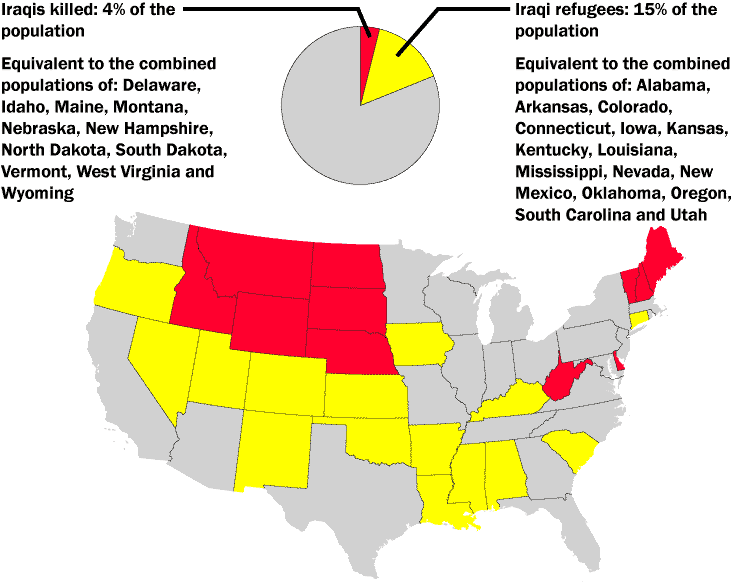 Paul Craig Roberts, Ph.D., "More War on the Horizon" (23 August 2007) ("America's hegemonic hubris is a sickness. A country that tolerates a war criminal while he openly plans to attack yet another country is definitely not a light unto the world.")
Chris Hedges, M.Th., "The Next Quagmire" (TruthDig.com, 3 September 2007) ("The Pentagon has reportedly drawn up plans for a series of airstrikes against 1,200 targets in Iran.")
Patrick Buchanan, "Phase III of Bush's War" (5 September 2007) (on Bush's plan to attack Iran next).
Paul Craig Roberts, Ph.D., "More War on the Horizon" (23 August 2007) ("America's hegemonic hubris is a sickness. A country that tolerates a war criminal while he openly plans to attack yet another country is definitely not a light unto the world.")
Chris Hedges, M.Th., "The Next Quagmire" (TruthDig.com, 3 September 2007) ("The Pentagon has reportedly drawn up plans for a series of airstrikes against 1,200 targets in Iran.")
Patrick Buchanan, "Phase III of Bush's War" (5 September 2007) (on Bush's plan to attack Iran next).
Lindsay Renick Mayer, "The Other Iraq Surge" (Capital Eye, 13 September 2007) ("A sharp increase in contributions from the military to Democrats suggests the Republican commander-in-chief and his party are losing the troops' support. . . . Donations May Be a Way to Protest, While Still Following Orders") (See also
26 October 2007 analysis, infra.)
"The disgraced ABC consultant and the push for war in Iran" (15 September 2007) (If journalist Alexis Debat fakes news stories to promote war, as he is "a leading source in pounding the drumbeat for war in Iran," the question arises: Is he "a lone wolf . . .
promoting himself. Or he is acting . . . as a conduit, spreading occasional disinformation at the behest of others"?)
Clive Boustred, "Department of Veterans Affairs Reports 73 Thousand U.S. Gulf War Deaths" (22 September 2007) (See VA site).
“Podhoretz Granted Secret Access To Lobby Bush On ‘The Case For Bombing Iran’" (24 September 2007) (“Norman Podhoretz, the 'patriarch of neoconservatism,' recently published a book entitled “World War IV: The Long Struggle Against Islamofascism,” staunchly supporting the Iraq war and pushing for war with Iran. . . . Podhoretz has argued that 'if we were to bomb the Iranians as I hope and pray we will . . . we’ll unleash a wave of anti-Americanism all over the world that will make the anti-Americanism we’ve experienced so far look like a lovefest.'”
See also
| "The New American Century" which documents the rise to power of the Neoconservative National Movement (NEOCONs) and their Project for an American Century (PNAC). Their plans for global domination and the required increase in military spending would require, in their own words, a catalyzing event along the lines of a new Pearl Harbor. The events of 9/11 were, to the NEOCONs, a dream come true" [or made to do so].
"This is no Pearl Harbor," by Robert Novak (13 September 2001) ("Security experts and airline officials agree privately that the simultaneous hijacking of four jetliners was an 'inside job,' probably indicating complicity beyond malfeasance."
"The Painful Truth and lies behind 9/11" and "Loose Change, 2d ed" (2006), elaborating this point, in engineering, architectural, and similar scientific vein.
"CIA Asset Susan Lindauer's book Extreme Prejudice: The Terrifying Story of the Patriot Act and the Cover Ups of 9/11 and Iraq: The Ultimate Conspiracy to Silence Truth (Lexington, KY: CreateSpace, 10 Oct 2010).
|
Linda S. Heard, "Let's try partitioning the US" (GulfNews, 1 Oct 2007) (Reaction to Senate vote to partition Iraq, as senators "think they have the right to do in Iraq. Surely if such [policy] is good enough for [Iraq], it's equally appropriate for the [U.S.]." Sarcastically: "How about a vote on the break-up of America? How about giving California back to Mexico, returning Hawaii to its indigenous islanders and Alaska to the Eskimos and Indians? Let's restrict Caucasians to the East and West coasts, and package-up a few states in between for African Americans and Latinos. And while we're about it, let's invite foreign conglomerates to buy up the country's oil, gas and timber."
Scott Ritter, "The Big Lie: ‘Iran Is a Threat’" (8 October 2007) ("Iranian military capability reached its modern peak in the late 1970’s, during the reign of Reza Shah Pahlevi. The combined effects of institutional distrust on the part of the theocrats who currently govern the Islamic Republic of Iran concerning the conventional military institutions, leading as it did to the decay of the military through inadequate funding and the creation of a competing paramilitary organization, the Iranian Revolutionary Guard Command (IRGC), and the disastrous impact of an eight-year conflict with Iraq, meant that Iran has never been able to build up conventional military power capable of significant regional power projection, let alone global power projection. . . . the notion of claiming a nation like Iran to constitute a security threat simply because it retains the intent and capability to defend its sovereign territory in the face of unprovoked military aggression is absurd.")
Jeremy Brecher and Brendan Smith, "How the Military Can Stop an Iran Attack" (The Nation, 10 October 2007).
Frank Rich, "The ‘Good Germans’ Among Us" (14 October 2007) (on Bush use of Gestapo “Verschärfte Vernehmung" torture techniques)
Fr. Andrew Greeley, "Will We Fall For War Vs. Iran?" (Chicago Sun-Times, 17 October 2007)
Prof. Francis A. Boyle (Law, Univ of Illinois), Protesting Power: War, Resistance and Law (Rowman & Littlefield Inc., 2007)
Prof. Maurice Isserman, "The Flower in the Gun Barrel" (The Chronicle Review, 19 October 2007) (incident of the anti-Vietnam War protest)
Timothy Gatto, "What the Media Won't Tell You: The Military is Supporting Anti-War candidates" (26 October 2007) ("the next time that some redneck or neo-con tells you that supporting [an anti-war candidate] is “Not supporting the Troops”, you tell them that the troops themselves are supporting these candidates.") (See also 13 September 2007 analysis, supra.)
Penny Coleman, "Veterans' Suicides: a Hidden Cost of Bush's Wars (AlterNet, 11 November 2007) ("suicide rate among solders that has now reached a 26-year record high [reminiscent of the] virtual epidemic of veteran suicides that followed the war in Vietnam")
Archbishop of Canterbury Williams, "Iraq and Afghanistan violated just war theory, says Williams" (11 November 2007) ("the Western-backed wars in Iraq and Afghanistan . . . failed to conform to the principles of 'just war' theory and brought great suffering.")
"120 US war veteran suicides a week" (Herald Sun, 15 November 2007)
("The US military is experiencing a "suicide epidemic" with veterans killing themselves at the rate of 120 a week . . . an average of 17 a day")
Gideon Polya, Ph.D., "Top US Lawyer And UNICEF Data Reveal Afghan Genocide" (8 February 2008) ("6.6 million post-invasion excess deaths")
William Blum, "Why Didn't They Know That the Iraq War Was a Mistake From the Start?" ("Was it faulty information?")
(5 March 2008)
General William Odom, "Tells Senate
Rapid Withdrawal Is Only Solution" (2 April 2008)
Paul Craig Roberts, Ph.D.,"Petraeus Testimony Next Week Will Signal Iran Attack"(5 April 2008)
Pat Flynn, "Irish Anti-War Activist Refused Entry Into The United States" (The Limerick Leader [Ireland], 9 April 2008) (citing US troops as "gunmen . . . allowed . . . to kill people in the Middle East”)
Robert Fox, "Cheney cold-shouldered: Dick Cheney's belligerence and aggressive anti-Iran rhetoric is driving Arab nations into the arms of Russia" (Guardian (UK) 12 April 2008)
Richard Norton-Taylor, "Top Bush Aides Pushed for Guantánamo Torture: Senior Officials Bypassed Army Chief to Introduce Interrogation Methods" (The Guardian, 19 April 2008) ("In his new book, Torture Team, Philippe Sands QC, professor of law at University College London, reveals that: Senior Bush administration figures pushed through previously outlawed measures with the aid of inexperienced military officials at Guantánamo." See also “Crossing The Rubicon” by Michael Ruppert.)
David Barstow, "Behind TV Analysts, Pentagon’s Hidden Hand” (The New York Times, 20 April 2008)
Ray McGovern, "What About the War, Benedict?” (23 April 2008)
Mick Meaney, “‘Western Leaders Are War Criminals’" (26 April 2008) ("The former Prime Minister of Malaysia, Mahathir Mohamad, has echoed calls for Western leaders to be charged with war crimes over the illegal invasion of Iraq. Speaking at Imperial College in London, Mahathir, who was in office from 1981 to 2003, singled out US President George Bush, former British Prime Minister Tony Blair and Australia’s former prime minister John Howard”)
Prof. Chalmers Johnson, “The Pentagon Strangles Our Economy: Why the U.S. Has Gone Broke” (Le Monde diplomatique, 26 April 2008) (Background)
Andrew Wimmer, “Obliterate Them!” (26 April 2008) (“Sixty years ago, as Europe lay in the ruins of war, Albert Camus was invited to the Dominican monastery in Latour-Maubourg. 'What does the world expect of Christians?' the friars wanted to know. 'What the world expects of Christians is that Christians should speak out, loud and clear, and that they should voice their condemnation in such a way that never a doubt, never the slightest doubt, could rise in the heart of the simplest man. That they should get away from abstraction and confront the blood-stained face history has taken on today.' German theologian and political activist Dorothee Soelle put it simply, 'The truth is concrete.' In 1948 at Latour-Maubourg, the Dominicans told Camus that the Catholic church had in fact spoken out, but that the arcane language of papal encyclicals had obscured the message. The Vatican had indeed signaled its condemnations, but by necessity through diplomatic indirection.”)
Gareth Porter, Ph.D., "Yes, the Pentagon did want to hit Iran" (Asia Times, 7 May 2008) (U.S. plan to hit six nations, i.e., Iraq, Iran, Syria, Libya, Sudan and Somalia)
Vincent Bugliosi, "The Prosecution of George W. Bush for Murder" (10 May 2008) (Review 1, and 2, due to the illegality of the War of Aggression Against Iraq)
Jim Lobe, "School Military Recruiting Could Violate International Protocol" (Inter Press Service, 14 May 2008) (on military targeting youth below legal age. documented in "Soldiers of Misfortune")
Ray McGovern, "Attack Iran: Trash the Constitution" (20 May 2008) ("Two years ago I lectured at the Naval Academy in Annapolis. I found it highly disturbing that, when asked about the oath they took upon entering the academy, several of the "Mids" thought it was to the commander in chief.") See also the video, "Crimes Against Peace: Was The U.S. Invasion Of Iraq Legal or Illegal Under International Law."
"China Inspired Interrogations at Guantánamo" (2 July 2008) ("Communist interrogation methods that the United States long described as torture became the basis for interrogations both by the military at the base at Guantánamo Bay, Cuba, and by the Central Intelligence Agency.")
"War crime suit filed against Israelis" (23 July 2008) ("The [defendant] list includes former Israel's war minister Benjamin Ben-Eliezer, his former military advisor Michael Herzog, former chief of staff Moshe Ya'alon, and former air force commander Dan Halutz, Ma'an News Agency reported on Tuesday [22 July 2008].")
June Mayer, The Dark Side (2008)
Prof. James Petras, "The New York Times: Making Nuclear Extermination Respectable" (30 July 2008) (rebutting "calls for the nuclear incineration of 70 million Iranians and the contamination of the better part of a billion people in the Middle East, Asia and Europe" re which the author "is utterly, starkly and clinically insane" in "his [anti-Iranian] genocidal ravings." "Unlike the Nazi past, we cannot claim, as the good Germans did, that 'we did not know' or 'we weren't notified', because it was written by an eminent Israeli academic and was published in the New York Times.")
Fr. Andrew Greeley, "America's Leaders Violated One of the Commandments" (30 July 2008) (Review of June Mayer's book The Dark Side: "June Mayer's carefully documented book The Dark Side demonstrates beyond doubt that the president, the vice president, the director of the CIA and their closest aides are war criminals. They violated international law, they violated American law, and they violated natural law.")
Prof. Howard Zinn, "A People's History of American Empire" (and Video, 28 March 2008)
Fareed Zakaria, Ph.D. The Post-American World (W. W. Norton & Co, 2008) (Review: “we are moving into a post-American world, one defined and directed from many places and by many people.” "America remains a politico-military superpower, but “in every other dimension — industrial, financial, educational, social, cultural — the distribution of power is shifting, moving away from American dominance.”)
Richard Esposito, Matthew Cole, and Brian Ross, "President Obama's Secret: Only 100 al Qaeda Now in Afghanistan" (ABC News, 2 December 2009) ("With 100,000 troops in Afghanistan at an estimated yearly cost of $30 billion, it means that for every one al Qaeda fighter, the U.S. will commit 1,000 troops and $300 million a year.")
Ray McGovern, “Iran a Threat? I Mean, Really?” (CommonDreams.org, 27 April 2010)
(“five years ago, a previous DIA director told Congress that Iran is not likely to have a nuclear weapon until 'early in the next decade' — this decade. Now, we're early in that decade and Iran's nuclear timetable, if you assume it does intend to build a bomb, has been pushed back to the middle of this decade. Indeed, the Iranians have been about five years away from a nuclear weapon for several decades now, according to periodic intelligence estimates. They just never seem to get much closer. But there's no trace of embarrassment among U.S. policymakers or any notice of this slipping timetable by the FCM.”)
Thomas Engelhardt, "The War Addicts: 2016 and Then Some" (Thursday, 30 September 2010) (on "Bob Woodward's new book Obama’s Wars, a vivid account of the way the U.S. high command boxed the Commander-in-Chief into the smallest of Afghan corners")
An example of the militarism attitude is from Prussia (the catalyst for modern Germany).
“. . . what is Prussia? The Prussian monarchy is the creation of war. Its history, its traditions, its ideals are simply those of war. It is the sole European kingdom which has been built up, province by province, on the battlefield, cemented stone by stone in blood. Its kings have been soldiers: sometimes generals, sometimes . . . drill-sergeants, but ever soldiers. The whole state organization from top to bottom is military. Its people are a drilled nation of soldiers on furlough: its sovereign [Kaiser Wilhelm I] is simply commander-in-chief; its aristocracy are simply officers of the staff; its capital is a camp [armed city]. Nowhere in Europe—not even in Russia—has the military tradition and ideal been sustained in so unbroken a chain.Prussia . . . has been the only European state organized on a military basis as completely as any state of antiquity. . . . Prussia in a distorted way is the Rome of modern Europe—a brave and energetic race giving their whole [nation] to war, and steadily conquering their neighbors. . . .
It seems necessary now again to repeat old truisms—that the slaughter of mankind is horrible in itself, that the trade [military service] of slaughtering mankind is a horrible one, that the morality of the slaughterer of mankind [soldiers] is necessarily a low one. . . . But now . . . war is to be rehabilitated. The military becomes the normal form of life. Our civil life is to be recast. Every citizen is to be a soldier. Every civilian talks of guns, and shells, and formations. . . .
The one great public question [media issue] is the recasting of our military system. . . . Our literature is the picturesque recounting of the battle or the seige. And thus we are falling back in morality a century. The military becomes the true type of human society; some pitiless strategist [general] is a hero; some unscrupulous conspirator is a statesman; and the nation which is the best drilled and the best armed in Europe is to go to the van [forefront] of modern civilization [as though an example to follow!] Brutalizing and senseless creed!” Source: Fredrich Harrison, “Bismarckism,” Fortnightly Review (London: December 1870), pp 634-635, 640 (i.e., written during the Franco-Prussian War of 1870).
". . . the United States, for generations, has sustained two parallel but opposed states of mind about military atrocities and human rights: one of U.S. benevolence, generally held by the public, and the other of ends-justify-the-means brutality sponsored by counterinsurgency specialists. Normally the specialists carry out their actions in remote locations with little notice in the national press. That allows the public to sustain its faith in a just America, while hard-nosed security and economic interests are still protected in secret."--Robert Parry, investigative reporter and author. (See also Stephen Kinzer's analysis, infra.)
“To include all that is designated as atheism, it is necessary to distinguish between theoretical atheism and practical atheism. Theoretical atheism, is the denial, in principle, that there is a god. . . . Practical atheism, on the contrary, is not limited to the intelligentsia, but represents the working [life-style] philosophy of large numbers of men [people]. Practical atheism is the denial, in practice [life-style], that there is a god [with laws]. For such a philosophy, the question of the existence of God [His laws] is irrelevant to the meaning of life and the decisions of human existence,” says “Atheism," Encyclopedia Britannica, Vol. 2 (1963), p 667. Said another way: "The greatest source of atheism in the world today is Christians, who acknowledge Jesus with their lips but deny Him by their lifestyles. That is what an unbelieving world simply finds unbelievable."
“Practical atheism does not deny God, but life is lived as if there is no God. There is complete indifference to His claims, and often there is outspoken and defiant wickedness (Psalm 14:1). This form of atheism is widely prevalent,” says David Horton, Ed., The Portable Seminary (Bloomington MN: Bethany House, 2006), § Atheism, p 410. “Hebrew has no equivalent word for athieism. In the Old Testament the form of atheism that one encounters is practical atheism—human conduct carried out without consideration of God (Psalm 10:4;
14:1;
53:1; cf.
Isaiah 31:1;
Jeremiah 2:13, 17-18;
5:12;
18:13-15).” p 409.
In short: “They profess to know God, but by their deeds they deny Him. . . .” Titus 1:15.
The opposite position is that the person “will not need to be forced by law to [right living] but will himself come running in a hurry . . . constrained within himself . . . [such] people will then come of themselves [internalized, inner-motivated, to right living] without your using compulsion,” says Martin Luther, Th.D., in Luther's Preface to the Small Catechism (1529).
This must be emphasized, repeated: Said another way: "The greatest source of atheism in the world today is Christians, who acknowledge Jesus with their lips but deny Him by their lifestyles. That is what an unbelieving world simply finds unbelievable.”
Such pro-war “Christians” and politicians are in reality “practical atheists,” denying relevance of God's laws in human existence, everyday life-style (e.g., God's anti-war principles and commandments). See 2 Corinthians 11:13-15 for background on such "Christians."
See also concerning "just war" theory, the analysis by Prof. John Howard Yoder, Th.D. (1927-1997), When War is Unjust: Being Honest in Just-War Thinking (Augsburg 1984) (summary from The Christian Century, 13 March 1991, pp. 295-298, and citing politicians telling contradictory versions simultaneously so as to appease different groups, thus refuting the various criteria supposedly enabling analyses re "just wars").
As troops are put in “mortal sin” situations, rape, murder, torture and other atrocities (sins) are foreseeable results. See for example,
Ruth Rosen, “A Wave of Sexual Terrorism In Iraq" (Tomdispatch.com, 14 July 2006)
Chris Floyd, “Home Free: American Power in Mahmudiyah" (17 July 2006) (on troops following leaders' immoral example)
Susan Van Haitsma, “The Ground Truth: Iraq War Veterans Speak Out” (19 September 2006) (shows drill instructors dehumanizing recruits as training to dehumanize others. Has first-hand accounts from soldiers. Reveals the ways their training to "Kill, kill" leads them to target Iraqi civilians)
New Zealand Herald, “Iraqi captive died with 93 injuries” (20 September 2006) (cites captives as beaten with iron bars, kicked, starved, and forced to drink their own urine as part of the abuse process)
“Before You Enlist! 15 Minute Video” (20 September 2006) (has straight talk from soldiers, veterans and their family members, tells what is missing from sales pitches by recruiters and military marketing efforts)
Pauline Jelinek, “Army suicides highest in 26 years” (Associated Press, 15 August 2007) (“Army soldiers committed suicide last year at the highest rate in 26 years . . . a rate of 17.3 per 100,000 — the highest in the past 26 years, the report said. The average rate over those years has been 12.3 per 100,000”).
Marilyn Marchione, AP Medical Writer, "
Thousands of GIs cope with brain damage" (9 September 2007).
|
 “The early Christians took Jesus at his word, and understood his inculcations of gentleness and non-resistance in their literal sense. They closely identified their religion with peace; they strongly condemned war for the bloodshed which it involved; they appropriated to themselves the Old Testament prophecy which foretold the transformation of the weapons of war into the implements of agriculture; they declared that it was their policy to return good for evil and to conquer evil with good,” says
Cecil John Cadoux, M.A., D.D.,
“The early Christians took Jesus at his word, and understood his inculcations of gentleness and non-resistance in their literal sense. They closely identified their religion with peace; they strongly condemned war for the bloodshed which it involved; they appropriated to themselves the Old Testament prophecy which foretold the transformation of the weapons of war into the implements of agriculture; they declared that it was their policy to return good for evil and to conquer evil with good,” says
Cecil John Cadoux, M.A., D.D., 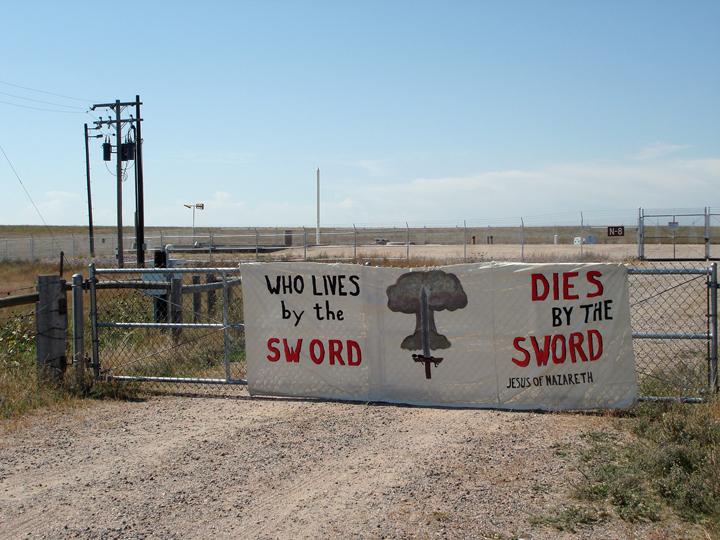
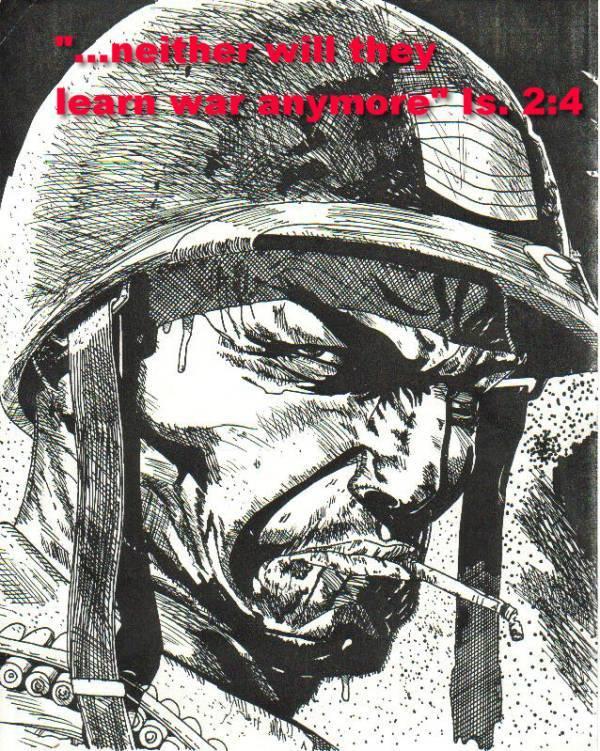
 Jeremy Scahill, Dirty Wars: The World Is a Battlefield (Basic Books, 23 April 2013) (Outlines why the war on terror was formulated, planned and brought about. And who benefits. Has background on war crimes by U.S. troops. And how the "war on terrorism" creates additional new present and future terrorists in reaction to US war crimes, e.g., regularly killing civilians with no combatant role. [Ed. Note: The Nazi Gestapo did better fact checking!! See, e.g.,
 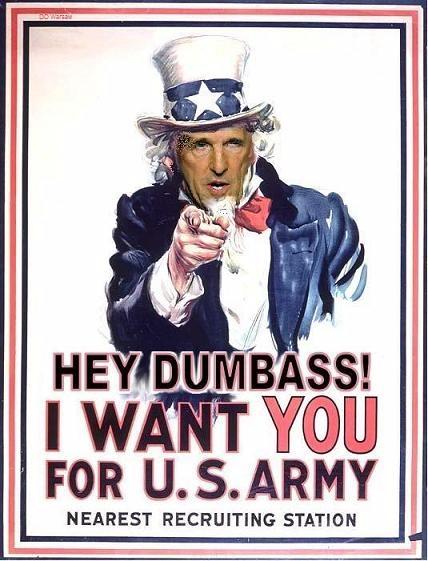 And note the type of persons who choose a military career. "'You say his military career is a result of his [mental] disturbance?' 'Most military careers are,'" says Herman Wouk, The Caine Mutiny: A Novel of World War II (Garden City: Doubleday & Co, Inc., 1951), chapter 35, p 416.
Note the
And note the type of persons who choose a military career. "'You say his military career is a result of his [mental] disturbance?' 'Most military careers are,'" says Herman Wouk, The Caine Mutiny: A Novel of World War II (Garden City: Doubleday & Co, Inc., 1951), chapter 35, p 416.
Note the 
 5. The Vietnam War began in the 1960's to prevent Vietnam from unifying as one country under long-time nationalist activists such as Ho Chi Minh, who'd written Vietnam's "Declaration of Independence" paralleling that of the U.S. Result: Vietnam was taken over by Ho Chi Minh's victorious nationalist supporters, and is now unified as one country. (See PBS series as depicted).
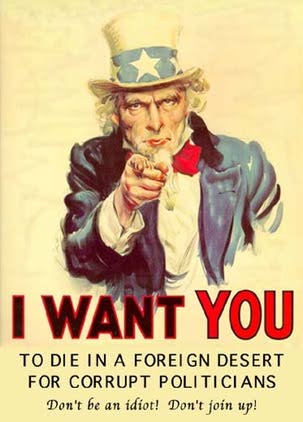 To learn the cost of Operation Iraqi Liberation in your community,
