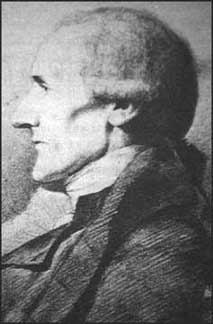
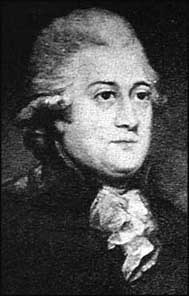
The letter of Patrick Henry to Robert Pleasants (afterwards President of the Virginia Abolition Society), written Jan. 18, 1773, sufficiently shows that his mind had been deeply affected with [persuaded by] the [abolition] movements among the "Friends" [Quakers].
| “Believe me,” says he, “I shall honor the Quakers for their noble efforts to abolish alavery. It is a debt that we owe to the purity of our religion to show that it is at variance with that law that warrants slavery. I exhort you to persevere in so worthy a resolution.” “I believe a time will come when an opportunity will be offered to abolish this lamentable evil.” |
| Ed. Note: Harriet Beecher Stowe, Key (1853), p 36, reprinted more from that letter. |
-70-
fewest slaves, and where the spirit of opposition to slavery was likewise most efficient and most predominant; while the regions most deeply involved in the sin of slaveholding and least accessible to the principles of emancipation, were precisely the same regions in which the apologists and partisans of British usurpation, were most numerous and influential—the regions in which the spirit of opposition to that usurpation was, to the smallest extent, and with the greatest difficulty roused.
The South was overrun with tories [pro-monarchists], while New England was united in favor of independence, almost to a man. Particular localities at the North might be mentioned, where the prevalence of slaveholding and slave trading was connected with a corresponding sympathy with despotic government.
It may be added, that the names most prominent in the Revolutionary struggle were also among the names most prominent in opposition to slavery, and it is not known that a single advocate of the abolition of slavery was otherwise than a firm asserter of the rights of the Colonies.
That the subsequent decline of the spirit of general liberty,
and the corresponding decline of opposition to slavery, have steadily gone hand in hand, until the propagandists of interminable slavery have derided the self-evident truths of the Declaration of Independence, and the people of the free States have listened with comparative apathy, are equally undeniable facts.
A full and correct history of the American Revolution, and of the incipient and successive steps taken to unite the Colonies under a new government, cannot fail to identify the movement with opposition to slavery, and the purpose and anticipation of its overthrow. A few documentary facts, in illustration, must suffice here.
The first general Congress of the Colonies assembled in Philadelphia, in September, 1774. Preparatory to that measure, the Convention of Virginia assembled in August of that year, to appoint delegates to the general Congress. An exposition of the rights of British America, by Mr. Jefferson,
-71-
was laid before this Convention, of which the following is an extract:
"THE ABOLITION OF DOMESTIC SLAVERY is the greatest object of desire in these Colonies, where it was unhappily introduced in their infant state. But previous to the enfranchisement of the slaves, it is necessary to exclude further importations from Africa. Yet our repeated attempts to effect this by prohibitions, and by imposing duties which might amount to prohibition, have been hitherto defeated by his Majesty's negative, thus preferring the immediate advantage of a few African corsairs to the lasting interests of the American States, and the rights of human nature, deeply wounded by this infamous practice."—Am. Archives, 4th series, Vol I, p. 696.
The Virginia Convention, before separating, adopted the following resolution:
Resolved, We will neither ourselves import nor purchase any slave or slaves imported by any other person after the first day of November next [1774], either from AFRICA, the WEST INDIES, or ANY OTHER PLACE."—Ib. p 687.
Similar resolutions, had been adopted by primary meetings of the people in county meetings throughout Virginia, during the month of July preceding the State Convention. At the meeting in Fairfax county, [George] WASHINGTON was chairman.
North Carolina also held her Provincial Convention in August, of the same year. Nearly every county in the State was represented. There were sixty-nine delegates. The following resolution was adopted:
"Resolved, That we will not import any slave or slaves, or purchase any slave or slaves imported or brought into the Province by others, from any part of the woild, after the first day of November next."—Ib., p 735.
Similar resolutions had been previously adopted in primary meetings of the citizens m other Southern provinces, now States.
It was after such demonstrations that the first General Congress assembled. Their first and main work was the formation of the "ASSOCIATION" which formed a bond of Union between the Colonies. This was nearly two years before the Declaration of Independence, so that "the Union" of the future States was effected before their Independence, a fact subversive of the common theory of the Constitution, which supposes inde-
-72-
pendent States first, and a compromise of the slave question, in order to the effecting of a Union, afterwards. The following extracts from the articles of Association will show the principles and the terms, so far as the slave question is concerned, upon which this first union was effected:
"We do, for ourselves and the inhabitants of the several Colonies whom we represent, firmly agree and associate under the sacred ties of virtue, honor, and love of our country, as follows:
* * * * * * *
2. "THAT WE WILL NEITHER IMPORT NOR PURCHASE ANY SLAVE imported after the first day of December next, after which time we will wholly discontinue the SLAVE TRADE, and will neither be concerned in it ourselves, nor will we hire our vessels, nor sell our commodities or manufactures, to those who are concerned in it."
* * * * * * *
11. "That a committee be chosen in every county, city, and town, by those who are qualified to vote for Representatives in the Legislature, whose business it shall be attentively to observe the conduct of all persons touching this Association, and when it shall be made to appear, to the satisfaction of a majority of any such committee, that any person within the limits of their appointment has violated this Association, that such majority do forthwith cause the truth of the case to be published in the gazette, to the end that all such FOES to the rights of British America maybe publicly known, and universally contemned as the ENEMIES OF AMERICAN LIBERTY; and thenceforth we respectively will break off all dealings with him or her."
* * * * * * *
14. "And we do further agree and resolve that we will have no trade, commerce, dealings, or intercourse whatever, with any colony or province in North America, which shall not accede to, or which shall hereafter violate this Association, but will hold them as UNWORTHY OF THE RIGHTS OF FREEMEN, and as inimical to the liberties of this country."
* * * * * * *
"The foregoing Association, being determined upon by the Congress, was ordered to be subscribed by the several members thereof, and thereupon, we have hereunto set our respective names, accordingly.
In Congress, Philadelphia, October 20, 1774
PEYTON RANDOLPH,
President,
NEW HAMPSHIRE—John Sullivan, Nathaniel Folsom.
MASSACHUSETTS BAY—Thomas Gushing, Samuel Adams, John Adams, Robert Treat Paine.
RHODE ISLAND—Stephen Hopkins, Samuel Ward.
-73-
CONNECTICUT—Eliphalet Dyer, Roger Sheiman, Silas Deane.
NEW YORK—Isaac Low, John Alsop, John Jay, James Duane, Philip Livingston, Wilham Floyd, Henry Wisner, Simon Bocrum.
NEW JERSEY—James Kinsey, William Livingston, Stephen Crane, Richard Smith, John De Hart.
PENNSYLVANIA—Joseph Galloway, John Dickmson, Charles Humphreys, Thomas Mifflin, Edward Biddle, John Morton, George Ross.
THE LOWER COUNIIES, NEWCASTLE, &c.—Caesar Rodney, Thomas McKean, George Read.
MARYLAND—Matthew Tilghman, Thomas Johnson, jr., William Paca, Samuel Chase.
VIRGINIA—Richard Henry Lee, George Washington, Patrick Henry, jr., Richard Bland, Benjamin Harrison, Edmund Pendleton.
NORTH CAROLINA—William Hooper, Joseph Hewes, Richard Caswell.
SOUTH CAROLINA—Henry Middleton, Thomas Lynch, Christopher Gadsden, John Rutledge, Edward Rutledge—American Archives, 4th Series, p. 915.
Such was the action of the first American Congress. These were items in the “Articles of Association.” How they were received in the Colonies will appear from the following:
| “We, therefore, the Representatives of the extensive District of Darien, in the colony of Georgia, having now assembled in Congress, by authority and free choice of the inhabitants of said District, now freed from their [British] fetters, do resolve:
“5. To show the world that we are not influenced by any contracted or interested [non-impartial] motives, but a general philanthropy for ALL MANKIND, of whatver climate, language, or complexion, we hereby declare our disapprobation and abhorrence of the unnatural practice of slavery in America, (however the uncultivated state of our countt), or other specious arguments may plead for it,) a practice founded in injustice and cruelty, and highly dangerous to our liberties, (as well as lives,) debasing part of our fellow-creatures below men, and corrupting the virtue and morals of the rest, and is laying the basis of that liberty we contend for, (and which we pray the Almighty to continue to the latest posterity,) upon a very wrong foundation. We, therefore, Resolve, at all times to use our utmost endeavors for the manumission of our slaves in this colony, upon the most safe and equitable footing for the master and themselves.”—JAN. 12th, 1775.—Ibid., p. 1136. |
The following action was taken by the Convention of Maryland, held in November, 1774, and re-adopted by a Convention more fully attended, in December:
| “Resolved, That every member of this meeting will, and every person in |
-74-
the province should, strictly and inviolably observe and carry into
execution the Association agreed on by the Continental Congress.” |
The declaration adopted by a general meeting of the freeholders in James City county, in Virginia, in November, 1774, is in these words:
| “The Association entered into by Congress being publicly read, the freeholders and other inhabitants of the county, that they might testify to the world their concurrence and hearty approbation of the measures adopted by that respectable body, very cordially acceded thereto, and did bind and oblige themselves, by the sacred ties of virtue, honor, and love to their country, strictly and inviolably to observe and keep the same in every particular.” |
The proceedings of a town meeting at Danbury, Connecticut, Dec. 12th, 1774, contained the following:
| “It is with singular pleasure we notice the second article of the Association, in which it is agreed to import no more negro slaves, as we cannot but think it a palpable absurdity so loudly to complain of attempts to enslave us while we are actually enslaving others.”—Am. Archives, 4th series, Vol. I., p. 1038.
These are but “specimens [samples] of the formal and solemn declarations of public bodies." “The Articles of Association were adopted by Colonial Conventions, County Meetings, and lesser assemblages throughout the country, and became the law of America—the fundamental Constitution, so to speak, of the first American Union.” “The Union thus constituted was, to be sure, imperfect, partial, incomplete, but it was still a Union, a union of the Colonies and of the people for the great [pro-freedom] objects [purpose] set forth in the articles. And let it be remembered, also, that prominent in the list of measures agreed on in these articles, was the discontinuance of the slave trade, with a view to the ultimate extinction of slavery itself.”* |
That this “sentiment [viewpoint] pervaded the masses of the people,” and that they understood themselves as laying the constitutional foundations of a permanent union and general government by these measures, may be seen by the following extracts from an eloquent paper, entitled “Observations addressed to the people of America,” printed at Philadelphia, in Nov., 1774:
____________________________________
* Speech of Hon. S. P. Chase, of Ohio, U. S. Senate, March 26, 1850. To this speech, and to that of Hon. Lewis D. Campbell, of Ohio, in the House of Representatives of the U. S , Feb. 19, 1850, we are indebted for the quotations made from the American Archives.
-75-
"The least deviation from the resolves of Congress will be treason; such treason as few villains have ever had an opportunity of commuting. It will be treason against the present inhabitants of the colonies—against the millions of unborn generations who are to exist hereafter in America—against the only liberty and happiness which remain to mankind—against the last hopes of the wretched in every corner of the world; in a word, it will be treason against God. * * * WE ARE NOW LAYING THE FOUNDATIONS OF AN AMERICAN CONSTITUTION.
"Let us, therefore, hold up everything we do to the eye of posterity. They will most probably measure their liberties and happiness by the most careless of our footsteps. Let no unhallowed hand touch the precious seed of liberty. Let us form the glorious tree in such a manner, and impregnate it with such principles of life, that it shall last forever. * * * I almost wish to live to hear the triumphs of the jubilee in the year 1874; to see the models, pictures, fragments of writings, that shall be displayed to revive the memory of the proceedings of the Congress of 1774. If any adventitious circumstance shall give precedency on that day, it shall be to inherit the blood, or even to possess the name, of a member of that glorious assembly."—Amer. Arch., 4 ser., vol. i, p. 976.
The spirit of 1774 was not extinct or languishing in 1776, a year memorable not only for the Declaration of American Independence, but for the previous enunciation of the same self-evident truths, applied to the sin of slavery, in a more elaborate and thorough elucidation of the whole subject than had before appeared.*
The argument of Dr. Hopkins against slavery is introduced by a notice of the action of Congress against the slave trade, and the statement that the traffic "has now but few advocates, and is generally exploded and condemned." The treatise contains the remarkable statement that "the slavery that now takes place," (in distinction from that of ancient times,) is "without the express sanction of civil government."†
| Ed. Note: This same point of view was expressed by
Gerrit Smith, Letter of Gerrit Smith to Hon. Henry Clay (New York: American Anti-Slavery Society, 1839), p 19
George Mellen, Unconstitutionality of Slavery (Boston: Saxton & Pierce, 1841), pp 431-432
Lysander Spooner, Unconstitutionality of Slavery (Boston: Bela Marsh, 1845), p 23
Abraham Lincoln, Peoria Speech (1854),
p 221
Lewis Tappan, et al., Proceedings of Convention (New York, 26-28 June 1855), p 34. |
This idea will now appear strange to most per-
____________
*"A Dialogue concerning the Slavery of the Africans, showing it to be the duty and interest of the American States to emancipate all their African Slaves. Dedicated to the Honorable the Continental Congress." By Samuel Hopkins, D.D., of Newport, R. I.
†The same idea seems involved in another portion of the treatise. "The several legislatures in these colonies," says the writer, "the magistrates and the body of the people, have doubtless been greatly guilty in approving and encouraging, or at least conniving at, this practice" (i.e., slaveholding). This is certainly remarkable language, especially from so accurate and discrimin-
-76-
sons. But the careful and reflecting reader of the history we have given in the preceding chapters, will have been led to inquire when and how the "express sanction," of "civil government" had been given to slavery in any form that could entitle it to the reputation of being legalized. The decision of Lord Mansfield in the Somerset case, four years previous, may have been in the mind of Hopkins, and he is known to have been in correspondence with Granville Sharp, with whose views the reader is acquainted.
What seems most remarkable is, that a treatise containing such a statement should not only have been extensively circulated without being questioned, but republished, and still more extensively circulated, nine years afterwards, by anti-slavery societies under the auspices of such statesmen as Franklin and Jay. If it be conceded that American slavery was "without the express sanction of civil government," that it was not, in a strict and proper sense, legalized, at the time when Hopkins wrote his treatise, a few months before the Declaration of Independence, it would be a curious question how it could have become legalized since. Assuredly, the far-famed Declaration of inalienable human rights cannot have given it any new validity!
"We hold these truths to be self-evident, that all men are created equal; that they are endowed by their Creator with certain inalienable rights, among which are life, liberty, and the pursuit of happiness." "To secure these rights, governments are instituted among men." "We, therefore, the representatives of the United States of America," &c. &c.
We enter into no argument here concerning the legal effect of that immortal Declaration, upon the tenure of slave property. But it is important to note down distinctly the historical facts. It was the "unanimous Declaration of the thirteen United (not disunited) States of America." The "Union" had already been formed, and has never since been dissolved.
____________
ative a writer as Hopkins, if slavery were universally and unhesitatingly held to be legal. Legislatures and magistrates are not commonly spoken of as "conniving" (closing their eyes upon) practices which are admitted to be legal! Such language describes their culpable neglect to suppress and punish practices that are unlawful.
-77-
On this point, there can be no mistake.* It was not only a Declaration of the States by their delegates, but was separately ratified by all the States, afterwards, and has never been repudiated or repealed since. In connection with the previous Articles of Association, it was the only constitution of the United States, until the adoption of the "Articles of Confederation" in 1778; and with these, thenceforward, until the adoption of the present Federal Constitution, in 1789.
It had power to legalize Acts of Congress and Treaties, as also to absolve citizens from their allegiance to the king of Great Britain.† Its repeal would have been an abandonment of Independence, and a return to the condition of colonies.
Besides this, the original thirteen States, except Connecticut and Rhode Island, formed Constitutions bearing date, variously, from 1776 to 1783. "They generally recognized, in some form or other, the natural rights of men, as one of the fundamental principles of the government. Several of them asserted these rights in the most emphatic and authoritative manner." So that the fundamental principles and self-evident truths of the Declaration of 1776 became the constitutional law of the several States. Vide Spooner, p. 46.
The Articles of Confederation, formed in 1778, contained no recognition of slavery, nor of distinctions of color. It was never pretended that, under these articles, the slaveholder whose slaves had escaped to another State, had any legal power to force him back.
In 1779 the Continental Congress ordered a pamphlet to be published, entitled, "Observations on the American Revolution," of which the following is an extract:
"The great principle (of government) is and ever will remain in force,
____________
*The reader is referred to the unanswered and unanswerable argument of John Quincy Adams on this point, in his address at Newburyport, 4th of July, 1837.
†John Hancock, President of Congress, in a letter to the Convention of New Jersey, then in session, and inclosing a copy of the Declaration of Independence, speaks of it as being "the ground and foundation of a future government." If the "ground and foundation" be removed, what becomes of the superstructure? But if this "ground and foundation" remains, what becomes of the validity of slave laws?
-78-
that men are, by nature, free; as accountable to Him that made them, they must be so; and so long as we have any idea of divine justice, we must associate that of human freedom. Whether men can part with their liberty is among the questions which have exercised the ablest writers; but it is conceded, on all hands, that the right to be free CAN NEVER BE ALIENATED; still less is it practicable for one generation to mortgage the privileges of another."
A more forcible denial of the possibility of legalizing slavery could not easily have been penned.

About this time, or not long after, Mr. Jefferson wrote his celebrated Notes on Virginia, in which his testimonies against slavery are so various and emphatic, that we hesitate what paragraph to select for quotation. The following serves to show what such men, at that time, expected and desired to see accomplished, and what was then, in Mr. Jefferson's opinion, the state of sentiment in the Southern States.
| "I think a change is already perceptible since the [1776] origin of the present revolution. The spirit of the master is abating, that of the slave is rising from the dust, his condition mollifying, THE WAY, I HOPE, PREPARING, UNDER THE AUSPICES OF HEAVEN, FOR A TOTAL EMANCIPATION." |
| Ed. Note: Full Citation: Thomas Jefferson [1743-1826], Notes on the State of Virginia (Philadelphia: Prichard and Hall, 1788) [Excerpt]. |
General [Horatio] Gates [1728-1806], the conqueror of [British General John] Burgoyne [1722-1792], emancipated, in 1780, his numerous slaves.
From the beginning to the close of the war, one uniform language was held. Soon after the peace of 1783, Congress issued an address to the States, drawn up by Mr. Madison, a main object of which was to ask the provision of funds to discharge the public engagements. The plea is thus urged:
"Let it be remembered, finally, that it has ever been the pride and boast of America that the rights for which she contended were the rights of human nature. By the blessing of the Author of these rights on the means exerted for their defence, they have prevailed against all opposition, and form the basis of THIRTEEN INDEPENDENT STATES."
The expression of similar sentiments did not then cease, nor were they confined to public acts.
"Jefferson, Pendleton, Mason, Wythc, and Lee, while acting as a committee of the House of Delegates of Virginia, to revise the State Laws, prepared a plan for the gradual emancipation of the slaves, by law."
In addition to these, "Grayson, St. George Tucker, Madison, Blair, Page, Parker, Edmund Randolph, Iredell, Spaight, Ramsey, McHenry, Samuel
-79-
Chase, and nearly all the illustrious names south of the Potomac, proclaimed it before the sun, that the days of slavery were beginning to be numbered."—Power of Congress over the "District of Columbia," by T. D. WELD [1838].
But it is needless to multiply these references. So universal were these sentiments, that Mr. Leigh, in the Convention of Virginia, in 1832, took occasion to say:
"I thought, till very lately, that it was known to every body that, during the Revolution, and for many years after, the abolition of slavery was a favorite topic with many of our ablest statesmen, who entertained with respect all the schemes which wisdom or ingenuity could surest for its accomplishment "
Mr. Faulkner, in the same Convention, alluded to the same fact, as did also Gov. Barbour, of Virginia, in the United States' Senate, in 1820.
These professions of the fathers of our republic were not totally unaccompanied with corresponding action.
The articles of Association, including the solemn pledge to discontinue the slave trade, appear to have been generally respected and observed. That there were unprincipled men who evaded or transgressed them, as there were other traitors to the cause of liberty, there can be no doubt After the close of the war, this is known to have been the fact But the States took early measures for its suppression.
"The first opportunity was taken, after the Declaration of Independence, to extinguish the detestable commerce so long forced upon the province (Virginia) In October, 1778, during the tumult and anxiety of the Revolution, the General Assembly passed a law, prohibiting, under heavy penalties, the further importation of slaves, and declaring that every slave imported thereafter, should be immediately set free " "The example of Virginia was followed, at different times, before the date of the Federal Constitution, by most of the other States."—Walsh's "Appeal"—Vide "Friend of Man," June 21, 1837 Copied from "Human Rights."
"We are not aware that any State allowed the importation of slaves at the time," when the Constitution was adopted "The first State that renewed the traffic, so far as we know, was S. Carolina." in 1803 —"Human Rights"—"F of Man;" as above.
Under what influences, and with what activity, the slave trade was resumed, from 1803 to 1808, will be shown in the proper place.
-80-
CHAPTER IX.
ERA OF FORMING THE FEDERAL CONSTITUTION.
Prevailing Sentiment—Washington—Luther Martyn—Wilhim Pinckney—Northwestern
Territory—Ordinance of 1787—Madison—"Understandings"—Wilson—
Heath—Johnson— Randolph—Patrick Henry—Iredell—"The Federalist," by Jay,
Madison, and Hamilton—Ratifications—Rhode Island—New York—Virginia—
North Carolina—Amendment—"Due process of law."
FROM the close of the Revolutionary war in 1783, to the sitting of the Constitutional Convention, was a space of only four years. Thence, two more years bring us to the adoption, of the Constitution, in 1789. What was the prevailing sentiment of that period?

In a letter to Robert Morris, dated Mount Vernon, April 12, 1786, George Washington said
"I can only say that there is not a man living who wishes more sincerely than I do to see a plan adopted for the abolition of it, (slavery,) but there is only one proper and effectual mode in which it can be accomplished, and that is by legislative authority, and this, so far as my suffrage will go, shall never be wanting "—9 Sparks's Washington, 158.
In a letter to John F. Mercer, September 9, 1786, he reiterated this sentiment:
"I never mean, unless some particular circumstances should compel me to it, to possess another slave by purchase, it being among my first wishes to see some plan adopted, by which slavery in this country may be abolished by law."—Ibid.
And in a letter to Sir John Sinclair, he further said:
"There are in Pennsylvania laws for the gradual abolition of slavery, which neither Virginia nor Maryland have at present, but which nothing is more certain than they must have, and at a period not remote."
By his last will and testament he made all his slaves free.
-81-
The testimonies of Franklin, Rush, and Jay, in strong opposition to slavery, have been cited in another connection.*
We have now traced the history of the "peculiar institution" down to the time when the Federal Constitution was about to be formed. Exceedingly "peculiar" indeed, are the vouchers for its authenticity and legality down to that point in our national history. What occurred while the Federal Constitution was in process of forming, is the next historical fact to be inquired after. What was likely to have occurred, and even, indeed, what could have occurred, may well nigh be read in the mere light of the historical facts already noticed. Those facts, at least, should not be left out of the account, in any attempts at a historical exposition of the Constitution, if, indeed, the advocates of the "institution" adventure into the field of history at all, in defence of their claims.
The simple history, and not the argument, must occupy, at present, our attention, and yet it is in the light of the pending controversy that we should ponder the facts. It is that contest that gives them their value, and they should be collected, arranged and studied with a view to the points to be illustrated and determined by them.
Luther Martin, of Maryland, advocated the abolition of slavery, in the Federal Convention of 1787, and in his Report of the proceedings of that Convention to the Legislature of bis own State.
William Pinckney, of Maryland, in the House of Delegates in that State, in 1789, urged, strongly, the abolition of slavery. We will give but a specimen of his language on that occasion.
| "Sir—Iniquitous and most dishonorable to Maryland, is that dreary system of partial bondage which her laws have hitherto supported with a solicitude worthy of a better object, and her citizens by their practice, countenanced. Founded in a disgraceful traffic, to which the parent country lent its fostering aid, from motives of interest, but which even she would have disdained to encourage, had England been the destined mart of such inhuman merchandize; its continuance is as shameful as its origin.'' |
____________
*Chapter IV.
-82-
NORTHWESTERN TERRITORY—ORDINANCE OF 1787.
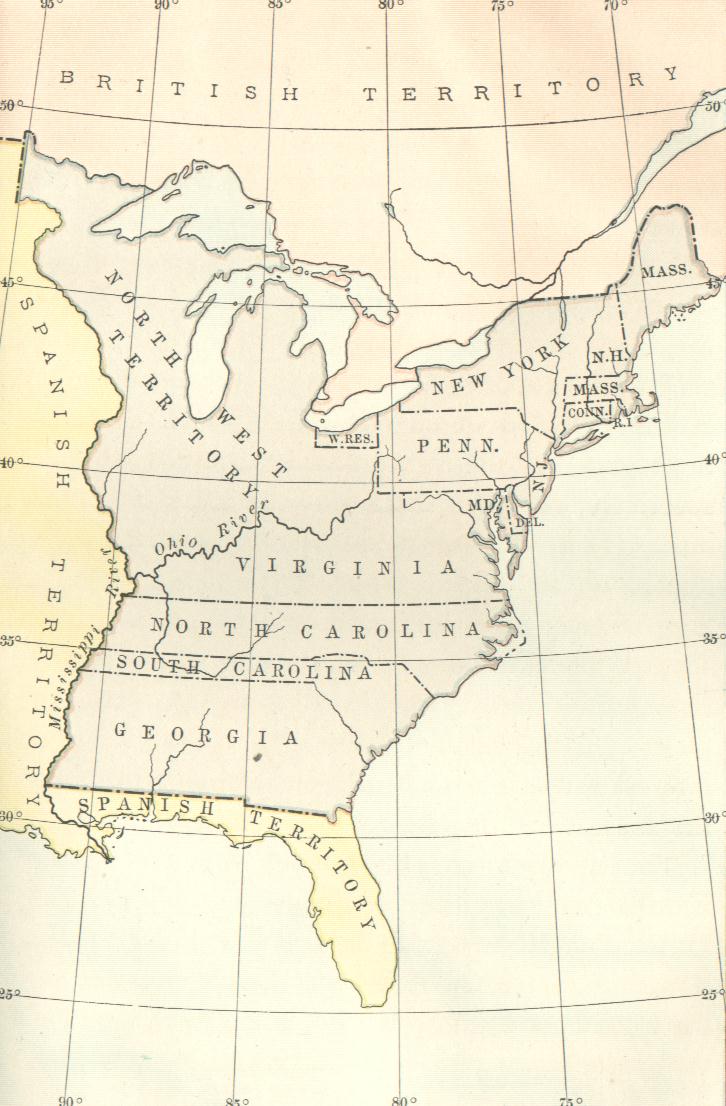
While the Convention for drafting the Constitution of the United States was in session, in 1787, the Old Congress passed an ordinance abolishing slavery in the North-Western Territory, and precluding its future introduction there. The first Congress under the new Constitution ratified this ordinance, by a special act. It received the approval of Washington, who was then fresh from the discussions of the Convention for drafting the Federal Constitution. The measure originated with Jefferson, and its ratification in the new Congress received the vote of every member except Mr. Yates, of New York, the entire Southern delegation voting for its adoption. By this ordinance slavery was excluded from Ohio, Indiana, Illinois, Michigan, Wisconsin, and Iowa.
The series of articles is preceded by this preamble:
| "And for extending the fundamental principles of civil and religious liberty, which form the basis whereon these republics, their laws and constitutions, are erected; to fix and establish those principles as the basis of all laws, constitutions, and governments, which forever hereafter shall be formed in said Territory; to provide also for the establishment of States, and permanent government therein, and for their admission to a share in the Fedcrul Councils at as early a period as may be consistent with the general interest:—Be it ordained and established," &c. &c. |
Then follow the articles. The sixth is as follows:
| "There shall be neither slavery nor involuntary servitude, otherwise than in the punishment of crimes, whereof the party shall have been duly convicted; provided, always, that any person escaping into the same, from whom labor or service may be lawfully claimed, in any one of the original States, such fugitive may be lawfully reclaimed, and conveyed to the person claiming his or her labor or service, as aforesaid." |
"The Constitution," it is claimed, "guaranties slavery." And "the compromises of the Constitution" are very generally conceded, even among those who disrelish and controvert the claim. We enter not now into matters of mere opinion. But the continuity and fidelity of the history we have attempted, compel us to attend to the facts.
-83-
Whatever those facts are, they are such as are interlinked, indissolubly, with the historical facts of the last previous chapter, and the preceding ones. History must be understood, if at all, in its connections.
The Constitution is in the hands of the people. We need not copy here its provisions. No claimant of the Constitutional guaranties of slavery adventures to rest the claim on the mere words of that instrument. He well knows that neither the terms "slave" nor "slavery" are to be found there. He goes out of the instrument for its exposition, and reposes on supposed facts, in the shape of "understandings" then entertained.
What were the "understandings" of that period? In the preceding chapter may be seen some of them. It is in place here to record more. We have seen what they were, up to the time of the framing and adopting of the Federal Constitution. What were they, then?
In the Convention that drafted the Constitution—
| Mr. Madison declared, he "thought it wrong to admit in the Constitution the idea that there could be property in men."—3 Mad Pap., 1429.*
"On motion of Mr. Randolph, the word 'SERVITUDE' was struck out, and 'SERVICE' unanimously inserted—the former being thought to express the condition of SLAVES, and the latter the obligation of FREE PERSONS."—Ib. 3, p. 1569. |
Such were the "understandings" of the Convention that drafted the Constitution. And with what "understanding" was it adopted by the people, in their State Conventions? Let us see.
____________
*In other words, Mr. Madison would not consent that the Constitution should recognize even the legality of slavery! This was a still more full, confident, and emphatic expression of the idea we have before quoted from Dr. Hopkins.
-84-
| vania. * * * The new States which are to be formed will be under the control of Congress in this particular, and slavery will never be introduced among them."—2 Elliot's Debates, 452. |
In another place, speaking of this clause, he said:
| "It presents us with the pleasing prospect that the rights of mankind will be acknowledged and established throughout the Union. If there was no other feature in the Constitution but this one, it would diffuse a beauty over its whole countenance. Yet the labor of a few years, and Congress will have power to exterminate slavery from within our borders."—Ib. 2, p. 484. |
In the Ratification Convention of Massachusetts, Gen. Heath said:
| "The migration or importation, &c., is confined to the States now existing only, new States cannot claim it. Congress by their ordinance for creating new States some time since, declared, that the new States shall be republican, and that there shall be no slavery in them."—Ib. 2, p. 115. |
Nor were these views and anticipations confined to the free States. In the Ratification Convention of Virginia, Mr. Johnson said:
| "They tell us that they see a progressive danger of bringing about emancipation. The principle has begun since the Revolution. Let us do what we will, it will come round. Slavery has been the foundation of much of that impiety and dissipation which have been so much disseminated among our countrymen. If it were totally abolished, it would do much good."—Ib |
Gov. Randolph rebuked those who expressed apprehensions that its influence might be exerted on the side of freedom, by saying:
| "I hope that there are none here who, considering the subject in the calm light of philosophy, will advance an objection dishonorable to Virginia, that, at the moment they are securing the rights of their citizens, there is a spark of hope that those unfortunate men now held in BONDAGE may, by the operation of the General Government, be made FREE."—Ib. 3, p. 598. |
Patrick Henry, in the same Convention, argued "the power of Congress, under the United States' Constitution, to abolish slavery in the States," and added :
| "Another thing will contribute to bring this event about. Slavery is detested We feel its effects. We deplore it with all the pity of humanity."—Debates Va. Convention, p. 463. |
"In the debates of the North Carolina Convention, Mr. Iredell, afterwards a Judge of the United States Supreme Court, said—
| 'When the entire abolition of slavery takes place, it will be an event which must be pleasing to every generous mind, and every friend of human nature.'"—"Power of Congress," &c., pp 31-2. |
-85-
Such are a few specimens of the expressed "understandings" with which the people adopted the Constitution.
Another class of historical facts; of the utmost importance to a right understanding of the slave question in America, relates to the expositions and arguments addressed to the people of the United States to persuade them to adopt the Federal Constitution. It is well known that the people were sensitively jealous of their rights at that period, and fearful of the encroachments of despotic power. A strong party, of which Mr. Jefferson (a prominent and zealous propagandist of abolitionism) was understood to be the nucleus, and afterwards became the successful presidential candidate, opposed the adoption of the Federal Constitution, as prepared by the Convention, on the ground of its alleged defects in not providing sufficient securities for personal rights, and a more ample and explicit enunciation of the self-evident truths of the Declaration of 1776.
This opposition [claiming that the proposed Constitution was not sufficiently pro-freedom] drew out the distinguished statesmen, Madison, Jay, and Hamilton, in a joint and elaborate defence of the Constitution as drafted, comprising a series of papers known as "The Federalist," and since collected into a large volume. These papers were extensively circulated before the action of the States, and were largely instrumental in securing their desired object.—No. 39 of "The Federalist," by James Madison, contains the following:
| "The first question that offers itself is, whether the general form and aspect of the government be strictly republican. It is evident that no other form would be reconcilable with the genius of the people of America, and with the fundamental principles of the Revolution, or with that honorable determination which animates every votary of freedom, to rest all our political experiments on the capacity of MANKIND for SELF-GOVERNMENT. If the plan of the Convention, therefore, be found to depart from the republican character, its advocates must abandon it, as no longer defensible." |
Mr. Madison proceeds, at some length, to discuss the question, "What are the distinctive characters of the republican form"? After distinctly repudiating the aristocracies and oligarchies of Holland, Venice, Poland, and England, as not being republican, though sometimes "dignified," very impro-
-86-
perly, "with the appellation," Mr. Madison proceeds further to define a republican government as one whose officers are appointed by THE PEOPLE, &c.
| "It is essential to such a government," says he, "that it be derived from the great body of society, NOT from an inconsiderable portion, OR, a favored class of it." |
And this is the same Mr. Madison, who, in the Convention for drafting the Constitution which he was now recommending, had insisted that the instrument must not recognize the legality of slavery.
The adoption of the Federal Constitution was thus successfully urged upon the people, by representing it as laying the foundation of the Government upon "the principles of the Revolution"—the principles of '76,—the principles promulgated so effectively by Mr. Jefferson, who had said—
| "The true foundation of republican government is the EQUAL RIGHTS OF EVERY CITIZEN, in his PERSON and PROPERTY, and in their MANAGEMENT," and who had explicitly designated the slaves as "citizens."* |
In No. 84 of "The Federalist" several pages are devoted to a consideration of what was evidently understood to be a vital point, in the minds of the people, who were so soon to decide on the adoption or rejection of the proposed Constitution.
"The most considerable of the remaining objections," says the writer, "is, that the plan of the Convention contains no bill of rights.'
The writer speaks of "the intemperate partisans of a bill of rights," and of their "zeal in this matter." This shows that many of the people were sensitive on this point, and that the friends of the proposed Constitution were afraid of its being rejected in consequence.
And how did "The Federalist" successfully allay this jealousy, and persuade the people to adopt the proposed Constitution?
____________
*With what execration should the statesman be loaded, who, permitting one half of the citizens thus to trample upon the rights of the other, transforms those into despotsm, destroys the morals of the one part, and, the amor patriæ of the other."—Notes on Virginia.
-87-
It was done, first, by citing a number of specific provisions in the Constitution, equivalent, (as was claimed) to so many corresponding items in a bill of rights; and, second, by citing the PREAMBLE to the Constitution, setting forth its objects "to secure the blessings of liberty," &c. to "the people of the United States." This Preamble, as being a part of the Constitution, and its very basis, to which all the rest was conformed, was represented as being not only a bill of rights in the general, but "a better recognition of popular rights " than could otherwise have been framed, and less liable to be set aside, under a "plausible pretence," by men "disposed to usurp power."*
The objectors had desired such a bill of rights as several of the States, particularly Massachusetts, had already adopted, and under which, before that time, the Courts of Massachusetts had decided slavery to be illegal. Yet "The Federalist" assured them that the Constitution was more than the equivalent of such bills of rights.
It was under the pressure of expositions and arguments like these, from leading members of the Convention, that the people were persuaded to ratify the Constitution that had been elaborated with closed doors. They ratified it with "the understanding," so frequently expressed by and among them, that the Constitution was in favor of freedom. We know of no record in which the ratification of that instrument was urged, either at the North or at the South, on the ground that it was the guaranty of any form of despotism—or on the ground that the conflicting interests of liberty and slavery had been compromised. The whole current of the political literature of that period forbids the idea that any such appeals could have been adventured.
But the people, though they ratified the Constitution, were
____________
*The reader is doubtless familiar with the modern [pro-slavery] pleas, that the Preamble has no controlling power over the Constitution; that it does not furnish a criterion for Constitutional exposition; and that, in fact, it is no part of the Constitution! We may judge what would have been the fate of the proposed Constitution, if its friends had outstript its enemies in representing it thus!
-88-
not satisfied to do so without insisting upon important [bill-of-rights-type] amendments. The Conventions of Virginia, North Carolina and Rhode Island, proposed a provision as follows:
| "No FREEMAN ought to be taken, imprisoned, or disseized of his freehold, liberties, privileges, or franchises, or outlawed, or exiled, or in any manner despoiled or deprived of his life, liberty, or property, BUT BY THE LAW OF THE LAND."—Elliot's Debates, 658. |
New York proposed a different provision:
| "No PERSON ought to be taken, imprisoned, or disseized of his freehold, or be exiled, or deprived of his privileges, franchises, life, liberty, or property, but by due process of law."—1 Ibid, 328. |
These various propositions came before Congress, and that body, at its first session, agreed upon several amendments to the Constitution, which were subsequently ratified by the States. That which related to personal liberty was expressed in these comprehensive words:
| "No person * * * * shall be deprived of life, liberty, or property, without due process of law."—Cons., Amend., Art. 5. |
It is to be noted, as an important historical fact, that this remarkable provision is an amendment coming in after the original instrument had been ratified, thus over-riding and controlling, like all other amendments, whatever in the original instrument may have been supposed to be of a contrary bearing.
The ratification of Rhode Island was longest withheld, and was most remarkable in its mode of expression. It was, in fact, conditional. It specified a long list of declarations of rights, and then said:
| "Under these impressions, and declaring that the rights aforesaid cannot be abridged, and that the explanations aforesaid are consistent with the said Constitution, and in confidence that the amendments hereafter mentioned will receive an early and mature deliberation, and conformably to the 5th article of said Constitution, speedily become parts thereof: We the said delegates," &c., &c., "do assent to and ratify the said Constitution." |
Among these declarations of rights were some equivalent to those of the Declaration of Independence.
Among the proposed amendments, above mentioned, was the following
| "As a traffic tending to establish or continue the slavery of any part of the human species, is disgraceful to the cause of religion and humanity, that |
-89-
| Congress as soon as may be, promote and establish such laws as may effectually prevent the importation of slaves, of any description, into the United States." |
From this it is seen, that the State whose citizens were most deeply engaged in the lucrative importation of slaves, the only State, perhaps, that was growing rich by the continuance of the slave system consented to ratify the Federal Constitution only on condition that the traffic should be speedily prohibited. No other ratification of the Constitution was ever made by Rhode Island. She never consented to the twenty years' delay of that prohibition.
-90-
CHAPTER X.
OF DIRECT ANTI-SLAVERY EFFORTS, INCLUDING ECCLESIASTICAL
ACTION, FROM THE PERIOD OF THE REVOLUTION TO
THE CLOSE OF THE LAST CENTURY, AND THE ABOLITION
OF SLAVERY IN THE NORTHERN STATES.
Republication of Hopkins' Dialogue (1785)—Edwards' Sermon (1791)—Anti-Slavery
Meeting at Woodbridge, N. J. (1783)—Abolition Societies in Pennsylvania, New
York, Rhode Island, Connecticut, Maryland, Virginia, New Jersey, Delaware—
Names of distinguished abolitionists—Memorial to Leg. of New York, by Jay,
Hamilton, &c.—Petitions to Congress, by B. Franklin and others—Discussions in
Congress—William and Mary College (Va.)—Action of Methodist E. Conference—
Presb. General Assembly—Baptists—Action of the States—Virginia, Delaware,
Rhode Island, Vermont—Massachusetts—Pennsylvania—New Hampshire,
Connecticut—New York—New Jersey—Census of remaining slaves.
SIGNIFICANT as are the facts recorded in the two preceding chapters, they would fail of producing their full and proper impression, unless connected with an account of other movements witnessed at the same time, and extending to a still later period of our history. It was not in the National Councils alone, the resolutions and acts of Congress, the corresponding proceedings of State and County Conventions, the action of State legislatures, and the declarations of prominent statesmen, that the rising of sentiment against slavery was apparent. Then, as at other times, under popular institutions, such manifestations were to be regarded as evidences of a still broader and deeper current of public opinion, that was producing them. Then, as now; here, as in Great Britain, the public bodies and functionaries nearest to the people, freshest from their bosom, most accessible to their inspection,
-91-
and most directly and vitally amenable to them ("Representatives" and "Commons," in distinction from "Lords" and "Senates"), were most deeply imbued with the principles of justice and freedom—a general fact of incalculable weight in the argument for thoroughly democratic institutions.
And back of this general public sentiment against slavery, were the moral influences that had been operating in that direction—the religious testimonies and the ecclesiastical action before mentioned. The power of the press, and of voluntary association, irrespective of sect, followed soon afterward.
The first edition of [Rev. Dr. Samuel] Hopkins' Dialogue was published at Norwich, Connecticut, early in 1776, as before stated.
| Ed. Note: Full Citation: Samuel Hopkins (1721-1803), A Dialogue Concerning the Slavery of the Africans: Shewing it to be the Duty and Interest of the American Colonies to Emancipate All Their African Slaves. With an Address to the Owners of Such Slaves. Dedicated to the Honourable the Continental Congress. To Which is Prefixed, the Institution of the Society, in New York, For Promoting the Manumission of Slaves, and Protecting Such of Them as Have Been, or May Be, Liberated (Norwich: J.P. Spooner, 1776). |
Its circulation was extensive, and is known to have produced a powerful impression upon the minds of reflecting men, including some in high stations. A second edition was issued in New York in 1785, "by vote of the society for promoting the manumission of slaves "—of which John Jay [later Chief Justice 1789-1794] was President, and which had been formed January 25th of that same year.
| Ed. Note: Full Citation: Samuel Hopkins (1721-1803) A Dialogue Concerning the Slavery of the Africans: Shewing it to be the Duty and Interest of the American States to Emancipate All Their African Slaves (New York: R. Hodge, 1785). |
Another publication, of great weight and influence, was the celebrated sermon of Dr. Jonathan Edwards, of New Haven, Conn., afterwards President of Union College, Schenectady; preached before the Connecticut Society for the Promotion of Freedom, &c., Sept. 15, 1791. It is a masterpiece of logical argument, and was extensively circulated by the manumission and abolition societies of that period, as it has been since by the more modern anti-slavery societies.
| Ed. Note: Full Citation: Jonathan Edwards (1745-1801), The Injustice and Impolicy of the Slave Trade, and of the Slavery of the Africans: Illustrated in a Sermon Preached Before the Connecticut Society for the Promotion of Freedom, and for the Relief of Persons Unlawfully Holden in Bondage, at Their Annual Meeting in New Haven, September 15, 1791 (New Haven: T. and S. Green, 1791). See excerpt cited at p 111, infra. |
By these two publications, the argument against slavery was placed upon a deeper and broader theological and metaphysical basis, and was pushed to more startling and radical conclusions, than in any previous writings on the subject with which we are acquainted. And it may safely be said that no later writers have gone beyond them in affirming the inherent sinfulness and deep criminality of slaveholding, and the duty of immediate and unconditional emancipation. Particularly is this true of the sermon of Edwards. If others have insisted upon these points with more vehemence of declamation, or
-92-
with a more brilliant display of rhetoric, there is no one who has more deliberately and triumphantly demonstrated those truths by a process of cool iron-linked argument, placing it forever beyond the power of man to unsettle them, without dethroning the moral sense, rejecting the inductions of reason, and abjuring the Christian religion. It is not known that any writer or public speaker of any note, has ever attempted to grapple with that sermon, attempting to criticize, or to confute it.
And yet this forbearance cannot be because the language employed is more smooth and mild than that of other writings that have been criticized as denunciatory. The preacher distinctly charges upon the slaveholder the crime of man-stealing, and the repetition of the crime every day he continues to hold a slave in bondage. He charges him also with "theft or robbery"—nay, with "a greater crime than fornication, theft, or robbery." He predicts that, "if we may judge the future by the past, within fifty years from this time it will be as shameful for a man to hold a negro slave, as to be guilty of common robbery or theft." In an appendix, Dr. Edwards answers objections against immediate emancipation, just as modern abolitionists answer them now.
Such were the sentiments which the abolition societies of the last century, directed by the patriots of the American Revolution, the founders of the Union, the framers and the adopters of the Federal Constitution, were intent to circulate through the country. If some of them, as statesmen, did not fully carry out the idea of immediate emancipation taught in such writings, they circulated them among the people, nevertheless. These were the effective weapons of their warfare against slavery, so far as they succeeded at all.
By these doctrines, mainly, the public conscience was reached, and the measures put in progress, which finally resulted in the abolition of slavery in some of the States. The doctrines are none the less true and trustworthy because the partial adoption of them produced but partial and tardy results. If the abolition of slavery in some of the States was so slow and gradual as to occupy a whole generation or more in the process, if in
-93-
some others it still lingers, or has been indefinitely postponed, while the system has strengthened itself, and the slave power has assumed the control of the nation and stealthily reversed its policy, the fault does not lie in the teachings of Hopkins and Edwards, but in the mistaken prudence of those who thought it more wise and safe to follow but partially in practice what was admitted to be right and true in the abstract. To this single fallacy, the failure of the Bevolutionary abolitionists, in their intended overthrow of American slavery, may be distinctly traced.
“The ruse of gradualism,” identical with deferred repentance for sin, produced its accustomed and legitimate fruits. It deceived them, as it deceives the greater portion of mankind.
We may honor their earnest endeavors, nevertheless, and rejoice in the success, however limited, with which their labors were crowned. It should be ours to emulate their love of freedom, and avoid their mistakes, the repetition of which would be less excusable in us.
An important and highiy spirited anti-slavery meeting is said to have been held at Woodbridge, New Jersey, appropriately convened on the 4th of July, 1783, just seven years after the Declaration of inalienable rights that was now admitted to have been manfully and successfully sustained. Dr. Bloomfield, father of Governor Bloomfield of New Jersey, is said to have presided on that joyous occasion, which was celebrated by a public dinner, for which was provided a roasted ox—a circumstance that attests the general and cordial attendance of the citizens.
Who could have predicted the era of pro-slavery mobs against abolition meetings then? Who would have looked for biblical defences of slaveholding, from the high places of Princeton? Who would have believed that churches and pulpits, generally, throughout the country, would ever be closed against the discussion of slavery, for fear of “disturbing the peace of our Zion?” Who would have believed that anti-slavery agitation [activism] would ever have been regarded with abhorreuce, as adverse to “the perpetuity of our glorious Union?” What value could the patriots of that
-94-
day have attached to any union that was not cemented on the basis of freedom, and designed for its guaranty?
ABOLITION SOCIETIES.
It may be difficult to enumerate all the manumission and abolition societies of this period, or to fix [identify], accurately, the precise dates of their organization. The particulars that follow embody what we have at command.
Dr. Holmes, in his “American Annals,” says that the Abolition Society of Pennsylvania was formed in 1774, and was enlarged in 1787. Hildreth, in his “History of the United States,” says the Pennsylvania Society was the first. Edward Needles, in his “Historical Memoir of the Pennsylvania Society for the abolition of Slavery, the relief of free negroes unlawfully held in bondage, and for improving the African race,” says the first associated action in Philadelphia was a meeting of a few individuals at the Sun tavern in Second-street, April 14, 1775,*
when a society was formed “for the relief of free negroes unlawfully held in bondage.” The society met four times in 1775, and adjourned to meet in 1776; but, on account of the war, no meeting occurred till February, 1784, after which its meetings were continued till March, 1787, when the Constitution was so revised as to include prominently “ the abolition of slavery” as in the above title. Of this Society, Dr. Benjamin Frankiin was chosen President.
The New York “Society for promoting the Manumission of Slaves, and protecting such of tbem as have been or may be liberated,” was formed January 25, 1785, as before mentioned. Of this society, John Jay was the first President. On being appointed Chief-Justice of the United States, he resigned, and was succeeded by Gen. Alexander Hamilton, who held the office a few months, until, on, receiving an appointment in the Federal cabinet, he removed to Philadelphia, and soon after his place was filled by "Gen. Matthew Clarkson, the United States Marshal for New York, a very pious, good
____________________________________
* One year later than the statement of Dr. Holmes.
-95-
man, and belonging to a different species from the general race of slave-catching marshals.”*
May 5, 1786, the committee of the New York Society reported that a similar society was about to be established at Providence, Rhode Island. In 1788 the Pennsylvania Society addressed their corresponding members in Rhode Island, about vessels fitting out there in defiance of the laws against the slave trade. In 1791 the Rhode Island Society is alluded to as having memorialized [petitioned] Congress, in conjunction with the abolition societies of Connecticut, New York, Pennsylvania, Baltimore, Virginia, and two societies on the eastern shore of Maryland.
The Maryland Abolition Society was formed in 1789. The Connecticut Abolition Society in 1790; the Virginia Abolition Society in 1791. The New Jersey Society, “for promoting the Abolition of Slavery,” in 1792.
The Maryland and Virginia Societies had auxiliaries in different parts of those States.
There was also a society in Delaware. In 1794, ten societies met in convention in Philadelphia, and continued to meet annually, for a number of years afterwards.
Of the Pennsylvania Abolition Society, Benjamin Franklin was chosen President, and Benjamin Rush Secretary, both signers of the Declaration of Independence, and the first-named just returned from the convention that drafted the
Federal Constitution. Among the officers of the Maryland Society was Samuel Chase, one of the signers of the Declaration of Independence, afterwards Judge of the United States' Supreme Court, and Luther Martin, a member of tho Constitutional Convention. Of the Connecticut Abolition Society, Dr. Ezra Stiles, President of Yale College, was the first President, and Simeon Baldwin was Secretary.
| “Among other distinguished individuals who were efficient officers of these abolition societies, and delegates from their respective State societies, at the annual meetings of the American Convention for Promoting the |
____________________________________
* MSS. by Hon. Wm. Jay.
-96-
| Abolition of Slavery, were Hon. Uriah Tracy, United States Senator from Connecticut; Hon. Zephaniah Swift, Chief Justice of the same; Hon. Cœsar A. Rodney, Attorney-General of the United States; Hon. James A. Bayard, United States Senator from Delaware; Gov. Bloomfield, of New Jersey; Hon. Wm. Rawle, the late venerable head of the Philadelphia bar; Dr. Casper Wistar, of Philadeiphia; Messrs. Foster and Tillinghast, of Rhode Island; Messrs. Ridgley, Buchanan, and Wilkinson, of Maryland; and Messrs. Pleasants, McLean, and Anthony, of
Virginia.”—Power of Congress, &c., pp. 30, 31. |
These Abolition Societies and the officers and members of them were not idle. They agitated the subject, circulated publications, and petitioned legislative bodies.
In 1786, John Jay drafted and signed a memorial to the Legislature of New York against slavery, and petitioning for its abolition, declaring that the men held as slaves by [unconstitutional] the laws of New York, were free by the law of God. Among the other petitioners were James Duane, Mayor of the City of New York, Robert R. Livingston, afterwards Secretary of Foreign Affairs of the United States and Chancellor of the State of New York, Alexander Hamilton, and many other eminent citizens of the State.*
Nor were petitions addressed only to the legislatures of the States in which the petitioners resided. The doctrines of moral and political non-intervention with the delicate subject had not then been discovered. The dogma that Congress has nothing to do with slavery in the States does not appear to have obtained general currency at that period. These statements are believed to express simple historical facts, and applicable up to a point of time after the Federal Constitution had been drafted, discussed, and adopted, and the Federal Government under that Constitution organized and put in operation. A few particulars will suffice to justify these statements.
Both the Virginia and Maryland Abolition Societies, at an early day, sent up memorials to Congress. We have not at hand the precise dates, nor is this important. The dates of the organization of these societies, particularly that of Vir-
____________________________________
* MSS. by Hon. Wm. Jay.
-97-
ginia, make it evident that their petitions were addressed to the new Federal Government. The Connecticut Abolition Society sent up a petition in 1791. The Society of Friends and the Pennsylvania Abolition Society had done so, still earlier, and their petitions came before the first Congress under the new Constitution, and were debated February 12th, 1790.*
These petitions were addressed to Congress. What could the petitioners have supposed that Congress had to do with the subject?
The Foreign Slave Trade, at that time, appears to have been interdicted [banned] by most of the States, in conformity with the original compact of l774, and was not resumed, even by South Carolina, as has already been stated, until 1802. And among the “compromises of the Constitution,” since claimed [later pretended], a prominent one, and the best authenticated, is that which prevented Congress from from interdicting the foreign traffic [slave trade], until 1808.
The cession of the District of Columbia was not accepted by Congress until July 16, 1790, some time after the presentation of the Pennsylvania petition. The seat of the Federal Government, then, and for some years afterwards, was at Philadelphia.
By the ordinance of 1787, slavery had been prohibitcd in the North Western Territory, and no one anticipated the admission of any new slave states.
What, then, was there for Congress to do, according to the doctrine of non-intervention now entertained [invented]? What was it that the petitioners asked? Against what did they petition? And where did it exist?
A copy of the Pennsylvania petition is before us, and portions of those from Connecticut and Virginia.
The Connecticut petitioners, (Pres. Stiles, Simeon. Baldwin, &c.) say:
| “From a sober conviction of the UNRIGHTEOUSNESS OF SLAVERY, your |
____________________________________
* Mr. Weld's pamphlet and the Liberty Bell give the date 1789, but Washington was not inangurated until April 30th of that year, and the “first Congress” commennced its first session, April 7th. Besides, the petition of the Pennsylvania Society, signed hy Benjamin Franklin, as published in the Liberty Bell, bears date of Feb. 3, 1790, and the Journal of Congress mentions its presentation, Feb. 12, 1790.
-98-
| petitioners have long beheld with grief our fellow-men doomed to perpetual bondage in a country which boasts her freedom. Your petitioners are fully of opinion that calm reflection will at last convince the world that THE WHOLE SYSTEM OF AMERICAN SLAVERY is unjust in its nature, impolitic in its principles, and in its consequences ruinous to the industry and enterprise of the citizens of THESE STATES.” |
The “Virginia Society for the Abolition of SLAVERY,” &c., in addressing the Congress of the United States, say:
| “Your memorialists, fully aware that righteousness exalteth a nation, and that SLAVERY is not only an odious degradation, but an outrageons violation of one of the most essential rights of human nature, and utterly repugnant to the precepts of the Gospel, which breathes 'peace on earth and good will to men,' lament that a practice so inconsistent with true policy and the inalienable rights of men, should subsist in so enlightened an age, and among a people professing that all mankind are, by nature, equally entitled to freedom. ” |
“The memorial of the Pennsylvania Society for promoting the abolition of SLAVERY,” &c., addressed “to the Senate and House of Representatives of the United States,” contains the following:
| “Your memorialists, particularly engaged in attending to the distresses arising from SLAVERY, believe it to be their indispensable duty to present this subject tn your notice. They have observed, with real satisfaction, that many important and salutary powers are vested in you, for 'promoting the welfarc and securing the blessings of LIBERTY to the PEOPLE of the UNITED STATES;'* and as they conceive that these blessings ought rightfully to be administered, WITHOUT DISTINCTION OF COLOR, to all descriptions of people, so they indulge thcmselves in the pleasing expectation that nothing which can be doue fur the relief of the unhappy objects of their care, will be either omitted or delayed.
“From a persuasion that equal liberty was originally the portion, and is still the birth-right of all men, and influenced by the strong ties of humanity and the principles of their institution, your memorialists conceive themselves bound to use all justifiable endeavors to LOOSEN THE BONDS OF SLAVERY, and promote a general enjoyment of the blessings of freedom. Under these impressions, they earnestly entreat your attention to the subject of slavery; that you will be pleased to countenance the RESTORATION TO LIBERTY of |
____________________________________
* This language is evidently taken from the Preamble to the Federal Constitution. “We, the people of the United States, in order to promote the general welfare; and scecure the blessings of liberty,” &., &c.
-99-
those unhappy men, who, alone, in this land of freedom, are degraded into perpetual bondage, and who, amid the general joy of surrounding freemen, are groaning in servile subjection; THAT YOU WILL DEVISE MEANS FOR REMOVING THIS INCONSISTENCY OF CHARACTER FROM THE AMERICAN PEOPLE, that you will promote mercy and justice towards this distressed race, and that you will step to the very verge of the power vested in you for discouraging every species of traffic in the persons of our fellow-men.
BENJAMIN FRANKLIN, PRESIDENT.”*
PHILADELPHIA, Feb. 3, 1790.
[Federal Gazette, 1790.] |
DISCUSSIONS IN CONGRESS.
How were these petitions understood in Congress? How were they received and treated? Were they understood to look in the direction of a general removal of slavery, as well as the slave trade? Were the petitioners denonnced as fanatics and madmen? Was the application repelled as treason against the Constitution and the Union?
On the other hand, were there any who expressed a readiness “to espouse their cause”? The reader of the following extracts from the discussions, will judge.
In the debate on the petition from Pennsylvania, Mr. Parker, of Virginia, said:
| “I hope, Mr. Speaker, the petition of these respectable people will be attended to, with all the readiness the importance of its object demands; and I cannot belp expressing the pleasure I feel in finding so considerable a part of the community attending to matters of such a momentous concern to the future prospenty and happiness of the people of Amenca. I think it my duty, as a citizen of the Union, TO ESPOUSE THEIR CAUSE.”
Mr. Page, of Virginia (afterward Governor) “was in favor of the commitment. He hoped that the designs of the respectable memorialists [petitioners] would not be stopped at the threshold, in order to preclude a fair discussion of the prayer of the memorial. With respect to the alarm that was apprehended, he conjectured there was none; but there might be just cause, if the memorial was NOT taken into consideration. He placed himself in the case of the slave, and said that, on hearing that Congress had refused to listen to the decent suggestions of a respectable part of the community, he should infer that the general Government, FROM WHICH WAS EXPECTED GREAT |
____________________________________
* This was probably the last important public act of Frankin, who died the same year.
-100-
| GOOD WOULD RESULT TO EVERY CLASS OF CITIZENS,* had shut their ears against the voice of humanity, and he should despair of any alleviation of the miseries he and his postenty had in prospect. If anything could induce him to rebel, it must be a stroke like this, impressing on his mind all the horrors of despair. But if he was told that application was made in his behalf, and that Congress were willing to hear what could be urged in favor of discouraging the practice of importing his fellow-wretches, he would trust in their justice and humanity, and wait the decision patiently.”
Mr. Scott, of Pennsylvania: “I cannot, for my part, conceive how any person CAN BE SAID TO ACQUIRE PROPERTY IN ANOTHER;† but—enough of those who reduce men to the state of transferable goods, or use them like beasts of burden, who deliver them up as the patrimony or property of another man.‡ Let us argue on principles countenanced by reason and becoming humanity. I do not know how far I might go if I was one of the Judges of the United States, and those people were to come before me, and claim their emancipation [as in Somerset v Stewart]; but I am sure I would go as far as I could [to enforce common and constitutional law].”§
Mr. Burke, of South Carolina, said: “He saw the disposition of the House, and he feared it would be referred to a committee, maugre [in spite of] all their opposition.”
Mr. Smith, of South Carolina, said: “that on entering into this government, they (South Carolina and Georgia) apprehended that the other States, not knowing the necessity of the citizens of the Southern States, would, from motives of humanity and benevolence, be led to vote for a GENERAL EMANCIPATION; and, had they not seen that the Constitution provided against the effect of such a disposition, I may be bold to say they never would have adopted it.”
“In the debate, at the same session, May 13th, on the petition of the Society of Friends respecting the slave trade, Mr. Parker, of Virginia, said: 'He hoped Congress would do all that lay in their power to restore to human nature its inherent privileges, and, if possible, wipe out the stigma that America labored under. The inconsistency in our principles, with wbich we are justly charged, should be done away, that we may show, by our actions, the pure beneficence of the doctrine we held out to the world in our Declaration of Independence.'”
“Mr. Jackson, of Georgia, said: 'IT WAS THE FASHION OF THE DAY TO FAVOR THE LIBERTY OF THE SLAVES. * * * What is to be done for compensation? Will Virginia set all her negroes free? Will they give |
____________________________________
* Here, again, we find the negro slaves expressly designated as citizens.
† Another blow at the idea of the legality of slavery.
‡ How does this harmonize with the [falsely alleged] Constitutional obligation of delivering up fugitive slaves?
§ A pregnant hint of the speaker's impression of the duties of the Federal Courts [to enforce common and constitutional law].
-101-
| up the money they have cost them, and to whom? When this practice comes to be tried, then the sound of liberty will lose those charms which make it grateful to the ravished ear.'"
"Mr. Madison, of Virginia: 'The dictates of humanity, the principles of the people, the national safety and happiness, and prudent policy, require it of us. The Constitution has particularly called our attention to it. * * * I conceive the Constitution in this particular was formed in order that the Government, whilst it was restrained from laying a total prohibition, might be able to give some testimony of the sense of America, with respect to the African trade. * * * It is to be hoped, that by expressing a national disapprobation of the trade, we may destroy it, and save our country from reproaches, and our posterity from the imbecility ever attendant on a country filled with slaves.
"I do not wish to say anything harsh to the hearing of gentlemen who entertain different sentiments from me, or different sentiments from those I represent. But if there is any one point in which it is clearly the POLICY OF THIS NATION, so far as we constitutionally can, to vary the practice obtaining under some of the State Governments, it is this. But it is certain that a majority of the States are opposed to the practice."—Cong. Reg., v. i., pp. 308-12; Weld's Power of Cong., &c., pp. 30-32. |
There may be some difficulty in apprehending, clearly, the import of some of the expressions used in this debate. This may be owing to our making a broad distinction, now, which seems scarcely to have been recognized at all, then, between the slave trade and slavery. It seems to have been taken for granted that the prohibition of the former would involve, virtually, the extinction of the latter. Georgia had desired a respite of twenty years, which, by the Constitution, had been granted. Thus far the hands of Congress were tied. Thus, at least, it was understood by the speakers. This was the compromise claimed. This exposition of the position of the speakers, if it be correct, enables us to understand the drift of their arguments. What then do we find?
First, we have the presentation of petitions, some of them said to be in respect to the slave trade, others of them (including that of Dr. Franklin) as evidently bearing upon "SLAVERY" itself, desiring for the slaves their "restoration to liberty," and that Congress would "devise means," in some way, for "removing this inconsistency from the American
-102-
character. The two descriptions of petitions appear to have had the same object, and to have been received and considered accordingly.
Next, we have two gentlemen from Virginia decidedly "espousing the cause" of the petitioners, followed up by a representative of Pennsylvania, on the same side.
Then, we have a specimen of the opposition, from South Carolina and Georgia; and finally, an effort, by Mr. Madison, to reconcile the difference between the parties, though strongly leaning to the side of the petitioners, and declaring that he represented, for his constituents, those sentiments.
The main object of the slave party, seems to have been to stave off present action. The House, and the Country, they saw and acknowledged, were disposed to be against them—disposed to liberate " the slaves." They pleaded the constitutional compromise, that is, the postponement till 1808. Yet they raised the question of compensation, as much as to intimate that if the country was ready to meet their demands in this respect, they might waive their constitutional objections. And this was then the extent of South Carolinian, and Georgian opposition!
"Humanity and Benevolence," they admitted, was on the side of the petitioners, and of those who might "vote for a general emancipation." Not a word of the dnngers of turning the slaves loose. Not a single threat of dissolving the Union. Not a lisp of the sacred guaranties of the Constitution, of the obligation to protect and extend slavery!
From the advocates of liberty, in the House, then, we hear no concessions of the compromises of the Constitution. Those, they left in the hands of their opponents, and in the hands of the illustrious pacificator between the two parties. And even his (Mr. Madison's) speech, would be accounted a radical abolition harangue, were it uttered in Congress now. It is instructive to ponder these contrasts. We need to be disabused of our vague impressions and educational prejudices, if we would understand the relation of slavery to our political institutions, as at first established.
-103-
Little incidents, often, more than imposing official documents, and public records, reveal public character and assist us to understand the spirit and temper of a particular age or people. "In 1791, the university of William and Mary, in Virginia, conferred upon Granville Sharp, of England, the Degree of Doctor of Laws."*
Who was Granville Sharp [1735-1813]? And by what discoveries in the sublime science of jurisprudence had Granville Sharp, a clerk in the ordinance department of Great Britain, commended himself to a Virginian University, for so distinguishing an honor? The reader of the preceding chapters understands. Granville Sharp had discovered and announced the utter and absolute illegality of slavery under the ægis of the British Constitution, and under the jurisdiction of English Common Law. With this discovery he had enlightened the British mind, had reversed the legal decisions and opinions of York and Talbot—of Blackstone and Mansfield.
Without a seat in the Court of King's Bench, nay, without the credentials that could entitle him, by the usages of Court, to stand up in its presence and plead a cause, Granville Sharp, by the simple force of his lofty intellect and indomitable and righteous purpose, had laid his hand on that Court of King's Bench, and compelled it to do (unwillingly enough) his bidding, in the decree that "slaves cannot breathe in England." More than tills—Granville Sharp, perceiving that this decree was binding on the colonies of Britain, as well as on the mother country, had solemnly admonished the British prime minister of his high responsibilities in this respect, and with all the majesty of a holy prophet had charged him, on the peril of his soul, to lose no time in suppressing slavery in America. This was the high merit of Granville Sharp.
For this, he wore, meekly, the clustering homage of the wise and good, of two hemispheres. The University of William and Mary, in Virginia, eagerly honored herself by honoring Granville Sharp. What a change has since taken place! Had Granville Sharp lived to visit the Univer-
____________
*Power of Congress, &c., p. 36.
-104-
sity of William and Mary, in 1835, his temerity would probably have cost him his life. He would have subjected himself to the liability of being ignominiously and unceremoniously hanged up, without judge or jury, or condemned to death under the laws of the State.*
Were the public sentiment of Virginia, and of the whole country, now, what they were in 1791, those English philanthropists who are now denounced as impertinent intermeddlers, would be fair candidates for the highest honors of the University of William and Mary, in Virginia.
Can it be credible that a change of sentiment like this can have come over Virginia, and over the nation, without bringing along with it new maxims of state policy, new principles of jurisprudence, new views of the relation of slavery to our Constitution and laws?—and with these—of necessity—new usages of Constitutional exposition,—new conceptions of the relations described by it, and of the obligations and rights growing out of those relations? May it be assumed, without scrutiny, that the usages and expositions with which we, in this age, have become familiarized, are trustworthy?
____________
*No exaggeration in this. The very writings of Granville Sharp could not have been safely circulated in Virginia in 1835, if indeed they can be at present. On charge of having circulated anti-slavery writing, Dr. Reuben Crandall was arrested and tried for his life, in the District of Columbia, and on prosecution of the late Francis S. Key, Esq., one of the most popular citizens of the District. The "incendiary publications," for the publishing of which the late R. G. Williams, of New York, was indicted, and demanded to be given up to the authorities of Alabama, by the Executive of that State, included the writings of Granville Sharp, and nothing beside them that could have been more offensive than they must have been. Nothing more strongly condemnatory of slavery and of slaveholders could have been found in the papers pillaged, from the U.S. mail at Charleston, and burnt.
By the laws of Virginia, the publishing or circulating of publications having a tendency to excite slaves or free people of color to insurrection or resistance, is punished with thirty-nine lashes; the second with death." Amos Dresser, though without the forms of a legal trial, suffered a public whipping in Tennessee. Whatever may have appeared on the antiquated statute books of Virginia, in 1791, the simple incident we have recorded affords evidence of the change of public sentiment we have described—a change the more marked, in proportion aa the sentiment of 1791 was in opposition to her own statutes.
-105-
ECCLESIASTICAL BODIES—METHODISTS.
The position and language of ecclesiastical bodies at that era, furnish another significant feature of our history.
In the year 1780, the sentiments [official views] of the Methodist societies in this country were thus expressed in the minutes of the Conference for that year:
| “The Conference acknowledges that slavery is contrary to the laws of God, man,* and nature, hurtful to society; contrary to the dictates of conscience and pure religion, and doing what we would not that others should do unto us, and they pass their disapprobation upon all our friends who keep slaves, and they advise their freedom.”—A. S. Manual, by Sunderland, p. 58. |
In 1785, the following language was held by the M. E. Church:
| “We do hold in the deepest abhorrence the practice of slavery, and shall not cease to seek its destruction, by all wise and prudent means.” |
The following is extracted from Sunderland's Anti-Slavery Manual, published in 1837:
| From Lee's History of the Methodists, p. 101, we learn that the M. E. Church was organized with a number of express rules on the subject which stipulated THAT SLAVERY SHOULD NOT BE CONTINUED IN THE CHURCH. One of them was as follows:
“Every member in our Society shall legally execute and record an instrument [for the purpose of setting every slave in his possession free] within the space of two years.”
Another was as follows:
“Every person concerned who will not comply with these rules, shall have liberty quietly to withdraw from our Society within twelve months following the notice being given him as aforesaid:—otherwise, the assistant shall exclude him from the Society.”
Another rule declared that
“Those who bought or sold slaves, or gave them away, unless on purpose to free them, should be expelled immediately.” |
____________________________________
*
“Contrary to the laws of man.” Here we find another admission of the illegality of slavery, corresponding with the doctrines of Granville Sharp, the decision of Lord Mansfield in the Somerset case, the expressions of Dr. Hopkins, the declaration of James Madison, and the speech in Congress of Mr. Scott, of Pennsylvania. Were all these ignorant enthusiasts? Or has slavery become legalized since?
-106-
| “And forty years ago” (i. e. in 1797), the discipline [doctrines] of this church contained the following directions on the subject:
“The preachers and other members of our Society are requested to consider the subject of negro slavery, with deep attention, and that they impart to the General Conference, through the medium of the Yearly Conferences, or otherwise, any important thoughts on the subject, that the Conference may have FULL LIGHT, in order to take further steps towards eradicating this enormous evil from that part of the Church of God with which they are connected. The Annual Conferences are directed to draw up addresses [petitions] for the gradual emancipation of the slaves, to the legislatures of those States in which no general laws have been passed for that purpose. These addresses [petitions] shall urge, in the most respectful but pointed manner, the necessity of a law for the gradual emancipation of slaves. Proper committees shall be appointed by the Annual Conferences, out of the most respectable of our friends, for conducting the business; and presiding elders, elders, deacons, and travelling preachers, shall procure as many proper signatures as possible to the addresses [petitions], and give all the assistance in their power, IN EVERY RESPECT, to aid the committees, and to forward the blessed undertaking. Let this be continued from year to year, till the desired end [goal] be accomplished.”—A. S. Manual, pp. 58-9. |
These directions were not a dead letter. Persons still living can remember the circulating of anti-slavery petitions, and the distributing of Wesley's “Tract on Slavery,” by the Methodist travelling preachers, as a part of their official business. So late as the year 1803, the Hymn Books of the M. E. Church, published by Ezekiel Cooper for the M. E. Book Concern, at Philadelphia, contained advertisements of the “Tract on Slavery.” Here then was the entire Methodist Episcopal connection [denomination] organized into a society for anti-slavery agitation [activism], its Annual Conferences inviting free discussion and seeking for more light, its preachers and church officers circulating anti-slavery publications and petitions to legislative bodies. The contrast with [deterioration in] later times we cannot stop here to present.
PRESBYTERIANS.
The General Assembly of the Presbyterian Church adopted, in 1791, a note to the one hundred and forty-second question in the larger Catechism, in, the Confession of Faith, in the words following:
-107-
| “I Tim. 1:10. 'The law is made for MAN-STEALERS.' This crime, among the Jews [Hebrews], exposed the perpetrators of it to capital punishment,
Exodus 21:16, and the apostle here classes them with sinners of the first [worst] rank. The word he uses, in its original import [meaing], comprehends [includes] all who are concerned in bringing any of the human race into slavery, or retaining them in it. Hominum fures, qui servos, vel libros abducunt, retinent vendunt, vel emunt. Stealers of men are those who bring off slaves or freemen, and KEEP, SELL, or BUY THEM. To steal a freeman, says Grotius, is the highest [worst] kind of theft. In other instances we only steal human property, but when we steal or retain men [people] in slavery, we seize those who, in common with ourselves, are constituted by the original grant, lords of the earth. Gen. 1:28. Vide Poli Synopsin in loc.” |
BAPTISTS.
| “At a meeting of the General Committee of the Baptists of Virginia, in
1788, the followmg point came up.—Semple's Hist. of Baptists in Virginia.
“Whether a petition should be offered to the General Assembly, praying [aking] that the yoke of slavery may be made more tolerable. Referred to the next session."
“1789. At this session the propriety of hereditary slavery was also taken up, and after some time employed in the consideration of the subject, the following resolution was offered bv Eld. John Leland, and adopted:
“Resolved, That slavery is a violent deprivation of the rights of nature, and inconsistent with republican government, and therefore (we) recommend it to our brethren to make use of every measure to extirpate this horrid evil from the land; and pray Almighty God that our honorable legislature may have it in their power to proclaim the great jubilee, consistent with the principles of good policy.”—“Facts for Baptist Churches,” p. 365. |
Action in Vermont.—The minutes of the Shaftsbury Association, in 1792, contain an expression against the slave trade,
and in favor of universal liberty.—Ib.
| “According to Benedict (History of the Baptists, first edition), there was,
in 1805, an Association of Baptists in Northern Kentucky, who separated
themselves from slaveholding Baptists,” &c. “Eld. David Barrow, once
a Virginia slaveholder, became, after emancipating his slaves, one of their principal men. He wrote a pamphlet on slavery, entitled 'Involuntary, unmerited, perpetual, absolute, hereditary slavery, examined on the principles of nature, reason, justice, policy, and Scripture.'—Other prominent advocates of these principles were, Elders Dodge, Carman, Sutton, Holmes, Tarrant, Grigg, and Smith.”—Ib. p. 366. |
-108-
LEGISLATIVE AND JUDICIAL ACTION.
Legislative and judicial action against slavery in several of
the States, was the natural result of the moral and religious influences described in this and the preceding chapters, and on the whole the effects may be considered commensurate with the causes operating for the production of them.
If it be said that the gradual and prospective emancipation provided for by the legislatures of several States did not correspond with tbe doctrines of the inherent sinfulness of slavery and of the duty of immediate and unconditional abolition, insisted on by Hopkins and Edwards, and exemplified by some of the Congregational churches, it must be remembered that these testimonies were not fully received and adopted by some of the eminent statesmen at the head of the anti-slavery societies by whom these writings had been circulated. Ideas of supposed necessity, expediency, or convenience, were permitted to modify and control the direct and fall application of principles admitted to be true and right in the abstract.
Those testimonies, moreover, had been counteracted and neutralized by the gradual and tardy action, with few exceptions, of ecclesiastical bodies, including even the Society of Friends. It was hardly to be expected that the work of purification in the State would be more speedy and thorough than in the Ghurch.
A paragraph from an Appendix, by Dr. Hopkins, to the second edition of his Dialogue on Slavery, printed at New York, under sanction of the Manumission Society, in 1785, embraces, in a few words, an account of the progress that had been made since the publication of the first edition, early in 1776.
| “Since the publication of this Dialogue, many things have been done and steps taken towards a reformation of this evil. In the States of Massachusetts and New Hampshire the slavery of the blacks is wholly abolished. And it is one of the fundamental articles in the Constitution of the proposed State of Vermont, that no slavery shall be tolerated there. The States of Rhode Island, Connecticut, Pennsylvania, and the lower counties of the |
-109-
| Delaware, have provided for the gradual abolition of slavery, and have ordered that all the blacks who shall be hereafter born in these States, shall be free at a certain age, and that no more slaves shall he introduced among them. And the State of Virginia has repealed a law, which was formerly in force there, against the freeing of the blacks, and now allows the masters of slaves to free them when they please.
“Thus, ALL THE STATES BUT FIVE,* have manifested a disposition to promote the freedom of the Africans.† And numbers of slaves have been liberated by their masters, under a conviction of the unrighteousness of holding them in slavery. This is a great advance in the desired reformation, and has given ground to hope that slavery will be wholly abolished in all the United States of America." |
To this it might have been added, that "in the Convention that formed the Constitution of Kentucky, in 1780, the effort to prohibit slavery was nearly successful." "But for the great influence of two large slaveholders—Messrs. Breckinridge and Nicholson"—the measure, it is believed, would have been carried.—"Power of Congress," &c. p. 34.
Virginia, in 1786, enacted that every slave imported into the Commonwealth should be free.
It is to be lamented that Virginia should have since re-enacted her laws against emancipation, and in many ways sought to strengthen the slave system. In Delaware, too, there must have been some retrograde steps, though the number of slaves has greatly diminished since 1785.
In 1777, the people of Vermont met in Convention and proclaimed Vermont an independent State. The first article of their bill of rights excluded slavery. Though not admitted into the Confederacy (owing to some claims of New York) till 1789, Vermont has the honor of having first provided for the abolition of slavery. Seventeen slaves are indeed set
____________
*The statement should have been six, viz. New York, Maryland, New Jersey, the two Carolinas, and Georgia. Vermont, a new State, having been reckoned, there were fourteen States then in the Union, instead of the original thirteen, in the mind of the writer.
†Virginia and Delaware, it seems, were then counted upon as being on the side of freedom, while New York and. New Jersey were reckoned on the other side. Another fact to be adjusted to the current theory of constitutional guaranties, which would present to us New York and New Jersey refusing to come into the Union, unless Virginia and Delaware would enter into the "compact'' to hunt fugitive slaves, &c.!
-110-
down to Vermont in the census of 1790. The revised Constitution of 1793 retains the prohibition of slavery.
"In Massachusetts, it was judicially declared, soon after the Revolution, that slavery was virtually abolished by the Constitution, and that the issue of a female slave, though born prior to the Constitution, was horn free."—Kent's Commentary, p. 252. [Ed. Note: James Kent's Commentary on the American Law, Vol II, 5th ed (1844)]
"In Massachusetts, all the negroes in the Commonwealth were, hy their new Constitution, liberated in a day, and none of the ill consequences objected [alleged by pro-slavers], followed, either to the Commonwealth or to individuals."—Appendix, hy Dr. Edwards, to his Sermon against Slavery, Sept. 15, 1791. [Ed. Note: See full citation, p 92, supra.]
In giving the opinion of the Court in the case of the Commonwealth versus Thomas Aves [35 Mass (18 Pick) 193], in 1836, Chief Justice Shaw said:—
"How, or by what act particularly, slavery was abolished in Massachusetts, whether by the adoption of the opinion in Somerset's case, as a declaration and modication of the Common Law, or by the Declaration of Independence, or by the [State] Constitution of 1780, it is not now very easy to determine, and it is a matter rather of curiosity than utility, it being agreed on all hands that, if not abolished before, it was so by the declaration of rights. * * *
"Without pursuing this inquiry further, it is sufficient for the purpose of the case before us, that by the Constitution, adopted in 1780, slavery was abolished in Massachusetts, upon the ground that it is contrary to natural right and the plain principles of justice. The terms of the first article of the Declaration of Rights are clear and explicit. 'All men are born free and equal, and have certain natural, essential, and inalienable rights, which are the right of enjoying and defending their lives and liberties, that of acquiring, possessing, and protecting property.'—It would be difficult to select words more precisely adapted to the abolition of slavery."—[18] Pickering's Reports pp. 209-10.
The suggestion of Chief Justice Shaw, that slavery may have been abolished in Massachusetts by the National Declaration of Independence, may be startling to some readers, but the similarity, not to say identity of that declaration with the article in the Massachusetts Constitution, and the coincidence of both with the well known powers of the Common Law, as applied and exemplified ''in Somerset's case,'' may induce the inquiry whether or how either one of the three "acts" specified by Judge Shaw could have had power to abolish slavery, unless either of the others possessed likewise the same power?
-111-
The answer to this query seems suggested by the intimation of Judge Shaw, that "it is matter rather of curiosity than utility" to fix upon a selection of the implements or "acts" of freedom.*
The first Federal Census, 1790, contains no enumeration of slaves in Massachusetts.
In Pennsylvania a law was passed the first of March, 1780, declaring all persons born in the State after that day, to be free at the age of twenty-eight years. Penalty seventy-five pounds for carrying a slave beyond the limits of the State.†
The first section of this act, of the nature of a preamble, recapitulates the condition into which the colonies were expected to be reduced by the tyranny of Great Britain, the grateful sense due for so great a providential deliverance, and the corresponding obligation and privilege of extending the blessings of freedom to others. The second section brings directly into view the condition of the negro slaves, and the demands of justice on their behalf, and then proceeds to the enactment above described.
There were those, it would seem, who were not satisfied
____________
*Since writing the above, the following item reaches us through a new work [Ed Note: See Excerpt] of Mr. Spooner—"A Defence for Fugitive Slaves [(Boston: B. Marsh Pub, 1850)]." We deem it altogether too important to be omitted here:
"As early as 1770, and two years previous to the decision of Somerset's case, so famous in England, the right of a master to hold a slave had been denied by the Superior Court of Massachusetts, and upon the same grounds, substantially, as those upon which Lord Mansfield discharged Somerset, when his case came before him. The case here alluded to was James vs. Lechmere, brought by the plaintiff, a negro, against his master, to recover his freedom."—[Emory] Washburn's Judicial History of Massachusetts [(Boston: Charles C. Little & James Brown, 1840)], p. 202.
That slaves should have been held in Massachusetts after this decision, that a new judicial decision should have been needed after the Revolution, and that Chief Justice Shaw, in 1833, should have been at a loss to fix, with precision, the earliest date and the grounds of the previous decisions, are very remarkable circumstances, all tending to illustrate the facility with which the practice of slaveholding has been continued, contrary to law, and the inattention of learned jurists to the facts as well as the law, on the subject.
The case mentioned by Washburn confirms very strongly the impression that slavery was as illegal in the Colonies, before the Revolution, as it is known and admitted to have been in England.
† Genius of Temperance, Sept. 19, 1833, copied from Emancipator.
-112-
with this partial and tardy justice. "Petitions in favor of the oppressed Africans'' were again presented to the Legislature in 1798, and a committee made a favorable report, March 8. They intimated that if the Bill of Rights, the Declaration of Independence, and the paternal character and overruling providence of a common Creator, were to be recognized, "the petitioners but speak the divine will, in requesting that this evil be done away from the land."*
Of the specific points of this petition, and of the legislative action had on it, we are not informed. The United States census for Pennsylvania, in 1790, exhibits 3,737 slaves, and in 1840, sixty-four.
It deserves notice that the efforts of that period had reference to the removal of slavery "from the land," and not merely from particular portions of it.
In New Hampshire, slavery was said to have been abolished, by constitutional declarations of rights, similar to those of Massachusetts, adopted in 1783, and taking effect in June, 1784. And yet, singularly enough, the census of 1790 shows 158 slaves in New Hampshire, and even that of 1840 gives one! By what tenure, and under what circumstances or pretexts slaves are held in New Hampshire, we are not informed. State Constitutions, it seems, as well as National Declarations, may be violated in practice, but the legality of such practices presents another question—the same that was agitated by Granville Sharp in Great Britain.
Rhode Island, the very seat of the African Slave Trade, was the seat also of early efforts in fiver of freedom. The exact date, or the precise form of the earliest legislative movements are not before us, but a note of Dr. Hopkins to his Dialogue, in 1776, mentions a proposed act, prohibiting the importation of negroes into this colony, and asserting the rights of freedom of all those hereafter born or manumitted within the same." He gives the preamble to this proposed act in the following words:
____________
*Statutes of Pennsylvania, vide National Era, Ang. 22, 1850.
-113-
| “Whereas, the inhabitants of America are generally engaged in the preservation of their own rights and liberties, among which those of personal freedom must be considered as the greatest; and, as those who are desirous of enjoying all the advantages of liberty themselves should be willing to extend personal liberty to others, therefore, be it enacted,” &c. |
“Is it possible,” exclaims Hopkins, “that any one should not feel the irresistible force of this reason?” In a note to the second edition, in 1785, he adds:
| “Since the above was published [in 1776], the General Assembly of that State have made a law, that all the blacks born in it after March, 1784, are made free. And the masters who have slaves under forty years old, are authorized to free them, without being bound to support them if afterwards they [refused reparations] should be unable to support themselves.” |
The census of 1790 reports 952 slaves in Rhode Island, and in 1840, FIVE.
In Connecticut, a law providing for the gradual abolition of slavery was enacted in 1784. In 1790, the number of slaves in that State was 2,759; in 1840, there were only SEVENTEEN.
In New York, “in 1799, an act of gradual emancipation was passed, declaring all children born thereafter to be free, males when coming to the age of twenty-eight, and females at twenty-five.” A fine of two hundred and fifty dollars was the penalty, and the freedom of the slave was the result of an attempt to sell him out of the State. Although masters were allowed to travel with their slaves, yet under severe fines they were obliged to return them; or, under oath, to make proof that unavoidable accident prevented the returning.
“In 1817 another act was passed, declaring all slaves to be free in 1827, and on July 4th of that year the act took effect, and every slave, nearly ten thousand, was manumitted without compensation to their owners [but also without reparations for themselves].”*
And yet, from some cause, the census for 1840 reports four slaves in the State of New York. In 1790 there were 21,324, being nearly three-fourths as many as there were in Georgia
____________________________________
* H. W. Beecher, New York Tribune, June 1, 1850.
-114-
at that time, nearly twice as many as there were then in Kentucky, and more than six times as many as there were in Tennessee! The proportion, when the Federal Constitution was adopted a year or two previous, could not have greatly varied, throwing New York, at that time, and for several years afterwards, somewhat conspicuously, into the ranks of the Slave States. Even down to 1800 there were 20,343 slaves, the number having decreased but 881 in ten years.
| Ed. Note: New York courts ruled that “there is no legal slavery” in People v Lemmon, 5 Sand SCR 681; 7 N Y Super 681 (12 Nov 1852) aff'd 26 Barb 270, 287-289 (Dec 1857) aff'd 20 NY 562 (March 1860). |
New Jersey took measures, in 1804, for the prospective abolition of slavery, but the process must have been a tardy one. In 1790 the number of slaves was 11,423. In 1840, it was 674.
In 1820 an act was passed emancipating all slaves born after 1805 at the age of twenty-five years, and imposing a fine of one hundred dollars and imprisonment for transporting slaves beyond the limits of the State, except slaves of full age who freely consented to go, before a judge of one of the courts in private.—Statutes of New Jersey, Congress Library. National Era, August 22, 1850.
In April, 1846, a law was passed and approved, ostensibly abolishing slavery, and declaring that every person then held in slavery was free, subject, however, to certain restrictions, which retain the same persons under the control of their masters, for an indefinite period, as apprentices. They are to “serve until discharged,” and the master is permitted “to discharge them by a writing executed in the presence of at least one witness, provided the apprentice be of sound mind, and capable of procuring a livelihood [having been denied reparations], and upon certificate of the overseers of the poor and two justices of the peace, to such capacity,” &c, &c. Such is the definition of freedom, and of the abolition of slavery, in New Jersey!—MSS, by Gov. Haines.
The census of 1840 records 3 slaves in Ohio, 3 in Indiana, 331 in Illinois, 11 in Wisconsin, and 16 in lowa. The only States, at that time, without slaves, were Massachusetts, Maine, Vermont, and Michigan. A short list of really non-slaveholding States!
In the States now commonly denominated non-slaveholding,
-115-
there were, in 1776, by computation, 46,099 slaves. In 1790 there were, by census, 40,870. In 1840, there were 1,129.
This decrease, though chiefly the effect of legislative and judical action, was not wholly so. By voluntary manumissions, the slave population must have been very essentially diminished.
Particularly must this have been the case in Rhode Island, where the diminution between 1776 and 1790, an interval of only fourteen years, was from 4,370 to 932, since the law of 1784 liberating only those who were born after that time, could have operated only to a very limited extent, in checking the increase of slave population.
In Pennsylvania, too, where legislation had only liberated those born after 1780, we find the decrease of slaves between the years 1776 and 1790, to have been from 10,000 to 3,737.
Church action [before their moral deterioration], rather than legislative or judicial, is to be credited with these manumissions in Pennsylvania and Rhode Island.
It is somewhat remarkable that South Carolina, between 1776 and 1790, exhibits a decrease of slave population, from 110,000 to 107,094, while the slaves of New York, in the same time, increased from 15,000 to 21,324. But the number of slaves in S. Carolina had increased, in 1840, to 327,038.
The increase of slavery in the Southern States, presents a striking contrast to the decrease in the Northern and Eastern Statcs. In 1776 the number of slaves in these is computed at 456,000. In 1790, by census, it was 567,527. In 1840, it was 2,486,126, including the District of Golumbia.
Thus, while in one part of the country, the slave population increased from less than half a million to nearly two and a half millions, in another part of the country it was diminished from above 46,000 to a little more than 1,100.
This diminution [reduction of slavery in the North], whether in the form of voluntary manumissions, or in consequence of legislative or judicial action, may be traced, almost entirely, to the moral, religious and political influences, exhibited in this and the preceding chapters. But for these, the eastern, middle, and north-western
-116-
States—in despite of all that has been said of soil and climate —would probably have been overspread with the foul stain and the blighting curse of slaveholding. It was the prevailing moral sentiment of the North that led to the abolition of slavery there. This is manifest from the fact that the emancipated slaves and their chiidren, are for the most part, still to be found at the North. They were not, in anticipation of emancipation acts, exported to other States, to any observable extent.
When, in 1827, ten thousand slaves were, in one day, set free, in the State of New York, they remained on the soil [meaning, they did not move away], and it is not known that a single slave had been sold into another State, in anticipation of that long expected event. Transportation [ouster, deportation] has never been made, in these States, a condition of freedom, nor, until after the organisation of the Colonization Society, was their removal sought as an [alleged] advantage to the communities in which they resided.
-117-
CHAPTER XI.
DECLINE OF THE SPIRIT OF LIBERTY, AND GROWTH OF SLAVERY,
SINCE THE REVOLUTION—THEIR CAUSES AND EARLY MANIFESTATIONS.
Importance of tracing disastrous social changes to their moral causes—Promises
made in adversity forgotten in prosperity—View of Dr. Hopkius—A humiliating
fact—Partial revival of the Slave Trade—Fallacy of expecting to abolish the traffic
during the existence of Slavery—The strategy of postponement—General decline
of Religion and Morals—Disbanding of the Army—Habits of idleness, and
tendency to Piracy and Slave Trade—Relaxation of vigilance—Decline of public
spirit—Vicissitudes of poverty and returning wealth—Concentration and control
of capital—Anti-Democratic Conservatism, and semi-infidel French Democracy—
The two rival parties—Misunderstood "horrors of St. Domingo''—Unforeseen
profitableness of cotton-growing—Unequal apportionment of representation—
Declining standard of morals in the Church—Rivalry of the Sects—Growing
prejudice against color—Influence of the Colonization project—Fatal fostering of
this prejudice—corroborated by estimate of Henry Clay.
THE study of history is like a journey, or an exploring tour, in the course of which, cheering prospects are sometimes unexpectedly succeeded by scenes less promising but necessary to be traversed, or the proposed end is not reached. If we would faithfully explore a country, we must not confine our attention to the pleasant portions of it. If we would improve it, we must acquaint ourselves with the unseemly features and untoward influences to be removed or remedied. If fields once fertile are becoming sterile, we must learn under what modes of tillage they have become so. If the buildings just erected and yet unfinished, are beginning to crumble, we must inquire after the nature of the materials, and the process of the structure.
The marked decline of the spirit of liberty in this country for half a century after the Revolution, is a fact too palpable
-118-
to escape notice. Between, the historical details of the last three chapters, and those that must appear in the following, there will be found, we fear, a chasm too wide and abrupt to comport with the ordinary vicissitudes of credible history. To the reader, of another country, or a future age, we shall appear to have been writing fiction, and even the verity of the public documents cited, will scarcely escape suspicion. But "truth is stranger than fiction."
The details to be presented will appear credible enough when we shall have become conversant with the moral causes at work beforehand, adapted to the production of them. To the reader who never stops to inquire after moral causes, or who reads on, without keeping them steadily in mind, the perusal of history can be of little value. It can supply him with no guide to the future, no element of congruity for the past. Such causes constitute, in reality, the most essential ingredient of true history. They are facts, at wholesale, fountains of facts, from whence all minor facts flow. We make no digression, then, in stating them.
We cannot promise a complete enumeration of all these causes. We may not be able, always, to distinguish causes from effects, nor to designate the precise point, in the history, where the defection began, nor decide positively what portion of the body politic was first corrupted, or first became corrupting. But wo can note down a few general facts.
1. We shall first venture to suggest, that the regard for human liberty, and the opposition to the slave trade and slavery, that were manifested during the revolutionary period, may have failed to prove permanent and abiding, because, in respect to great numbers of the people, including some prominent citizens, those sentiments were not as deep seated and as disinterested as they should have been, and therefore a change in the aspect of public affairs would naturally bring with it a change in the manifestation of such sentiments. To suppose otherwise would be to suppose an unprecedented purity of purpose, of which no other nation has yet furnished a parallel. This suggestion does not discredit the fact of an actual declension. It only indicates one of the causes of it. Without any
-119-
previous tendency to declension [deterioration], other causes would have had little power.
It is easy to see, that, in many ways, the revolutionary period [1776 era attitude] presented peculiar inducements to the abolition of the slave trade and slavery. To fight for their own liberties while enslaving others, was an incongruity too glaring to consist with national reputation, or with intelligent self-respect. Like all other men [people], in times of pressing danger and sore calamity, our fathers might make solemn promises of amendment [reform, repentance], which would be liable to be forgotten and disregarded, on the return of security and peace. The fear of an insurrection of the slaves, or of their desertion to the enemy, in time of war, might present an argument in favor of their emancipation, that would influence many minds, until the danger had passed away. Such, indeed, was the fact. A note of Dr. Hopkins to his Dialogue, in 1776, will place this fact in a clear and impressive light.
| “God is so ordering it, in his providence, that it seems absolutely necessary that something should speedily be done in respect to the slaves amongus, in order to our safety, and to prevent their turning against us, in our present struggle, in order to get their liberty. Our oppressors have planned to gain the blacks, and induce them to take up arms against us, by promising them liberty [pursuant to existing law] on this condition; and this plan thcy are prosecuting to the utmost of their power, by which means they have persuaded numbers to join them.
“And should [if] we attempt to restrain them by force and severity, keeping a strict guard over them, and punishing those severely who shall be detected in attempting to join our opposers, this will be only making bad worse, and serve to render our inconsistency and cruelty more criminal, perspicuous, and shocking. and bring down the righteous vengeance of heaven on our heads.
“The only way pointed out to prevent this threatening evil, is to set the blacks at liberty ourselves, by some public act and laws, and then give them encouragement to labor, or take up arms in defence of the American cause, as they shall choose. This would, at once, be doing them some degree of justice, and defeating our enemies in the scheme they are prosecuting.” |
This wise and righteous counsel was not followed, but it is impossible to tell how extensively the slaves were kept quiet, by the public testimonies made in favor of their freedom, and by the hopes thus inspired.
-120-
In his Dialogue [1776], Dr. Hopkins had insisted so strongly on the tokens of divine displeasure hanging over the nation, on account of this crying sin, that on the re-publication of the work [1785], after the return of peace, he thought it necessary, in an Appendix, to notice [answer] the objection, that if slavery were so great a national sin, as had been represented, Divine Providence would not have favored the cause of America; and therefore, the representations that had been made of the danger of defeat, in consequence of this wickedness and inconsistency, had been unfounded and rash. One answer of Dr. Hopkins to this objection, was, that
| “since the [1776] publication of this dialogue, many things have been done and steps taken, towards a reformation of this evil”— |
proceeding to enumerate, (as we have before quoted [pp 109-117],) the States that had either abolished slavery or taken measures in that direction.
He adds, that if these hopeful beginnings, commenced in times of affliction, were not followed up and completed in prosperity, we may expect divine judgments, still.
And here, he [Dr. Hopkins] quotes as applicable to this country, in such a case, that remarkable passage in the prophecy of Jeremiah, Chapter 34, where it is recorded that the king and princes of Judah, in a time of siege and distress entered into a solemn
| “resolution and covenant to free all their slaves”—but “when their fears and distress were removed, they returned to their former practice,”—for which God commissioned Jeremiah to tell them that since they had “refused liberty to their brethren, he [God] would proclaim a liberty for them [the Jews], even a most dreadful liberty to the sword, to the pestilence, and to the famine, and cause them to be removed [exiled] into all the kingdoms of the earth,” &c. |
Ed. Note: See elaboration by George B. Cheever,
God Against Slavery (1857), Chapters VII and X. |
The contrast between Hopkins and some of his successors, in the same religious denomination in New England, who have recently applauded the efforts of our most recreant politicians to draw, still doser, the fetters of the enslaved, and to punish those who shelter the outcasts [under the Fugitive Slave Law (1850)], is too palpable and glaring to escape observation: and the question forces itself upon our attention, notwithstanding their technical agreement in creeds and forms, whether teachers so opposite in their
-121-
practical expositions, should be regarded as teaching, in reality, the same religion, and serving the same Master.
It is in the same connection, in that Appendix, that Dr. Hopkins notices the pecuniary troubles and distresses that still, at that time, (1785) embarrassed the country, and threatened its ruin, in evidence that the danger of divine judgments had not yet disappeared. And as a reason for fearing yet greater judgments, he proceeds to mention, what belongs to this portion of our history, as an important, but painfully humiliating fact. Though the General Congress and the Colonies or States had solemnly covenanted to discontinue the slave traffic [trade], and had interdicted it, yet, by prominent and wealthy individuals, it was now beginning, on the return of peace, to be revived, and was not effectually suppressed by the authorities. We will state this in the words of that celebrated author [Dr. Hopkins].
| “We are again going into the practice of that seven-fold abomination, the slave trade, against which, in the beginning of the war, we bore public testimony, and entered into a united and solemn resolution wholly to renounce it, and all connection with those who should persist in this evil practice.
“A number of vessels [ships] have been sent from some of the States in New England, and other States, to Africa, to procure slaves, and they are in such demand in the West Indies, and in some of the Southern States, and especially South Carolina, that several [financially] successful voyages have been made, thousands of slaves brought into these United States, and sold at extraordinary prices, by which others are tempted and encouraged to go into this trade, and there is a prospect that it will take place to as great a degree asit has heretofore, unless it should be [is] suppressed by those in public authority, or by the people at large.” |
The precise extent to which this infamous traffic was resumed, cannot now be ascertained. But there is reason to think it was quite limited, until (as before stated) it was allowed by South Carolina, in 1803.
2. The experiment of putting a stop to the slave trade during the existence ofslavery—and the policy of attempting to abolish either the one or the other, or both of them, by the mere force of moral suasion, witbout corresponding and adequate political action, was fully tried by the philanthropists and patriots of the revolutionary period, and with a result
-122-
that should prove a caution to all their successors who may be engaged in the cause of human freedom. To maintain penal [criminal] laws against any other forms of crime, and permit this crime of crimes to go “unwhipt of justice,” is a solecism in legislation, in jurisprudence, and in civil polity, without a parallel for inconsistency and folly. This capital error we put down as one of the leading causes or outstandmg signs of the lamentable defection [deterioration] of this nation from the principles of civil government they had marked out for themselves, in their declaration of human rights, and their definition, of the objects and characteristics of a legitimate and just civil government.
3. “The ruse of gradualism”—the strategy of delay—the contamination of temporary compromise, was another kindred error, (if it may be called another) and the same with which the friends of liberty have been frequently beset, and sometimes foiled, in their more recent as well as more early endeavors.
4. The general decline of pure religion and sound morality, after the close of the revolutionary struggle [1776-1783], another fact commonly noticed by the better portion of the community at that period, was almost certain to include in it a decline of the spirit of liberty, of a tender regard for human rights, and of sensibility to the flagrant iniquities of the slave trade and slavery.
Though the war of the Revolution contributed in many respects, and with the better portion of society, to foster the spirit of freedom; yet, like other wars, it had its demoralizing tendencies, and the disbanding of the army was the occasion for the development of them.
Not a few of the soldiers, and some of the officers, had contracted a distaste for the habits of sober and patient industry, in which they had, in earlier life, been educated; and, to a frightful extent, the spirit of lawlessness and licentiousness had been mistaken for the spirit of freedom. The spirit of gambling adventure, amid the pecuniary fluctuations of that period, and the depreciation of the continental paper currency, contributed its share to pro-
-123-
duce the recklessness, unscrupulousness, and haphazard adventure for which a considerable portion of that generation were distinguished. The anti-slavery writings of a Hopkins and an Edwards can hardly be supposed to have had much effect upon this [white trash] class of society who had learned to cast off their respect for moral and religious instructions and restraints in general.
The rapid inroads of intemperance, profanity, and irreligion, were among the marked features of that period, even in New England, as we learn from the testimonies of such writers as Emmons. The [white trash] class of the community just alluded to, were ripe for any unlawful enterprise rather than for patient, quiet rural labor. The slave trade, as well as other forms of piracy, was not lacking for men of this class to man its vessels, and even to take charge of them, as supercargoes [ship officers] and captains. And in how many ways the characteristics of such an age [era] would tend to strengthen and perpetuate slavery, we need not stop to describe.
5. A general decline of the spirit of liberty succeeded to the exhausting struggles of the Revolution, almost by a law of the human mind, if we may adventure to say so, a process in human affairs very difficult to be counteracted, except by the most resolute and disinterested exertions. The one idea of national independence, which had come to stand as the synonym of the idea of freedom, had so long held the mind of the nation in an agony of attention and suspense, that when the struggle was over, and the national independence acknowledged, it was taken for granted [assumed] that the liberties of the nation were secured.
Even with the most philosophical and philanthropic, a vague, indefinite, and ill-conceived impression of the “spirit of the age” as it is called, that was to carry everybody onward and upward to the dignity of freemen, without the exhausting cares, anxieties, and solicitudes of those who had almost worn themselves out in the long struggle, had operated as a welcome furlough, or discharge from service. When the army and the commander-in-chief [George Washington] were permitted to retire from the public defence, why should not they [do so]?
The human mind, so long and so intensely kept on the stretch,
-124-
sought repose, and, unhappily, in this case, before the giant despotism of the age [era] had been vanquished. Even the strong-minded and the keen-sighted failed to perceive this!
How much more the masses of the people, whose vigilance and combined efforts were then needed? Withdrawing their attention too much from public affairs, they expended their strength on their own personal and domestic concerns, that now needed unusual care, after a season of comparative neglect. A people impoverished by a seven, years' war, were now to replenish their exhausted stores, and pay off their public and private debts, at a time when the proportion of producers had been diminished, first by the demands of the war, and next, by the flood of idlers, or worse than idlers, which had come with the return of peace.
How easily would most men [people] excuse themselves from anti-slavery agitation [activism] at such a period, to say nothing of an unwillingness to hazard, afresh, at the close of a civil war, the amicable relations that remained. In all this we see a cause, not an adequate excuse, for the general apathy that succeeded to the revolutionary struggle.
The lesson for our instruction is, the importance of never relinquishing a contest for freedom, till it is thoroughly secured, or of never yielding a moral controversy till it is settled on the right basis.
6. When the private and the public purse were replenished, when prosperity had succeeded to poverty, when wealth, at the opening of the present century, rolled in upon the nation, the former habits of disinterested or even of patriotic devotion to public affairs and the interests of human freedom did not return. The pursuit of wealth had begotten the inordinate love of it. Inattention to the demands of liberty and justice had resulted in the disregard of them.
Inequality of possession, continually increasing and in striking contrast to earlier times, had undermined the spirit of equality, and introduced aristocratic tastes. Humanity and human rights were less valued than weaith. The concentration of capital created a new element of political power, and diverted it from its former channels. The possession of wealth, or of talents prostituted
-125-
to the support of its claims, instead of a disinterestcd advocacy of human liberty and equal justice, supplied passports to seats in the State and National Gouncil, to places of authority and power. Here was another cause [loss of the prior agrarian-egalitarian attitude and situation], and another step in the downward tendencies of the nation; the beginning of that powerful aristocracy of wealth that afterwards openly opposed the discussion of the slave question.
7. Earlier than this, and somewhat if not altogether distinct from it in the first place, though afterwards learning to combine with it, and becoming at length wholly absorbed in it, and obliterated by it, was a more elevated aristocracy, (not using the word in its most odious sense,) beginning to exhibit itself, almost immediately after the close of the revolutionary struggle.
Tn the effort to establish a national Constitution, to organise a new general government, and to mark out a course of national policy, this element became distinctly visible. It might be described as the aristocracy of intellect, combined, to a great extent, (though with some marked exceptions,) with high moral worth, which, in the absence of numbers, gave it, for a time, great weight and power. It was not so much, if at all, an aristocracy of misanthropy or of gross selfishness, as of conscious superiority of intelligence and character, and a distrust in the capacities of the mass of the people for self-government.
With a goodly share of the friends of humanity and justice in its ranks, (the friends of the enslaved,) seeking earnestly their future or ultimate freedom, it nevertheless failed to yield its full assent to those self-evident truths of the Declaration of Independence which must lie at the basis of any consistent and thorough agitation [activism] for the present removal of slavery.
If the masses of the people could not safely be intrusted with the experiment of self-government, as this class of statesmen seem to have supposed, it would have been the consummation of folly and madness to have set the slaves all loose, at once, without any previous preparation for freedom. Even the professedly democratic portion of our public men were, by no means, prepared to apply their principles to the case of the unlettered and uncultivated negro
-126-
population, though they were willing to hazard the experiment with the more favored and better educated whites.
Was it to be expected, then, of those who trembled at the experiment of republican institutions even for the educated yeomanry of New England, without the protecting shadow of a royal throne, or its equivalent in some form—those who sought to restrict as much as possible the right of suffrage, making property the evidence of qualification; those who sought for balances and checks against the people, and the placing of the highest officers of government at the greatest practicable distance from their control—was it to be expected, we demand, of such a school of statesmen, that they should signalize themselves by demanding the immediate and unconditional emancipation of the enslaved? Most assuredly it was not. And no such anomaly was witnessed.
Admit that they embodied a majorlty of the most intelligent, respectable, philanthropic, and religious portion of the community, as has been plausibly, and perhaps justly, claimed for them—admit that among their prominent men were some of the most prominent and worthy patrons of manumission, and even of abolition societies—admit that they favored the circulation of the more radical and truly democratic anti-slavery doctrines of Hopkins and Edwards*—it nevertheless remains true that no prominent statesman of this class, (nor even of their more democratic opponents,) proposed an immediate and unconditional abolition of slavery.
The democratic theory of human rights and corresponding capabilities, was not then sufficiently understood, to warrant [enable] such a movement. We mention this as an indisputable and important historical fact—not for any purposes of invidious reproach. If the best friends of the enslaved among our purest and most prominent statesmen were not ready to demand for them immediate justice, then their continued enslavement was a matter of course, until the rise
____________________________________
* We cannnot say that Hopkins and Edwards were not both identified, in their political influence, as most of their clerical associates were, with the school of politics we have describod. It would be remarkable if they were not. But their writings on slavery are among the most radically democratic of their times.
-127-
and ascendency of the slave power riveted their chains. The fact and philosophy of gradualism, and consequent postponement, has, in part, its historical elucidation just here.
Fidelity to historical truth compels us to add, that the class of statesmen just described exerted a powerful influence in moulding the Federal Constitution; that they distinguished themselves and obtained their political name, as Federalists, by advocating its adoption; that the administration of the Federal Government, on its first organization, came into their hands; that they administered it for the first twelve years [1789-1801], during which time the national policy was gradually but substantially settled upon the basis upon which it has been administered ever since,* so far as the slave question is concerned, only that the exorbitant demands of the slave power have been constantly “growing with its growth, and strengthening with its strength.”
Impartiality requires us to notice these facts concerning the Federal party while in power, as the Democratic party so called, is justly obnoxious to the charge of violating, even more conspicuousiy and outrageously, the free principles of which they boast, during their much longer administration [1801-1829, 1833-1841, 1845-1849, 1853-1861] of the government in after [subsequent] years.
The want [lack] of a thorough, consistent, and Christian democracy, therefore, is distinctiy visible in the origin and continuation of the pro-slavery policy of the national government, and to this fact, as to a comprehensive cause, the present ascendency of the slave power may be traced. Had the “Federalists” been more democratic in their theory of civil government—had the “Democrats” (or “Republicans,” as they were then called [pre-1857]) reduced their own theory to practice.†
____________________________________
* Facts, in evidence of this, will be adduced in the proper connection of the history.
† Having never belonged to either of those parties, nor voted more than twice or thrice before the formation of the Liberty party in 1840, (though an attentive witness of party strugles since 1804,) the writer [William Goodell (1792-1878)] hoped to have presented a picture which would have been admitted by all the intelligent friends of liberty to be a just and impartial one. But on submitting his manuscript to the inspection of judicious friends, he finds his mistake. He now makes up his mind that some good men of
-128-
the system of American slavery would have been abolished at an early period of our history.
8. In close connection with the preceding facts, it should be noticed that the excesses of the first French Revolution [1789], commencing soon after our Federal Government went into operation, must have contributed largely, as we know it did, to bring democratic principles into disrepute, to increase and fortify the jealousies and fears of conservatists, and confirm the impression of insecurity to life, to property, and to civil order, if large masses of men should at once be released from absolute control.
If millions of educated and polished Frenchmen could not be transferred at once from a state of mere political servility to a state of civil and political freedom, without becoming fired with the frenzy of demons, abjuring all the restraints of religion, subverting the state, proscribing [banning] the church, engulfing society and property in the wildest chaos of disorder; drenching the land with blood, and exterminating each other by the rapid succession and violent proscription [banning] of rival factions, how could it be thought safe or prudent to release suddenly from a state of still deeper degradation a more ignorant population of slaves?
Thus it must have been that men [people] reasoned, especially that portion of them whose previous jealousy of [hostility toward] popular ascendency had been so unequivocally manifested, who looked upon these trans-atlantic developments with unmingled horror, and pointed to them as evidences in confirmation of their predictions.
Even the most sanguine and democratic among our American statesmen, and those who had most joyfully hailed the dawn of liberty in France, were compelled, though reluctantly, at length to join in the general condemnation of such excesses, and to feel if they could not re-echo the appeals now so eloquently made
____________________________________
opposite parties will think him unjust to their party. No course seems to remain for him but the expression of his own convictions. He has no desire nor temptation to follow the bad custom of abusing the obsolete Federal party, the representative of a former age [era]. A more honest and patriotic party never administered the governinent. We have only attributed to it a defective theory, consistently followed—a less reprehensible error than that of its opponent, the holding of a better theory in abeyance, for the sake of pro-slavery support and the spoils of office.
-129-
concerning the dangers of such freedom. If a conclusion adverse to the sudden emancipation of the slaves was not logically deduced and propounded in the form of a syllogism, the impression must have been effectually made. The horrors of the French Revolution, like the perverted story of “the horrors of St. Domingo” [see p 370, infra] some time afterwards, have ever since been on the lips of the conservators of slavery.
Ed. Note: Already before the 1789 French Revolution, the educated elite had a strong hostility to the slave trade. The Societe des Amis des Noirs was founded in 1788. Its members included Condorcet (a philosopher who wrote extensively, under a pseudonym, against slavery), Lafayette, Brissot, and Robespierre.
The Revolutionary agenda included ending both the slave trade and slavery. In a mere five (5) years, in 1794, the National Convention outlawed the slave trade.
This occurred after bitter disputes. Antoine Barnave, a member of the National Convention, who opposed the abolition of slavery, was executed. |
So late [recently] as the beginning of the present anti-slavery agitation, in 1838, the “reign of terror” in France, and “the horrors of St. Domingo,”* were successfully adverted to [alleged] by opposers [of emancipation]; and the doctrines of immediate and unconditional emancipation, as taught by Edwards, were systematically confounded with [pretended to be the same as] the “Jacobinism of the first French Revolution”—a misrepresentation less excusable now, than during the dimness and confusion, near the close of the last century.
9. This untoward influence of the French Revolution was increased by the undeniable fact, that a leaven of the French infidelity, and the maxims of disorganization, had insinuated themselves into the ranks of the democratic party in this country, and appeared to find favor with some of the popular leaders of that school, some of whom had advocated slave emancipation. The cry of the French atheists—“No monarch in heaven, no monarch on earth,” if not re-echoed in this
____________________________________
* The story of St. Domingo, correctly told [see p 370, infra], gives no countenance to the idea of the dangers of emancipation. The first act in the tragedy of horror, was hefore emancipation had been proposed. The abolition of slavery, some time after, took place quietly, and was followed by years of good order and prosperity. It was the perfidious attempt of Napoleon, after all this, to subjngate [conquer] the island, and re-enslave the colored inhabitants, that opened the second scene of the tragedy, which was indeed enacted in blood, and drove the surviving whites from the island. The danger of slavery, not freedom, is the only legitimate inference from this history.
The horrors of the French Revolution, too, in like manner, are to be charged mainly upon the corruption in the Church, and the despotism in the State [government], that reduced the French philosophers into atheism, and drove the populace to desperation. And then it was but a counterfeit of true democracy that was introduced, and holding no nearer affinity to it than the corrupted Christianity of France had held to the Christianity of Christ. In fact, the anarchy that was misnamed liberty, was only a reproduction of the old despotisms in another form, trampling all the inalienable rights of humanity under foot, and resulting in a settled military despotism [Napoleon I] in the end.
Ed. Note: For more on wicked "Christian" clergy causing infidelity, see Rev. William W. Patton, Pro-slavery Interpretations of the Bible: Productive of Infidelity (1846).
In reality, the French Revolution was overthrowing fake Christianity, Diocletianism, Emperor-Worship. Real Christianity had long before been essentially abolished. The French Church were Emperor-Worshippers, preaching the heresy of "divine right of kings," thus were correctly rejected.
Note also: “The readiness with which Southern [politicians] prefer the most false and audacious claims [e.g., falsifying causes] . . . exhibits a state of society in which truth and honor are but little respected.”—Lewis Tappan, Address to the Non-slaveholders of the South: on The Social and Political Evils of Slavery (New York: S.W. Benedict, 1843), p 36.
For more on such politicians, click here. |
-130-
country, was listened to by many without marked disfavor. The violent overthrow of a corrupt and oppressive [heresy-preaching] Church in France, had involved along with it the open repudiation of Christianity [the Emperor-Worship version] and the Bible [i.e., Church heresies contrary to the Bible], and had suggested the idea of the overthrow of all churches.
Thomas Paine, a leading democratic writer of this country during the Revolution, and the intimate friend of Thomas Jefferson, came home from a sojourn in France, deeply imbued with these sentiments [beliefs], and found kindred spirits here, where his infidel writings had preceded him.
In the ranks of this school might be numbered not a few of that class of American revolationists, before noticed, whose influence and example, like Paine's*, were not on the side of morality and social order, and who could not have contributed, had they been thus disposed (as very many of them were not) to any healthful or hopeful enterprise for slave emancipation. Had any thing been desired or attempted,† in that direction, by the party absorbing this class of influences, and coming into power with Mr. Jefferson, in 1801, it is not improbable that the cry against them, of “infidelity, anarchy, and bloodshed” would have been, if possible, redoubled. That the opposite
____________________________________
* Paine was an advocate of the abolition of slavery, and as clerk of the Pennsylvania House of Assembly, affixed his signature to the act of prospective emancipation in that State. The infidel principles and [alleged] lax morals of Paine occasioned much prejudice against his doctrine of the “rights of man.”
† There is no evidence that the Democratic or Republican party, at any period, was inclined to abolish slavery. Among all the loud and bitter complaints raised by them against the alleged despotic tendencies of the Federal party, its support of slavery was never mentioned. And among all the democratic measures proposed by Mr. Jefferson while in office, the abolition of slavery was not one. His own eloquent writings against slavery could not persuade him to emancipate (as Washington had done) his own slaves. The early identification of a majority of leading slaveholders with the Democratic party, and the steady control of that party by them, ever since, has always been a great puzzle and a great stumbling-block in the way of Democratic progress.
The historical solution seems to be, that Northern talent and Northern capital (the natural rivals of Southern talent and capital) had committed themselves against the democratic theory. The only way to “get up an issue” was to espouse the theory, but blink [at] the particular application to slavery, with the double advantage of neutralizing and disarming the hostile principle. And if democratic measures favored labor, the slaveholder adroitly stood in the place of the Sonthern laborer, and might count on the co-operation of the Northern laborer.
Ed. Note: Southrons and the "Christian Right" for generation have mastered this type scam, mouthing and yapping some moral truth, while sabotaging applying it, a blatant form of "double-talk." These hypocrites and saboteurs of morality continue this evil approach for generations, pretending to be “Bible-Belt” types.
In the 21st century, they purport themselves to be opponents of
abortion, drugs, crime,
immorality, AIDS and same-sex marriage, etc., while adroitly causing them via the tobacco connection. For background examples, click here.
A modern cover-story name for this group is "Right to Life"! -- while supporting nearly every imaginable pro-death activity!
For Rev. John Wesley's analysis, see p 27, supra. For the voting aspect, see pp 196-197, infra. |
-131-
party, while in power, under Washington and Adams, and amid the opposition they encountered, and the jealousies, the panic, and the confusion of that singular crisis, should have attempted anything so radically democratic and unprecedented as the sudden emancipation of all the slaves, most assuredly was not to have been expected.
We say nothing in excuse of the derelictions of either of these parties, nor in peculiar or exclusive reproach of either of them, but we think it important to present a true and impartial account of the facts of that period, that the causes of our present unhappy position may be understood, and avoided in future. A Christianity crippled by an alliance with even the most pure and elevated description of aristocracy, is incompetent to the task of securing human freedom. A democracy, or a philanthropy, however ardent and radical, that is not based upon the Christianity of the Bible, is equally impotent, for the same sublime mission.*
10. Among the influences tending strongly to bribe the public sentiment, and change the political tendencies of the country, especially at the South, on the slave question, have been justly reckoned the increased and unforeseen profitableness of slave labor, in consequence of the invention of the cotton-gin, by Mr. [Eli] Whitney. Of the reasons which had operated to produce the conviction, during the revolutionary period, that slavery was a waning system that must soon. be abandoned, the unprofitableness of slave labor was doubtless, in many minds, a leading one. This economical view of the subject must have become the more prominent as the moral influences and the generous enthusiasm, of the revolutionary period gave place to plans of individual thrift and accumulation. Then it was that the blighting influences of slavery must have begun to be felt; but a wonderful [bad] change was at hand, the almost magical result of a labor-saving machine, in the hands, not of
____________________________________
* It belongs to a later period of the history of the parties to remark, that the rival aristocracies of the North and South, throwing the Federal party and its successors into the embraces of the one, and the Democratic into the bands of the othcr, have effectually prevented the abolition of slavery.
-132-
the laborer himself, but of the capitalist who controlled him, and appropriated the avails of his labor. And thus, at the very moment when the more worthy and noble considerations in favor of liberty had almost ceased to occupy the slaveholder's attention, the most powerful temptations were presented to his cupidity and avarice. Under this temptation, he fell. And the policy of the national government was, in consequence, changed. On this point, we present the testimony of two statesmen holding opposite views, in general, of the slave question.
| “What, then, have been the causes which have created so new a feeling in favor of slavery in the South—which have changed the whole nomenclature of the South on the subject—and from being thought of and described in the [curse, evil, scourge] terms I have mentioned and will not repeat, it has now become an institution, a cherished institution there; no evil, no scourge, but a great [alleged] religious, social, and moral blessing, as I think I have heard it latterly described? I suppose this, sir, is owing to the sudden uprising and rapid growth of the cotton plantations of the South. * * * * * *
“The tables [economic records] will show that the exports of cotton for the years 1790 and 1791 were hardly more than forty or fifty thousand dollars a year. It has gone on increasing rapidly until it may now be, perhaps, in a season of great product and high prices, a hundred millions of dollars. Then there was more of wax, more of indigo, more of rice, more of almost everything exported from the South than of cotton. I think I have heard it said, when Mr. Jay negotiated the treaty of 1794 with England, he did not know that cotton was exported at all from the United States; and I have heard it said that, after the treaty which gave to the United States the right to carry their own commodities to England in their own ships, the custom-house in London refused to admit cotton, upon an allegation that it could not be an American production, there being, as they supposed, no cotton raised in America. They would hardly think so now.”—Speech of D. Webster, U. S. Senate, March 7, 1850. |
| “Unhappily, the original policy of the Government and the original [pro-emancipation] principles of the Government in respect to slavery, did not permanently control its action. A change occurred—almost imperceptible at first, but becoming more and more marked and decided, until nearly total. The Honorable Senator from Massachusetts, in the course of his late speech, noticed this change, and ascribed it to the rapid increase in the production of cotton. Doubtless, sir, this was a leading cause. The production of cotton, in consequence of the invention of the cotton-gin, increased from 487,600 pounds in 1793, to 6,276,300 pounds in 1796, and continued to increase very rapidly |
-133-
| afterwards. Of course the market value of slaves advanced, and masters were less inclined to emancipation.”—Speech of S. P. Chase, U. S. Senate, March 26, 1850. |
When the cotton manufacture of the North came to engross so great an amount of northern capital, a bond of affinity between northern and southern capitalists [the "Lords of the Lash" and the "Lords of the Loom," Wendell Phillips' term] was created, which at length, has almost indissolubly interwoven the Eastern States in the web of the slave power. If anything is to be done to disentangle or cut the threads, it must be done soon.
11. There is yet another cause to be mentioned, that operates, perhaps, still more strongly to attach the slaveholders to their present system, and bind the North to their car [viewpoint]. Except to the growers of cotton and those who raise human herds, further north, to sell to them, the slave system, even now, is not a pecuniary benefit to the slaveholder. Though many individuals are enriching themselves by the system, the southern country, on the whole, is becoming impoverished by it.
| Ed. Note: For details on this effect, see, e.g.,
Rev. John Rankin, Letters (1823), pp 64-65
Alvan Stewart, Legal Argument (1845), pp 49-50 |
But there is, at the South, a still more potent passion than the love of wealth. It is the lust of political power, and slavery has always been an element of political power to the slaveholders in the Southern States. Though frequently, if not commonly, a minority, in the different States, (counting slaves, free colored persons, and non-slaveholding whites,) the slaveholders have always held the political power of the slave States in their own hands, and may calculate upon doing this while the slave System continues.
Since the adoption of the Federal Constitution, in 1789, slavery has also become an all-controlling element of political power in this nation, in the hands of an oligarchy of slaveholders. This element, at first, was scarcely perceived. It originated in that [falsely alleged] provision of the Constitution which gives to the South a representation for their slaves, in the apportionment of representatives, and in the election of President and Vice President of the United States. A perception of this advantage has taught the slaveholders to regard the slave system as the grand instrument of their political ascendency in the nation. It has taught political aspirants at the North to become sycophantic and servile.
| Ed. Note: The disproportion in Electoral Votes had been cited a decade earlier by Lewis Tappan, Address to the Non-slaveholders (1843), pp 50-51. |
-134-
hese joint influences, like the upper and nether mill-stone, are rapidly grinding to powder [destroying] the last hopes of American freedom, unless the remedy be promptly applied by the resolute withdrawal of votes from slaveholders and their sycophants [accessories]. The federal patronage, and the national policy, in the hands of slavery, have been found too powerful for the remaiming energies of freedom. These advantages remaining with the slave power, the nation becomes enslaved.
12. Of all the causes or indications, in that period, of a decline of the spirit of liberty, and of a corresponding resuscitation of the once waning system of slavery, tbere was none more comprehensive, more significant, or more influential [horrible] than the changed [morally deteriorated] spirit and position of the Church.
| Ed. Note: See exposés by, e.g.,
Deacon James Birney, Bulwarks (1842)
Rev. Stephen Foster, Thieves (1843)
Rev. Parker Pillsbury, Forlorn (1847). |
Not one of the causes or indications already enumerated, has failed to affect, most injuriously, the character and the influence of the Church, and when the weight [influence] of the Church itself came to be thrown into the scale of [for] slavery, each one of the causes or indications connected with the transition could not fail to receive fresh accessions of strength; and, by being combined in the bosom of the Church, consolidating and intrenching themselves there, with a compactness and solidity unknown before, they have rendered themselves almost impregnable, ever since.
In speaking of this transition of the Church, we do not forget that the Church had not, at any period, divorced herself wholly from slavery, nor even, as a whole, taken the ground of immediate and uncompromising action on the sabject. The doctrine of "gradual" repentance, resulting, in part, from the defective theologies then commonly in vogue, and which rejected the idea of sudden moral transformations, was the fatal error of the Church, and from her it had been imbibed by the best statesmen of the age, nurtured and taught in her bosom.
But we speak of the transition of the Church as we do of the corresponding transition of the State. We give both bodies the credit of no small degree of earnestness and honesty, in their opposition to slavery during the revolutionary
-135-
period, though they failed of applying promptly the appropriate remedy, in its proper form. The transition of which we speak was from this state of honest opposition to slavery and incipient though dilatory action against it, to
a state of comparative apathy, first;
of a quiescence, next; and
finally, of apology, of biblical defence, and of opposition to all earnest endeavors to diffuse information on the subject, andto array a public sentiment [viewpoint, attitude] against slavery.
When the external pressures, and the special dangers [the "fear" that Britain would enforce the anti-slavery law] incident to the slave system, during the [Revolutionary] war [1776-1783], were removed from the community by the return of peace, they were removed also from the Church.
The Church, too, as well as the world, forgot her solemn resolutions, in the hour of distress, to put away this iniquity from her bosom. When philanthropists contented themselves with mere moral suasion, without demanding distinct and effective legislation on the subject, they acted upon maxims they had imbibed in the Church; a Church that neglected to preach the religious duty of political justice in “delivering the spoiled out of the hands of the oppresser [Jeremiah 22:3],” and “executing judgment between a man and his neighbor.”
When projects of gradualism deceived the friends of the oppressed, it was because the Church had taught the doctrines of gradualism
["grace," doing away with Bible commandments] rather than those of immediate and unconditional compliance with all the divine precepts. When the moral reformers of those times consented to moral compromises, they were kept in countenance by the corresponding policy of the Church, from which they had received, directly or indirectly, their moral education [disinformation], and of which the greater part of them were members.
The general decline of pure religion and sound morality after the Revolution, is known to have affected, very seriously, the Church, and it was the testimony and the complaint of her most vigilant watchmen, that her standard of morality, and the efficacy of her discipline could not be restored to their former state. How evidently and how disastrously must such a fact have affected the position of the Church on the slave question!
| Ed. Note: Others have also noticed depravity in the professing Church, see, e.g.,
Rev. Stephen S. Foster, The Brotherhood of Thieves, or, A True Picture of the American Church and Clergy (1843)
Rev. William W. Patton, Slavery, the Bible, Infidelity: Pro-slavery Interpretations of the Bible: Productive of Infidelity” (4 August 1846)
Upton B. Sinclair, The Profits Of Religion: An Essay in Economic Interpretation (New York: Vanguard Press, 1918), especially §§ 1.6,
§ 5.7,
§ 16, etc. |
And how notoriously have these manifestations been increasing ever since!
-136-
Even revivals of religion have doue little towards restoring the ancient standard of morals. The moral duties have been less insisted on from the pulpit, and the religion revived and propagated in times of religious awakening, has been commonly of a corresponding [deteriorated] type, till the idea that ministers and churches must not meddle with political [meaning, widespread, commonly committed] sins, has grown up into theories concerning “organic sins,” that would have astonished our fathers.
The general decline of the spirit of liberty that was witnessed in the community, was witnessed also in the Church, and the same moral lethargy and stupor came over them both. The influx of wealth, the erection of castes and aristocracies in society, that displaced simplicity and equality in the State, produced similar effects in the Church.
Especially was it true that the more elevated aristocracy of [alleged] intelligence, of [alleged] character, and of spiritual pride, that led prominent statesmen to distrust their fellow-citizens in the exercise of their God-given rights, found its home and its sanctuary in the high places of the Church and the ministry, by whom the policy of those statesmen was most earnestly and effectively sustained.
Ed. Note: Compare the modern "Christian right," also allied with the most reactionary politicians, only difference being—different excuses.
Note origin of such "Emperor-worship" religion. |
By these, in an especial manner, were the [alleged] horrors of the French Revolution so exhibited as to teach the danger of according to human beings, as such, the exercise of essential human rights. However honest may have been the error, and however plausibly maintained, it was none the less to be deplored.
The unexpected profitableness of slave labor in the production of cotton was a temptation to the Church, as well as to the rest of the community, and with the rest of the community the Southern Church fell into the snare. And the profitableness of the cotton manufacture at
the North, and the consequent sympathy of the manufacturer with the planter, has influenced the Northern Church, not excepting the Society of Friends [Quakers], as really (if not as universally) as it has the rest of the community.
The same may be said of the temptations of ambition, connected with this anomalous element of political power, and among our most
-137-
supple and obsequious politicians, are honored and even [allegedly] devout members of the Church.
So that all the elements and causes of declension [moral deterioration], in respect to the treatment of slavery, that have appeared and operated in the body politic, have appeared and operated likewise in the Church. There they have become concentrated, there they have been strengthened, there, above all, they
have been baptized “into the name of the Father, and of the Son, and of the Holy Ghost”—
have been seated at the communion table,
have been elevated into the pulpit,
have been installed trustees and professors of Colleges and Theological Seminaries;
have been made managers and life members of Bible, Tract, and Missionary Societies,
have shaped the course of ecclesiastical bodies,
and revised and controlled the discipline [doctrines] of the Church.
Besides all this, the Church has seemed to embody elements of deterioration peculiarly her own. Her divisions into rival sects and theological schools have ensnared her; she has compromised her Christian principles, has neutralized, or withdrawn her testimony, and has faltered in her administration of discipline, to gain strength and numbers wherewith to carry on schismatic and polemic [denominational] wars within her own bosom!
When the Methodist testimonies against slavery were found to stand in the way of the comparative growth and prospective ascendency of the Methodist sect, then the severity of Methodist discipline [doctrine] against slavery must be relaxed (so we have been told by the apologists of that policy) to propitiate the favor of slaveholders.
In the same way, and for the same object [reason, growth], the testimonies of the Presbyterian sect against slavery must be rendered a dead letter, and the most pointed of them at length, expunged. The unity and extension of the sect, and the harmony of its ecclesiastical action throughout the country, must not be disturbed by any agitation of the exciting [offending] question [slavery issue].
The cry of “peace, peace,” must drown the voice of remonstrance against the crying sin of the Church. And thus the Church becomes a privileged body, the mem-
-138-
bers of which appear to claim peculiar exemption from reproof for their sins.
| Ed. Note: For exposés of Church deterioration, see, e.g.,
Deacon James Birney, Bulwarks (1840)
Rev. Stephen Foster, Thieves (1843). |
13. There is still another and a most potent element and evidence of [moral] deterioration, on this subject, that we know not how to treat of, as its magnitude and its meanness demand. Whenever we attempt to speak or write upon it, we feel our cheeks burning with indignation and shame. We know not how or in what terms to describe it; to what origin to trace it, or by what considerations to attempt to dislodge it from the minds of sane men.
From its flat contradiction of the Bible, we should characterize it as decidedly of infidel parentage, yet we find it nestling in the bosom of the Church. From its unaccountableness, we should describe it by the names of hypocrisy and pretence, did not its malignity prove its sincerity and reality.
Were it less murderous and less blasphemous, we might laugh at it; were it less ludicrous, we might reason against it; were it less mean, we could enter the lists against it, as an object of honorable warfare.
We should attribute it [the color prejudice, racism] to sheer vulgarity and ignorance (where we find it signally at home) but that we meet with it also in circles claiming refinement and learning. We allude to the infatuation [prejudice, racism]
that virtually predicates humanity upon the hue of the skin, that disbelieves that “God had made of one blood all nations of men” [Acts17:26],
that arrogates to less than one-sixth part of the human race the exclusive monopoly of our common humanity,
that thus falsifies the self-evident truths of our Declaration of Independence, and sets up, in the temples of Jehovah [the churches], the monuments of heathen caste.
Existing in and controlling both the community and the Church, this prejudice should have been noticed earlier in our enumeration of evil influences, but it seems not to have attained its gigantic growth till the united energies of a lapsed Church and State had first provided for it, new methods of culture. We do not say that the Colonization Society organized in 1816, created this prejudice [racism], for without such a [pre-existing] prejudice the [bizarre] idea of colonizing [expelling] a portion of our citizens on the ground of their color could not have been conceived [invented].
-139-
But we do say that the existence and operations of that Society have more than quadrupled the strength and the extent of that prejudice [racism], in a few brief years. It is a prejudice [racism] stronger at the North than at the South, because the two colors do not come so constantly in contact. Yet, at the North, it had scarcely made its appearance in common schools and worshiping assemblies, at the beginning of the present century, as many can testify.
The Maryland laws, before quoted [p 22], forbidding white women to marry negroes, simply for the reason stated, that the latter were slaves, afford sufficient proof of the modern date of this prejudice [racism], and of its origin in the slave System.
In countries not familiarized with a population of colored slaves, (as in Russia and Poland, where the serfs are all whites,) the prejudice against colored people is unknown, and its existence among us is there discredited, considered an inexplicable phenomenon.
In France, in England, in Germany, and throughout all Europe, though the Jews are a degraded [discriminated against] caste [ethnic group], the educated negro has free [unsegregated] access, and on terms of unquestioned equality, to the very highest circles of society.
It is reserved to a nation [the U.S.] pluming [priding] itself upon being the world's teacher of the doctrine of human equality, to deny the common courtesies of life, along with the essential rights of humanity, to a large part of the human species, (to the very race first proficient in literature and civilization,) on account of their color! Thus do we [the U.S. under “Bible-Belt” domination] invite and merit a world's scorn!
Were it not for this stupid prejudice against color [racism], the sceptre of the slaveholding oligarchy would drop powerless at once, and the nation would be disenthralled. Sustained by this debasing prejudice, its supremacy must remain unbroken, and the nation must be enslaved [remains under slaver domination, tobacco pushers].
Slavery knows no color.—
| “In the progress of time, some one hundred and fifty or two hundred years hence, but few vestiges of the black race will remain among our posterity.” |
So says [Kentucky senator] Henry Clay,* and the
____________________________________
* Speech of Henry Clay, in the U. S. Senate, in 1839. In this speech Mr. Clay urged [blatantly false] arguments against “emancipation, immediate or gradual” as he favored slavery continuing forever, including of whites.
| Ed. Note: The South wanted slavery forever, in perpetuity, so were expanding slavery. See, e.g., the views of the Charleston (City) Gazette, cited by
James G. Birney, The American Churches: The Bulwarks of American Slavery (1840), p 7. See also the matter of pro-slavery congressmen, cited by Rep. Owen Lovejoy, "The Barbarism of Slavery"
(5 April 1860), p 206. |
“The first [falsely alleged] impediment, is the absolute want [lack] of power in the Federal Government to effect the
-140-
constant and rapid blending of colors [per slavers' mass rapes] at the South justifies the estimate. But the bleaching process removes not the taint of slavery. The child of the slave mother follows her condition. Persons of the whitest complexion are already held as
| Ed. Note: in fact, the federal government had power to end slavery by multiple methods. See examples cited by Lewis Tappan, et al., Proceedings of Convention (New York, 1855), pp 21-22.
|
____________________________________
purpose.”
“The next obstacle in the way of abolition arises out of the fact of the presence, in the Slave States, of three millions of slaves. No practical scheme for their removal or separation from us, has yet been devised or proposed.” [The Colonization scheme, then, is not “practical.”]
“The third impediment to immediate abolition, is to be found in the immense amount of capital which is invested in [unconstitutional] slave property.” “The total value of slave property then, by estimate, in the United States, is twelve hundred millions of dollars. And now it is rashly proposed, by a single fiat of legislation, to annihilate this immense amount of property! To annihilate it without indemnity, and without compensation to the owners.”
“I know there is a visionary dogma [religious and constitional law viewpoint] which holds that negro slaves [humans] cannot be the subject of property: I shall not dwell long on the speculative abstraction [morals and Constitution]. That is property which the law declares to be property. Two hundred years of [unconstitutional] legislation have sanctified and sanctioned negro slaves as property.”
“It is frequently asked, What is to become of the African race among us? Are they forever to remain in bondage?” * * * “Taking the aggregate of the two races, the European is constantly, though slowly, gaining on the African portion. In the progress of time, some one hundred and fifty or two hundred years hence, but few vestiges of the black race will remain among our posterity.”
The speech [by this insane but powerful politician unable to distinguish practice from rule of law] will repay close study. In no part of it does Mr. Clay intimate a future abolition of slavery. [Southrons intended slavery forever, expanded it!] The “impediments“ he urges will not diminish. The limited powers of the Federal Government—the sanction of centuries of legislation—the impossibility of separation or removal—the appalling amount of property invested—all these, except the first item, must increase.
Neither does Mr. Clay predict the future extinction of SLAVERY, but only the disappearance of the “black race from among OUR posterity!” The language is exceedingly guarded, and [in view of slavers' mass rapes] commendably accurate. Mr. Clay knows that the slave population, like the free, are increasing in a geometrical ratio. And that, if it be true that the free (or as he has psays] it, the European portion) are gaining a little more rapidly, this does not alter the fact of the rapid increase of slaves, whatever their color may be. Indisputably it is the process of amalgamation, and nothing else, that lays the foundation for the estimate that one hundred and fifty or two hundred years will “leave but few vestiges of the black race AMONG our posterity!” Neither the “slaves” nor the “blacks” are diminishing by depopulation, like the Indians and the Sandwich Islanders. The reverse is the known fact. Mr. Clay's remedy for the “bondage of the African race” is manifestly a future enslavement of a vastly greater number of “our posterity” “AMONG” whom will remain “but few vestiges of the black race in one hundred and fifty or two hundred years.”
Gov. [George] McDuffie, of South Carolina, had declared a laboring community [working class, blue collar], “bleached [white] or unbleached [black],” “a dangerous element in the body politic.” He had anticipated their enslavement, in the Northern States, in “less than a quarter of a century.”
| Ed. Note: For more on the issue of "bleached" [white] slavery, see, e.g., William I. Bowditch, Esq., White Slavery in the United States (New York, N.Y.: American Anti-Slavery Society, 1855). |
To Mr. Clay it was reserved to intimate a respite of one hundred and fifty or two hundred years, showing how it must then be inevitably iutroduced, by causes already in operation, and fortified by formidable “obstacles” and “impediments” in
-141-
slaves—fugitives are thus described in advertisements, hunted, captured at the North, and taken back again. And it is known that, in some cases, white persons have been kidnapped who had no African blood in their veins.
To this point, then, at length, our [U.S.] declension [moral decline] has reached. We hesitate to give up the insane prejudice that supports slavery, though told never so plainly, and from the best authority, that the consequence must be the loss of our own liberties—the enslavement of our own children! Nay, while we hear it proclaimed from the loftiest battlements of slavedom, that “the noblest blood of Virginia,” the noblest blood of our revolutionary sires [the Founding Fathers], runs in the veins of slaves.*
____________________________________
the way of their removal. Those “obstacles” and “impediments” present the problem for the laboring people of the free States. Unless overcome, the prophecy of Mr. Clay must become history. There is no possible or conceivable alternative. Let the people banish prejudice against color, and all Mr. Clay's “impediments” and “obstacles” would vanish in twenty-four hours.
| Ed. Note: Gerrit Smith, Letter to Henry Clay (1839), had further refuted Clay's “impediments” and “obstacles” assertions. |
* It has been credibly reported, over the signatures of respectable citizens, that a reputed daughter of Thomas Jefferson has been seen exposed for sale at auction in New Orleans, as a slave. The known usages [customs, traditions, habits, practices] of slavery in America are such as to render the statement a highly probable one. It is also said that a grand-daughter of Mr. Jefferson is among the colonists of Liberia. The statement, along with the following, is from a communication in “Frederick Douglass' paper” for March 25, 1852:
| “I have heard from an eye witness, that on more than one occasion, when the sage
of Monticello left that retreat for the Presidential abode at Washington [now, the “White House”], there would be on the top of the same coach a yellow boy 'running away.'
“And when told that one of his slaves was going off without leave, Jefferson said, 'Well, let him go, his right is as good as his father's!' And, somehow that boy would get a doceur before the 'parting of the ways.'”
Ed. Note: See also related modern data on Thomas Jefferson and Sally Hemings. This evidence from 1852 is consistent and corrroborative. |
-142-
CHAPTER XII.
POSITION OF THE AMERICAN CHURCHES RESPECTING SLAVERY
DURING THE FIRST HALF OF THE NINETEENTH CENTURY.
I.—METHODIST EPISCOPAL CHURCH.
General Conference of 1801—do. of 1836—Contrast with 1797—Leading Ministers—-
Prof. E. D. Sims—Dr. S. Olin—Pres. Thornton—Bishop Soule—Dr. Bond—Pres.
Fiske—Bishop Hedding—"Refusal to put to vote Anti-Slavery Resolutions in
Conference—Georgia Annual Conference—S. Carolina Conference—"Book Concern"
—General Conference for 1840—Division concerning slaveholding Bishops—
Grounds of the division—Slaveholding statistics of M. E. Church, North.
IN speaking of the position of the churches, we shall have reference to the general fact—the principal religious nominations—the leading influences—not forgetting that there are honorable exceptions to the picture we shall be compelled to present.
The former anti-slavery testimonies of the Society of Friends, and also of the Presbyterian and Methodist, and some of the Baptist churches, until near the close of the last century, we have presented already.* Of other denominations, as such, at that period, we had nothing of an authentic character to record. We are assured that there were earnest opposers of slavery among Episcopalians, and other religious communions.
Of the course of the principal denominations since that time, and their position at present, we propose now to treat; in doing which, such facts will be brought forward as will enable the reader to form his own judgment in the premises.
____________
*See Chapters IV. and IX.
-143-
METHODIST EPISCOPAL CHURCH.
In reverting to the action, of the Methodist Conferences, towards the close of the last century (Chap. IX.), the reader would almost be warranted to take it for granted that slaveholding, in that religious denomination, must have speedily come to an end. There can be no doubt that such was the intention of the Conferences, and that such was the general expectation at the time. Such, however, was not the fact.
The fatal error seems to have consisted in an unwarrantable lenity towards delinquent members, in not promptly enforcing the discipline [anti-slavery doctrine], and this under the delusive expectation that they would, in a short time, be prepared to take the step, voluntarily, themselves, without being authoritatively coerced. Never, perhaps, was there a more striking illustration of the danger of such delays. The church that, with a full and clear perception of the iniquity of a practice existing among its members, has not fidelity and energy to expel it at once, has no reason to flatter itself that it ever will.
If the Friends [Quakers] were more successful notwithstanding their tardy process, the reason may perhaps be found in the fact, that they did not so directly sin against their own conscientious convictions, in withholding church discipline. They were first led to condemn, what appeared to be the abuses of slavery, then, the slave trade, and at last, slaveholding itself. And so far as their convictions went, they put them in practice. But Methodism, which had its rise amid the testimonies and the conviction that “SLAVERY is the sum of all villanies” [p 27], could not sit down with that iniquity in her skirts without being overcome by it.
In 1801, the General Conference said—
“We are more than ever convinced of the great evil of
African Slavery, which still exists in these United States.” |
And there the testimony still stands [51 years later, 1852]. “More than ever convinced of the great evil,” and “more than ever” wedded to it and embedded in it. Such testimonies, though sometimes apparently relied upon, to disprove the pro-slavery
-144-
character of the Church, contain the strongest proof of the inexcusableness of its position. The Church knows the evil, but nevertheless hugs it to her bosom.
Yet there should be noticed here, perhaps, a studied dilution of the testimony previously given. In 1780 [p 106, supra], slavery was admitted to be
| “contrary to the laws of God, man, and nature, and hurtful to Society, contrary to the dictates of conscience and true religion, and doing what we would not that others should do unto us.” |
This [wording] clearly describes it [slavery] as a sin. But in 1801 it is only designated, in vague terms, as an evil; whether physical or moral, is not expressed. To those who would understand the [deteriorating] course and the [lowered morality] position of our ecclesiastical bodies, these nice distinctions should be noticed with care. “Fraud lurketh in generalities,” said Lord Coke [an eminent word analysis expert].
| “Rev. Robert Emory, in his history of 'The Discipline,' informs us that he finds the following:—
“In 1789, 'The buying and selling the bodies and souls of men, women, or children, with intention to enslave them.'
“In 1793, it reads 'The buying or selling of men, women, or children, with an intention to enslave them.'
“In 1808, it reads 'The buying and selling of men, women, and children,' &c.
“For this alteration no authority is found in the Journal of the General Conference.”—“The Grounds of Secession, from the M. E. Church”—By O. Scott, p. 45.
“And the following, from a letter published in the Pittsburg Christian Advocate, by Rev. Mr. Drummond, is not less important:
“If we take the action of the General Conference as a true index of anti-slavery feeling and zeal in the Church, I think it apparent that these have been considerably diminished, since 1800.”—Ib. pp. 45-46.
“In 1804, the paragraphs about considering the subject, and petitions to the legislatures (viz: No. 4, of 1796, and No. 6, of 1800) were stricken out.”
1808—Paragraph 2 and 3 of 1796 were struck out, and the following substituted:
“3. The General Conference authorizes each Annual Conference to form their own regulations, relative to buying and selling slaves.”—Ib. p. 47. |
Ed. Note: Bibliographic data for Robert Emory's (1814-1848) Discipline book is: History of the Discipline of the Methodist Episcopal Church (New York: Carlton & Porter, 1843; reprinted by Lane & Sandford, 1844 and 1851; and by G. Lane & C.B. Tippett for the Methodist Episcopal Church, 1845).
Bibliographic data for Orange Scott's (1800-1847) Grounds of Secession book is: The Grounds of Secession from the M. E. Church, or, Book for the Times: Being an Examination of Her Connections with Slavery, and Also of Her Form of Government: To Which is Added Wesley upon Slavery (New York: C. Prindle, 1848; reprinted by L.C. Matlack, 1849 and 1851). Co-authors included Jotham Horton; La Roy Sunderland, etc.). |
The General Conference of the Methodist Episcopal Church, held at Cincinnati, in 1836, declared that they
| “wholly disclaim any right, wish, or intention, to interfere with the civil and |
-145-
| political relation of master and slave, as it exists in the slave-holding States of this Union.” |
This was adopted by a vote of 120 to 14.
The action of the Conference, at the same time against abolitionists, will be noticed in another chapter.
What we have to do with, now, is the changed [morally deteriorated] attitude of the [1830's - 1850's] Methodist Episcopal Church, respecting slavery. We quote their proceedings still farther on this point. In their Pastoral Address, dissuading their members from agitating [speaking out on] the subject, they say—
| “The question of slavery in the United States, by the constitutional compact whicb binds us together, as a nation, is left to be regulated by the several State Legislatures themselves; and thereby is put beyond the control of the general [federal] government, as well as of all ecclesiastical bodies; it being manifest that in the slaveholding states themselves the entire responsibility of its existence or non-existence rests with those State Legislatures.” |
| Ed. Note: Note the extreme moral and integrity deterioration. They used to know that the Constitution was anti-slavery, and the role of the courts in enforcing anti-slavery laws as per the MANY precedents! |
What [new] “Constitutional Compact” had there been made since 1797, when the General Conference, as before shown,* had required its preachers to memorialize [petition] the legislatures?
And if, as stated in 1836, the sole responsibility rested on the State Legislatures, why not continue to memorialize them still? There must have been Methodists in those legislatures, and probably few or no members of those bodies held seats there without the aid of Methodist votes?
Aside from this, how could any state or national arrangements relieve the Church from the responsibility of carrying out its own Church discipline [doctrine]? The truth was expressed in the Resolution just now quoted. The Conference had “no wish” “to interfere in the civil and political relation of master and slave.” Too many of them were slavemasters themselves [infilitrated into the Church].
Another important thing to be noticed here, is, the new views of the M. E. Conference, since 1797 or 1801 and 1836, on the snbject of the bearings [meaning, relevance] of the Federal Constitution on the question. It indicates a corresponding [morally deteriorated] change in the community in general. New expositions and applications of
____________________________________
* Chap. IX.
-146-
constitutional law must have grown up [Goodell says sarcastically], or we should not witness such a change of language.
| Ed. Note: Actually, the "change of language" was due to moral and integrity deterioration. |
Leading non-slaveholding ministers of the M. E. Church, were now forward [willing] to take similar [morally deteriorated] ground, and even to vindicate falsely allege] the rightfulness of slaveholding.
|
“Having established the point, that the first African slaves were legally brought into bondage, the right to detain their children in bondage, follows as an indispensable consequence. Thus we see that the slavery which exists in America, was founded in right.”—Professor E. D. Simms of Virginia Conference.
“Not only is holding slaves, on the conditions and under the restrictions of the discipline [church doctrine], no disqualification for the ministerial office; but I will go a little further, and say, that slaveholding is not constitutionally a forfeiture of a man's right, if he may be said to have one, to the office of a bishop.”—Dr. S. Olin, Pres. of the Wesleyan University, Middletown, (Ct.)
“That God not only permitted it, but absolutely provided for its perpetuity. The act of holding a slave then, under all circumstances, God being judge, is not sin.”—Pres. S. C. Thornton, Centenary College, Miss. Conference.
“I have never yet advised tbe liberation of a slave, and think I never shall.”—Bishop Soule at the Pittsburg Conference, Washington, Pa., July, 1839.
“The buying of a slave may be an act of great humanity under certain circumstances, as well as the holding of those already in possession. And, moreover, we should be as much opposed to the introduction, of a rule of discipline [doctrine], to expel from our communion [membership] all who bought a slave, whatever the motives might be, as we are to a rule to expel all slaveholders under all circumstances.”—Dr. Bond of N. Y., to R. Boyd, 1840. |
The late [vile] Wilbur Fisk, D. D., President of the Wesleyan University, Middletown, Conn., said:
| “The relation of master and slave may, and does, in many cases, exist under such circumstances as free the master from the just charge and guilt of immorality.”
“The general rule of Christianity not only permits, but in supposable cases enjoins, a continuance of the master's authority.”
“The New Testament enjoins obedience upon the slave, as an obligation DUE to a present rightful authority.” |
“Rev. Elijah Hedding, D. D., one of the six Methodist Bishops,” and also a northern man, said:
| “The right to hold a slave is founded on this rule: 'Therefore, all things |
-147-
| whatsoever ye would that men should do to you, do ye even so to them; for this is the law and the prophets.”—Ch. Adv. and Jour., Oct 20, 1837. |
Bishop Hedding, presiding at the New England Conference, in 1838, refused to put [allow the members to discuss] resolutions, condemning the buying and selling of slaves, and at the same time refused to put [allow discusison of] a motion declaring slavery to be a moral evil.
| “In the year 1837, the Baltimore Conference passed the following resolution:
“That in all cases of administration under the General Rule in reference to buying and selling men, women, and children, &c., it be, and hereby is recommended to all committees, as the sense of this Conference, that the said rule be taken, construed, and understood so as NOT to make the guilt or innocence of the accused to depend upon the SIMPLE FACT OF PURCHASE OR SALE, but upon the attendant circumstances of cruelty, injustice, or inhumanity on the one hand, or those of kind purposes or good intentions on the other, under which the actions shall have been perpetrated, and further it is recommended, that, in all such cases, the charge be brought for immorality, and the circumstances be adduced as specifications under that charge.'” The Grounds of Secession, &c., pp 53-4.
“The General Conference of 1840 approved of the journals of the Baltimore Conference, with this resolution in them—approved of them, this resolution and all, consequently, approved of it, and made it their own. ”—Ib. |
For a full account the reader is referred to the work just quoted, and also to Lucius O. Matlack's “History of American Slavery and Methodism,” from 1780 to 1849, an elaborate and documentary work of nearly 400 pages.
| Ed. Note: Its bibliographic citation data is: Lucius C. Matlack, The History of American Slavery and Methodism from 1780 to 1849; and, History of the Wesleyan Methodist Connection of America, in Two Parts (New York: 1849). |
| “The Georgia Annual Conference unanimously resolved [contradicting Founder Wesley],“that slavery, as it exists in the United States, is not a moral evil.”
The South Carolina Conference unanimously adopted the following: “Whereas, we hold that the subject of slavery in these United States is not one proper for the action of the Church, but is exclusively appropriate to the civil authorities, therefore, resolved, that this Conference will not meddle with it, farther than to express the regret that it [reference to the sin of slavery] has ever been introduced [cited], in any form, into any of the judicatures [departments] of the Church.”
“Rev. W. Capers, D.D.,” who offered this resolution, explained it as “implying that slavery is not a moral evil. He understood it as equivalent to such a declaration. His purpose was that of not only reproving some wrongdoings at the North, but with respect also to the General Conference,” &c. “If slavery were a moral evil—that is, sin—the Church would be bound to take cognizance of it.”—[January, 1839.] |
-148-
| “The Book Concern, in New York, up to the division which followed the General Conference of 1844, published books for the whole connection, North and South; hence, in the republication of English works which have contained allusions to slavery, various [censoring] expedients were resorted to, to render them acceptable to slaveholders. Sometimes the anti-slavery matter is said to have been expunged, and in other cases it has been attempted to explain it away by notes appended by the American Book-room editor.”—True Wesleyan, Jan. 24, 1852. |
The Editor of the True Wesleyan, proceeds to specify an instance of the latter. In re-publishing Watson's Theological Institutes, in which were found some pointed remarks against slaveholders, a note is appended, evidently designed to make [create] the [misleading] impression that it is not applicable to American slavery.
Ed. Note: Its bibliographic citation data is: Richard Watson (1781-1833) Theological Institutes, or, A View of the Evidences, Doctrines, Morals and Institutions of Christianity (London: J. Mason, 1823, 1829, 1830, 1831, 1832, 1841, 1850; and London: Wesleyan-Methodist-Room, 1830, and in the U.S.A.:
New York: N. Bangs & J. Emory for the Methodist Episcopal Church, 1825, 1826, 1827, 1828;
New York: J. & J. Harper, 1830
New York: Emory and Waugh, 1831
New York, B. Waugh and T. Mason, for the Methodist Episcopal Church, 1831, 1832, 1834
New York: T. Mason and G. Lane, for the Methodist Episcopal Church, 1836
New York: G. Lane, for the Methodist Episcopal Church, 1840)
New York: Lane and Sandford for the Methodist Episcopal Church, 1843)
New York: G. Lane & C. B. Tippet for the Methodist Episcopal Church, 1845, 1848)
New York: Lane & Scott, 1850)
New York: Carlton & Porter, 1850)
New York: Phillips & Hunt, 1850
New York: Nelson & Phillips, 1850
New York: Carlton & Lanahan, 1850
Cincinnati: Hitchocock & Walden, 1850)
New York: Hunt & Eaton, 1850
Cincinnati: Cranston & Stowe, 1850
New York: Lane & Scott, 1851)
New York: Carlton & Phillips, 1852)
See also John McClintock, Analysis of Watson's Theological Institutes (New York: Eaton & Mains, 1842; New York: Carlton & Porter, 1842; and New York, Phillips & Hunt, 1842). |
The General Conference for 1840 adopted the following:
| “Resolved, that it is inexpedient and unjustifiable for any preacher to permit colored persons to give testimony against white persons, in any State where they are denied that privilege by [racist] law.” |
A motion was made to re-consider this Resolution, and several attempts were made at compromise, but after a long discussion, the resolution was permitted to stand. Thus was the ecclesiastical polity [doctrine] of the Church conformed [deteriorated] to the slave code.
Ed. Note: Instead of the Church overcoming the world (Romans 12:21 and Revelation 3:21), fleeing sin (1 Corinthians 6:18, (1 Corinthians 10:14, 1 Timothy 6:11, and 2 Timothy 2:22), resisting the devil (James 4:7), refusing to partake of worldy sins 1 Timothy 5:22), the Church was overcome, embracing sin.
What should have happened, instead, was that instead of partaking in evil, people were to have become partakers in the holy divine nature, 2 Peter 1:4. Example: “Let him that stole steal no more,” Ephesians 4:28. Don't be overcome by evil, Romans 12:21. Resist the devil, James 4:7 and 2 Peter 5:8-9.
Be holy, 1 Peter 1:16. Abstain from lusts, 1 Peter 2:11.
|
Sometime after the "Wesleyan" secession from the M. E. Church on account of slavery, a division took place in the Methodist Episcopal Church, growing out of the refusal of the Church to consent to having slaveholding bishops. Of this division we present the following account from the True Wesleyan (a paper of the Wesleyan Secession,) then edited by Rev. Luther Lee, as copied into the Annual Report of the Am. and For. A. S. Society, for 1850:
| “The action of the General Conference which led to the separation, was not against slavery or slaveholding by the membership or ministers, but simply against slaveholding by the Episcopacy [hierarchy, bishops], and that not upon principle, but wholly upon the ground [basis] of expediency. This division was brought about by the Southern and not by the Northern members, who did what they could to prevent it, and now condemn the act as unjustifiable; but it did not throw all the slave States into the Southern General Conference. Official documents show that there are, at the present time, in the Northern |
-149-
|
General Conference, eight annual Conferences, a part or the whole of whose territory is in the slaveholding States. There are many slaveholding preachers in the M. E. Church, and it ordains slaveholders to the ministry. It is computed that there are in the M. E. Church, North, not less than four thousand slaveholders, and twenty-seven thousand slaves.”*
It would be difficult to reconcile with these facts the strong anti-slavery resolutions of the General Conference of the Methodist Episcopal Church North, in 1849 and in 1850, denouncing slavery in severe terms, repudiating “the low standard of morality that sanctions the settlement of any difficulties by a compromise of moral principles,” and concluding the whole by the following:
“Resolved, that Christians cannot consistently give their influence to elevate men to places of honor and trust who are known to be supporters of any great social and moral evil.
“Resolved, that the glory of God and the good of mankind require the exclusion of slaveholders from the Christian Church.”—Annual Report American and Foreign Anti-Slavery Society, 1850.
|
This progress, (if it be progress) as well as the inconsistencies connected with it, may perhaps be accounted for, by the movements among Northern Methodist Abolitionists, resulting in a secession, and in the organization of a new ecclesiastical connection, called the Wesleyan Church. These movements made it necessary to oppose the election of a slaveholding bishop, and to adopt strong resolutions against slavery.
____________________________________
* The following statement apparently varies from the preceding, in respect to the number of slaveholding Conferences:
“The Methodist Church North has about one-fifth part as many slaveholding societies as the entire church South. It reports in the slave States three annual conferences, 857 preachers, and 86,627 members, all in actual and full fellowship with slaveholding.”—Pres. Blanchard, as reported by Cleveland True Democrat, Sep. 26, 1851.
The solution, as furnished us by Mr. Lee, is, that five of the Conferences, viz., the Pittsburg, the Ohio, the Indiana, the Illinois, and the Philadelphia, though bearing Northern names, include portions of slave territory; while the Western Virginia, the Missouri, and the Baltimore, are slaveholding, of course: eight in all.
-150-
CHAPTER XIII.
POSITION OF THE AMERICAN CHURCHES, ETC. CONTINUED.
II.—THE PRESBYTERIAN CHURCH.
General Assembly, 1815—1816—1818—Erasure of anti-slavery testimony of 1794—
Synod of Kentucky, 1834—Anti-slavery testimony and pro-slavery practice—
General Assembly, 1835—"Doctors of Divinity" engaged in the traffic—1836—
Pro-slavery pamphlet from Princeton—Discussion—Indefinite postponement—
General Assembly of 1837—Anti-slavery memorials laid on the table—Excision of
four Northern Synods—Division of General Assembly in 1838—And the reason—
"OLD-SCHOOL" Assembly declined. discussing Slavery—In 1843, laid Anti-slavery
memorials on the table without reading—In 1845, declared that "to treat slavery
as necessarily a sin, would be to dissolve itself"—In 1847, re-affirmed its former
testimonies—In 1850, declared the "interference'' of the General Association of
Massachusetts on the subject "offensive''—NEW-SCHOOL GENERAL ASSEMBLY,
1838, Anti-slavery memorials withdrawn—In 1839, "referred the whole subject to
the Presbyteries"—In 1840, "indefinitely postponed"—"Vesuvius capped, for
three years"—In 1843, censured Presbyteries that had excluded slaveholders—
In 1846, declared Slavery unrighteous, but could not exelude slave-holders—In
1849, was ignorant of any blame resting on its slaveholding members—In 1850,
refused to call slaveholding "an offence under the discipline"—"Deplored the
workings of the whole system"—Again "referred it to the Presbyteries"—And
invited the "Old-School" Assembly to commune with them.
Notwithstanding the testimony of the Presbyterian Church, in 1794, that it is "man-stealing" to "keep, sell, or buy slaves," or "retain men in slavery," yet the Church contented itself with recording its doctrine without reducing it to practice. No discipline was enforced, and the custom of slave-holding, among its members and even among the officers of the Church, became general [widespread, common, rampant sin], in the slave states.
In 1815, the General Assembly declared their "approbation [support] of the principles of civil liberty," and their "deep concern at any vestiges of slavery which may remain in our country." This is theory. In practice, they urge the lower judicatures to prepare the young slaves "for the exercise of liberty when God, in his providence, shall open a door for emancipation."
-151-
| “This recommendation is an implied permission to their slaveholding members to dismiss all thoughts of emancipation at present, waiting for some colonization opening, or some undefined providence of God.”—Statement of Pres. Blanchard and others, in letter to Chr. A. S. Convention in Cincinnati.
In 1816, the General Assembly, while it called slavery a “mournful evil,” directed an erasure of the note (of 1794) to the eighth commandment.
“In 1818, it adopted an 'expression of views' in which slavery is called a 'gross violation of the most precious and sacred rights of human nature, utterly inconsistent with the law of God, which requires us to love our neighbor as ourselves, and totally irreconcilable with the spirit and principles of the gospel of Christ, which enjoin that 'all things whatsoever ye would that men should do to you, do ye also to them.' [Matthew 7:12.]
“But, instead of requiring the instant abandonment of this 'gross violation of rights,' &c., the Assembly exhorts the violators to 'continue and increase their exertions to effect a total abolition of slavery, with no greater delay than a regard to the public welfare demands,' and recommends, that if 'a Christian professor shall sell a slave, who is also in communion with our Church,' without the consent of the slave, the seller should 'be suspended till he should repent and make reparation.'”* |
The effect of this temporizing and procrastinating policy was precisely such as might have been anticipated. The “mournful evil” only struck its roots deeper under such pruning.
In 1834, the Synod of Kentucky adopted a report on slavery, in which they draw a thrilling [horrifying] picture of the cruelties and horrors of the internal slave trade, in which families are forcibly separated from each other. They say:
| “These acts are daily occurring in the midst of us.” “There is not a village or road that does not behold the sad procession of manacled outcasts, whose chains and mournfui countenances tell that they are exiled by force from all that their hearts hold dear. Our church, years ago, raised its voice of solemn warning against this flagrant violation of every principle of mercy, justice, and humanity. Yet we blush to announce to you, that this warning has been often disregarded, even by those who hold to our communion. Cases have occurred in our own denomination where professors of the reli- |
____________________________________
* Vide Amer. Churches, &c., by J. G. Birney, to whose statement we have added a further extract from the Expression of Views, as republished by the General Assembly in 1846. (Ch. In., April, 1846.)
-152-
| gion of mercy HAVE TORN THE MOTHER FROM THE CHILDREN, AND SENT HER INTO A MERCILESS AND RETURNLESS EXILE. Yet acts of discipline have rarely [never!* followed such conduct.” |
But, who would have believed it?—the Synod of Kentucky were not, and are not, in favor of present emancipation on the soil [without forced deportation]. With a knowledge of the “incontestible fact” (as Henry Clay calls it), that the internal slave trade is inseparable from slavery, and equally aware, as they must be, that no removal of the slaves could be effected in a ccntury, the Synod of Kentucky, and its leading members, who tell us this sad story, are unwilling to listen to any proposal for emancipation, without the colonization [forced deportation] of the slaves.
And the one only Presbyterian minister within their bounds [denomination] who advocated immediate and unconditional emancipation on the soil [without deportation], was given to understand by his Presbytery, that he could not consistently remain with them.†
The [Presbyterian] Synod has fresh cause to “blush”—but it will need something besides blushes to purge out the plague spot. To “confess” avails little, unless they “forsake.”
In 1885, Mr. Stewart, of Illinois, a ruling elder, in advocating sundry anti-slavery memorials [petitions], urged the General Assembly to take action on the subject. He said:
| “In this [Presbyterian] church, a man may take a free-born child, force it away from its parents, to whom God gave it in charge, saying, 'Bring it up for me,' and sell it as a beast, or hold it in perpetual bondage, and not only escape corporal punishment, but really be esteemed an excellent Christian.
“Nay, even ministers of the Gospel, and Doctors of Divinity, may engage in this unholy traffic, and yet sustain their high and holy calling.”—“Elders, ministers, and Doctors of Divinity, are, with hoth hands, engaged in the [depraved] practice.” |
The facts were not disputed; yet nothing was done to censure the act or the actors, further than to appoint a committee, a majority of whom were known to be opposed to the prayer [petition] of the [anti-slavery] memorialists [activists] (of which the late Dr. Samuel Miller,
____________________________________
* J. G. Birney, long resident in Kentucky, says “never.”
† J. G. Fee.—The intimation was heeded.
-153-
Professor at Princeton, was chairman), to report at the next session.
In 1836, this [pro-slavery] report was presented at Pittsburg. In a preamble, it is said that
“the subject of slavery is inseparably connected with the [unconstitutional] laws of many of the States of this Union, with which it is by no means proper for an ecclesiastical body to interfere,”* [to have Church members follow Bible anti-slavery commands!] and that
“any action on the part of this Assembly, &c., would tend to distract and divide our churches,” &c. [by exposing the blatant sinners]
Resolutions were therefore recommended declaring it
“inexpedient for the Assembly to take any further order in relation to this subject;”
also affirming [alleging] that the note on the eighth commandment, in 1794 [p 151, supra], was “introduced irregularly—never had the sanction of the church, and therefore never possessed any authority,” &c.
A minority of the committee, Messrs. Dickey and Beman, presented a report, declaring “the buying, selling, or holding a human being as property” “a heinous sin,” that “ought to subject the doer of it to the censures of the church,” &c., &c.; whereupon forty-eight slaveholding delegates met apart, and resolved that if any such action was taken by the Assembly they [as unrepentant blatant sinners] would not submit to the decision. They also, at an adjourned meeting, prepared a substitute for Dr. Miller's resolution, declaring that “the General Assembly have no authority to assume or exercise jurisdiction in regard to the existence of slavery.”
The subject was finally disposed of by a long preamble and a brief resolution, that “this whole snbject be indefinitely postponed.”
In the meantime, while the Assembly were in session, a pamphlet being a reprint of an article in the Princeton Repertory, was issued from the Pittsburg press, labelled, “for gratuitous circulation” among the members of the Assembly. It is said to have been written by [vile] Prof. Hodge, of Princeton,
____________________________________
* Yet the funds of the Presbyterian Church, at this moment, to the amount of more than $94,000, were invested in the South-Western banks, in prospect of gaming more than 6 per cent. interest, on account of the unprecedented briskness of the domestic slave trade. For the sequel see a succeeding Chapter.
-154-
and is regarded at the South as the strongest Bible argument for slavery. It contained the following [blatantly false pro-slavery disinformation]:
| “At the time of the advent of Jesus Christ, slavery in its worst forms prevailed over the world. The Savior found it around him in Judea, the apostles met with it in Asia, Greece, and Italy. How did they treat it? Not by the denunciation of SLAVEHOLDING as necessarily SINFUL. The assumption that slaveholding is, in itself, a crime, is not only an error, but it is an error fraught with evil consequences.” |
In 1837, many anti-slavery memorials [petitions] were presented to the [Presbyterian] Assembly. They were referred to a committee, of which [vile] Dr. Witherspoon, a slaveholder, of South Carolina, was chairman, and which reported, near the time for adjournment, that the memorials be “returned to the house,” and the chairman moved to lay the whole subject on the table [refuse consideration of the subject]. This was done by a vote of 97 to 28.
At this same session the General Assembly excinded [expelled, excommunicated, disfellowshipped] four northern Synods, called New School, containing a Presbyterian population of about sixty thousand persons. This was done ostensibly on account of theological differences, but it is remarkable that it cut off a very large proportion [percentage] of the active opponents of slavery in the communion [membership] of the Presbyterian Church. Dr. G. A. Baxter, President of the Union Theological Serninary, Prince Edward Co., Va., changed sides suddenly from New School to Old, about the same time, and justified the change by avowing that “one motive” was the firm position of the Old School against abolition. And since the separation, in 1838, some anti-abolition clergyman, once known as New School, within the bounds of the excinded Synods, in the State of New York, have transferred their relations to the Old School.
OLD SCHOOL GENERAL ASSEMBLY.
“In 1838, the two Schools separated,* leaving three slaveholding Presby-
____________________________________
* The separation in 1838 is understood to have been for the same cause [pro-slavery] as the excision of 1837.
According to a correspondent of the New York Observer, Dr. Gardiner Spring, of New York, at a Colonization Meeting in Washington City [D.C.], in 1839, held the following language:
-155-
teries represented in the New, and between thirty and forty in the Old.”— “Since that time the Old School has abode firmly on the [pro-slavery] Princeton ground.”
In 1838, the O. S. General Assembly resolved that “it is of the greatest consequence to the best interests of our [Presbyterian] church, that the subject of slavery shall not be discussed in the ensuing General Assembly,” &c.
lu 1843, they laid anti-slavery memorials [pettions] on the table without reading [refusing to consider them].
In 1845, after an hour's discussion, at Cincinnati, they adopted a report that they could not treat slavery as necessarily a sin, “without charging the apostles of Christ with conniving at such sin.” “For the [Presbyterian] Assembly to make slaveholding a bar to communion would be to dissolve itself.”—Vide statements of Pres. Blanchard and Cincinnati Herald of May 28, 1845; Chr. Inv., June, 1847.
| Ed. Note: They were doing more pro-slavery disinformation. See honest background on the Early Church Apostolic Era, by, e.g.,
Edward C. Rogers, Slavery Illegality in All Ages and Nations (1855), pp 27-33
Rev. John G. Fee, An Anti-Slavery Manual, or, The Wrongs of American Slavery Exposed By the Light of the Bible and of Facts (1851), pp 72-86
Harriet Beecher Stowe, The Key to Uncle Tom's Cabin (1853), pp 228-240. |
In 1847, the General Assembly reaffirmed all its former testimonies on slavery, contradictory as they were.
In 1850, in reply to a resolution of the General Association of Massachusetts communicated to the General Assembly, and very courteously expressing their conviction that the cause of religion required the removal of slavery from the churches, the General Assembly adopted the following [hostile, disdainful, substitute for a reply]:
| Resolved, “That our delegates to the next General Association of Massachusetts be directed to inform that venerable body that this General Assembly must consider itself the best judge of the action which it is necessary for it to take as to all subjects within its jurisdiction, and that any interference on the part of that General Association with its action upon any subject upon which this General Assembly has taken action, is offensive, and must lead to an interruption of the correspondence which subsists between that Association and the General Assembly.”—Oberlin Evan., June 19, 1850. |
| Ed. Note: As these were pro-slavery sinners, unrepentant sinners, they were not “easily entreated” as per Bible guidance, James 3:17. |
From the Old School we now turn to the New.
____________________________________
“He stated that the unhappy divisions in the Presbyterian Church had grown out of this opposition” (i. e. to “the [slaver hostility to the pro-Bible] proceedings and designs of the Abolition Society”), “and, painful as it was, they [slavers] were obliged to rend [split] the church to avoid being engulfed in [caused to repent by] the [pro-Bible] sentiments, feelings [views], and schemes of abolitionists [to enforce Bible teadchings].”
At other times, the ground of division had been stated to be the heresy of “New School” theology, and tendencies towards Congregational Church government in the New School portion of the Presbyterian Church.
-156-
New-School General Assembly
| “In 1838, the New-School General Assembly appointed a committee on anti-slavery memorials, which reported 'that the applicants, for reasons satisfactory to themselves, have withdrawn their papers.' The committee was discharged.”—Birney's American Churches, &c., p. 33. |
The excuse [pretext] was, that business connected with the division of the two assemblies made it difficult to attend to another subject.
| “In 1839, it referred the whole subject to the Presbyteries, to do what they might deem advisable.”
“In 1840, a large number of memorials and petitions against slavery were sent in, and referred to the usual committee. The committee reported a resolution—referring to what had been done last year*—declaring it inexpedient for the Assembly to do anything further on the subject. Several attempts were made by the abolition members of the Assembly to obtain a decided expression of its views, but they proved ineffectual, and the whole subject was indefinitely postponed.”—Ib.
This measure was adopted on motion of “Rev. Samuel H. Cox, D.D.,” of the city of Brooklyn (N. Y.) On the motion being carried, he exultingly said: “Our Vesuvius is safely capped for three years”—the Assembly not meeting again till 1843.—Ib.
“In 1843, the General Assembly censured the action of those anti-slavery Presbyteries which had excluded slaveholding from their pulpits and communion tables, and requested them to rescind their acts; thus condemning them for obeying their own advice, or excluding slaveholding" from fellowship.”—Letter of Pres. Blanchard, &c. |
In 1836, the General Assembly adopted a paper drawn up by Dr. Duffield, declaring the unrighteous and oppressive character of slavery, lamenting its continued existence in the churches, exhorting to the use of all means in their power to put it away from them, since no mere mitigation of its severity “would be regarded as a testimony against the system, or as, in the least degree, changing its essential character.”
After all this, the Assembly, nevertheless, at the same time,
____________________________________
* The language employed, either in 1839 or '40, we believe, was this: “Solemnly referring the whole subject to the lower judicatories, to take such action as in their jndgment is most judicious and adapted to remove the evil”—refusing the request of Rev. Geo. Beecher to insert the word moral before evil; that is, they refused to call slavery a moral evil.”—Vide Letter of Pres. Blanchard and others.
-157-
proceeded to say that it
| “cannot determine the degree of moral turpitude involved”—“cannot pronounce a judgment of general and promiscuous condemnation,”—it recognizes “embarrassments and obstacles in the way of emancipation”—it cannot “excinde [exclude, excommunicate, disfellowship] slaveholders from the table of the Lord”—it would rather "sympathize with and succor them in their embarrassments”—it “condemns all [pro-Bible] divisive and schismatic measures tending to destroy the [atheist] unity, and disturb the peace of our [Presbyterian] Church.”
The “Assembly possesses no legislative or judicial authority;” it must, therefore, “leave it with the [lower, subordinate] Sessions, Presbyteries, and Synods,” &c., &c.! —Vide Chr. Inv., June, 1847. |
The confusion, incongruity, and self-contradiction of this action, can hardly escape notice, even when our attention is confined to the doings of this one session. Slavery is characterized as unrighteous and oppressive; but this unrighteousness and oppression must not be promiscuously [widely] condemned, nor excluded from the table of thc Lord, lest it should destroy the unity and disturb the peace of the Church.
Still more confused, incongruous, and self-contradictory does the action of the General Assembly appear, when the doings of one session, in one year, are compared with those of another. In 1839, the whole subjcct was referred to the Presbyteries; in 1848, the Presbyteries were censured for acting, and requested to rcscind their acts; but in 1846 the subject was again referred to the Presbyteries. In 1846, as in 1839, the Assembly possessed no legislative or judicial authority; but in 1843 its powers appear to have been ample.
The true solution seems to be that the Assembly has no power against slavery, but claims and exercises power in its favor. It could not censure slavery, but it could censure Presbyteries by whom slavery is censured.
It could go farther than this, and restore to his former standing, a minister (Dr. Graham) who, in 1845, had been suspended by his Presbytery (acting on recommendation of the Assembly,) for [fraudulently] defending slavery by the Bible.* This was done in 1846, or afterwards.
____________________________________
* He [heretically] maintained that Jesus Christ “has authorized slaveholding, in the charters of the Church, and in all the laws he ever made, for its regulation.”
-158-
The General Assembly of 1846 also invited the Old School General Assembly, then sitting in the same city, to unite with them in a celebration of the Lord's Supper, but the invitation was declined, and the [pro-slavery] Old School Assembly bears the blame of the “schism.”
Thus does the Presbyterian New School, like the Methodist Episcopal Church North, by a fair implication, profess that slavery is not to be regarded as a sufficient cause of division, or a bar against Christian communion. This will further appear as we proceed.
In 1849, the General Assembly, in strange forgetfulness, one would think, of the facts conceded or implied in its testimony of 1846, declared:
| “That there has been no information before this Assembly to prove that the members of our Church, in the slave States, are not doing all they can (situated as they are, in the providence of God) to hring about the possession and enjoyment of liberty by the enslaved.”—Copied from Letter of Pres. Blanchard, &c. |
The slaveholders could, at any time, if they pleased, give their slaves a “pass” into the Free States, which, in most cases, would not only be eagerly accepted, but carried into operation with little or no expense or trouble to the masters, to say nothing of the practicability, in Kentucky, &c., of making them legally free on the soil [meaning, without deportation].
In 1850, the General Assembly, (no longer triennial, *) came together again, and after a long discussion, during which a number of propositions for acting against slavery were rejected, settled down upon a declaration vcry closely resembling that of 1816, so far as direct action by thc General Assembly is concerned.
Among the propositions rejected, one, presented by “Rev.
____________________________________
* In 1849, overtures were sent down to the Presbyteries in favor of making the General Assemblies annual again, instead of triennial, and in 1850, on their coming together, the answer being favorable, the constitution was changed back again, making the [denomination-wide] meetings henceforth annual. The policy of having triennial conventions had answered [achieved] its [immoral, pro-slavery] purpose, there being now no fires in the “Vesuvius” [i.e., the abolitionists had been expelled or were otherwise gone] to threaten an explosion [raising the sinfulness-of-slavery issue].
-159-
H. Curtiss of Indiana,” was,
| “That the enslaving of men [humans], or the holding of them as property, is an offence, as defined in our Book of Discipline, Chap. I., Sec. 3, and that as such, it calls for inquiry, correction, and removal, in the manner prescribed by our rules, and should be treated with a due regard to all the aggravating or mitigating circumstances of each particular case”—also, “that this General Assembly, in the exercise of its power of bearing testimony against immorality in practice,“ and “of attempting reformation of manners, and the promotion of charity, truth, and holiness, through all the churches under their care, do most earnestly recommend to the proper [subordinate] judicatories to take measures in accordance with the foregoing principles.” |
This would seem sufficiently mild and guarded, if the [Presbyterian] Assembly had been willing to meet directly, the sin, in any way of effective reproof.
Equally so was another proposition presented by P. F. Smith, an Elder, from Pennsylvania, affirming that slaveholding was “prima facia an offence within the meaning of our Book of Discipline,” and throwing upon the slaveholder “the burden of showing such circumstances” as “will take away from him the guilt of the offence.”
The rejection of these propositions will assist the reader to a better understanding of the [weak, near-meaningless] propositions adopted by the Assembly, the most pointed of which was the following:
| That slavery “is fraught with many and great evils.” That they “deplore the workings* of the whole system of slavery,” and that “the holding of our fellow-men in the condition of slavery, except in those cases where it is unavoidable by the [unconstitutional] laws of the State, the obligations of guardianship, or the demands of humanity, is an offence in the proper import of that term, as used in the Book of Discipline, Chap. I., Sec. 3, and should be regarded and treated in the same manner as other offences.” Also referring the subject to the [subordinate] “Sessions and Presbyteries, &c.” |
____________________________________
* In 1846, the General Assembly had called slavery “unrighteous.” Having failed to purge away this “unrighteousness,” it must, in 1850, be spoken of in milder terms. It is only an “evil,” the “workings” of which are “deplorable.” Among its ”deplorable workings” should be reckoned its power to neutralize and alter the moral creed of the church.
-160-
The exceptions above specified will be found to embrace the very excuses in view of which all slaveholders continue the practice, except those who justify slavery, “in the abstract,” and consider it a blessing instead of an evil.
Even this [limited] action [allowing “exception” a mile wide], however, was strenuously opposed.
| “The vote stood 84 to 16, under a written protest of the minority who were for no action, in the present [depraved] state of the country. Two were excused from voting.”—N. Y. Observer, June 15, 1850. |
The adoption of even this evasive [weak exception-oriented] testimony is to be construed in the light of the following action, by the same body, at the same session, by which, after this idle show of threatening some sorts of slaveholders with Church discipline, the New School General Assembly eagerly throws its arms of embrace around all sorts of slaveholders in the Old School Assembly, including slavery propagandists, extensionists, slave sellers, and all. A statement was unanimously adopted, of which the following is the substance:
| This Assembly cherished the idea of re-union, (with the Old School Assembly,) until 1841, when it was reluctantly relinquished. “Again, in 1846 they expressed the desire for union with onr brethern, and, pained by the unusual exhibition of two such bodies, at apparent strife with each other, they proposed to the other Assembly, a mutual recognition of each other, by communing together at the table of our Master.” “These propositions and overtures were all made in good faith.” “We do not pretend to question the motives of our brethren in rejecting them.”
Declining, under these circumstances, to make any new overtures, the Report and the Assembly, say:
“We should be untrue to ourselves, before God and the world, did we not frankly avow our readiness tu meet in a spirit of fraternal kindness and christian love, any overtures which may be made to us by the other body.”—See N. Y. Observer, June 15, 1850. |
Thus, then, “before God and the world,” the New School General Assembly of 1850 “unanimously” declared itself ready to commune with the Old School, at a tirne when the great body of Old School Presbyterians at the South were zealous for the extension of slavery, claimed of the Federal Government its extension as an act of justice, and defended it
-161-
as a Bible institution.—See letter of a Southern Clergyman in New York Observer, same date as the above.
The discriminating reader will now judge for himself respecting the moral difference between the Old School and the New, in their relations to slavery. The one has more slave-holders under its jurisdiction than the other, but both tolerate the practice.* The one does this to retain many members; the other to retain a few. The one does it believing slavery to be a Bible institution; the other, believing it to be "unrighteous" and "oppressive." The one makes no pretence of any intention to discipline any sort of slaveholders; the other holds the rod over a class of them that it "has no information" of being found within its enclosures, but yearns to go out of its boundaries to clasp them to its bosom.
In 1851, the General Assembly met at Utica, New York. It declined to take action against slavery, and won the commendation of President [Millard] Fillmore [1850-1853], who expressed to some members of the Assembly his high gratification with the proceedings.
____________
*The following statement is from a lecture by Pres. Blanchard, as reported in the Cleveland True Democrat of Sept. 26, 1851:
"The Old School branch has now fifty slaveholding Presbyteries; more than one-third of its whole number.
"The New School Assembly, at its first separate meeting in 1838, was followed by but three slaveholding-commissioners, and there was fervent prayer and strong hope that this might become an anti-slavery body. But once separated from the Old School and seized by the natural desire for denominational success, it has steadily increased its slaveholding wing till it has now twenty slaveholding Presbyteries, between one and two hundred ministers, and from fifteen to twenty thousand members, in the slave States, all walking in Christian fellowship with slaveholders.
-162-
CHAPTER XIV.
POSITION OF THE AMERICAN CHURCHES, ETC. CONTINUED.
III.—CONGREGATIONALISTS.
Connection with Presbyterians and the South—Pro-slavery Sermons—Prof. Stuart—
Andover Theo. Seminary—General Association of Connecticut, 1834, 1836, 1840,
1845—Rejected Resolutions compared with Resolutions Adopted—General Asso.
of Massachusetts, 1834, 1837, 1849—Convention of Cong. Ministers, 1848—Gen.
Conf. of Maine—Cong. Periodicals, N. E. Spectator, Vermont Chronicle.
CONGREGATIONALISTS, like Baptists, are subject to the control of no ecclesiastical body, holding jurisdiction over the whole country. Unlike Baptists, Presbyterians, and Methodists, they number no churches, or none sufficient to deserve notice, in the present slaveholding States. They claim to be, emphatically, the descendants and successors of the Puritans, and of that particular branch of them whose democratic polity gave origin to the free institutions—so far as they are free— of republican America.
Congregationalists have had, moreover, the chief influence in moulding the religious and moral sentiment of New England; they have their central home and seat in the birth-place of Hopkins and Edwards, the scene of their agitating anti-slavery labors, in the atmosphere of a theological literature enriched by those luminaries, and still cherished in the churches as a badge of honorable distinction.
Theoretically, they are, for the most part, or claim to be, of the same creed or phase of religious faith, the very technicalities of which are identified with the most uncompromising of all schemes of ethics, allowing no palliatives of transgression, no exceptions to the demand of immediate and unconditional
-163-
abandonment of all sin. Assuredly, then, Congregationalists can have no valid excuse, if they are not foremost in their opposition to slavery. Of those to whom much is given shall much be required. [Luke 12:48].
But Congregationalists, through their Associations of Ministers, have held regular correspondence and close affinity with Presbyterians; have received delegates from the General Assembly, and sent delegates to them. Congregational ministers removing out of New England, have readily become Presbyterian. And Presbyterian ministers have been received as pastors of Gongregational churches. Congregationalism in Connecticut has been so modified as to be claimed by Presbyterian writers as being virtually Presbyterian. In the Middle and Northwestern States, a “plan of accommodation,” so called, has brought churches claiming to be Congregational into connection with the Presbyteries.
In all these ways, as well as by missionary co-operation, by plans and processes of ministerial education, as well as by similarity of creed, and identity of rituals and forms of public worship, the cord of sympathy and the bond of unity betwcen Congregationalists and Presbyterians have been strengthened. Congregational ministers, educated in New England, transferred to the Presbyterian church, and located, by the enterprising spirit of New England emigration, in the slaveholding States, have often become slaveholders themselves, and defenders or apologists of the slave system, and commonly without forfeiting their [alleged] religious character or ecclesiastical standing with their friends and relatives in New England.* The same spirit of emigra-
____________________________________
* The following statement, made by “Rev. A. H. H. Boyd, of Virginia,” in the New School General Assembly of the Presbyterian Church, in 1850, has a bearing quite as appropriate and significant upon Northern Congregationalists, as upon northern Presbyterians:
“In the Southern country we depend upon the north for ministers, in a great neasure. Few of our Southern young men are educated for ministers. In some parts it is necessary that some born South should endorse a minister, before commencing his labor [job], because some have endeavored [by daring to preach Bible principles] to loosen the [alleged] relation of master and slave.”—N. Y. Observer, June 15, 1850.
A similar remark would apply to schoolmasters, only that there is, perhaps, less
-164-
tion, and especially the habit of temporary sojourn, or residence, as school teachers, or as commercial adventurers, in the slaveholding States, has drawn large numbers of Congregational laymen into close sympathy with Presbyterian slaveholders at the South, with whom they have worshipped. Becoming comparatively wealthy, and returning home to the North, to settle for life, not a few of them, though preferring
for their own comfort a residence in a free State, have lost their abhorrence of the sin of slavery, and have exerted a wide and strong influence in favor of a religious fraternity with slaveholders. Intermarriages between slaveholding and non-slaveholding familles, commercial intercourse [businesses], and political co-operation, are thrown into the same scale.
Congregationalists in New England, as well as other members of churches, and perhaps to a greater extent than in most other sects at the North, as being most numerous and enterprising, have been subjected to [vile] influences of this character. Besides all this, Congregational ministers in New England, along with other gentlemen of the learned professions, (who were then chiefly members of Congregational churches,) constituted a large portion of the few who were slaveholders, during the existence of slavery in the Northern and Eastern States, there being few, then, in New England, of other religious sects, thus making that denomination responsible for a very great portion of all the slaveholding that ever existed in New England. And there is no reason to think that all of these slaveholding Congregationalists, whether laymen or ministers, ever welcomed heartily and fully the radical [Biblical] views of Hopkins and Edwards on this subject, or ceased to become slaveholders until slaveholding became impraeticable under the State laws.
It would be idle to suppose that facts like these would be without their significance and bearing in that general decline
____________________________________
jealousy of them. Schoolmasters and ministers for the South have been reckoned among the staple exports of New England, and they are commonly adapted to the market. Can the Congregational churches of New England, which supply a large share of these teachers of religion and literature, be uninfluenced by such facts?
-165-
of the spirit of liberty already noticed [pp 118-142, supra], or that they could fail to affect the position of the Congregational ministers and churches of New England, on the opening [beginning] of the present anti-slavery contest [activism].
The distribution of the Princeton pamphlet among the members of the Presbyterian General Assembly, at Pittsburg, in 1836, before mentioned [pp 154-155, supra], was the beglnning of a series of similar [vile] demonstrations among clergymen at the North, not excepting Congregational ministers in New England, from whom at least three printed sermons in [pretended] biblical defence or palliation of slavery appeared not long afterwards. They were echoes of the Princeton doctrine, not marked with any unusual force of reasoning; and, not coming from sources particularly suited to arrest attention, they produced no very deep, general, or permanent impression.
The most remarkable thing in respect to them was, that they procured for their authors no such ecclesiastical disclaimers, in the proceedings of their respective associations and consociations, as those with which the doctrines or measures of abolitionists in the same ecclesiastical connections were so bountifully visited about the same time. If not fully approved, they were not accounted so heretical as to deserve the notice that would have been given to any departure from their recognized thelogical standards. The same doctrine from Dr. Graham, some years afterwards, was branded as a heresy by the Pres•yterian Synod of Cincinnati. But in 1836 it does not appear to have been regarded as “heresy,” by the Congregational bodies in New England, whatever may be supposed to have been the prevalent sentiment [beliefs, doctrines] among them.
Nor can it be said that any remarkable improvement was perceptible in 1837. In that year an occasion presented itself for remonstrating against the heresy of biblical human chattelhood, had it been accounted a heresy, as promulgated from a quarter that could not be accounted too obscure to require notice.
MOSES STUART, Professor in the Theological Seminary at Andover, Mass., stood then, and for many years afterwards,
-166-
at the very head of the department of sacred literature among the Congregationalists in New England. To him, more than to any other man living at that time, and while he held his professorship, were biblical students of the Congregational order encouraged to look up for solid instruction in the science of expounding the Scriptures. What he might say concerning the teachings of the Bible on the subject of slavery would be likely to exert, at least, as powerful an influence among Congregationalists as the expressed opinions of any other man.
The late Dr. Fisk, then President of the Wesleyan University, at Middletown, Conn., whose views of slavery the reader has seen in our account [p 147, supra] of the position of the Methodist Episcopal Church, addressed a letter to Prof. Stuart, designed to draw out, for publication, his views of the slave question. The following is an extract from Prof. Stuart's answer:
| Ed. Note: For full answer, see reprint in Rev. Beriah Green, The Chattel Principle (1839), pp 7-8. |
| “1. The precepts of the New Testament respecting the demeanor of slaves and of their masters, beyond all question, recognize the existence of slavery. The masters are in part 'believing masters,' so that a precept to them, how they are to behave as masters, recognizes that the relation may still exist, salva fide et salva ecclesia* Otherwise, Paul had nothing to do but to cut the band asunder at once. He could not lawfully and properly temporize with a malum in se.†
“If any one doubts, let him take the case of Paul's sending Onesimus back to Philemon, with an apology for his running away, and sending him back to be his servant for life.
The relation did exist, may exist. The abuse of it is the essential and fundamental wrong. Not that the [extortion] theory of slavery is in itself right. No. 'Love thy neighbor as thyself'—'Do unto others that which ye would that others should do unto you,' decide against this. But the [extortion] relation once [immorally] constituted and continued, is not such a malum in se as calls for immediate and violent disruption at all hazards. So Paul did not counsel.
“2. 1 Tim. vi. 2, expresses the sentiment, that slaves, who are Christians and have Christian masters, are not, on that account, and because, as Christians they are brethren, to forego the reverence due to them as masters. That is, the [extortion] relation of master and slave is not, as a matter of course, abrogated between all Christians. Nay, servants should in such a case, |
____________________________________
* i.e., “Without violating the Christian faith or the church.”
† i.e., “That which is, in itself, sin.”
-167-
| a fortiori, do their duty cheerfully. This sentiment lies on the very face of the case. What is the master's duty in such a case may be in respect to liberation, is another question, and one which the apostle does not here treat of.” |
Learned men are not always wise.
Ed. Note: Here it is not a matter of “wisdom.” Stuart's problem is psychiatric. Stuart is a tobacco user. Such are notoriously medically documented as mentally disturbed in their reasoning. For example, Dr. William M'Donald, says, in 1 The Lancet (#1748) 231 (28 Feb 1857), “no smoker can think steadily or continuously on any subject. . . . He cannot follow out a train of ideas.” Here Stuart cannot comprehend that a relation or situation begun immorally, in extortion, cannot morally be continued!
See also Pastor Rufus W. Clark, M.A.,
A Review of the Rev. Moses Stuart's Pamphlet on Slavery, entitled Conscience and the Constitution (Boston: C. C. P. Moody, 1850).
|
Beneficial as the science of biblical exigesis may be, when needed, and when directed by Christian simplicity and manly common sense, it can never be otherwise than powerless, except for mischief, when wielded either without or against them, or when used to mystify and perplex what is already plain. Aside from such glosses as those just now quoted, and in the absence of the iniquitous practices that gave rise to them, no simple-minded reader of the New Testament would ever have detected in the passages commented upon, the slightest sanction of such usages as those that go to define modern slaveholding.
The art [here, fraud], most assuredly, is not a desirable one, that could thus torture and invert [alter] the plain import [meaning] of Paul's Letter to Philemon.
In this instance, the beautiful and affectionate dissuasive of “Paul the aged” against the too rigid exaction of an honest debt, voluntarily assumed, is transmuted [falsified] into an apostolic warranty and example for the rendition, of fugitive slaves. This result could not be reached without a palpable and direct falsification of the text; which says, “Receive him”—“Not now as a servant, but above a servant, a brother beloved,” “both in the flesh, and in the Lord:” a brother, in the secular as well as the religious acceptation of the term. Instead of this, the apostle is [falsely] represented as “sending him back to be a servant for life.”
Onesimus was not a slave, for a slave can make no contract and incur no debt. Yet Paul entreated (what he says he might have enjoined by authority), that the obligation should be cancelled.
But whatever we consider to be the relation between the parties, the entire drift [meaning, purpose] of the epistle was evidently to induce a change, and not a continuance, of the relation.
In his exposition [alleged explanation] of 1 Tim. 6: 2, the learned [but mentally ill] writer coolly [insanely] took for granted [assumed] the very gist of the controversy, by [psychotically] assuming that the word rendered “master” is equivalent to “slaveholder,” and that there could have been no “servants” [employees] but
-168-
“slaves.” It had often been shown that this was not the fact, but the Professor takes no notice of this [prior scholarship], and makes no attempt to prove or show the contrary.
It would be difficult to reconcile Prof. Stuart with himself, or with the plain dictates of the Christian religion and of common sense, which the learned and the unlearned can equally understand. The following [irrational, disturbed] propositions and results will be found involved in his statements:
“The theory of slavery is not, in itself, right,” but the practice of slavery is not, in, itself, wrong.
The law of love and the golden rule decide the question of slavery one way, but Paul's advice to servants and masters, and his sending back Onesimus, decide it the other way.
The [extortion] relation may exist without violating Christianity or the Church, but the relation is founded in a theory that is not, in itself, right; in other words, Christianity and the Church are not violated by the opposite of moral right.
The “abuse” of the relation “is the fundamental and essential wrong,” but the relation itself cannot claim its origin in moral right.
The relation, though not founded in moral right, when “once constitued” is not a moral wrong.
Paul “could not temporize with” what was wrong in itself; but he would not “cut asunder at once” the bond of a relation that was the opposite of moral right.
And while the [mentally ill] Professor decides promptly that Paul would not do this, he confesses he cannot tell what Paul would say of “the duty of the master in respect to liberation” because that question was “one of which the apostle does not here treat of.”
“The duty of the master in respect to liberation,” was the very question that then agitated the country. It was because abolitionists insisted upon this “duty,” that they were opposed and censured, and the pen of Prof. Stuart was invoked [by pro-slavery Dr. Fisk] to counteract their influence. To this end he controverted [fraudulently, indeed psychotically, denied via bizarre self-contradictory claims] their [abolitionists'] doctrine [from the Bible], that slaveholding is sinful.
If [slavery is] not sinful, who could urge upon them [slavers] the “duty” of giving up the practice? But,
-169-
after all, it is conceded [by Stuart] that Paul was not treating of the duty of liberation, and Prof. Stuart does not know [!] what he [Paul] would have said on that subject.
| Ed. Note: It is not that the mentally ill "do not know" the truth, e.g., that he is not Napoleon, for example, but that their brain condition is so damaged as to be unable to reason correctly, linearly! |
Then Paul was not treating of the [Bible] lawfulness or unlawfulness of slaveholding:—he was not treating on the question whether “the relation of master and slave” was “abrogated among Christians.” If Prof. Stuart was aware of all this, why did he labor to make the contrary impression?
Does any one now inquire whether, or to what extent, the Congregationalists of the North and of New England were responsible for these [vile] opinions of Prof. Stuart? We will answer by propounding another inquiry.
Suppose Prof. Stuart, instead of writing what we have here quoted concerning slavery, had written a biblical defonce of Universalism, or of some other doctrine that orthodox Congregationalists had considered “heresy.” Then suppose the intercourse, the bearing, and the relations of the Congregational sect towards Prof. Stuart had continued to be what every one knows they were [favorable and supportive], at the time of his writing on slavery, and for fifteen years afterwards—we ask, whether orthodox Congregationalists in England, and whether public sentiment, the world over, would not inevitably have held New England Gongregationalists, as a body, responsible for his doctrines?
When Dr. Graham, in the Presbyterian Church, wrote a biblical defence of slaveholding, his Synod suspended him from the ministry. Why? Because they knew that they should otherwise be held responsible for his heresy; which was substantially the same with that of Prof. Stuart,* who, had he been a member of the Synod of Cincinnati, would probably have been suspended, likewise.
It may be said [alleged] that Congregationalists hold no such ecclesiastical powers. But they hold and freely exercise (no
____________________________________
* It may be said that Prof. Stuart's defence of slavery was less self-consistent than Dr. Graham's, containing concessions that [on scrutiny] overturned his whole argument. This only shows that he was not unaware that the prlnciples of Christianity were hostile to slavery, while he was laboring to construe particular texts in its favor.
Ed. Note: This is a typical sitaution of tobacco-caused physical deterioration of the brain due to typical tobacco-caused psychiatric disorder. Wherefore, Stuart was unable
[1] "to appreciate the wrongfulness of his conduct [writing],”
[2] “to conform his conduct [writing] to the requirements of the [Bible] law.”
These are the two factors for being deemed insane in the eyes of the law, see precedents, e.g., People v Matulonis, 115 Mich App 263; 320 NW2d 238 (1982). |
-170-
“General Assembly” forbidding them) the power of withdrawing religious co-operation and communion. Had Prof. Stuart avowed himself a Universalist, it would have been promptly done. And the same result would have been witnessed had a defence of slavery been thought as heretical as Universalism.
Suppose, again, that Prof. Stuart had written concerning adultery, or concubinage (one feature of slavery), or concerning robbery, or horse-stealing, or any other known and proscribed crime, as he wrote concerning slaveholding. Would or would not an impartial public sentiment abroad, or in coming ages, hold the sect responsible that continued to hold fraternity with him, to confide in him as a religious teacher, an accomplished educator of religious teachers?
No personal dislike of Prof. Stuart has occasioned these remarks. He had his attractive traits of character. He was the admired representative of a class—a very large class—of Congregational ministers, his associates and pupils. His memory is still venerated; he is proudly pointed to, by his sect, as “the father of the science of biblical criticism in America;” and the clergy of other sects recognize the validity of the claim.
All this [pretense that the Bible condones slavery] tends directly and almost irresistibly to confirm, in the community, the [wrong] belief that slaveholding is not inconsistent with the Bible. If “the father of biblical criticism” says so, who shall contradict it? One in ten of those who receive his testimony, may infer the innocency of slaveholding; while nine in ten will infer the moral deficiency of the Bible, and this will swell the tide of horror and amazement at “infidel abolitionism.”
Impartial history, if it attempts to look below the surface of things, and trace effects to their causes, must give marked prominence to influences like these. The real position of the sects [denominations] could not otherwise be understood.
It is not known that the Trustees, Faculty, and friends of the Theological Seminary at Andover, were ever distressed with the apprehension [concern] that Prof. Stuart's heresy on the slave question would [promote heathenism,] diminish the patronage, or injure the reputa-
-171-
tion of their institution, in which he held so conspicuous a post. But no one will doubt that those fears would have risen to a high pitch, had he dissented from the policy of the Colonization Society, or avowed himself an advocate of immediate and unconditional emancipation.
The views of Prof. Stuart were extensively circulated among the Congregational churches and ministry of New England. Had there been any general or earnest dissent from them, or if his intimate associates had been grieved at his course, the religious journals of the denomination would have contained evidence of the fact.
Slight shades of difference in metaphysical speculation, among professors of theology, have given rise to rival claims among the Theological Seminaries of New England, but the position of the learned Professor at Andover concerning slavery has occasioned no manifestations of that character. Dissent was indeed strongly expressed; but it was the dissent of an inconsiderable though increasing minority, not of the main body.
It may be in place to add here, that soon, after the passage, by Congress, of the Fugitive Slave Bill, in 1850, Prof. Stuart (who had previously resigned his Professorship at Andover), appeared as the public defender and eulogist of Hon. Daniel Webster, for the part he took in procuring and vindicating that iniquitous measure. In company with Dr. Leonard Woods, late Professor at Andover, Prof. Ralph Emerson, of the same institution, and other Congregational ministers,* he gave his signature to a paper drawn up for the purpose. And afterwards he vindicated his position in a pamphlet, at some length.
This new demonstration in favor of slavery, we are happy to add, appears to have been less favorably received among Congregationalists, than the former one. It is understood that most of the Professors at Andover declined signing the paper above-mentioned (though they entered no public protest
____________________________________
* Among the names appended to this paper were those of Dr. Dana of Newburyport, Rev. W. W. Rogers of Boston, Prof. Sparks of Harvard College (Unitarian), &c., &c.
-172-
or disclaimer against it), and the pamphlet has probably exerted an influence in the direction opposite to its design.*
GENERAL ASSOCIATION OF CONNECTICUT.
The General Association of Congregational Ministers in Connecticut have repeatedly defined their position in respect to slavery. The resolutions adopted at different times are as follows:
| “At Vernon, in 1834. Resolved, That to buy and sell human beings, or to hold and treat them. as merchandise, or to treat servants, free or bond, in any manner inconsistent with the fact that they are intelligent and voluntary beings, made in the image of God, is a violation of the principles of the word of God, and should be treated by all the churches of our Lord Jesus Christ as an immorality, inconsistent with a profession of the Christian religion.
“Resolved, that this Association regards the laws and usages in respect to slavery, which exist in many of the States of this Union, as inconsistent with the character and responsibilities of a free and Christian people, and holds it to be the duty of every Christian, and especially of every Minister of the Gospel, to use all prudent and lawful efforts for the peaceful abolition of slavery.
“At Norfolk, in 1836. Resolved, that in the judgment of this Association, the buying and selling of human beings, and the holding them for selfish ends [purposes], by the ministers and members of our Churches removing to the South, is a great sin, and utterly inconsistent with their Christian profession.
“At New Haven, in 1840. Resolued, that American slavery, is, in the opinion of this body, inconsistent with the principles of the Gospel, and its immediate abolition by those who have the legal power, is a duty in the discharge of which the blessing of heaven may be expected.
“Resolved, that we recommend to the churches under our care, a prayerful consideration of this important subject, and the exertion of their appropriate influence for the emancipation of all the enslaved throughout this land and throughout the world.” |
____________________________________
* And yet it remains true that the Fugitive Slave Bill of 1850 has its earnest advocates among Congregationalists, as it certainly has among the leading ministers and editors of the Presbyterian and other denominations, by whom a strenuous effort has been made to cast odium and reproach npon those who maintain, in reference to this enactment, that [per Acts 5:29] the laws of God are paramount [superior] to the unrighteous edicts of man, and annul them. Under such circumstances, it would seem the duty of all who fear [respect, obey] God, to bear solemn testimony agaiust such impiety.
-173-
| “In 1845. Resolved, that we again adopt these resolutions, as the expression of our present views, and direct our scribe to transmit a copy of them to the stated clerks of each of the bodies, styled “The General Assembly.” |
To the reader uninitiated in the nice distinctions elaborated by the New England Congregational Clergy, in their discussions on this subject, these Resolutions, standing by themselves, would appear to be tolerably distinct testimonies against the practice of slaveholding. To understand them correctly, they must be construed in the light of what the same bodies refused to say, on the same subject, and also in the light of the discussions had, at the time of adopting them.
We will, therefore, put them by the side of the resolutions “offered by Rev. Mr. Perkins of Meriden, in 1845,” but not adopted:
| “Whereas, this Association has frequently delivered its opinions in relation to slaveholding—and whereas, recent events, such as the imprisonment of Christian men, on the charge of aiding slaves to escape, and the late [recent] action of the General Assembly of the Presbyterian Church, seems to require the reiteration of our views, therefore resolved:
“1st. That we consider slaveholding as an outrage on human rights, and at variance with the spirit of Christianity.
“2d. That no man is bound in conscience to obey slave law.
“3d. That while it may be matter of judgment and expediency what measures should be taken, and what risks incurred in aiding the colored man to escape from bondage, as once the like considerations should have been weighed in deciding how far we should have gone in aiding a white slave to escape from Algiers; yet the right to give such aid, we hold to be undeniable.
“4th. That we recommend, to our churches, to give a place to the slave in their prayers and benevolent efforts, together with the usual religious objects of the day.
“5th. That our delegate to the General Assembly of the Presbyterian Church, carry from us to that body, a letter on its connection with slavery.” |
After a long debate, these Resolutions were set aside [rejected], and the action taken which has already been recorded. On a comparison it will be seen that the Association declined saying that “no man is bound in conscience to obey slave law”—declined expressing sympathy for “Christian men,” imprisoned on charge of aiding fugitive slaves—declined affirming the
-174-
right of [Good Samaritan-like] assisting such fugitives—declined recommending to the Churches to place anti-slavery efforts with other benevolent and religious objects—declined addressing to the General Assembly ofthe Presbyterian Church, a letter on its connection with slavery [aiding and abetting, i.e., partaking contrary to 1 Timothy 5:22.
On a further examination of the Resolutions at different times adopted by the General Association, and re-affirmed in 1845, some further differences between the sentiments [views] expressed, and the rejected resolations of Mr. Perkins, will be manifest.
The General Association, even in 1834, had learned, it seems, to condemn “slavery,” rather than “slaveholding.” The distinction was not then understood by the public as it has since been insisted on, and the preamble of [by] Mr. Perkins, stating that the General Association had “frequently delivered its opinions in relation to slaveholding,” seems to have been considered too inaccurate a statement (as doubtless it was) to be endorsed. The Association had not condemned the act, but only the abstraction.
The resolutions of 1834 expended their strength upon “laws and usages,” rather than upon persons doing a wrong act under shelter of them. They would be understood at the South as bearing against the slave trade, rather than against slave holding. They suggested, likewise the implication of a sentiment [view] since insisted on, that slaves may be held without being “treated as merchandise,” and that the distinction between “bond and free” is, by no means, the significant point in that matter.
The resolution of 1836, plainly condemns huying, selling, and holding human beings as slaves, only when it is done for selfish ends; thus teaching, by implication, the doctrine now openly insisted on, that all this may be innocently and even laudably done, for benevolent ends—which is all the license the slaveholder asks. He thinks [pretends to outsiders, that] he only holds slaves for their own good.
The resolution of 1840 retains the same distinction between slavery and slave-holding; that is, slavery in the abstract, and
-175-
slavery in practice, the former being almost universally condemned: the latter, very extensively defended or palliated [excused].
The debates on the proposed Resolutions of Mr. Perkins illustrate the meaning [meaninglessness] of the Resolutions adopted.
Rev. Mr. Andrews vindicated the course of the General Assembly. Slavery (he [deceptively] said) existed in the time of Christ and his apostles. They did not condemn it. He would vote for no resolution that did not distinctly avow that slaveholding was not sin.
| Ed. Note: For the truth about Christ, the Apostles, and early Christianity, see, e.g.,
Harriet Beecher Stowe, The Key to Uncle Tom's Cabin (1853), pp 228-243
Edward C. Rogers, Slavery Illegality in All Ages and Nations (1855), pp 27-33
Rev. John G. Fee, An Anti-Slavery Manual, or, The Wrongs of American Slavery Exposed (1851), pp 72-95. |
Rev. E. Hall, of Norwalk, said that if he supposed there was the least danger that these resolutions would pass, he would make a strenuous speech. He abhorred slavery totally, and from the bottom of his heart, but these resolutions were rank Garrisonism and Dorrism. He could not think more than one or two persons would vote for them.
Dr. Bennett Tyler (of the Theological Seminary at East Windsor) said [with intent to mislead] that “Christ and his apostles did not condemn slaveholders, nor command them to emancipate their slaves.”
“Rev. Mr. Ely” repeated the old [knowingly false] story of Paul's returning a fugitive slave to his master. He would seek the conversion of the slaves first, and then seek their liberty in the Lord's way and in the Lord's time.
The [pro-slavery] New York Observer, in its account of this matter, declares that the resolutions introduced by Mr. Perkins were the most ultra and untenable [most pro-Bible!] ever heard of in any ecclesiastical body.
A severer satire upon “ecclesiastical bodies” it would be difficult to indite [cite]. If the Resolutions of Mr. Perkins were too ultra, there was an opportunity presented to the General Association, had they been disposed, to have adopted others of a sufficiently accommodating [weak] character.
| “Rev. S. W. S. Dutton was convinced that the [Bible-based] resolutions of Mr. Perkins would not pass. If they were disposed of, he would offer the following:
“1. Resolved [to deal with the "abuses" in slavery],
That the buying and selling of human beings for gain;
the forced separation of husbands and wives, parents and children; the permission, by masters, to servants under their control, to live in a temporary concubinage [fornication, adultery], liable to be ended at any time by the caprice of either party, or by the caprice of others;
the withholding the Bible and the ability to read the Bible, by masters, from servants under their control and care;
and in general, the treatment of servants by masters in any manner inconsistent with their nature as immortal beings, for whom Christ gave himself to die,
are crimes utterly inconsistent with a standing and a name in the Church of Christ.
“2. Resolved, That all those [unconstitutional] laws, whether of individual States or of the United States, which, instead of prohibiting and punishing these crimes [sins], |
-176-
| “require, or encourage, or allow them, are a foul disgrace to a people who glory in the possession of freedom as God's inalienable gift to man, and are deeply to be deplored by all friends of their country, as fitted [foreseeably] to call down upon it the direst judgments of heaven.
“3. Whereas, There is a common fame [infamy], the cry of which has gone abroad to the ends of the earth, that these crimes [sins] are perpetrated hy ministers and members in both branches of the Prcsbyterian Church in this country; therefore,
“Resolved, That our delegates be directed to present a copy of these resolutions to each branch of the Presbyterian Church, with our fraternal request, that the truth of this common fame [infamy] be puhlicly denied, or, if that be inconsistent with facts, that proper and effectual measures be taken to bring the offenders to repentance.” |
These Resolutions are similar in spirit to those presented to the American Board at Brooklyn, the same year, by Dr. Leonard Bacon of New Haven, and unsuccessfully advocated by him, on that occasion. He also advocated the above resolutions of Mr. Dutton, before the General Association of Connecticut.
What objection could there have been against them? They were specially designed to waive the mooted questions of the sinfulness both of slavery and slaveholding, and fix upon what are claimed to be the abuses of the system. He urged upon the Board, and upon the General Assembly, the importance of condemning, distinctly, these practices.
Why could it not be done? Why, but because, instead of an indefinite and vague abstraction there was an inconvenient and well understood specification [listing] of prevalent practices; of practices which would criminate the great body of [pretended] religious slaveholders ["Bible-Belt"] at the [demonized] South? Because, moreover, the third Resolution would be understood at the South as evidence that the General Association of Connecticut were in earnest [at last sincere] for the removal of these practices.
It will be seen, on inspection, that the action of the General Association of Connecticut does not conflict with the positions of Professor Stuart, or, at least, only as Professor Stuart's positions conflict with each other. Self-consistency is not to be expected, where the effort is to avoid the condemnation of
-177-
that which common sense and common decency will not consent to defend.
GENERAL ASSOCIATION 0F MASSACHUSETTS.
This body of Congregational Ministers have been led to record [establish] a somewhat different testimony, and one which it might be difficult to reconcile with their patronage of Professor Stuart, and of the American Board.
In 1834 the General Association adopted the following Resolutions:
| “1. Resolved, That the slavery existing in this country, by which more than two millions of our countrymen are deprived of their inalienable rights, and held and treated as mere merchandise, is a violation of the law of God and the fundamental principles of our national government.
“2. That this Association regards those usages and laws in the slaveholding States which withhold the Bible as a book to be read from the slave population, as inconsistent with the spirit of Christianity [not to mention, Christ's repeated citing to "read"].
.“3. That we deeply sympathize with our enslaved brethren, and commend their cause to the prayers of the Christian Church.
“4. That the efforts reeently made in some of the slaveholding States for imparting religious instructions to the slaves, are regarded by us with lively hope and earnest prayers for their universal extension.
“5. That the principles and objects of the American Anti-Slavery Society, so far as they do not come in collision with the American Colonization Society, meet with our approbation” |
A sixth resolution recommended the Colonization Society to the continued support of the churches, by collections on the Fourth of July, &c. How far the first three resolutions were congruous with the remaining ones, and how well they comported with the subsequent activities of those who voted for them, we do not now stop to inquire. But it is proper to remark that these resolutions were adopted in the presence of the agents of the two societies, (the Anti-slavery and the Colonization,) who were pressing their rival daims, and at a time when the opposition of leading Colonizationists to the Anti-slavery movement had diminished the receipts [donations, income] of the Colonization Society.
-178-
In 1837, the General Association adopted the following:
| “Whereas, Slavery, as it exists in our country, is a great moral and social evil; and whereas, no man should feel indifferent respecting that which the God of heaven disapproves, therefore.
“1. Resolved, That the assumed right of holding our fellow-men in bondage, working them without wages, and buying and selling them as property, is obviously contrary to the principles of natural justice and the spirit of the gospel, offensive to God, and ought to cease with the least possible delay.
“2. Resolved, That we approve of free and candid [uncensored] discussion on the subject of slavery, and also of all other proper methods of diffusing light and promoting correct moral sentiment, which may have an influence to do away the evil.”—Eman., Aug. 10, 1837. |
How well these resolutions, especially the second, correspond with the action of the General Association at the same session, and the year previens, in respect to the labors of anti-slavery lecturers among their churches, the reader will judge when he shall have seen the record, in another chapter, of the opposition raised against abolitionists. For the present, we let it stand disconnected with those matters, and by the side of other Congregational testimonies concerning slavery.
In 1849, the General Association adopted the following:
| “Resolued, That, in maintaining correspondence and connection with the two General Assemblies of the Presbyterian Church, we look with deep solicitude upon the position of those bodies with respect to the sin of
slavery; that our own strong sympathies are with those brethren in these Assemblies who are laboring in an earnest and Christian spirit to put an end to this evil; and that we desire our delegates to those Assemblies, in a decided but courteous manner, to express our deep conviction, that the right of the enslaved, the cause of true religion, and the honor of the Great Head of the Church, require those ecclesiastical bodies to use all their legitimate power and influence for the speedy removal of slavery from the churches under their supervision.” |
The fact of a religious connection and fraternal intercourse between the Congregationalists of Massachusetts and the slaveholding Presbyterians of the South, is here distinctly recognized, an item of some importance, as we sometimes hear it confidently [brazenly falsely] denied. The manner in which the Old School General Assembly, as already mentioned, repulsed this remon-
-179-
strance, affords some evidence that they regarded it as having been uttered in earnest. It affords, at the same time, an occasion and an opportunity for the General Association of Massachusetts to show, by their future course and position, whether they are prepared to carry ont the principles involved in this testimony. The alternative is now fairly presented to them, of forbearing a repetition of that testimony, or of ceasing to “maintain correspondence and connection” with the Old School Presbyterian Church.
THE CONVENTION OF CONGREGATlONAL MINISTERS of Massachusetts, in 1848, appointed a committee to prepare a report on slavery.
The committee made an elaborate report in 1849. The Convention approving of “the general principles and results of the same,” authorized its publication.* The annual report of the Am. & For. A. S. Society says, that it contains some things which they (the anti-slavery committee) cannot approve, but that, on the whole, it bears “a faithful testimony against the wrongfulness of slavery.” From some extracts it appears that this document
| denies that “slavery, as it exists in the United States, and as it has been [supposedly] legalized,” is sanctioned by the Bible.
It affirms that the Mosaic institutions are “utterly repugnant, and destructive to, all slaveholding and slavery;”
and finally, that “it well becomes the Convention of Gongregational Ministers of this ancient Commonwealth solemnly to declare to the world their deep conviction of the injustice and inhumanity of the system of slavery, and of its absolute repugnance to all the principles of the word of God.” |
GENERAL CONFERENCE OF MAINE.
This body is composed of Congregational ministers and lay delegates. In 1836, the Conference
| “Resolved, That slaveholding, as it exists in a portion of these United States, is a great sin against God and man, for which the nation ought to |
____________________________________
* Published by T. R. Marvin, Boston: 93 pages. This Convention consists of both “Orthodox” and Unitarian Cougregational ministers, associated for some special objects [limited purposes].
-180-
| humble itself, and for the speedy and entire removal of which, every Christian ought to pray and use all suitable means within his reach.”—Eman. |
The Congregational ministers and churches of Maine, as a body, have appeared to be more earnest in their condemnation of slavery, than those of Massachusetts and Connecticut.
| In 1846, the General Conference adopted a paper expressing their “surprise and grief” at the then recent action of the General Assembly of the Presbyterian Church, which, say they, “appears to be directly at variance with [contradicts] the former report made by the General Assembly in 1818, and to be intended as a [fraudulent] justification of the system of slavery now existing in the Southern States.”— Chr. Inv., Feb. 1846. |
CONGREGATIONAL PUBLICATIONS.
Ihe Christian Spectator, the organ of the New Haven or New School Theology of New England, was earlier in its [lying] defence of slavery than the Old School Doctors at Princeton, or the Professor at Andover.
| “The Bible contains no explicit prohibition of slavery. It recognizes, both in the Old and New Testaments, such a constitution of society, and it lends its authority to enforce the mutual obligations resulting from that constitution. Its language is, 'Slaves [employees, students], obey your masters [employers, teachers], and, masters [employers], give unto your slaves [employees] that which is just and equal, knowing that ye also have a master in heaven.' There is neither chapter nor verse of holy writ which lends any countenance to the fulminating spirit of nniversal emancipation, of which some specimens may be seen in some of the newspapers.” —New Haven Chr. Spectator, Sept., 1832, Vol. II., No. 5, p. 473; Gen. Temp., April 17,1833.
“Domestic slavery, in the light of the Scriptures, and in the light of common sense, is justifiable to the same extent, and on exactly the same principles with despotism on a larger scale. The right and the wrong of both is, materially, perhaps we should say precisely, the same.” * * *
“What is the duty of the Emperor of Russia towards his fifty millions of slaves? Is it his crime that they are his slaves?” &c., &c.—Ib. |
| Ed. Note: Fortunately for Russia, the Emperor there did not wait for "Christians" to say to free the serfs. He read Harriet Beecher Stowe's book, and did so as a result of that book, NOT as the result of False Christianity such as these vile clergy typify. The heathen clergy of Russia, pretending to be Christian, had not taken the lead against serfdom! Had in fact held serfs! |
The innocency of “despotism” in general is strange doctrine in America, and among the sons of the Puritans, admitting, for the sake of the argument, that chattel slavery is no worse—which is not true [see p 27, supra].
On the vitally important subject of oral instruction for slaves, as a substitute for the reading of the scriptures, the Congre-
-181-
gational press, in New England, to some extent, took substantially, the ground of the following extracts. The Portland Christian Mirror, if we mistake not, contained some suggestions in that direction.
The Editor of the Vermont Chronicle, (Rev. Joseph Tracy,) afterwards Editor of the Boston Recorder, and more recently assistant Editor of the N. Y. Observer, wrote of the slaves as follows:
"They have a right to such religious and other instruction as they are capable of receiving. When they have profited by that, they will be capable of receiving more, and so on, till they become capable of performing the duties of freemen and THEN they will have a right to be FREE. That they have a right to be taught to read, immediately, we do not say, but their right to be taught that which it will be immensely difficult, all but impossible, to teach them without reading, is as evident as the sun at noon-day."—Vermont Chronicle, vide Emancipator, March 11, 1834.
"The art of reading, we know, wonderfully increases the facility with which we may fit ourselves for the performance of duty, but it is possible to become safe citizens without it. We, therefore, PASS NO SENTENCE, either OF CONDEMNATION OR APPROVAL, ON THOSE WHO WITHHOLD THIS ART FROM THEIR SLAVES. We only say they must be educated. You must educate them. Take your own way to do it. If you find it SAFE to put books into their hands, it will diminish your labor immensely. If not, you must do it, nevertheless. The labor of educating them without books will be immense, but, books or no books, it must be done, and if books are UNSAFE instruments, you must work the harder."—Sermon of Rev. Joseph Tracy, before the Vermont Col. Soc.
"Capable of receiving!" How long before they will be "capable" of learning to read? What right have one class of men to sit in judgment, and decide upon the capabilities of another class to receive and study the scriptures? If we may "pass no sentence of condemnation" on this assumption in America, then we must cease our condemnation of it in Spain and Italy.
-182-
CHAPTER XV.
POSITION OF THE AMERICAN CHURCHES, ETC. CONTINUED.
IV.—BAPTISTS.
Charleston (S. C.) Association—Savannah River (Geo.) ditto—Goslein (Va.) ditto—
Rev. Dr. Furman—Sale of his negroes—Dr. Bolles—"Pleasing union" among
Am. Baptists—"Southern brethren, generally Slaveholders"—North Carolina
Association—Baptist Triennial Convention—Board of Foreign Missions—Acting
Board, at Boston—Baptist Home Mission Society—Am. and For. Bible Society—
Am. Bap. Publication Society.
UNLIKE Presbyterians and Methodists, the Baptists are subject to no great ecclesiastical body, holding supervision over all the Churches and members of the denomination, Northern and Southern. The non-slaveholding portion, therefore, of the Baptist sect, at the North, can plead no organic difficulties, of an ecclesiastical character, in the way of their entire separation from the sin of slaveholding, and their untrammeled religious testimony against it.
If they receive the sin into their pulpits, and seat it at their communion tables, it is not because the canons of their church require them to submit to such arrangements, nor because any Bishops, Conferences, or General Assemblies, have imposed the burthen upon them. The bond of affinity and sympathy between Baptist slaveholders and Baptist Anti-Slavery men, if it exists at all, exists voluntarily, and not by compulsion—exists as a veritable reality and not as a mere matter of appearance and form.
That Southern Baptists, like Southern Methodists, Presbyterians, and Episcopalians, are commonly slaveholders (except those of them who are slaves,) we need not spend time to
-183-
prove, as it will not be denied. A few facts will show the general [vile, morally depraved, lying, debauched, unchristian] position of Southern Baptists, on the subject.
In 1835, the Charleston Baptist Association addressed a memorial [correspondence] to the Legislature of South Carolina, in defence of slavery. They say:
| “The said Association does not consider that the holy scriptures have made the fact of slavery a question of morals at all. The Divine Author of our holy religion, in particular, found slavery a part of the existing institutions of society, with which, if not sinful, it was not his design TO INTERMEDDLE, but to leave them entirely to the control of men. Adopting it, therefore, as one of the allowed relations of Society, he made it the province of his religion only to prescribe the reciprocal duties of the relation. The question it is believed is purely one of political economy, &c.” |
As it is here assumed that Christ and Christianity do not “intermeddle” with questions of mere “political economy,” and as slavery is affirmed to be purely such a question, and not a question of morals, it might be inquired why an ecclesiastical body should depart from what it alleged to be Christ's example, by “intermeddling” with this purely political subject? The “Association” proceeded to affirm [alleged] their right to hold slaves, and to say:
| “Neither society nor individuals, have any more authority to demand a relinquishment without an equivalent, in the one case than in the other,” (that is, their right to) “the money and lands inherited from ancestors or derived from industry.” |
The Association then [practice law, erroneously] claims [contrary to the Constitution!] for the State of S. Carolina, the exclusive right “to regulate the existence and continuance of slavery within her territorial limits,” and they add:
| “We WOULD RESIST, TO THE UTMOST, every invasion of THIS RIGHT, come from what quarter and under whatever pretense it may.” |
The object [purpose], then, of this ecclesiastical memorial [correspondence] to the State Legislature, was to affirm the inherent right of slaveholding, on the same basis of the rights of property in “money and lands,” to
invoke or encourage a continued legislative protection of this supposed right, and to pledge The Charles-
-184-
ton Baptist Association, to the support of this legislative action, even to the point of resistance to the utmost.
Sad business for the professed disciples of him who came to proclaim the jubilee of deliverance to the captives! [Luke 4:18 per Isaiah 61:1].
How Baptist slaveholders understand the tenure of their assumed rights of property in man, and at what expense they expect those rights to be maintained by their State Legislatures, may be learned from the following:
In 1835 the following query relating to slaves, was presented to the Savannah River Baptist Association of ministers:
| “Whether, in case of involuntary separation [as by master selling a spouse] of such a character as to preclude all future intercourse, the parties [spouse victims of immoral masters] may be allowed to marry again.”
ANSWER.
“That such separation among persons situated as our slaves are, is civilly a separation by death, and they believe that, in the sight of God, it would be so viewed. To forbid second marriages in such cases, would be to expose the parties not only to greater hardships and stronger temptations, but to church censure for acting in obedience to their masters, who cannot be expected to acquiesce in a regulation at variance with justice to the slaves, and to the spirit of that command which regulates marriage between Christians.
The slaves are not free agents, and a dissolution by death is not more entirely without their consent and beyond their control than by such separation.” |
Incidentally here, the fact leaks out that slave cohabitation is enforced by the authority of the masters, for the increase of their human chattels, and that this is done in utter contempt of the divine institution of marriage.
And a body of [pretended] devout ecclesiastics gravely decide that inasmuch as this [depraved] process, in connection with thc frequent and forced separation from each other of wives and husbands belonging to Baptist churches, is inseparable from the slave system, the divine institution of marriage, as expounded by Christ, must be modified in conformity with the slave code, in order that those whom God hath joined together [Matthew 19:6; Mark 10:9], may, by man, be put asunder, so that Baptist wives may have two husbands and Baptist husbands may have two wives, without being subjected to “church censure.”
The “censure” of such churches, verily [sarcastically], must be of vast
-185-
benefit in rebuking the sin of adultery! If any testimony were wanted, to establish the fact that slavery is incompatible with marriage, the Savannah River Baptist Association have furnished it to our hands.
In the same year, 1835, the ministers and messengers of the Goslein Baptist Association, assembled at Free Union, Virginia, adopted resolutions, [falsely] affirming their right to slave property.
| Ed. Note: See also other analyses of the South's anti-marriage policy and these type events by, e.g.,
Deacon James Birney, Bulwarks (1840), pp 26-27.
Harriet Beecher Stowe, Key (1853), p 205
Rep. Owen Lovejoy, "The Barbarism of Slavery" (5 April 1860), p 204b
Rev. Parker Pillsbury, Acts of the Anti-Slavery Apostles (1883), p 53.
|
In 1833, [vile] Rev. Dr. [Richard] Furman addressed to the Governor of South Carolina an exposition of the views of Baptists, in which he [lied about the Bible and] said:
| “The right of holding slaves is clearly established in the Holy Scriptures, both by precept and example.”
“Dr. Furman died not long afterward. His legal representatives thus advertised his property for sale:
“'NOTICE.
“'On the first day of February next will be put up at public auction, before the Court-house, the following property, belonging to the estate of the late Rev. Dr. Furman, viz.:
“'A plantation or tract of land on and in Wateree Swamp; a tract of the first quality of fine land on the waters of Black River; a lot of land in the town of Camden; a library of a miscellaneous character, CHIEFLY THEOLOGICAL;
27 NEGROES,
some of them very prime; two mules, one horse, and an old wagon.'” |
This is Baptist religion at the South. And what is it at the North?
| “The late Rev. Lucius Bolles, D.D., of Massachusetts, Cor. Sec. Amer. Bap. Board for Foreign Missions, in 1834, said:
“'There is a pleasing degree of union among the multiplying thousands of Baptists throughout the land.' * * * * * 'Our Southern brethren are generally, both ministers and people, slaveholders.'”—American Churches, &c. |
“The great majority of northern Baptists endorse this statement and certify the essential identity of their religion with that of Southern Baptists, by joining with them in sending THEIR religion . . . to the heathen.
The North Carolina Baptist Convention, in 1838 or 1839,
-186-
adopted a report of a Committee on the religious instruction of people of color. After urging, in a series of Resolutions, the duty of instructing slaves, they close with the following:
| “Resolved, That by religious instruction be understood, VERBAL communications on religious subjects.”—Vide Cincinnati Cross and Baptist Journal, as quoted in A. S. Lecturer, No. 3. |
Thus careful were they to be understood as not intending to recommend giving slaves the Bible and permitting them to read.
THE BAPTIST TRIENNIAL CONVENTION.
This body was organized in 1814.
| “Under its constitution, slaveholders and non-slaveholders united on terms of social and moral equality. This was its fatal error. It caused the Convention, from its birth to its dissolution, to sanction [support] as Christian a slaveholding religion.” “The first President was Richard Furman, a slaveholder of South Carolina. He filled the office till 1820, when another slaveholder, Robert B. Semple, of Virginia, succeeded him, and was President till 1832, when Spencer H. Cone,* of New York (City) was elected, who held the office till 1841, when another slaveholder, William B. Johnson, of South Carolina, was elected, at the close of whose term of office, 1844, Francis Wayland became President. Thus, for twenty-one of the thirty years of this organization, slaveholders were its Presidents.”—Facts for Bap. Churches pp. 14, 15. |
Connected with the Triennial Convention was a General Board of Baptist Foreign Missions; and subordinate to this was an “Acting Board,” located in Boston.
So late as 1844, near the time of the dissolution of that body, it came to light that there was a slaveholding missionary in its employ, a Mr. Bushyhead, who was laboring among the Cherokees. He lived in a fine dwelling, had a plantation, and several slaves.—Ib. p. 102.
It also appeared, not long after, that there were several southern missionaries employed by the Board, and that, among these Mr. Davenport and his wife, at Siam, were slaveholders.
____________________________________
* In 1823 or 1824, Mr. Cone was pastor of a slaveholding Baptist Church in Alexandria (D. C.).
-187-
This was stated, on authority of the "Christian Index," (a Southern Baptist paper) by the New York Baptist Register, of Utica, N. Y., April 6, 1845.—Ib. p. 113-17.
It was also stated, on good authority, that several others among the foreign missionaries were slaveholders.—Ib. p. 122-3.
"THE AMERICAN BAPTIST HOME MISSION SOCIETY
was organized in the City of New York, April 27, 1832." "Missionary Societies" (northern and southern) "by paying into its treasury their surplus funds, become auxiliary." Its constitution makes no distinction between slaveholders and non-slaveholders. "The Society has elected slaveholding officers, sent out slaveholding missionaries, and planted slave-holding churches, and all this in perfect keeping with its Constitution. Slaveholders are, to-day, (1850) on its list of life members, and its treasury is open to the price of men and women and little children." "As the Missionary of this Society, (Mr. Tryon,) entered Texas, he drove his slaves before him."—Ib. p. 63-65.
It was publicly stated, at a meeting in Philadelphia, by Eld. Duncan Dunbar, that twenty-six slaveholders had been employed by the Board.—Ib. p. 65.
The subject of employing slaveholding Missionaries came up for consideration, at its twelfth annual meeting, at Philadelphia, in 1844, but, after discussion, no action was taken against it. Instead of this, a Resolution (drawn up by Eld. R. Fuller, a slaveholder of South Carolina, and a Biblical defender of slavery,) was adopted, assuming neutral ground, and disclaiming fellowship, as a Society, either with slavery or anti-slavery. At this meeting, Eld. B. M. Hill, Corresponding Secretary of the Society, stated that the Southern States paid more into the treasury than the Northern States, and therefore more southern missionaries were appointed than northern ones.—Ib. p. 88-90.
At the meeting of the Society at Providence, R.I., April, 1845, some further discussion was had, and some incipient
-188-
measures for a division between the North and the South were considered, and a committee appointed to mature a plan. Assurances were given that, in the meantime, no more slaveholding missionaries should be appointed. But the promise was violated. "Two slaveholding missionaries had been appointed in February, and one of them was appointed again the next year, after the fact of his slaveholding had been published in the Minutes of the Baptist Convention of North Carolina, as a proof that the Home Missionary Society was willing to employ slaveholders, and as an evidence that no rule had been adopted at Providence prohibiting the appointment of slaveholders."—Ib. 149-162.
THE AMERICAN AND FOREIGN BIBLE SOCIETY,
(Baptist) was organized in 1837, the year of the martyrdom of [Rev.] Lovejoy, and after the murderous spirit of slaveholding ministers and church members against northern abolitionists had been fully revealed. It was a fraternal union between the leading ministers and the great majority of the lay brotherhood of Baptists, at the North and at the South. It had, in 1841, fifty-eight auxiliary societies in the slaveholding states. It has never been without slaveholding officers.—Ib. p. 58-9.
The (Baptist) "Christian Index," Georgia, of November 16, 1848, contained an appeal in behalf of this Bible Society, and also an advertisement, in which "a plantation with some twenty negroes, stock of every kind," &c., were offered for sale.—Ib. p. 323-4.
At a meeting of this Society, it was "Resolved to furnish every family in the United States with a Bible."
Eld. Abel Brown immediately rose and inquired, mildly, whether the resolution embraced slaves? Scarcely had the words escaped his lips, when the house resounded with the cry of "Order! order! order!" and the President, Eld. Spencer H. Cone, with emphatic voice and gesture, called out to him,—"Sit down, Sir! you are out of order."—Ib. 327.
The Society has never published its intention of giving the Bible to the poor heathen in the slave states, though it is be-
-189-
lieved that money has been repeatedly offered to the Society for the object, and that they have, invariably, refused to receive it.—Ib. 327-8.
And yet, in a communication to the committee of the (English) General Baptist Missionary Society, the Board of the American and Foreign Bible Society, Nov. 3, 1847, over the signature of Eld. Spencer H. Cone, said, of the Society,—
"They have never withheld the Bible from the slave." And they further say they have reason to believe that "the colored race, bond and free," receive a fair proportion of their books!
Of the credibility of these statements, the American reader can judge.—Ib. 325-334.
The Board further says: "We have never designed, nor are we conscious that we have done aught to abet the system or practice of slavery." Yet the Society (1849) receives slave-holders to membership, has 59 auxiliaries, 506 life members, 99 life directors, and 9 Vice Presidents, in the slave states.—Ib. p. 333-4.
"THE AMERICAN BAPTIST PUBLICATION SOCIETY,"
is also "a bond of union between the North and the South," publishing nothing against slavery.—Ib. p. 340-44.
A further account of the position of Baptist organizations in respect to slavery, will appear in another chapter, as connected with the movements of abolitionists, and Baptist "Free Missions."
-190-
CHAPTER XVI.
POSITION OF THE AMERICAN CHURCHES, ETC., CONTINUED.
V. THE PROTESTANT EPISCOPAL CHURCH.
Testimony of John Jay, Esq.—Sermon, of Mr. Freeman—Bishop Ives—Protestant
Episcopal Society of South Carolina—Bishop Bowen—"The Churchman"—Prohibition
of reading—General Theological Seminary—Treatment of a Colored student,
Alexander Crummel—Position of Rev. Drs. Milnor, Taylor, Smith, and Hawks—
Dissent of Bishop Doane—Exclusion of Colored Ministers from Ecclesiastical Councils—
Episcopal Convention at Philadelphia—St. Thomas' Church.

THE prevailing temper of the Protestant Episcopal Church is thus testified of, by John Jay, Esq., of the City of New York—himself an Episcopalian—in a pamphlet entitled, "Thoughts on the Duty of the Episcopal Church, in relation to Slavery."
| "Alas! for the expectation that she would conform to the spirit of her ancient mother!
"She has not merely remained a mute and careless spectator of this great conflict of truth and justice with hypocrisy and cruelty, but her very priests and deacons may be seen ministering at the altar of slavery, offering their talents and influence at its unholy shrine, and openly repeating the awful blasphemy, that the precepts of our Saviour sanction the system of American slavery.
"Her Northern (free State) clergy, with rare exceptions, whatever they may feel on the subject, rebuke it neither in public nor in private, and her periodicals, far from advancing the progress of abolition, at times oppose our societies, impliedly defending slavery, as not incompatible with Christianity, and occasionally withholding information useful to the cause of freedom.''—Birney's American Churches, &c., pp. 39, 40.
"In 1836, a Clergyman of North Carolina, of the name of [George W.] Freeman, preached, in presence of his bishop (Rev. Levi S. Ives, D.D., a native of a free State), two sermons on the rights and duties of slaveholders. In these |
-191-
| he essayed to justify, from the Bible, the slavery [Ed Note: e.g., kidnapping, man-stealing, piracy, torture, rape, forced prostitution] of both white men and negroes, and insisted that, "without a new revelation from heaven, no man was authorized to pronounce slavery wrong."
"The two sermons were printed in a pamphlet, prefaced with a letter to Mr. Freeman from the Bishop of North Carolina, declaring that he had 'listened with most unfeigned pleasure' to his discourses, and advised their publication, as being 'urgently called for at the present time.'
"The Protestant Episcopal Society for the Advancement of Christianity in South Carolina thought it expedient, and, in all likelihood, with Bishop Bowen's approbation, to republish Mr. Freeman's pamphlet as a religious tract!"—Ib., p. 41. |
The Churchman, edited by a Doctor of Divinity, and previously an instructor in a theological seminary, held the following language, in respect to the legal prohibition of teaching the colored population to read:
| "All the knowledge which is necessary to salvation—all the knowledge of our duty towards God, and our duty to our neighbor, may be communicated by oral instruction, and therefore a law of the land interdicting other means of instruction, does not trench upon the law of God."—Ib. |
This argument would justify the Romish Church in withholding the Bible from the laity. And by the same kind of logic it might be argued, with much greater force, that, since "the holy scriptures are able to make men wise unto salvation" [2 Tim. 3:15] therefore, in a community that can read and that has Bibles, "a law of the land interdicting other means of instruction" (oral instruction by preaching) "does not trench upon the law of God." If the civil or ecclesiastical authorities may interdict some means of religious instruction, they may interdict others.
The vile, morally depraved atheist clergy such as Messrs. Freeman and Ives, with malice aforethought, spit on the Constitutional/Bill of Rights' right to freedom of religion, mandating that individuals themselves, not government or others, get to decide the methods of religious activity, including how individuals learn and study—orally, written, or combination.
For a list of other vile, morally depraved clergymen, click here. |
If they [Ed Note: politicians's laws] may interdict the Bible, they may, doubtless, interdict the "Book of Common Prayer" and all the forms of instruction, including the rituals of the Episcopal or any other church. To such results do those drive their arguments who would defend the usages of slavery.
The employment of such arguments certifies what those usages are, and that the slave code is not a dead letter. The quarter they come from indicates the relative position, in respect to them, of the Church and the State. If the prevailing religion of the country did not sanction them, they could not be protected by the State
-192-
laws; nay, such enactments would not have been made. No civil government, however despotic, can "interdict" the standard books of the prevailing and predominant religion, and survive the process. Whenever the prevailing religion of the country shall be the religion of the Bible in. which is contained the divine injunction, "Search the Scriptures" [John 5:39], the laws and the usages "interdicting" the same Scriptures will, of course, become obsolete, and the slave system, which can be supported only by such interdiction, will fall.
Alexander Crummel, a colored young gentleman, of the city of New York, made application to "become a candidate for holy orders." He received from his bishop the usual circular in such cases, in which he was encouraged to "belong to the General Theological Seminary,'' located at New York. In the statutes of the Seminary it is expressly said, "Every person producing to the Faculty satisfactory evidence of his having been admitted a candidate for holy orders," &c., "shall be received as a student of the Seminary."
He was, however, referred to the Board of Trustees. A committee was appointed to consider and report, consisting of Bishop Doane, Rev. Drs. Milnor, Taylor, and Smith, and Messrs. D. B. Ogden, Newton, and Johnson. The next day (June 26, 1839), Bishop Doane, on request, was excused from further service on this committee, and Bishop Onderdonk, of Pennsylvania, appointed to fill the vacancy. This committee reported, June 27th, that "having deliberately considered the said petition, they are of opinion that it ought not to be granted," and they recommended a resolution accordingly, winch, on motion of Rev. Dr. Hawks, was adopted. Mr. Huntington moved that the subject be referred to the Faculty, which was lost. Bishop Doane, June 28th, asked leave to state to the Board his reasons for dissent, with a view to the entering of the same on the minutes. Leave was not granted.
During these proceedings Mr. Crummel was advised by the Bishop of New York to withdraw his petition, and was assured that the Faculty were willing to impart to him private instruction. In the minutes of the proceedings there was a careful avoidance of all allusion to the cause of
-193-
excluding Mr. Crummel, leaving it to be inferred that it was for some cause besides his color, which was not the fact. Mr. Crummel afterwards became a member of the Theological department of Yale College, but not being treated there as white students are, he was compelled to complete his education in Europe! He is now an ordained clergyman of the American Protestant Episcopal Church.
Regularly ordained ministers and rectors of parishes have been excluded from seats in the ecclesiastical councils of their church, solely on account of their color. "The rector of a colored church in Philadelphia is excluded by an express canon of the Diocesan Convention."—Vide J. G. Birney's Am. Churches, pp. 39-41.
Quite recently, the Episcopal Convention of Pennsylvania, sitting in Philadelphia, after discussion, decided against the admission of colored delegates.
We learn from the Saturday Evening Post, that at the late Episcopal Convention, a final decision was made upon the question of admitting representatives from the African Church of St. Thomas.
The majority of the committee appointed to consider the subject, reported adversely to the admission, arguing that the color, and physical and social condition and education of the blacks, render them unfit to participate in legislative bodies. The Rev. Mr. Montgomery submitted a minority report, which stated that, in the month of September, 1794, Bishop White laid before the Convention the Constitution of St. Thomas's Church, and it was then resolved, that as soon as they should sign the Act of Association, they should be entitled to all the privileges of the Diocese. It also urged that the exclusion of delegates on account of their color, was contrary to the spirit of Christianity, and the practice of the church in apostolic times.
After a short discussion, the vote was taken upon adopting the report of the majority, which was decided as follows: Clerical, ayes 44, nays 42. Lay votes, by churches, ayes 50, nays 17. So it was resolved that the delegates from St. Thomas' Church should not be admitted to seats in the Convention!!—Liberator, June 28, 1850.
The large number of nays, in the clerical vote, deserves notice, as an encouraging indication, and as contrasting strongly and remarkably with the vote of the laity.
-194-
CHAPTER XVII.
POSITION OF THE AMERICAN CHURCHES, ETC. (CONTINUED.)
VI.—OTHER SECTS—GENERAL VIEW.
Protestant Methodist Church—Dutch Reformed—Roman Catholics—Unitariansm,
Universalists and Restorationists—Free Will Baptists—Cumberland Presbyterians—
Orthodox and Hicksite Friends—Scotch Covenanters—General View. Testimony
of Rev. James Smylie, of Mississippi—S. W. Chr. Adv. & Journal—Presb. Synod,
Kentucky—Rev. C. C. Jones, of Georgia.
WE have now spoken of the principal religious denominations in America. The reader has already noticed our cheerful recognition of the fact that in all of them there are earnest friends of the slaves. Of some of the smaller sects, it cannot be said that their position essentially differs from the preceding, though smaller and younger sects are commonly more free than larger ones.
THE PROTESTANT METHODIST CHURCH (which rejects Episcopacy) has a Southern as well as a Northern membership, and allows slaveholding. After some agitation in their General Conference, and some signs of a Northern secession in Western New York, a General Conference at Cincinnati declined any anti-slavery action, the Northern Conferences did not secede, and there has been little or no agitation since.
THE DUTCH REFORMED CHURCH is not known to differ in respect to slavery from northern Congregationalists and Presbyterians with. which sects it co-operates in the enterprise of Foreign Missions.
There are some advocates of emancipation among the ROMAN CATHOLICS, but it is not known that the number is
-195-
large, or that the question of slavery, or of the treatment of the colored people, has been agitated in that communion. The Catholics in the Slave States are as generally slaveholders as others.
UNITARIANS, UNIVERSALISTS, and RESTORATIONISTS, whose church polity is generally Congregational, were not included in our account of the Gongregational sect [denomination]. We cannot say that they differ widely from other sects at the North, though they have little or no direct ecclesiastical connections or branches at the South. They are divided on the abolition question, as other sects [denominations] are .
A large, though select number of UNITARIAN MINISTERS, signed, some time slnce [ago], an extended document against slavery, but not taking, it is believed, higher ground than the “orthodox” General Association of Massachusetts and General Conference of Maine had taken several years before. Whether the document is better honored by them, in practice, as a general fact, we cannot tell. Nor can we conjecture how anti-slavery resolutions would be disposed of in their regularly constituted Associations, if it were their habit to bear testimonies in that way. We have heard of no thorough anti-slavery churches of that sect, or of the witbdrawal of ministers and laymen for re-organization, on account of the slave question, though there are earnest and active abolitionists among them, and of the radical type not approved by the late Dr. Channing.
The statements made in the last sentence may, perhaps, apply to Universalists and Restorationists. A large, if not a general ASSOCIATION OF UNIVERSALISTS, some time since [ago] adopted a general testimony against slavery.
Of all these, as sects [denominations], we must however say, that the weight of their influence, especially at the ballot-box, as in the case of the larger sects, is not against slavery, but in its support.
Ed. Note: It is not enough to merely “talk the talk,” one must also “walk the walk.” One must do more than write nice-sounding resolutions. One must do more than “hear”; one must also be a “doer” [James 1:22]. One most do more than lip-service, with hearts, actions, far from doing right [Isaiah 29:13]. And see background on Christian deterioration.
In the modern era, supposedly "moral" clergy and churches often urge voting for pro-tobacco politicians, notwithstanding the No. 1 killer status of tobacco and its multiple injurious and killer effects. |
And we cannot here, and in this particular, make an exception in favor of some other sects [denominations], as the “ORTHODOX” and the “HICKSITE” FRIENDS, and the FREE-WILL BAPTISTS, who claim the merit of being opposed to slavery, and whose printed
-196-
“testimonies” to that effect have not been wanting [lacking].* To say nothing now of their general treatment of active abolitionists belonging to their own sect [denomination] (a topic of which we are not directly speaking in this chapter), the general influence of even these [supposedly moral] sects, or of a majority of their members, especially at the ballot-box, has been, and still is, on the side of the [immoral, demonized, depraved] slave power, in voting for slaveholders and their supporters.
| Ed. Note: How church members vote, is a strong indicator of what a church actually favors (regardless of its pious sounding words). Test your church. |
The majority of “FRlENDS [Quakers],” of both classes, have not only voted for slaveholding candidates for the Presidency, but, in the case of the late General Taylor, for a candidate whose sudden and surprising popularity (first at the South, and then at the North) was owing wholly to the terrible [wicked] success (sometimes by the aid of bloodhounds) with which he prosecuted aggressive pro-slavery wars, in further contempt of the professed principles of Friends.
If such be the [immoral] position [members voting for slavery] of what have been [misleadingly] called the anti-slavery sects [denominations], by way of distinction, what must be the position of the others? Who can marvel that, in the case just adverted to, the preponderating influence of Presbyterian and Congregational ministers should have been cast into the same scale with the Friends? And what can be said in excuse of such a [depraved] course [of action], when an united rally at the polls, by professed Christians of all sects [denominations], even in the free States alone, in opposition to the slave power, would so manifestly and so speedily terminate its iron and bloody sway?
In due justice to FREE-WILL BAPTISTS, it should be further said, that their periodical publications and ecclesiastical bodies have generally, if not uniformly, taken anti-slavery ground, from the beginning of the agitation [activism] on the subject. And at an early day they separated themselves (the Northern and principal portion of them) from a considerable body of Southern Free-Will Baptists, who refused to relinquish slavehold-
____________________________________
* It is possible [immoral, hypocritical] for a sect [denomination] or religious body, in its public or corporate character, and by its official and formal declarations and proceedings, to maintain a strong testimony against slavery, and even (as in the case of the Free-Will Baptists and Friends) to withdraw religious fellowship from slaveholders; while the great body of its members and officers, for political ends, sustain slavery at the polls.
-197-
ing. Their testimony, on the whole, is perhaps not behind that of the “Friends [Quakers].”
THE SCOTCH GOVENANTERS, or Associate Beformed Presbyterian Church, is anti-slavery, and having scruples (on other grounds) that deter them from voting at all under our government, they are free from pro-slavery voting.
THE CUMBERLAND PRESBYTERIANS have sometimes been described as anti-slavery, but their “General Assembly refuse to legislate [summarize Bible doctrine] on the subject of slavery, on the plea that, as spiritual bodies, they have no cognizance of civil matters [despite Bible commands on the subject].”—An. Report Am. & For. A. S. Soc., 1852, p. 19.
“THE DISCIPLES”—sometimes called Campbellites (from their founder, Alexander Campbell)—are numerous at the West and South. They are slaveholders and slaves. [Vile] Pres. [James] Shannon, of Bacon College, a prominent member of the sect, [falsely] says:
| “Thus did Jehovah stereotype [show] his approbation of domestic slavery, by incorporating it into the Jewish religion, the only religion on earth that had the divine sanction.” |
Alexander Campbell himself, in his “Millennial Harbinger,” [falsely] says:
| “There is not one verse in the Bible inhibiting” it [slavery], but many regulating it. It is not, then, we conclude, immoral.”—Pillsbury's “Church as it is,” pp. 52-3. |
Of the anti-slavery churches, sects [denominations], ecclesiastical bodies, and missionary organizations that have grown out of the abolition movement, and which arc controlled by abolitionists, we shall give some account in another connection.
GENERAL VIEW.
The record we have presented looks in the direction of a general estimate of the religious influences of the country on the slave question. And it indicates the position of the professed Christianity of the North, as represented by the different sects [denominations]. If there be any farther inquiry needed respecting the system that is thus sustained, or whether, in the hands of
-198-
professing Christians of the different sects [denominations] at the South, it be the thing that its opposers represent it to be, a few testimonies may satisfy the inquirer [reader].
| “The Rev. James Smylie, A.M., of the Amite Presbytery, Mississippi, in a pamphlet published by him” (about fifteen years ago [1836]), “in favor of American slavery, says:
“If slavery be a sin, and advertising and apprehending slaves, with a view to restore them to their masters, is a direct violation of the divine law [Deut. 23:15-16], and if THE BUYING, SELLING, AND HOLDING a slave FOR THE SAKE OF GAIN, is a heinous sin and scandal, then verily, three-fourths of all the Episcopalians, Methodists, Baplists, and Presbyterians, in eleven States of the Union, are of the devil. They hold, if they do not buy and sell slaves, and, (with few exceptions,) they hesitate not to apprehend and restore runaway slaves, when in their power [contrary to Deut. 23:15-16].” |
| Ed. Note: Rev. Stephen S. Foster in The Brotherhood of Thieves (1843), also quotes this admission, pp 14-15. |
The Editor of South West Christian Advocate and Journal, a periodical of the Methodist Episcopal Church, corroborates this general statement, so far as that Church is concerned, as follows:
| “If, however, the holding of men, women, and children, in bondage, UNDER THE ORDINARY CIRCUMSTANCES that connect themselves with slavery in the SOUTHERN STATES, constitutes us a pro-slavery Church, then we are a pro-slavery Church in this restricted or privately understood interpretation, for we do not regard slaveholding as sinful, AS IT EXISTS IN THE SOUTHERN STATES, provided the master feeds, instructs, and governs his slaves, according to the directions laid down in God's word.” |
By the testimony of the Presbyterian Synod of Kentucky, of [vile] Rev. C. C. Jones of Georgia, and also of the Synod of S. Carolina and Georgia, the fact is established that slaveholding church members in general do not give their slaves any more religious instruction than other slaveholders do, which, in most cases is none at all, so that the slaves—to use their own language—are in the condition of heathenism.
| Ed. Note: See more on Rev. C. C. Jones, cited by Harriet Beecher Stowe, in The Key to Uncle Tom's Cabin, p 243 and p 244. |
Putting these things together, we have a complete and full refutation of the [pro-slavery] pretence
that Christian slaveholders hold slaves for their own good,
that they make a wide distinction between slavetrading and slaveholding,
and that they treat their slaves better than they are generally treated by others.
-199-
Any amount of testimony might be addeded to the same point. We only advert [allude] to the topic, in this place, to exhibit, as clearly as we can, in one view, the relation of our religious sects [denominations], in America in general, to the condition and treatment of the slaves, and to slaveholding.
PREJUDICE AGAINST COLOR.
That prejudice against the colored people, which constitutes one of the main pillars of slavery [pp 139-152, supra], is fostered in most of the
[so-called “Christian”] Churches, including some that—in other respects—bear testimony against the system. Their support of the Colonization Society (as will be shown. in its place,) is a sufficient indication of the fact. Another evidence is the erection of the negro pew, and, in some Churches, the custom of administering the Lord's Supper to colored persons, by themselves, after the distribution to the whites.
In Theological Seminaries, as well as in Colleges, the same spirit of caste is commonly witnessed.
In some cases, it invades the sanctuary of the dead, and forbids the interment of colored persons in burial places designed for the whites.
A Protestant Episcopal Church at Rye, Westchester Co., (N. Y.,) accepted a deed of gift of ground for a cemetery, a condition of which deed was, that no colored person should be buried within the enclosures. The condition is carefully fulfilled. In selling burial lots to individuals, the officials of the Church having charge of that business, insert the same conditions in the conveyance. This fact is stated on authority of Hon. William Jay, a member of the Protestant Episcopal Church, and residing in the same county.
A Presbyterian Church in Philadelphia advertised burial lots for sale, with the particular recommendation of them, that no colored persons, or executed criminals, were buried in the cemetery.
A Congregational Church in New Haven, Con., parcelled off, in its cemetery, a side lot, for the burial of colored persons, after the manner of the negro pew. But it became necessary
-200-
to enlarge the cemetery, and bury whites on the other side of the colored people, so that they now occupy the centrr! An omen, perhaps, of the future position of that despised race, in America.
To the credit of Roman Catholics, it must be said, that they maintain no arrangements of caste founded in color, in their Churches.
-201-
CHAPTER XVIII.
POSITION OF THE AMERICAN CHURCHES, ETC. CONTINUED.
VII.—VOLUNTARY SOCIETIES CONNECTED WITH SEVERAL SECTS
CONCLUDING REMARKS
AMERICAN BOARD—Employment of Slaves by Missionaries—A Missionary a
slave-owner—Slaveholding tolerated in Mission Churches—Board, at Rochester, decline
interfering (1844)—At Brooklyn, 1845, decide against excluding pious Slaveholders
from Church ordinances—In 1846, at New Haven, decline further action—In 1847,
at Buffalo, promise inquiry—Mission and letter of Mr. Treat—Reply of Choctaw
Missionairies—Vindicate their right to have slaves—Rejected resolutions of Dr
Bacon, it Brooklyn (1845)—Doctrine of "organic sins"—AMERICAN HOME
MISSIONARY SOCIETY—No rule to exclude Slaveholders from Mission Churches
—Has greatly increased the list of its slaveholding Churches since 1842—Other
agencies—AMERICAN BIBLE SOCIETY—No Bibles for Slaves—Offer of funds for
that object rejected—Auxiliary Society at New Orleans disclaimed the intent
to supply colored people—Auxiliary Society, Orleans County, N.Y. , refused a
donation of Bibles to fugitives—Modified but doubtful position of the Parent Society
in 1849—AMERICAN TRACT SOCIETY—Publishes nothing against Slavery—
Mutilation of books —AMERICAN SUNDAY SCHOOL UNION—Rejects books that
disapprove slavery—Closing remarks.
MISSIONS—AMERICAN BOARD
THE following statements are from a paper, adopted by the Illinois Central Association, and prepared by a committee, consisting of Pres. Blanchard, Rev. D. Gore, and G. Dewy, at Lafayette, October 9th, 1849*:
| “The action which the Board has taken from year to year, on the subject of slavery, is as follows, viz:
"1. Some thirteen years since [ago], the Prudential Committee, in correspondence on the subject, declared against the missionaries hiring slaves, except in cases of emergency.
|
____________
*National Era, Nov 8, 1849.
-202-
| “2. In 1841, eight years ago, at Philadelphia, the subject came before the Board on petition of certain ministers of New Hampshire, who represent themselves as supporters of the Board, not Abolitionists, yet opposed to slavery, and they ask the Board to declare itself distinctly on that subject, as they had done on the subject of other public vices which obstructed the missionary work To this New Hampshire petition, the Board, by their committee's report, adopted, reply that
“'The Board can sustain no relation to slavery which implies approbation of the system, and, as a Board, can have no connection or sympathy with it.'
“At that time, however, slaves were employed in the service of the mission schools, the owners being paid for their service, and slaveholders were without objection received to the mission churches, both which practices have continued ever since, and still continue. One of their missionaries, too, was at that time a slave owner—the Rev. Mr. Wilson, of Africa.
“In 1842, at Norwich, Connecticut, several 'memorials and other papers on the subject of slavery' were read by Mr Greene, and referred The Board, in their answer, say, 'They cannot but hope that he (Mr. Wilson) will ere long be able, with such counsel and aid as the Prudential Committee mav give, to accomplish the object (the liberation of his slaves) in a manner satisfactory to hmself, and kind and beneficent to them (i.e., his slaves).'
“In 1843, at Rochester, New York, one memorial on slavery was read by Mr. Greene, and the Board refer, for answer, to their former action on the subject.
“In 1844, at a very large meeting of the Board at Worcester, Massachusetts, memorials on the subject of slavery were committed to Drs. Woods and Tyler, Chancellor Walworth, Chief Justice Williams, Drs. Stowe, Sandford, Pomroy, Tappan, McLane, and Secretary Greene.
“The memorials this year set forth that slavery is 'actually tolerated' in the Mission Churches among the Choctaws, 'by the admission of slaveholders as members,' to the hindering of the missionary work, and diminishing the funds of the Board In their answer, which was adopted by the Board, the committee reiterate the words of the Philadelphia report, three vears before, 'That the Board can sustain no relation to slavery which implies approbation of the system,' &c. But they add, as explaining that clause, 'plainly intimating that we consider it an obvious evil, the removal of which does not fall within the province of the Board.'
“They ask further time to obtain information as to slavery in the Choctaw mission churches, but observe, meantime, that missionaries there, so far as facts appear, have been guilty of 'no violation or neglect of duty.'
“In 1845, the Board met at Brooklyn, New York, and much discussion |
-203-
| was elicited by a long report from the above committee, which report, with proposed amendments, was re-committed, reported again, and finally unanimously adopted. This celebrated Brooklyn report declares, among other things, that in the Cherokee and Choctaw missions, 'both masters and slaves were received into the churches on the same principles.'
“'That Baptism and the Lord's Supper cannot be scripturally and rightfully denied to those who give credible evidence of piety;' and that,
“'The missionaries, in connection with the churches which they have gathered, are the sole judges of the sufficiency of this evidence.'
“The committee further report, that at that time there were in the Choctaw churches 20 slaveholders and 131 slaves. In the Cherokee churches, 15 slaveholders and 21 slaves. Total, 35 slaveholders and 152 slaves, in a total membership of 843. And this Brooklyn report further explicitly recognizes the doctrine that both 'master and slave may be gathered into the fold of Christ,' and intimates that this is the way to prepare the master to consent to emancipation.
“In 1846, at New Haven, Connecticut, papers on the subject of slavery were laid before the Board, from the General Congregational Association of Illinois, New Haven East Association, and other bodies. They were referred to a committee, consisting of Chancellor Walworth, Drs. Parker, Stowe, and others, and they reported:
“'That they consider the further agitation [raising] of the subject here as calculated injuriousiy to affect the great cause of missions in which the Board is engaged.'
“Up to this time, the doctrines on which the Board stands respecting slavery are:
“1. That slavery, though an admitted evil, is one which the Board is not responsible for removing; and
“2. That masters and slaves are to be received into fellowship in the churches, givng evidence of piety; and
“3. That the missionaries and churches among the Choctaws are the only judges of the credibihty of that evidence.
“In 1847, the Board met at Buffalo, New York, when an honorary member of the Board moved that a committee be appointed to inquire whether any further action is required in reference to slavery among the Choctaws and Cherokees. The Secretaries replied, that 'they had every possible disposition to remove slavery and every other evil and sin as speedily as possible from the mission churches,' and that one of their number would visit the missions in question, and thw whole subject of their slavery relations would come up on his report the following year.
“Mr. Secretary Treat accordingly visited those Indian missions, and the resuit of his visit, his report, and the correspondence connected with it, are before the public. The material facts shown by his report are, the one con- |
-204-

(pp 204-209)
"The American Board of Commissioners for Foreign Missions and the Home Missionary Society certainly contrast favorably with the corresponding agencies in their sister sects. Their records show at least enough hostility to slaveholding mingling with their councils, to keep the subject in agitation from. year to year."—Ib.
OTHER AGENCIES.
"The missionary piety of a country is its popular piety. Bible, Tract, Sunday School, and other subordinate operations, walk in the light of the missionary enterprise, and are merely an expansion and part of it. We have not the statistics at hand, but a table showing the sum annually collected and disbursed in this country for religious and benevolent uses, under circumstances which imply the admission of slaveholding to the communion table, is alone sufficient to keep up the evangelical character of slavery. For every subscriber who pays, and every agent who collects, and every person who receives a shilling of the conscience fund of the United States, which is raised by that religion which allows slavery to its communion table, either consciously or unconsciously utters a silent confession of his faith, that slaveholding is privileged in the Church of God."—Ib.
THE AMERICAN BIBLE SOCIETY, at an early day, aroused [inspired] the religious community with the proposal to supply every family in the United States with Bibles. The auxiliary societies, the agents, and the ministry in general, for a number of years, kept the enterprise prominently before the public; large and general contributions were made for the object; the widow's mite was cast into the treasury, and, at length, the report went forth, re-published by the presses of Christendom, that the magnificent work had been accomplished.
On investigation, some time afterwards, it appeared that there had been a slight oversight in the statement. The bulk of the laboring population, in half the states of the republic had, somehow, been overlooked in the distribution. The only reasons of this neglect were, that they
were of a darker complexion than their neighbors [i.e., a different species],
were of African descent,
were chiefly held as slaves, and
for these causes were not encouraged or permitted to read
.
The number of the families left destitute [omitted] (regarding every five persons as a family) was four hundred and sixty thousand, or, a population of two millions three
-210-
hundred thousand, comprising a little more than one-sixth part of the population of the whole country.
This was quite an important destitution [omission]. With a view to its supply, the American Anti-Slavery Society, in May, 1834, (through a committee representing several religious denominations,) submitted a written proposal to the American Bible Society, in which they offered to contribute to the funds of the society five thousand dollars, provided the society would appropriate the same amount to the supply of the destitute [omitted] colored population, and carry the measure into effect in two years from the 4th of July, 1834.
The offer was not accepted by the Bible Society, and no mention was made of it in its Annual Report. Prominent members and supporters of the institution professed to regard the offer [of money for Bibles for slaves] as a rude attack, amounting to an insult. The chief apologies for the course of the society were,
(1) that the laws of the slave states did not permit the slaves to read, and
(2), that the work of distribution belonged to the auxiliaries, and not to the parent society.
To these apologies it is sufficient to answer that in its foreign operations the society does not hold itself circumscribed by the legislation that interdicts the scriptures—nor did its structure nor the proper province of its auxiliaries debar the parent society from proposing the supply of every family in the United States with Bibles. It would have been as easy for it to have proposed the completion of that supply, and undoubtedly this would have been done, if there had been no fear of offending slaveholding church members.—See Emancipator, May 27, and June 24, 1834.
An agent of the Bible Society, some time afterwards, was detected in furnishing a Bible to a colored person in New Orleans. He was arrested, but released on the ground of his not being acquainted with the laws, and his promising not to repeat the offence. The Bible Society of New Orleans, auxiliary to the American Bible Society, publicly disclaimed the act, and protested its innocency of any intent to furnish the colored people with Bibles. The "Parent Society" is not
-211-
known, to have uttered any reproof or remonstrance to its "auxiliary," or any regret at the course it pursued.
At a meeting of the Orleans County (N.Y.) Bible Society, "a Resolution was introduced, that the society request the American Bible Society to make a donation of Bibles for the fugitive slaves in Canada West. This was opposed, and finally lost." No laws against the distribution could be pleaded in this case.*—Oberlin Evangelist, July 2, 1845. Chr. Inv. March, 1846.
Whatever of progress, or appearance of progress, has been made by the American Bible Society, will be shown by the following.
"Public attention, says the Annual Report of the A. and F. Anti-Slavery Society (1849), has been drawn, more than at any previous time, towards the obligation of circulating the Bible among the slave population. The South begins to feel that 'considerations of sound policy, as well as Christian obligation,' require attention to the subject. Some Christians in that portion of the country realize the duty of supplying slaves with the Bible, and are doing it to a limited extent.
"At the North, unwonted interest has been manifested on the subject. The American Bible Society has been urged to take up the matter. In their monthly 'Record,' under the head of 'Slaves,' they acknowledge receipts for this purpose; but in a circular issued some months since, they say, 'Local distributions should be made under the direction of the auxiliaries. On these organizations at the South devolves the duty, beyond doubt, of supplying the slave population of that region—so far as this work is to be done'; and they request that contributors to the income of the Society would not restrict their contributions to this object, as the funds must remain in part unexpended.
"It has also been stated to applicants, at the Bible House, that they have no fund for slaves, that they do not intend to have, and rather than have, they would prefer to return to the donors money sent for that object. At the same time, it is but just to say, that the managers of the American Bible Society resolve that they will promptly avail themselves of every opportunity to further the distribution of the Bible among the slave population at the South, and that copies will be supplied to any responsible person for that object. The secretary acknowledges that the applications of the Anti-Slavery Society have done good, and the managers avow, in the circular, that 'so far as
____________
*The excuse made was, that the measure would be thought to savor of abolitionism, would hazard the peace and welfare of the society, and therefore it should be left to individuals to make the request.
-212-
there are colored freemen, or slaves within the limits of an auxiliary, who can be reached, who are capable of reading the blessed word of God, and are without it, they should unquestionably be furnished with it, as well as any other class of our ruined race."—Liberty Almanac for 1849.
THE AMERICAN TRACT SOCIETY prepares, publishes, and circulates tracts against every sin forbidden in the decalogue, except that particular form of sin which involves the violation of the entire code—the sin of subverting the family relation, reducing the image of God to a chattel, and robbing a man of himself.
The charge is not that they decline circulating the writings of "modern fanatics," on this subject. They equally avoid circulating the testimonies
of Hopkins, of Edwards, of [John] Wesley,
of [Hugo] Grotius, of Hannah More, of John Locke,
of John Jay, of Dr. Primatt, of Dr. Price,
of the Abbe [Guillaume] Raynal, of the Abbé [Henry] Grégoire,
of James Beattie, of Dr. Adam Clarke, of Arch Deacon Paley,
of Edmund Burke, of Dr. Johnson, of Bishop Horsley, of Bishop Porteus,
of Dr. Robertson, of Bishop Warberton, of Thomas Scott,
of Granville Sharp, of Thomas Clarkson, of Fowell Buxton,
of Dr. Dick, of John Angell James—of the Christian poets,
Cowper
[Ed. Note: Poems:
1;
2;
3;
4 ], Pollok, and Montgomery.
|
The volumes of general Christian literature since the beginning of the African slave trade [Ed. Note: 1430's - 80's says Edw. Rogers], furnish, it would seem, no suitable materials from which the Committee of the American Tract Society, with all their tact and skill in the art of pruning, could cull an eight page tract against human chattelhood, against slaveholding, against the slave system, or even in relation to those topics.
More marvellous, still:—In all the ranks of the learned, the wise, the good, the discreet, of our own age and nation, who cherish the American Tract Society as an instrumentality for teaching human relations and duties, for admonishing an erring world of its sins; among all the writers on whom the Tract Committee depend, and to whom they look for tracts adapted to the times we live in, not one, it seems, has been prevailed upon or has succeeded, in furnishing a page of instruction upon a subject in respect to which—it is said—imprudent
-213-
and rash writers are leading Christians astray! What a wonderful condition of things is this? What sorcery has paralyzed this arm of the Church—the arm that should wield the Christian press, amid the influences that corrupt and destroy?
But this is not the worst of the case. The Society is not merely guilty of neglect. It commits a positive injury. By its mutilation of books it compels the common Christian literature of the English language to bear false witness. By its garbled biographies of the sainted dead, by its suppression of their earnest testimony against slavery, by its smothering the expression of the purest Christian affections of their hearts, it hides the distinctive traits of their Christian character, and falsely holds them up as specimens of the kind of piety that expresses no abhorrence of slaveholding. It is a perversion of truth. It is a deceitful representation of the character described:
"A case has recently appeared; the memoir of Mary Lundie Duncan, of Scotland, by her mother. It first had a wide circulation abroad; then was published in this country, in full, by the Carters, in various styles, and some of them as cheap as could be desired; but now has been published, abridged, by the American Tract Society. It is, however abridged very slightly, its size being scarcely at all lessened, but some important omissions are made.
"According to the Independent (for January 22), the following is omitted on page 79:
"'We have been lately much interested in the emancipation of slaves: I never heard eloquence more overpowering than that of George Thompson. I am most thankful that he has been raised up. O that the measure soon to be proposed in Parliament may be effectual!"
"In the following paragraph, the sentences in brackets are expunged in the Tract Society's edition:
"'August 1. Freedom has dawned this morning upon the British colonies. [No more degraded lower than the brutes—no more bowed down with suffering from which there is no redress.] The sons of Africa have obtained the rights of fellow-subjects, the rights of man, the immortal creation of God. [Now they may seek the sanctuary, fearless of the lash; they may call their children their own.] Hope will animate their hearts, and give vigor to their efforts.'
" Such mutilations have their object. We are sorry to see in them an unworthy subserviency to the foul behests of slavery."—Oberlin Evangelist, 1852.
-214-
Such is a specimen of the methods of those who superintend our religious literature, and who cannot approve "the measures" of abolitionists.
THE AMERICAN SUNDAY SCHOOL UNION is prompt to expurgate from her Sunday School libraries whatever may have incidentally crept into them, in familiar abstracts of Scripture history, which might be construed into a disapproval of American slavery, though the books may not have been written for that end, nor by writers at all identified with present efforts for the abolition of slavery.*
CONCLUDING REMARKS.
We must not pursue, further, the specific action of the American churches, and the organizations that have grown out of them. Apart from what has been presented already, and much more of the same character, which it would be easy to add, there is one general fact, the consideration of which might suffice, of itself, to determine the question of their relation to slavery.
The Northern churches commonly foster the spirit of caste by repudiating social equality with the colored man, and by maintaining the negro pew. This fact has been adverted to by legislators in the free states, (once in a Report by a Legislative Committee of the State of New York) as furnishing the reason why it is impossible for the State Governments to restore to the colored citizens their acknowledged political and civil rights. So long as this unrighteous prejudice is indulged by the churches, it must bind them to the car of the slave-power as its voluntary victims and tools. It must seal their lips from the utterance of God's words of rebuke.
While such diseases prey upon the vitals of the Church, while she "refuses to be healed, and knows not
____________
*The late Mr. Gallaudet, who was never identified with active abolitionists, revised an English book for the American Sunday School Union, called "Jacob and his Sons," in three small volumes, which, after being circulated awhile, was dropped by the committee, because, in its biography of Joseph, it contained a passage alluding to slavery, which gave offence to the South.
-215-
(pp 216-219)
CHAPTER XIX.
ACTION OF THE FEDERAL GOVERNMENT, TO THE CLOSE OF
THE FIRST PRESIDENTIAL ADMINISTRATION.
Preliminary observations—Secrecy of the Convention of 1787—Names
and dates of the different Presidents—Federal action under the first
President—Action in Congress on the Anti-Slavery petitions—Acceptance
of Slave territory (now Tennessee), ceded, under restrictions, by
North Carolina—Cession of the Federal District—Congressional re-enactment
of Slavery—The act unconstitutional—Fugitive Slave Bill of 1793—
Examination of it—Unconstitutional provisions—Escape of a female slave of
the President—Slavery in the Federal District—Naturalization Law, 1790,
for "white persons"—Act of 1792 for organizing a "white militia—
Admission of Tennessee as a Slave State, 1796—Kentucky previously.
FROM the Church, we now turn again to the State. Having seen the position of the former, we need not be surprised by any similar manifestations in the latter. When the salt loses its savor, we may expect to meet with putrefaction in the masses around it. The political morality of a nation may sometimes fall below the level of its current religion, but never rises above it. When the leading religious teachers of a country maintain that sins "interwoven by legislation into the structure and frame-work of society," may therefore find a quiet home in the Church, there can be no effectual security against unrighteous enactments. A high premium—so to speak—is thus bid, before hand, for wicked laws.* When such teachers denounce the doctrine that iniquitous enactments are, before God, null and void, and that the laws of God are
____________
*The Fugitive Slave Bill was enacted in 1850. The doctrine that "organic" or national sins must not be excluded from the Church, was promulgated at the meeting of the American Board, in Brooklyn, in 1845.
-220-
of higher authority than the edicts of man, the defences of liberty as well as the foundations of morality will be likely to give way, and the land be inundated with despotism and crime. So long as moral causes continue to produce their appropriate effects, it must remain true that a people consenting to come under the influence of such teachers, must be exposed to the loss of their liberties. And while a God of equity controls human affairs, a people that voluntarily sustain such enactments must fall under his displeasure.
It must be a short-sighted ambition, whether in ecclesiastics or statesmen, that overlooks, in its estimates, the sure verdict of coming years, and purchases the popularity of an hour at the price of a perpetual future infamy. They should know that no arts of cunning can cover them from the scrutiny of posterity, and no power of patronage protect them from the reproving pages of history. And in this anticipation they should read the presage of the still surer sentence of their Supreme Judge, in the world to come.
Wicked rulers may be canonized by false teachers, and, for a season, be reverenced for saints, as well as lauded for statesmen. But Time, (to say nothing of Eternity) will tear off the mask, and their names will stand for the representatives of falsehood and folly.
In the State, as in the Church, the downward course of declension is often silent, stealthy, and for a time, unperceived, but without repentance and amendment, apostacy and ruin must be the final result.
Sustained by such sentiments, and commending them to the reader, we now approach the inner sanctuary of our political temple, (the temple, perhaps, of our nation's idolatry,) into which it has been thought sacrilege to gaze. The reverence with which we have been accustomed to regard the doings of our half-deified statesmen, may now be sadly disturbed. But the scrutiny must proceed; and though the Hebrew prophets' "chambers of imagery" should be revealed, we must brace wide open the doors. If the sight reduces our reverence of men, it may increase our veneration of God.
-221-
SECRECY OF THE FEDERAL CONVENTION OF 1787.
One of the most important facts in our national history, so far as the connection of the Federal Government with slavery is concerned, bears the same date with the sittings of the Convention of Delegates, in 1787, by whom the draft of our Federal Constitution was prepared; and it stands connected with the circumstances and manner of their procedure. It is the fact that that most important Convention, (a knowledge of whose discussions was of deeper interest to the people, than the knowledge of any other discussions ever held in the country,) sat constantly with closed doors, and under an injunction of secrecy, the veil remaining unlifted, till the generation, whose responsibilities required a knowledge of those deliberations, had not only acted, but had passed off the stage.
It is in no spirit of censoriousness that we allude to this important historical fact. We neither say nor believe that the arrangement was adopted for unworthy ends. Assuredly this was not the purpose of the noble friends of universal liberty who were members of that body. The arrangement may nevertheless be regarded a most important historical fact, and one upon which the entire political history of the country, as connected with slavery, has ever since hinged. It may also be regarded as a most calamitous fact, and one for the existence of which, there seems to have been no adequate cause. The Convention was not a military council, deliberating upon measures that might have been reported in the camp of an. enemy. It was a political body, sitting in time of peace, and among constituents who were entitled to know how and why they were acting. It is natural to suppose that the policy of secrecy resulted from habits and maxims imbibed under a kingly dynasty. This apology may excuse the delegates, but it could not do away the effects of their arrangement. It was anti-democratic in its character, and could not but produce corresponding results. It is important that the friends of freedom observe this, and derive from it a maxim
-222-
for future guidance: 'The slightest departure from democracy endangers freedom.'
Had the Convention sat with open doors, with their deliberations gazetted daily, as in Congress, there is no room to believe that the slave question in America could ever have stood where it now stands. What is now shrouded in mystery would have been held up in the light of the sun. Had the people of that generation found in those proceedings, the "compromises" and "understandings" now claimed for slavery, the draft reported would never have been "the Constitution." No draft, in connection, with such "understandings," would ever have been reported. The reader of the preceding history will judge of this, for himself.* But if (as we believe) there were no such "understandings" and "compromises," other than those found in the draft, the gazetted discussions would have disclosed none, and no pretensions of them could have been afterwards set up. In either case, the open Convention, would have given us a free country, instead of a conquered territory of the Slave-Power, ruled by a petty oligarchy of slaveholders.
It is easy to see how the arrangement of secrecy gave rise to the pretensions of the Slave Power, in the first place, and has favored it ever since.
It [secrecy] could not fail to favor the acts of any in the Convention (if there were such) who might choose to make use of the Constitution for purposes of evil, of which the people, whose instrument and act it was, never dreamed.
It [secrecy] opened the door for conjecture, for insinuation, for assumption, for the monopoly of occult interpretation, for the claim of unexpressed "understandings, compromises and guaranties."
It [secrecy] afforded opportunity to give direction to technical ambiguity and circumlocution, in the document itself.
It [secrecy] enabled Cabinets, Legislatures, and Courts of Law, if they pleased, to foist, unperceived, a Constitution of their own devising, in the place of the Constitution submitted to the people.
The people, in such a case, can have no secu-
____________
*See Chapters VIII, and IX.
-223-
rity from the most monstrous perversions of the Constitution, but by insisting upon a rigorous adherence to that righteous rule of legal interpretation, based upon the Common Law, that imperatively forbids any construction to be put upon any instrument which shall make it conflict with equity and justice, so long as the language employed will possibly admit of a construction which would make it equitable. What a revolution would an adherence to that righteous rule produce!
The following Table will be useful for reference, as we proceed:
| George Washington | was | President | from | 1789 to 1797.
| John Adams | " | " | " | 1797 to 1801.
| Thomas Jefferson | " | " | "
| 1801 to 1809.
| James Madison | " | " | " | 1809 to 1817.
| James Monroe | " | " | " | 1817 to 1825.
| John Quincy Adams | " | " | " | 1825 to 1829.
| Andrew Jackson | " | " | " | 1829 to 1837.
| Martin Van Buren | " | " | " | 1837 to 1841
William H. Harrison,
and John Tyler | " | " | " | 1841 to 1845.
| James K. Polk | " | " | " | 1845 to 1849.
| Zachary Taylor | " | " | " | 1849 to July 9, 1850.
| Millard Fillmore | " | " | " | (July 9) 1850 to
| | | | | | | | | | | |
Slaveholding Presidents, about 49 years—Non-Slaveholding, about 14 years, up to 4th of March, 1852.*
Ed. Note:
For background on how the South [in modern terms,
the "red states" vs the "blue states"] could install such a disproportionate
number of Presidents, see, e.g.,
Gerrit Smith, Letter (1839), p 26
Lewis Tappan, Address (1843), pp 50-52
Abraham Lincoln, Peoria Speech (1854), pp 233-234
Charles Sumner, Barbarism of Slavery (1860),
p 230. |
FEDERAL ACTION UNDER THE FIRST PRESIDENT.
The anti-slavery petitions of 1790, before mentioned,† though they evidently found favor with the majority of the members of Congress, nevertheless failed of securing their object. A somewhat favorable Report was made by the
____________
*Washington was inaugurated April 30th, his successors (except Tyler and Fillmore), March 4th. Harrison survived his inauguration but one month, Taylor one year and above four months.
†Chapter X.
-224-
Committee to whom they were referred, in which the confidence was expressed that the State Legislatures would revise their laws, from time to time, when necessary, and promote the objects mentioned in the memorials, and every other measure that may tend to the happiness of slaves."—also assuring the memorialists that "in all cases to which the authority of Congress extends, they will exert it for the humane objects of the memorialists, so far as they can be promoted on the principles of justice, humanity, and good policy."—2 Deb. Cong. Old Ser. 1465, as quoted by S. P. Chase, U. S. Senate, March 26, 1850.
In deference to the members from South Carolina and Georgia, this Report was frittered away till it embraced only these points, viz: that Congress could not interfere with slavery in the States, nor prohibit the importation of slaves till 1808, but could prohibit American citizens from importing slaves for the supply of foreigners, and provide for the humane treatment, on their passage, of slaves imported here. Thus was taken, the first step in the policy of evasion and compromise, in the Congress of the United States, from which, has followed its downward course ever since. Vide Speech of S.P. Chase, as above.
In the same year (1790) North Carolina tendered to the United States a cession of territory including the present State of Tennessee, on condition that the provisions of the Ordinance of 1787, for the North Western territory, prohibiting slavery, should not be extended over that region. The cession was accepted on these terms. Thus the policy of the country, on that subject, was reversed, and Congress was led, for the first time, to giue its direct sanction to slavery.—(Ib.)
By the Constitution of the United States, Congress was empowered "to exercise exclusive legislation in all cases whatsoever, over such district (not exceeding ten miles square) as may, by cession of particular States, and the acceptance of Congress, become the seat of Government of the United States."—Art. I., sec. 3.
On the 22d of December, 1788, Maryland made an act of cession for this purpose. On the 3d of December, 1789, Vir-
-225-
ginia made a similar act of cession, and the two parcels fixed upon by Congress, in accordance with these acts, comprised the District of Columbia, ten miles square.*
And on the 16th of July, 1790, Congress passed an act, accepting these cessions, and providing that the laws of the two States over their respective portions of the District should remain in force UNTIL the time fixed for the removal of the Government thereto, and UNTIL Congress shall otherwise by law provide."
By this wholesale and summary though covert process, the Federal Government re-enacted over the Federal District those slave laws which, had they not been thus re-enacted, would have become inoperative at the very moment the cession was accepted, upon the admitted maxim that slavery can exist only by force of positive municipal or local law. Yet Congress had no more power or authority, under the Constitution, to make a slave, than it had to establish an order of nobility, or create a king. The procedure was a flagrant usurpation of power, a violation of the Federal Constitution, and the act, so far as the existence of slavery in the Federal District is concerned, should be set aside by the Courts of the United States, as unconstitutional, null, and void.
This point is of too much importance to be lightly passed over. We will fortify our position by introducing a brief outline of an argument in the Speech of Hon. Horace Mann, of Massachusetts, in the House of Representatives of the United States, February 23, 1849 [Cong. Globe]. No answer to the argument is known to have been attempted.
We quote only the propositions of Mr. Mann, without the luminous illustrations and ample authorities by which he elucidated and sustained them. But the propositions shine with sufficient clearness, in their own light.
"1. Slavery has no legal existence unless by force of positive law."
"2. A man's legal condition may be changed by a change in the government over him, while he remains in the same place, just as effectually as it
____________
*The portion west of the Potomac, ceded by Virginia, has recently been retroceded back again.
-226-
can be changed by his removal to another place, and putting himself under another government."
3. "The jurisdiction under which the inhabitants of what is now the District of Columbia lived, prior to the cession of the District by Maryland to the United States, was utterly and totally changed at the moment of the cession—at the moment when, according to the provisions of the Constitution, they ceased to be citizens of the State of Maryland, and became citizens of the District of Columbia."
4. "Congress, in attempting to re-enact the Maryland laws, to uphold slavery in this District, transcended the limits of its constitutional power. It acted unconstitutionally. It acted in plain contravention of some of the plainest and most obvious principles consecrated by the Constitution. If so, no one will dispute that its act is void. I do not deny, then, that Congress used words of sufficient amplitude to cover slavery; but what I deny is, that it had any power to give legal force to those words."
5. "My next proposition therefore, is this: that as Congress can do nothing except what it is empowered to do by the Constitution, and as the Constitution does not empower it to establish slavery here, it cannot establish slavery here, nor continue it."
The case is plain. There only needs a Granville Sharp to press the question before the Federal Courts. Its Blackstones and Mansfields, though steeped in prejudice, and fettered by precedent, as their English predecessors were, would be forced to yield, and the charm of judicial infallibility would be broken.
KENTUCKY, which had been under the jurisdiction, of Virginia, was admitted into the Union in 1792, as an independent State. This commenced, the policy of admitting new slave Slates.
We come next to the law of 1793, under cover of which the Federal authorities assist in returning fugitive slaves to their masters.
The Constitution, of the United States contains the following provision:
"No person held to service or labor in one State, under the laws thereof, escaping to another, shall, in consequence of any law or regulation therein, be discharged from such service or labor, but shall be delivered up on claim of the party to whom such service or labor may be due."—Art. IV., Sect. 2.
From the mere language of this section, no one would sus-
-227-
pect that it referred to slaves. It makes no mention of such a class, but very accurately describes the case of apprentices and other persons who were under a voluntary contract to perform labor, having received an equivalent in advance, and being in debt for the same. Strictly construed, it could not apply to slaves.
It speaks of persons: but according to the "laws" of the slave States, a slave is not a "person," but a chattel. It speaks of persons "held to service or labor," but slave law holds no one to "service or labor,"* any more than it does to a life of prostitution and idleness. It only holds its victim as property—and of reclaiming property the section under review says nothing.
The clause provides that no "law or regulation" of any State shall "discharge" the party owing service. It does not say that either the State into which he has escaped, or that the United States shall enforce the claim, or help carry him back. No "service or labor" can be due from a chattel to its proprietor. The slave can owe no debt, because he "can form no contract." And were it otherwise, and if the State to which he had escaped, or the United States, were required to act in the case, it must be an act of adjudication between debtor and creditor, in which, after hearing both sides, and balancing the "labor" performed against the debt "due," a decision would have to be made whether any "service or labor" remained "due," or otherwise.
This is all that can be gathered from the mere language. Not only does it fail to describe the case of fugitive slaves, but if the provisions of the bill were honestly and rigorously applied to them, it would, in most cases, result in their dis-
____________
*Mr. [James] Madison tells us explicitly, that when the framers of the Constitution used the word "service," they were careful to make choice of that term, because it did not express the condition of slaves, but of free persons.
On motion of Mr. Randolph, the word 'servitude' was struck out, and 'service' UNANIMOUSLY inserted—the former being thought to express the condition of slaves, and the latter the obligation of free persons.'—Madison Papers, Vol. III., p. 1569.
How then could they have expected that when they used the word "service," the people would understand them to mean "servitude?" But unless the above clause does mean "servitude'' and not "service," it cannot mean fugitive slaves!
-228-
charge, as nothing would be found "due" from them, even admitting that they could sustain the relation of debtors.
But, as already noticed, the language does describe the case of persons owing service or labor, by voluntary contract. And there were circumstances that might be supposed to call for some such provision at that time, and in the city of Philadelphia, where the Convention was sitting. It was common for ship-masters there, in accordance with previous contract, to advertise and sell at public auction, whole ship-loads of "German-redemptioners," as they were called, or emigrant laborers. That is, their services were sold for a term of time, sufficient to pay for their passage. And this shows, by-the-by, that the mere phrases "buying and selling" men, does not prove them to be chattel slaves. These "persons held to service and labor in one State, under the laws thereof," were in the habit, in great numbers, of "escaping to another" State, and thus evading the payment of their just dues. This was the ground of much complaint, and it would be considered proper that they should "be delivered up, on claim of the party to whom such service or labor (might) be due."
And is there the slightest evidence that the people of the Northern States, in adopting the Constitution, understood that the clause referred to fugitive slaves?* While the Quakers
____________
*An unexpected answer to this query comes to hand while we are penning it, in a speech of Hon. Daniel Webster, in the Senate of the United States, July 17, 1850. Alluding to a letter of Gov. Berkeley of Virginia, to Gov. Endicott of Massachusetts, in 1644, in which the latter is requested to return some fugitive "servants," Mr. Webster proceeds to say:
"At that day, I do not suppose there were a great many slaves in Massachusetts, but there was an extensive system of apprenticeship, and hundreds of persons were bound apprentices in Massachusetts, some of whom would run away. They were as likely to run away to Virginia as anywhere else; and in such cases, they were returned, upon demand, to their masters. So true is that, that it was found necessary, in the early laws of Massachusetts, to make provision for the seizure and return of runaway apprentices. In all the revisions of our laws, this provision remains; and here it is in the revised statutes now before me. It provides that runaway apprentices shall be secured upon the application of their masters, or any one on their behalf, and put into jail until they can be sent for by their masters; and there is no trial by jury in their case, either."
A very important and timely distinction of Mr. Webster, unless he means to insinuate the identity of "bound apprentices in Massachusetts'' with slaves!
-229-
of Pennsylvania and Rhode Island, and other friends of freedom, objected so strongly to the twenty years of respite to the slave trade (Rhode Island withholding her ratification from that clause), is it credible that no complaint would have been made against a provision understood to require the return of fugitive slaves?
In "The Federalist"—by Madison, Jay, and Hamilton—in defence of the federal Constitution,* removing objections, and persuading the people to adopt it, Mr. Madison himself devotes ample space to a consideration of the objections against the apportionment of representation, and the twenty years respite to the slave trade, the latter of which Mr. Madison regrets.
Is it credible that he would have omitted to notice the clause requiring the return of fugitive slaves, if the people had understood that there was such a provision? Could he have passed it by, as he does, in silence? Or, what can we imagine he would have said of it, with those memoranda in his desk, since published, affirming that the Convention unanimously defined the term "service" as applying only to "the obligation of free persons"—affirming, also, that, as a member of the Convention, he would not "introduce into the Constitution the idea that there could be property in man."†
In the whole volume, of nearly five hundred pages, we have
____________
Compare this statement with the language of the Constitution, and it is easy to see how the good people of Massachusetts (in the absence of any of our more modern expositions and uses of that instrument), would be likely to understand the provision. Whatever he may have intended by alluding to these facts, he entirely fails to sustain the claims of the slaveholders. He turned their boasted constitutional requisition in quite another direction! He shows us how the people of Massachusetts would have required such a provision [on run-away pre-paid apprentices even] if there had been no slaves in the country!
Another fact, before noticed, becomes particularly interesting in this connection. The attentive and thoughtful reader of the preceding history will be very likely, just here, to remember that there is no evidence that there were, legally, any "slaves'' in Virginia in 1644, when Gov. Berkeley requested the return of some "servants.'"—See Chapter II.
*These papers were at the time circulated among the people in the public journals, and were afterwards collected into a volume.
†Madison Papers Vol. III., pp. 1429-30.
-230-
been unable to detect a single paragraph referring to the subject of fugitive slaves, though much space is devoted to an enumeration of the causes and dangers of disagreement between the States, and the importance of harmony between them.
These facte are introduced, here, not as forestalling or even as discussing the constitutional question involved, but for the simple purpose of showing, distinctly and fully, under what circumstances the law of 1793 was enacted.
Six years had now elapsed, since the Constitution had been drafted, and four years since it had gone into operation. During all this time there had been no law for returning fugitive slaves, as there had been none under the old confederation. There had been no public anticipation of such a law—no general understanding that the duty of such an enactment devolved on the Federal Congress—and, what is still more remarkable—no complaints, much less, no loud and boisterous clamors, from slaveholders, on account of the absence of such a law.
Nor is it credible, that at a time when manumissions were so extensive, and the spirit of liberty and opposition to slavery so widely diffused, there were not considerable numbers of successful escapes. A female slave of President Washington himself is understood to have escaped to New Hampshire, during some part of his administration, whether before or after this enactment we cannot now say. The President, it seems, sent a messenger after her, but Gov. Gilman, not having learned his ethics from [smoker] Moses Stuart [1780-1852] nor his constitutional expositions from Daniel Webster [1782-1852], neglected a fair opportunity to arrest her—though apprized of the wishes of the illustrious claimant—and even assisted in putting her out of the reach of her pursuers; an act for which the present Federal courts would have subjected him to a heavy fine—a process not to be adventured, in those days.*
Very possibly it may have been in consequence of some
____________
*The particulars, which went the rounds of the papers a few years since, were taken from the lips of the aged woman herself, who was then living in New Hampshire.
-231-
cases of this description that the slaveholders in Congress introduced the law of 1793. They seem to have understood the tactics of such legislation. The act is couched in language resembling that of the Constitutional provision already cited. Without any direct mention of slaves, it is so framed that a court of slaveholders, or those who are appointed by them, could make it answer their purpose.
It is no new thing for those who would "frame mischief by a law" to cover up their designs by ambiguities that the people will not, at inst, understand, and thus prevent opposition and excitement The consequence, not unfrequently, is, that the enactment is constructed so loosely, that honest statesmen and jurists, whenever they come upon the stage, will set them aside, as usurpations, or as inadequate for the purposes to which they had been applied. An example we have, in the acts of Parliament under which the slave tiade was sheltered, but which Mr. Pitt, (as before noticed) declared to be even prohibitory of the practice.*
The enactment now under review bears marks of a similar character, and nothing on the face of it would be likely to excite general alarm or suspicion. Yet the courts, in due time, took care to give it a meaning adverse to freedom, though eminent jurists are beginning to deny the constitutionality of some of its provisions, particularly that cardinal feature of it, sustained by the Federal Courts, hitherto, by which it assumes for Congress, on behalf of the United States, the prerogative of providing for the return of fugitive slaves.†
____________
*The enactmcnts under cover of which the courts have carried on religious persecutious, hae very commonly been of the same vague and ambiguous character, and for the same reasons Even the intended victims of such laws have thus been quieted and prevented from a timely opposition to them. How important to guard the people against such arts!
†See Jay's View of the Action of the Federal Government in Behalf of Slavery, p 30. Since penning the above paragraph, the testimony of an aged and prominent citizen has thrown further light on this subject. An "immense meeting" of citizens of Boston, for repudiating the Fugitive Slave Law of 1850, was held in Faneuil Hall, October 14, of the same year. The "call" to this meeting was headed by the venerable JOSIAH QUINCY, formerly Mayor of Boston, and since President of Harvard University, Cambridge, "more than four score years of age." In a letter
-232-
"By the act of 1793, the slaveholder may, himself, without oath or process of any kind, seize his prey, where he can find him, and at his leisure (for no time is specified), drag him before any justice of the peace, in the place, whom he may prefer." "Before this magistrate, who is not authorized to compel the attendance of witnesses in such a case, the slaveholder brings his victim, and if he can satisfy this judge of his own choice, 'by oral testimony or affidavit,' and, for ought that appears in the law, by his own oath, that his claim is well founded, the wretched prisoner is surrendered to him a slave for life, torn from his wife and children, bereft of all the rights of humanity, and converted into a chattel, an article of merchandize, a beast of burden."—Jay's View, pp 31-2.
"The Federal Constitution declares, 'In all suits at common law, where the value in controversy shall exceed twenty dollars, the right of trial by jury shall be preserved,' but the act of 1793, in suits in which 'the value in controversy' exceeds all estimation, dispenses with trial by jury, and indeed with almost every safeguard of justice and personal liberty"—Ib., p 32.
To suppose that such a statute is constitutional, is to suppose that the Constitution does not secure our liberties. To suppose that it could be legally binding, would be to reverse the foundation maxims of universal Common Law, and to deny that "Statutes contrary to fundamental morality are void."
____________
addressed to J. I. Bowditch, Esq., and read at the meeting, Mr. Quincy states that the law of 1793 excited, from the first, "the surprise and utter disgust" of "every class of citizens in Massachuetts," and that "they regarded that law as violating the principle of the compact, as they understood it, when they acceded to the Constitution of the United States." He states that in the year 1794, he was sent for to defend, as counsellor at law, a slave who had been arrested under this act. In his defence, he "denied the authority of the law of Congress, and of the magistrate under it, to deliver an inhabitant of Massachusetts into the custody of another, unless after trial by jury according to the constitution of this State." While he was speaking, a confusion and loud noise interrupted him, and the alleged slave passed out and escaped! About two weeks after, Rufus Greene Amory, a lawyer of eminence, received a letter from the master of the slave directing him to prosecute Josiah Quincy for obstructing his agent! Mr. Amory, who showed the letter to Mr. Quincy, "felt the folly of the pretense," and Mr. Quincy heard nothing more of the prosecution.
It is said that for many years after the passage of this bill, the owners of fugitive slaves seldom if ever made use of it or attempted it, except in the case at Boston. Instead of this, they resorted to various strategems to decoy them. Long afterwards, and up to a recent date, the process was a covert one, under pretense of arrests for petty thefts.
-233-
We next glance at the legitimate workings of that manifestly unconstitutional act of Congress of 16th of July, 1790, by which the Federal Government extended the then expiring slave laws of Maryland and Virginia over the District of Columbia.
A Committee of Congress on the District of Columbia, reported, 16th July, 1827, that, in the County of Washington, ceded by Maryland,
"If a free man of color should be apprehended as a runaway, he is subjected to the payment of all fees and rewards given by law for apprehending runaways; and upon failure to make such payment, is liable to be sold as a slave!"*
"That is" (says Judge Jay), "a man acknowledged to be free, and unaccused of any offence, is to be sold as a slave, to pay the fees and rewards given by law for apprehending runaways.'"—Ib., p. 37.
The Committee's report further states, "that in the part of the District ceded by Virginia, a FREE NEGRO may be arrested, and put in jail for three months, on suspicion of being a fugitive. He is then hired out to pay his jail fees, and if he does not prove his freedom within twelve months, is to be sold as a SLAVE!"—Ib., p. 36.
And yet, on hearing this Report, Congress made no alteration of these laws.
Mr. Jay has farther shown how the law offers to the only JUDGE, in this case (the Marshal of the District) a high bribe to sell men, he knows to be free, and thus become a manufacturer of slaves! The proceeds of the sale remain in his pocket, after the sale, unless the master of the person arrested appears, and claims the balance.—See Jay's View, p. 35-6.
All this appears to be under the Maryland act of 1719, May session, chap. 2, (as cited by Sunderland, in his Anti-Slavery Manual, page 92,) and re-enacted in the manner already noticed, in 1790, by the Congress of the United States!
____________
*That this law is not a dead letter, or an empty abstraction, is proved by the statement of Judge Cranch, and more than one thousand citizens of the District, who say, in their petition to Congress in 1828, against the slave trade in the District, that colored persons entitled to freedom are lodged in jail as runaways, and then sold to the traders! And they narrate a particular instance.—See Sunderland's Anti-Slavery Manual, p. 93.
-234-
Another item will indicate the incipient apostacy of that period. The federal Constitution had recognized no distinctions on account of color. Any attempt, in that direction, would have been abortive. In the forming of the Articles of Confederation, in 1778, the proposal to introduce the word "white" before "inhabitants" had been significantly rejected. Now, notice the contrast.
"So early as 1790, Congress passed an act describing the mode in which 'any WHITE person' might be naturalized and admitted to the rights of an American citizen."—Jay's View, p. 24.
"Two years after (1793), an act was passed for organizing the militia, which was to consist of 'each and every free, able-bodied, WHITE male citizen.'"—Ib.
Thus were the free colored population degraded and spurned from the national defense. The bad precedent was followed by succeeding administrations, in oilier acts of indignity toward that class of citizens; and all at the bidding of slavery.
In 1796, Tennessee, another Slave State, was admitted into the Union. Kentucky has been previously admitted.
Up to this point we have only traced the action of the Federal Government, in behalf of slavery, under the administration of the first President, with some of the direct effects of that policy. During this period, we have seen the beginning of compromise, servility, and evasion, on the part of the National Congress. We have seen the acceptance of the territory constituting Tennessee, on the condition, imposed by North Carolina, that it should remain sacred to slavery. We have seen the unconstitutional establishment of slavery in the District of Columbia, through the re-enactment, by Congress, of the Slave Laws of Virginia and Maryland, including the authorized sale of free citizens into slavery, for the payment of the expenses of their unwarrantable imprisonment! We have seen the admission into the Union, of two new Slave States. We have seen the Constitution again violated, and the sacred right of trial by jury cloven down, where the question of freedom and slavery is involved, by the law of 1793, for reclaiming fugitive slaves. We have seen the Constitution
-235-
further violated by the introduction of caste, and the virtual establishment of a privileged order, founded on birth, or blood, in our naturalization and militia laws.
And all this, under the administration and with the sanction of GEORGE WASHINGTON, whom we have been taught to consider the pattern of everything that is republican and Christian.
We would gladly cast the veil of oblivion over such facts, but they form a part of the public history of our country. There they stand, on the imperishable record of the past, which we may neither falsify, nor overlook, nor obliterate. We must know them, or not understand the history of our country. We must ponder them, and judge righteously concerning them, if we would solve the problem on which is suspended our nation's freedom.
We are permitted to console ourselves with the refreshing remembrance, that Washington, by his last Will and Testament, emancipated all his slaves at his decease, thus writing his own condemnation and recantation of all he had ever done in support of slavery. But his own condemnation of the wrong, should not silence ours. The administration even of Washington exhibits its catalogue of national sins, which must be penitently confessed and put away, if we would enjoy, as a nation, the forgiveness and the blessing of Heaven.
Above all, we must learn to repudiate the folly, and abhor the impiety of thrusting the name or the statue of Washington between the sin of oppressive legislation and the laws of the most High God. As well might we set up the graven image of any other national idol as to set up his.*
____________
*It might serve to correct our extravagant adulation of Washington, Jefferson, and our other national idols, if we would remember their almost violent opposition to each other, as the heads of rival parties, criticising and even criminating each other, quite as eagerly as their successors have ever done. By some of the journalists supporting Mr. Jefferson, the retirement of Washington was hailed as a national deliverance. On the other hand, the zealous partizans of Washington and Adams regarded the elevation of Jefferson as a great public calamity, preached sermons to prevent it, and fasted and lamented when it took place. We have no occasion to renew those contentions, which became personal and bitter between the first
-236-
CHAPTER XX.
SUBSEQUENT ACTION OF THE FEDERAL GOVERNMENT—COLORED
PEOPLE—SLAVE TERRITORY—NEW SLAVE STATES—FEDERAL DISTRICT.
Cession of Georgia and South Carolina—Mississippi Territory—Admission of Kentucky,
Tennessee, Alabama, Mississippi—Missouri—Purchase of Louisiana and
Florida—Four more Slave States—Missouri Compromise—Instances of prohibiting
Slavery—Government of the Federal District—A great Slave mart—Testimony of
a Grand Jury of the District (1802)—Of Judge Morrell (1816)—John Randolph
and Alexandria Gaz. (1827)—Petition of Judge Cranch and others (1823)—"Wash.
Spectator" (1830)—Insecurity of Northern Citizens—Crandall, Chaplin, &c.
HAVING traced the beginnings of our national declension, we must proceed with the remaining part of the history. The whole might almost be read, by anticipation, from the germ already examined. No subsequent administration, amid all our fluctuations of national policy, has run counter to the pro-slavery precedent furnished by the first.
The insult to colored citizens, commenced by the naturalization and militia laws, under the administration of Washington, was renewed and extended by the law organizing the Post Office Department, under Mr. Madison, in 1810, providing that "no other than a free WHITE person shall be employed in carrying the mail of the United States, either as a post rider or driver of a carriage carrying the mail," under a penalty of fifty dollars.—Jay's View, p. 24.
(Ed. Note: Full Citation: William Jay [1789-1858], A View of the Action of the Federal Government in Behalf of Slavery [New York: J. S. Taylor, 1839]).
____________
two Virginian Presidents. We may admire much in the one and in the other, but we must be indeed stupid to regard them infallible, or shipwreck our liberties in order to follow them implicitly, or revise or throw away our Bibles and declarations of self-evident truths, in order to avoid seeing their inconsistencies, or in deference to the imaginary and immaculate saintship of either of them.
-237-
In 1820, under Mr. [James] Monroe [President, 1817-1825], Congress authorized the WHITE citizens of Washington to elect WHITE city officers! These WHITE officers were authorized "to prescribe the terms on which free negroes and mulattoes may reside in the city,"' and they exercised this absurd and wicked authority in the very spirit in which was conferred.—Ib. p. 25-26.
SLAVE TERRITORIES AND NEW SLAVE STATES.
Slavery under jurisdiction of Congress, and commencing under the administration of Washington, has been continued ever since. Not only in the District of Columbia has this been done, but in Territories belonging to the United States, has the institution been fostered, preparatory to the admission of them as new Slave States into the Union.
In 1803, Georgia ceded to the United States the country lying between her present western limit and the Mississippi, stipulating that the Ordinance of 1787, in all its provisions, should extend to the ceded territory, "that article only excepted which forbids slavery." This cession was accepted, and the territory placed under a Territorial Government, restricted from all interference with slavery."—Speech of S. P. Chase, U.S. Senate, March 26, 1850.
This was under the administration and with the concurrence of Mr. Jefferson, author of the Notes on Virginia, the Declaration of Independence, and the Ordinance of 1787. This added, in due time, the two Slave States of Mississippi and Alabama, to "our glorious Union!'' The former was admitted in 1817, and the latter in 1819, both under the administration of Mr. Monroe.
Thus it appears that since the adoption of the Federal Constitution, in 1789, we have admitted into the Union the four Slave States of Kentucky, Tennessee, Alabama, and Mississippi, from territory within our original limits; and, except in the case of Kentucky, the National Government has previously protected slavery in them, while exercising authority over them, as territories, previous to their admission into the Union as independent states.
But this is not all. The national resources have been ex-
-238-
pended to purchase new territory for the erection and admission of new Slave States.
In 1803, we acquired Louisiana by purchase from the French Republic * [not from the Indian owners!, and contrary to Spain's policy and sovereignty claim]. There were at that time about forty thousand slaves held within its limits, under the French law. The treaty contained this stipulation:
| "The inhabitants of the ceded territory shall be incorporated in the Union of the United States, and admitted as soon as possible, according to the principles of the Federal Constitution, to the enjoyment of all the rights, advantages, and immunities of citizens of the United States; and, in the meantime, they shall be maintained in the free enjoyment of their liberty, property, and the religion which they profess."—8 ., 202. |
This stipulation, interpreted according to the plain sense of its terms, and carried into practical effect, would have enfranchised every slave in Louisiana: for no one, I apprehend, will venture to affirm that the slaves were not inhabitants. Independently of this stipulation, it was the duty of the Government—even more imperative than in 1787, for since then the whole country south of the Ohio and east of the Mississippi had been formed into slave States and slave Territories—to establish freedom as the fundamental law of the new acquisition. But this duty was not performed. There was some feeble legislation against the introduction of slaves from foreign countries, and of slaves imported since 1798 from the other States; but that was all, and that was useless.—Speech of S. P. Chase, U.S. Senate, March 20, 1850.
This, too, was under the administration of Mr. Jefferson. The purchase was, with him, a favorite measure, and it is not known to the writer that he proposed the abolition of the slavery existing there. So strong were his impressions, at one time, that the purchase transcended the Constitutional powers of the Federal Government, that he contemplated recommending an amendment to the Constitution for that special object, but he finally persuaded himself that the people were so desirous of the purchase that the formality of an amendment might be waived!
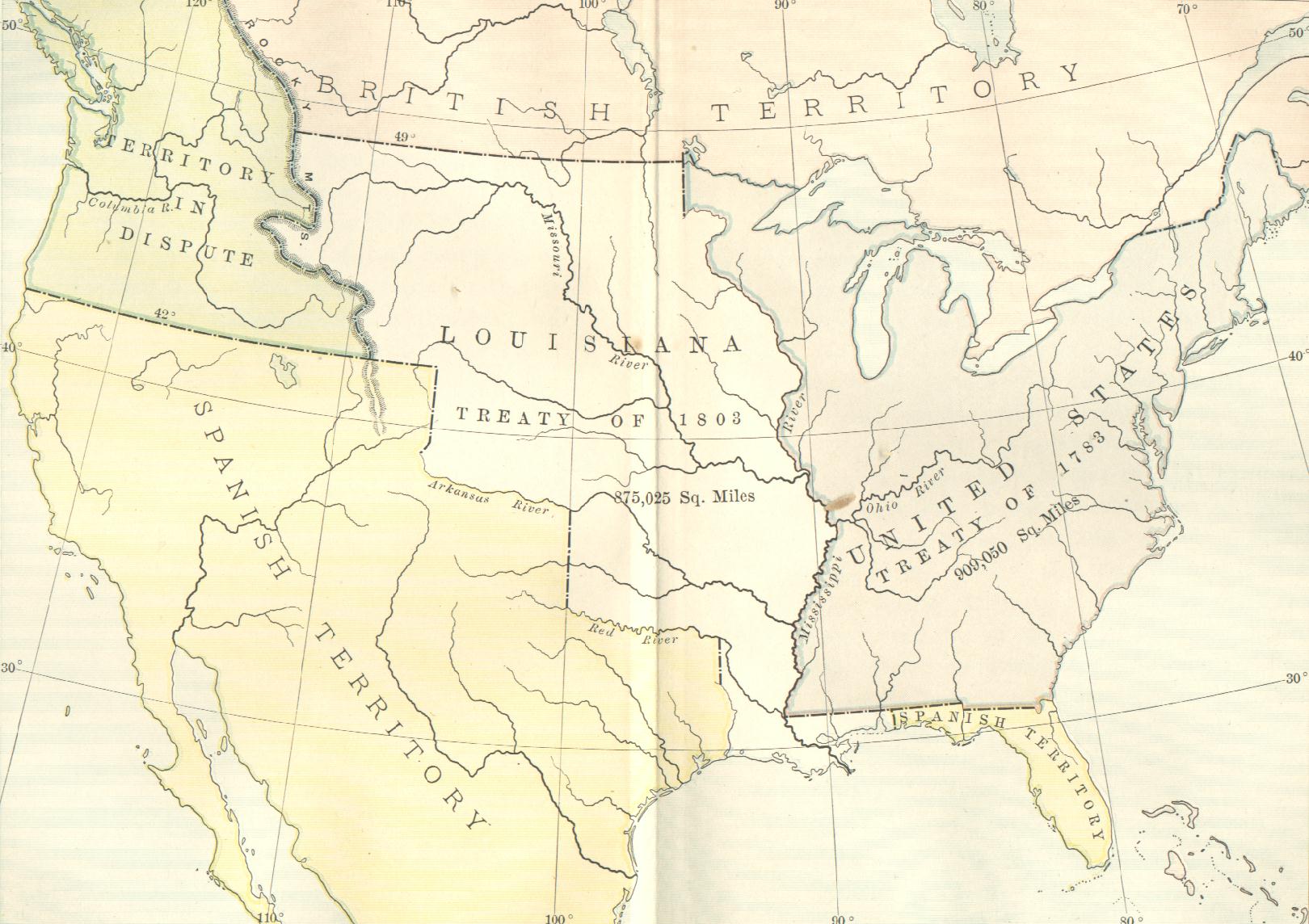
Then came the cession of Florida by Spain in 1819. The stipulation in the treaty was substantially the same as in the treaty with France;† the
____________
*This was at a cost to the nation of fifteen millions of dollars.
†8 U. S. Stat. at Large, 256, as quoted by Mr. Chase.
-239-
duty of the Government in respect to the acquisition was the same; and there was the same failure to perform it.
Finally, Texas came in, in 1845, not as a Territory, but as a State.—S. P. Chase, as above.
The purchase of Florida for the sum of five millions of dollars, was under the administration of Mr. Monroe. The annexation of Texas was under that of Mr. Tyler.
The purchase of Louisiana resulted in the admission of three new Slave States, formed out of the purchased territory, viz: Louisiana, admitted under the administration of Mr. Madison, in 1812; Missouri, (after much debate, and a so called "compromise") under Mr. Monroe, in 1821; and Arkansas, under General Jackson, in 1836. Florida was admitted under Mr. Tyler, March 3, 1845.
The dates and the names of the Presidents show the continuity of the policy, during the long lapse of time, and under the successive administrations of the Government.
The contest concerning the admission of Missouri as a slave state, occurred during the Congressional session of 1819-20, and was decided in March, 1820. The proposal for the admission of Missouri, was artfully coupled with a proposal for the admisson of Maine, a free state. It was contended that the one was an equitable balance for the other. But this plea did not satisfy the North. The "compromise" consisted in the introduction of a provision that in the future admission of States from the residue of that territory, the line of division between slavery and freedom should be the parallel of 36° 30' North latitude, the northern side of that line being appropriated to freedom.
This proposal was resisted manfully for a time, but under a threat of dissolving the Union, it was carried by a small majority in the House. But the vote fixing the conditions of the future admission of a State could not bind a future Congress, so that the "compromise," as usual, gave the South all, and the North nothing.
Four new slave states from our original territory, four more from territory acquired by purchase, and one from an-
-240-
nexation, make nine added in all, to the dominion of slavery, and to the strength of the Slave Power.
It is proper to record here, the instances of Federal legislation of an opposite character.
By the 7th section of the act organizing a Territorial Government for Mississippi, passed in 1798,* the importation of slaves into said Territory from any place without the United States, was prohibited under severe penalties. This was ten years before Congress had the power, under the Constitution, to prohibit the importation of slaves into the States.—Speech of Mr. Bingham, of Michigan, in Congress, June 4, 1850, Nat. Era, July 18.
This was under the administration of John Adams.
On the 7th of May, 1800, an act was passed for the organization of a territorial Government, for Indiana, and slavery expressly prohibited therein.
This act was approved by John Adams.
January 11, 1805, the northern part of Indiana was erected into the territory of Michigan, and slavery prohibited. February 3, 1809, the Territory of Illinois was established, with the like prohibition as to slavery. These two latter acts received the approval and signature of Thomas Jefferson.
On the 20th of April, 1836, Wisconsin was organized as a Territory, and slavery prohibited within its limits. This act was approved by General [President Andrew] Jackson.
The Territory of Iowa was established by act of Congress of the 12th of June, 1838, under the administration of Mr. Van Buren; and here also was slavery prohibited.
On the 14th of August, 1848, the Territory of Oregon was organized, which contained the same provision in the memorable and time-honored words, "there shall be neither slavery nor involuntary servitude therein, except fur the punishment of crime."—Ib.
This was under the administration of Mr. Polk.
These acts concerning Indiana, Michigan, Wisconsin, Iowa, and Oregon, were only in pursuance of the Ordinance of 1787, yet they are so many attestations to the Constitution-
____________
*This territory, organized in l798, comprised only a region of country ceded by South Carolina, but was afterwards, in 1804, enlarged, so as to include a part of the country ceded by Georgia in 1802, as stated by Hon. S. P. Chase, in his speech before quoted. This statement will explain an apparent, but not real discrepancy in dates, in the two quotations.
-241-
ality of that measure, and the consequent power of Congress to prohibit slavery in the Territories of the United States.
The same principle was likewise involved, and recognized, in the act, before noticed, for authorizing the admission of Missouri, in 1820, containing, as it did, a clause "to prohibit slavery in certain territories," that is, in all the Louisiana purchase North of 36° 30' North latitude.
And there had been a previous recognition of that principle, in its application to a part of the same purchase.
By the act of the 26th of March, 1804, that part of Louisiana south of the Territory of Mississippi was organized into a Territorial Government, by the name of Orleans. By this act, the importation into said Territory of slaves from abroad was prohibited, and also the importation of any slave from within the United States who should have been brought into the country since the 1st of May, 1798, or who should thereafter be brought into the United States. It further provided that no slave should be brought into said Territory, except by a citizen of the United States, who should remove there for actual settlement, and who should at the time be the bona fide owner of such slave; thus directly interdicting the domestic as well as the foreign slave trade in this Territory of Orleans. This act was approved by Jefferson.—Speech of Mr. Bingham.
When President Monroe was about to give his signature to the Missouri act of 1820, he required each member of his Cabinet, (the Heads of Departments and Attorney General,) to give their opinions in writing, on the questions whether the act was consistent with the Constitution, and whether "Congress has a right, under the powers vested in it, by the Constitution, to make a regulation prohibiting slavery in a Territory?" All the members of the Cabinet, including the late John C. Calhoun and John Quincy Adams, gave written answers in the affirmative. This is proved by the diary of J. Q. Adams.—See Speech of T. H. Benton at Jefferson City, Mo., May 26, 1849, in New York Evening Post, June 14, 1849.
The Federal Government, then, in establishing and fostering slavery in the Territories, has done so with the full knowledge of its Constitutional power to prohibit it. The moral and political responsibility, therefore, rests upon it.
-242-
Another circumstance connected with the admission of Missouri deserves notice.
The act of Congress authorizing the people of Missouri to form a Constitution, preparatory to admission, was passed in March, 1820. The State Constitution, presented at the next Congress, contained a clause "to prevent free negroes and mulattoes from coming to and settling in this State, under any pretext whatever." As this provision was contrary to the Constitution of the United States, which, secures "to the citizens of each state all the rights and immunities of citizens in the several states," (many of the states having colored citizens) Congress passed an act, in March, 1821, authorizing the President to admit Missouri on condition that said clause should not be so construed as to exclude citizens of any other States. Missouri complied with the conditions, and by proclamation of the President, was admitted, August 10, 1821. [See Speech of T. H. Benton, at Jefferson City, May 26, 1849.]
This instance of the supervision by the Federal Government, over the Constitution of a State asking admission, and in a point touching the rights of "negroes and mulattoes" involves important principles, and may be of use as a precedent, hereafter.
GOVERNMENT OF THE FEDERAL DISTRICT.
The District of Columbia is under the exclusive jurisdiction of the Federal Government. In another connection we have shown how that Government was administered at the beginning, and so far as the condition of things there could be traced directly to the act of Congress of 1790. We then saw free colored citizens, on suspicion of being fugitives from slavery, thrown into jail, and then sold into slavery with their posterity forever, for the payment of their jail fees—the expenses of their causeless arrest! We will now look again at the continuance of that enormity, in its connection with the domestic slave trade, systematically carried on in the District.
From a number of causes, the Federal District has been, at
-243-
some periods, the principal slave mart in America. The policy of Virginia and Maryland has, at times, forbidden the traders to bring in slaves from othor States, and expose them for sale, while the Federal District, under the policy of Congress, has been under no such restriction. The fact that the District is the resort of citizens from all the states, including Senators and Representatives, who may desire to buy or sell slaves, has given it an advantage over other slave markets, which has been eagerly improved.
As early as 1802, the grand jury of Alexandria complained of this traffic as a grievance demanding legislative interference. In 1816, Judge Morrell, of the U.S. Circuit Court, took notice of the nuisance, in his charge to the grand jury of Washington. The same year, John Randolph, of Virginia, himself a slaveholder, moved, in the House of Representatives, for a committee to inquire into the "inhuman and illegal traffic."*
The Alexandria Gazette, of June 22, 1827, described, in terms of just abhorrence, the scenes witnessed in connection with the traffic. In 1828, a petition, headed by Judge Cranch, and signed by more than one thousand citizens of the Federal District, was presented to Congress, imploring its interference. In 1830, the Washington Spectator described the traffic, and exclaimed, "Where is the O'Connell in this Republic that will plead for the emancipation of the District of Columbia?"
Merchants of large capital engaged in the lucrative business, with their establishments in Alexandria and Washington City, and advertised, "Cash for five hundred negroes," with as much coolness as if they were so many horses! Franklin & Armfield, Alexandria, J. W. Neal & Co., Washington, Wm. H. Williams, George Hephart, William H. Richards, &c., are or have been among the number of these. Some of them have bad large prison-houses built for the purpose; and some-
____________
*This traffic is doubtless as "legal" as any part of the pystem. Henry Clay, in his famous speech in the U. S. Senate, in 1839, declared the traffic inseparable from the tenure of slave property. But here we find John Bandolph declaring the traffic "illegal!" "Was he in error?
-244-
times the public jails, built by money appropriated by Congress, have been put to the same infamous use. Large vessels were advertised and employed to transport slaves to New Orleans.
One dealer advertised for "any number of young and likely negroes from eight to forty years of age." As a general fact, little or no regard is paid, either in the purchase or the sale to the sanctities of the family relation, which, in fact, the laws and the usages of the system do not recognize as existing at all! Yet all this, says Judge Jay, is "in virtue of authority delegated by Congress," and he cites his authority.
"The 249th page of the laws of the city of Washington, is polluted by the following enactment, bearing date 28th of July, 1831:
"For a LICENSE to trade or traffic in slaves, for profit, four hundred dollars."—Jay's View, p. 87.
The petitioners of 1828, before mentioned, including Judge Cranch, express themselves in the following language:
"While the laws of the United States denounce the foreign slave trade as piracy, and punish with death those who are found engaged in its perpetration, there exists in this District, the seat of the Federal Government, a domestic slave trade, scarcely less disgraceful in its character, AND EVEN MORE DEMORALIZING IN ITS INFLUENCE. The people are, without their consent, torn away from their homes; husband and wife are frequently separated, and sold into distant parts; children are taken from their parents, without regard to the ties of nature, and the most endearing bonds of affection are broken forever. Nor is this traffic confined to those who are legally slaves for life. Some who are ENTITLED TO FREEDOM, and MANY who have a limited time to serve, are sold into unconditional slavery, and, owing to the defectiveness of our laws, they are GENERALLY carried out of the District before the necessary steps can be taken for their release."—"The people of the District have, within themselves, no means of legislative redress, and we appeal to your honorable body as the ONLY ONE vested by the American Constitution with power to relieve us."
But that "honorable body"—a controlling majority of whom were from the non-slaveholding States—found other business, it would seem, more to their taste, than the granting of the prayer of these petitioners! Yet this was under the administration of a northern President (John Quincy Adams), whose
-245-
power of appointment assuredly, could not have been a rod over the heads of northern aspirants, as is commonly the case. Could there have been a fear, among rival partisans, that an agitation of "the delicate question" might affect the elections?
The liberties of Northern citizens are not secure in the Federal District, "under exclusive jurisdiction of Congress." In 1835, Dr. Reuben Crandall, from the State of New York, was arrested, imprisoned, and tried for his life, in Washington City, for having loaned to a white citizen, at his own request, a pamphlet against slavery.
In 1850, Gen. Wm. L. Chaplin, from the same State, "was arrested by the authorities of Washington. City, on the charge of assisting fugitives. While we are now writing, two citizens of free States, Messrs. Drayton and Sayre, are incarcerated in the jails of the Federal District, for the alleged crime of having assisted* certain citizens of that District to emigrate, in "pursuit of happiness," to another portion of the country, and enjoy "all the rights and immunities of citizens in the" "States" of their intended residence.
____________
*More correctly, perhaps, we might say, "On suspicion of having intended to assist," for the vessel in winch these emigrants took passage was found, and the
arrest was made, in the waters of Maryland, the very State under whose laws they were claimed to be held!
-246-
CHAPTER XXI.
FURTHER ACTION OF THE FEDERAL GOVERNMENT—AMERICAN
SLAVE TRADE—AFRICAN SLAVE TRADE.
Slave trade between the States, under jurisdiction of Congress—Its nature and
extent—Testimony of T. J. Randolph—Niles' Register—Natchez Courier—Virginia
Times—Virginia Exports—U.S. Gazette—Prof. Andrews—Prof. Dew—C. F.
Mercer—Mr. Gholston—H. Clay—Negro Speculation of 1837—Mississippi Imports
—Northern losses by Southern bankruptcy—Funds of the Presb. Church—
Shipments from Federal District—Acts of Congress regulating the traffic—Brig Comet
—Brig Encomium—The Enterprise—Negotiations with Great Britain for payment
for Slaves—Case of the Brig Creole—of the Schooner Amistad. African
Slave Trade, though abolished, connived at—Duplicity in Negotiations with G. Britain
—Refusal to take effective measures for suppression—Negotiations with Republic
of Colombia—Deceptive Act declaring the trade piracy—A plan of the Virginia
Slave-breeders—Connected with the project of Colonization—Notice of various
Acts of Congress concerning the Slave trade—1794, 1800, 1803, 1807, 1809, 1818,
1819, 1820—Allowed enslavement by Louisiana, of slaves known to have been
illegally imported—The abuse founded on an Act of Congress—No instance of
a slave trader being punished with death, according to law. La Coste convicted
by Judge Story, but pardoned by President Monroe.
THE slave trade in the District of Columbia is only a part of that detestable traffic carried on under the Federal jurisdiction. The slave trade between the States is under the same jurisdiction, for "Congress shall have power to regulate commerce with foreign nations and among the several States." U.S. Constitution, Art. I, Sect. 8, Clause 3.*
____________
*The legislative acts of some of the slave States, prohibiting, from considerations of local policy, the importation of slaves from other States, have been set aside, if we mistake not, by their own courts, as unconstitutional, on the ground that the regulation of inter-State commerce devolves upon the Federal and not the State Governments.
-247-
(pp 248-261)
themselves, and if any slave trader has suffered death in the United States, as a pirate, we confess our ignorance of the fact."—Jay's View, p. 108.
Notwithstanding this repeal, the State of Alabama, Jan. 1, 1823, passed "an act to carry into effect the laws of the United States, prohibiting the slave trade," in which—with singular effrontery—"the laws of the United States" on the subject, were grossly violated, by authorizing the Governor to sell, for the benefit of the state, all persons of color who should be brought into the state contrary to the laws of the United States prohibiting the slave trade!!!—See Toulman's Digest 643; Stroud, 164.
"The laws of the United States," in accordance with the Constitution, are "the supreme law of the land; and the judges in every state shall be bound thereby, anything in the Constitution or laws of any state to the contrary notwithstanding."—U. S. Constitution, Art. V. And yet we know of no action of the Federal authorities, or of the courts of Alabama, for setting aside this open and flagrant insult to a law of Congress by a state legislature.
Thus it is that the Federal Government puts down the African slave trade by calling it "piracy."
-262-
CHAPTER XXII.
FURTHER ACTION OF THE FEDERAL GOVERNMENT.—CONTINUED
SUBSERVIENCE OF THE NATIONAL DIPLOMACY TO THE
DEMANDS OF THE SLAVEHOLDERS.
Negotiations with Great Britain and Mexico for the surrendering of fugitive slaves—
Compensation obtained of Great Britain for slaves captured—Negotiations with
Spain and the South American Republics to prevent emancipation in Cuba—
Threat of preventing it by force of arms.
WE have already seen the corps diplomatic employed at the national expense (both of money and honor) for the protection of the American domestic slave trade, and in shameful evasion of the admitted obligation of assisting to suppress the African slave trade. But this is not the only vile service to which the diplomacy of the nation has been subjected by the slave power.
The Federal Government has negotiated with Great Britain and with Mexico, for the surrendry of fugitive slaves, and has actually obtained compensation from Great Britain for slaves captured in war, or taking refuge on board their armed vessels.
During the last British war, American slaves sometimes absconded, and took refuge on board the armed vessels of the enemy. Slaves were also captured, at times, and carried off. In negotiating the treaty of peace, this matter was not forgotten. Our Commissioners at Ghent, (Messrs. Clay, Bayard, Russell, Gallatin, and John Quincy Adams,) were carefully instructed by Mr. Monroe, then Secretary of State, under Mr. Madison, to "insist" upon the return of the slaves taken
-263-
from the southern states, or full payment for their value. So adroitly did the Commissioners fulfil their trust that they not only obtained compensation for the slaves captured, but also, (as ultimately settled) for those who had absconded to the vessels of Britain. The application of the treaty to the case of the latter, was contested by the British Cabinet. The decision was referred to [Alexander I.] the Emperor of Russia, who, in 1818, decided in favor of the American claim, which, at length, in 1836, was liquidated, with interest, amounting to one million two hundred and four thousand dollars.—Jay's View, pp. 53-58.
Thus, though the treaty of peace did not contain a single stipulation for securing either one of the objects for which America had ostensibly declared the war, ("free trade, sailors' rights," &c.,) yet it did contain ample and even exorbitant remuneration for fugitive slaves. On this issue, during the negotiation, was suspended the question of peace or continued war!
Another negotiation with Great Britain, concerning fugitive slaves, took place under the administration [1825-1829] of John Quincy Adams [1767-1848] , Henry Clay [1777-1852] being then Secretary of State, and had special reference to those who had taken refuge in Canada. The House of Representatives, May 10, 1828 requested the President to open a negotiation with the British Government, for the surrendry of these fugitives. At the next session, the House called on the President to inform them of the result.
 "The President immediately submitted a mass of documents to the House, from which it appeared" (says Mr. Jay,) "that the zeal of the Executive in behalf of 'the peculiar institution' had anticipated the wishes of the Legislature. Two years before the interference of the House, viz: on the 19th of June, 1826, Mr. Clay, Secretary of State, had instructed Mr. Gallatin, American minister in London, to propose a stipulation for 'a mutual surrendry of all persons held to service or labor, under the laws of either party who escape into the territories of the otber.'"
Mr. Clay dwelt on the number of fugitive slaves in Canada, and suggested the benefits, to West India planters, from such a stipulation. In
-264-
February, 1827, the subject was again "urged upon Mr. Gallatin, informing him that a similar treaty had just been negotiated with Mexico. In July, the British minister declined the proposal. Mr. Barbour, the successor of Mr. Gallatin, was directed to renew the application. He did so, but was answered promptly by the British minister, that the "law of Parliament gave freedom to every slave who effected his landing on British ground."—Jay's View, p. 47-50. The reader will readily trace this "law of Parliament" to the decision of Lord Mansfield in the Somerset case, and to the sagacity and perseverance of Granville Sharp [1735-1813].
As to the treaty negotiated with Mexico, the Mexican Congress refused to ratify it. The refusal, as will appear in the sequel, was among the real grounds of our quarrel and war with Mexico, but it was not prudent to invade the dominions of Great Britain.
The Federal Government, by its diplomacy, has labored effectually to prevent the abolition of slavery in the neighboring Spanish Island of Cuba, lest such an occurrence should seriously affect the stability of slavery in our own Southern States.
The immediate cause of alarm was the war raging between Spain and her American Colonies, and the prospect that the latter would throw off the dominion of the parent government, as the North American Colonies of Great Britain had done. The ordinary vicissitudes of war might emancipate the slaves of Cuba, but the danger was increased by the fact that the Spanish Colonies on this Continent had shown a disposition to extend to all their inhabitants, irrespective of color or condition, the liberties for v/hich they were contending. Some of them had already abolished slavery, and others of them were taking measures in that direction. If Cuba should share in the revolution, the Cuban slaves would doubtless become free.
Through the American Minister at Madrid, Mr. Everett, the Spanish Government was accordingly implored by the Cabinet at Washington to become reconciled to the colonies. Could this interference be traced to a love of peace, or an
-265-
earnest desire for the independence of Spanish America, it might be regarded with admiration. But the instructions of our government to Mr. Everett, by the Secretary of State, Mr. Clay, forbid us thus to interpret the proceeding. "It is not for the new Republics," (said Mr. Clay to Mr. Everett,) "that the President wishes you to urge upon Spain the expediency of concluding the war." He proceeded to hint at the probable effects upon Porto Rico and Cuba, intimated that the "people of the United States could not be indifferent spectators," and that the possible contingencies of a protracted war "might bring upon the Government of the United States duties and obligations the performance of which, however painful it should be, they might not be at liberty to declined."
In other language, it would be the duty of the American Government to prevent those islands from becoming the theatre of the war, even if the effort should involve the United States in a war to prevent it!
This letter was dated April 27, 1825. Of course it was under the Presidency of Mr. Adams, and among the earliest acts of his administration. The significancy of the transaction is made, if possible, still plainer, by the tone soon after held by the administration towards our incipient sister republics, who, in the enthusiasm of their young love of liberty, had confidingly invited us to sit in council with them, at their proposed Congress of American Republics at Panama; an invitation to which the public pulse in the United States—at least at the North—beat a hearty response. Messrs. Anderson and Sargeant were appointed our Ministers to that Congress.
 But in his letter of instructions to them, May 8, 1826, our Secretary [of State], Mr. Clay, gives them to understand the real object of their mission to that Congress of Freedom. It was rumored, and doubtless with good reason, that Colombia and Mexico meditated a descent upon [rescue of] Cuba, with a force that should confer upon its inhabitants a share in the blessings they were seeking. Such an enterprise, however, the Government of the United States would by no means permit. THIS message, their Ministers at Panama were required [instructed] to convey to them. And it was given in language sufficiently explicit and peremptory.
-266-
"The United States," (they were to be told,) "have too much at stake in the fortunes of Cuba to allow them to see a war of invasion prosecuted in a desolating manner, and ONE RACE of the inhabitants combating against another."
"The duty to defend themselves against the contagion of such a new and dangerous example, would constrain them, even at the hazard of losing the friendship of Mexico and Colombia, to employ all the means necessary to their security."
That is, the United States would sooner go to war with Colombia and Mexico—would sooner join with despotic Spain in reducing them to their former condition—than to stand neutral and see the same liberation extended to Cuba!
Cold comfort this to the new republics in our neighborhood, just throwing off the yoke of European bondage! THIS was the message conveyed them by the administration of Mr. Adams, at a time when the bulk of our northern citizens were exulting, in their simplicity, at the idea of holding a friendly and fraternal conference, at Panama, with our new republican neighbors. They knew, indeed, that certain southern members of Congress had blustered when the subject of the mission was under debate in both Houses, had denounced the new republics as "buccaneers, drunk with their new-born liberty," because they had abolished slavery; even threatening to prevent the liberation of Porto Rico and Cuba, by force of arms. But they did not then know that the Federal Executive and Cabinet were in sympathy with them.
The threat had the desired effect upon Colombia and Mexico; the enterprise was abandoned, and Cuba remains enslaved!
The fears of our Government were not, however, at once allayed. The war continued, and Cuba might yet become free. Mr. Van Buren, Secretary of State under President Jackson, on the 22d of October, 1829, instructed our Minister at Madrid, Mr. Van Ness, to press on Spain a termination of the war. "Considerations," he remarked, "connected with a certain class of our population, make it the interest of the southern section of the Union that no attempt should be made in that island to throw off the yoke of Spanish dependence."—Jay's View, p. 120-127.
-267-
CHAPTER XXIII.
FURTHER ACTION OF THE FEDERAL GOVERNMENT—
HAYTI—
FLORIDA—THE SEMINOLE WAR.
Non-intercourse with Hayti—Refusal to acknowledge its independence—Invasion of
Florida, while a Spanish province, to break up a fortress of fugitive slaves—
Threatened Conquest of Florida by the Georgians—Purchase of Florida—Florida
Indians—Seizure of Osceola's wife, as a slave—Seminole
War—Indians hunted with blood-hounds.
WE are burthened with the accumulated instances and modes in which our Federal Government has sustained slavery. We cannot proceed with the minute details. We will hastily advert to a few other topics.
TREATMENT OF HAYTI.
The American Government has manifested an inveterate and continual hostility to Hayti, for no reason but because Hayti is an independent nation of emancipated slaves. To the present hour we have neglected to recognize the independence of Hayti, and maintain no diplomatic relations with her, though our commercial intercourse with the island has been more important than with several of the European nations, with whom, at a great expense, we maintain such relations. By this neglect, numbers of our citizens having claims on the Haytien Government have been provided with no means of indemnity. The American Congress, in February, 1806, during the administration of Mr. Jefferson, suspended commercial intercourse with Hayti, in servile obedience to the arrogant and peremptory demand of Napoleon, who was intent
-268-
on reducing the inhabitants to submission, by starvation. At the Congress of Panama, before mentioned, our Ministers were instructed to decline any recognition of Hayti.—Jay's View, pp. 127-144.
INVASION OF FLORIDA AND DESTRUCTION OF FUGITIVE
SLAVES WHILE FLORIDA WAS A SPANISH PROVINCE.
This demonstration was made under the administration of Mr. Madison, and in conformity with directions from Mr. Crawford, Secretary of War, addressed to General Jackson, March 15, 1816. General Jackson had, however, anticipated these directions. The object openly avowed, was to break up a fort of between 250 and 300 blacks, who, it was said, enticed and protected negroes from the frontiers of Georgia. A gun-boat, by order of Commodore Patterson, fired upon the fort; the magazine exploded, and nearly three hundred Indians and negroes, men, women, and children, were killed or mortally wounded.—Ib. p. 50-52.
PURCHASE OF FLORIDA.
But the trouble did not cease. President Monroe was harassed with numerous letters from slaveholders in Georgia, declaring that their slaves were escaping continually into Florida, and finding an asylum there,* and if the Province was not secured by treaty, the Georgians would take it by force. These facts, according to Timothy Pitkin,† were stated in a secret session of the House of Representatives, on the subject of the treaty, in 1819. The treaty of purchase (at the national expense, five millions of dollars) was concluded that same year.
____________
*Though slavery existed in Florida, it was of a much milder type than that of the United States. Free colored people enjoved greater security, and the country afforded facilities for the secretion of fugitives, or thoir subsidence in retreats of difficult access, and among Indians.
†Quarterly A. S. Mag., Jan., 1836, p. 197.
-269-
THE SEMINOLE WAR.
Florida was nevertheless destined to be the theatre of a pro-slavery war, prosecuted by the government of the United States. The Seminole Indians inhabited the marshy portions of that country. Fugitive slaves took refuge with them, and sometimes intermarried among them. Osceola, one of their chiefs, became the hero of a painfully interesting tragedy, illustrative of this condition of things. The following is from an account of him by M. M. Cohen:
"Osceola, or Powell, as he was called by the whites, had a wife to whom he was much attached, whose MOTHER was a mulatto, who ran away, was adopted by the Indians, and married one of their chiefs. Though the FATHER was free, yet the children, by the law of the South, take the condition of the MOTHER. Osceola's WIFE was seized as a slave by a person claiming her under the right of her MOTHER'S FORMER MASTER! The high spirited husband attempted to defend her, but was overpowered, and put in irons by Thompson, who commanded the party." "This transaction has been said to be the origin of the war in Florida."—Quar. A. S. Mag., Vol. II., p. 419.
In this war Osceola was a conspicuous leader. He was perfidiously captured by the American Generals Herandez and Jessup, being surrounded by two hundred horsemen while "holding a talk," or negotiation, with his captors, in October, 1837. This was under the administration of President Jackson.
The cost to the United States of this long protracted slave hunt (for it was nothing else), has been estimated at forty millions of dollars. "What has the North to do with slavery?"
In this war, the American flag was disgraced by the importation of blood-hounds from Cuba, and the employment of them in hunting down the Indians, by advice and under the direction of General Zachary Taylor, whose services in the Seminole and Mexican wars—both for the benefit of
-270-
slavery—were rewarded with the Presidency of the United States [1849-1850]. It is quite remarkable that many who were loud in their condemnation of the administration of Gen. Jackson, on account of the use of the blood-hounds, were afterwards the zealous supporters of Gen. Taylor, the idol of the South. Thus do our parties bind us to slavery.
-271-
CHAPTER XXIV.
FURTHER ACTION OF THE FEDERAL
GOVERNMENT—ACQUISITION OF TEXAS.
Slavery abolished in Mexico, including Texas—Emigration of American Slaveholders
and Slaves to Texas—Attempted seizure of Texas by Americans in 1819—Conspiracy
of settlers at Nacogdoches, in 1826—Scheme to purchase Texas, 1827—Mexican
refusal to sell—Texan Land Companies in the States—Armed emigration to
revolutionize Texas— Meeting of sympathy in the States—No Executive action
against it—Standard of revolt raised in Texas—Proclamation of Independence and
re-establishment of slavery—Remonstrance of the Mexican Minister—Mendacious
reply of Mr. Forsythe—Gen. Gaines stationed near the frontier to countenance
the revolters—Battle of San Jacinto—Defeat of Santa Anna—Acknowledgment
by the American Government of Texan Independence—Proposed union with
the States—Various obstacles and delays—Final admission of Texas, in 1845,
and speedy hostilities with Mexico.
TEXAS was a province of Mexico, and Mexico was a colony of Spain. In the general struggle of the Spanish American colonies to throw off the Spanish yoke, Mexico took a part, and asserting her independence, took measures in forming her constitution of government, in 1824, for the prospective but complete abolition of slavery. Having achieved her independence, she proceeded to cut short the tardy process of gradual extinction, by proclaiming the immediate and entire abolition of slavery, and the emancipation of all the slaves, September 15, 1829.*
Ed. Note: Mexican anti-slavery writings date as far back as Bartolomé de Albornoz, Prof of Law, University of Mexico, Anti-Slavery (1573).
"In 1829 [Mexico's President] Vicente Guerrero issued a decree for the abolition of slavery. Slavery scarcely existed in Mexico outside [American-dominated] Texas. . . .—Henry Bamford Parkes, A History of Mexico (Boston: Houghton-Mifflin Co, 1938-1970), p 201.
Under President Thomas Jefferson (1801-1809), "the Neutral Ground Treaty [was made and] remained in effect until 1821, when ratification of the Treaty of Amity, Settlement and Limits between the United States of America and His [Spain's] Catholic Majesty recognized the Sabine [River, not the Rio Grande
River 120 miles further south-east]as the official boundary between [the U.S.] Louisiana and Texas."—Milton Lomask, Aaron Burr: The Conspiracy and Years of Exile 1805-1836 (New York: Farrar Straus Giroux, 1982), p 169; and Profs. Fred Anderson and Andrew Cayton, The Dominion of War: Empire and Liberty in North America, 1500-2000 (New York: Viking, 2005), Chapter 5, p 238 ("boundary running along the Sabine, Red, and Arkansas rivers as far as the Continental Divide").
And "by [Jefferson] endorsing a neutral region admittedly bounded on the west by [then] Spanish soil, the United States had relinquished its often-asserted claim to most if not all of Texas" (Lomask, supra, p 170).
So when the U.S. committed aggression against Mexico, pretending the Rio Grande River 120 miles into Mexico was the boundary, it was lying, and its own records show it was lying. The 1821 Treaty is in the U.S. government's own records!—the American State Papers-Foreign Relations, Vol. IV.
|
Texas was of course included, with the rest of Mexico, under these acts. But Texas was in process of settlement by emigrants from our American slave States, who had gone
____________
*Quarterly A. S. Mag., Jan., 1836, p. 195; Jay's Mexican War, p. 12. (Ed. Note: Full Citation: William Jay [1789-1858], A Review of the Causes and Consequences of the Mexican War [Boston: B. B. Mussey, 1849].)
-272-
thither with slaves, and with the view of extending their favorite "institution" into that new and fertile country. Lawless adventurers from the United States, under James Long, had attempted the forcible seizure of Texas for this purpose, as early as 1819,* while the country was a portion of Mexico, and under the jurisdiction of the Spanish Government, with which we were at peace; but the enterprise had failed.
When it was seen that the young Mexican Republic, by its Constitution of 1821, had provided for the gradual extinction of slavery, a body of American settlers, near Nacogdoches, under a leader of the name of Edwards, raised the standard of insurrection in 1826, declaring Texas independent, but were soon put down by the Mexican forces. "The united Provinces of Coahuila and Texas formed one State, and its Constitution, adopted in 1827, contained an article giving freedom to all who should be hereafter born, and prohibiting the introduction of slaves."†
Such was the position of things in Texas when the Mexican proclamation, of Sept. 15, 1829, emancipated every slave in the Mexican dominions. This produced the greatest dissatisfaction among the American emigrants in Texas, and they determined to resist the execution of the law. For this purpose, one of them was deputed to the United States to procure arms and ammunition. In the distracted and feeble condition of Mexico, the new party then just coming into power felt it politic or necessary to relax the decree, so far as Texas was concerned, permitting a modified apprenticeship of the emancipated slaves, but providing that no indentures or contracts should be valid for more than ten years from their respective dates.‡
This relaxation prevented an immediate rupture, but neither the Texan settlers, nor their friends in the United States, were satisfied, nor had they been before the emancipation decree had gone forth. The settlers wanted the unrestricted,
____________
*Jay's Mexican War, p. 12.
†Ib.
‡Quarterly A. S. Mag., Jan., 1836, p. 195.
-273-
restoration and perpetuity of slavery. Our slave consuming States wanted an open field for slave emigration and security from a free border for fugitives. Our slave breeding States could brook no curtailment of their prospective privilege of a growing market. Texas must be made slave territory at all hazards. But the settlers were too weak to resist successfully the Mexican government. Expeditions fitted out from the United States, at the expense of the slaveholders, in 1819 and in 1826, had been found insufficient. What could be done?
The plan was soon decided upon. Texas must be purchased of Mexico, at the expense of the United States. The Federal Government must do for the slaveholders, what they could not do for themselves.
The prosecution of this plan was attempted under the administration of Mr. [John Quincy] Adams [1825-1829], Mr. [Henry] Clay [1777-1852] being Secretary of State, by whom, in March, 1827, Mr. Poinsett, our Minister in Mexico, was instructed to offer one million of dollars for the purchase. Under President Jackson, in 1829, the bid was raised to five millions, and when the offer was declined, Mr. Poinsett offered the Mexican government A LOAN OF TEN MILLIONS, proposing to take Texas in pawn until repaid, intending, of course, to get possession, stock it with slaves, and keep it at all events! This offer was justly considered an insult.
This same year, Thomas H. Benton, Judge Upshur, Mr. Gholson, and other prominent Southern statesmen as well as editors, openly urged the necessity of acquiring Texas as a means of extending slavery and improving the slave market.
The negotiation was relinquished as a failure. The Mexicans refused to dismember their republic by selling Texas. This, too, after having also refused, in 1827, as before noticed, to stipulate for the surrendry of fugitive slaves. From this time it was resolved to get Texas by force. If the vineyard of Naboth could not be purchased from him for money, he could be killed, and the field taken for nothing.*
____________
*1 Kings, chap. xxi.
-274-
Ed. Note: See also David Lee Child (1794-1874),
The Taking of Naboth's Vineyard,
or History of the Texas Conspiracy,
and
An Examination of the Reasons Given by the
Hon. J. C. Calhoun, Hon. R. J. Walker, and Others,
For the Dismemberment and Robbery
of the Republic of Mexico
(New York: S. W. Benedict & Co., 1845)
|
Now came the era of Texan land companies—armaments—invasions—insurrections. Extensive tracts of land, said to have been obtained by grants from the Mexican government, came into our American market, and were speculated upon by capitalists, gamblers, politicians, and demagogues. These purchases secured only a title to the soil, under Mexican jurisdiction. But that which the purchasers were after was slave plantations, and this end could not be obtained without wresting Texas from the jurisdiction of Mexico.
Not a little of this capital was invested by citizens of the non-slaveholding states. Three of the principal Texan land companies were established in the City of New York, the scrip being of little value while Texas remained under the anti-slavery laws of Mexico, but was expected to rise rapidly whenever Texas became independent.
Recruits of volunteers from the United States were at length openly enlisted for this enterprise, and proceeded to Texas, under popular military commanders, who publicly announced their intentions, and advertised in the public prints for the number of men they respectively wished to employ. Armed emigration was now all the rage. Public meetings of the "Friends of Texas'' were advertised and held, at which speeches were made in favor of assisting the Texans, military companies of emigrants were paraded, and the enthusiasm raised to a high pitch. In Mississippi, in Florida, in North Carolina, in various parts of the Slave States, and even in Cincinnati, Ohio, were these scenes witnessed, and arms and ammunition openly purchaised to aid in these expeditions. On their starting from their places of rendezvous, the Gazettes and Journals of the day exultingly heralded their departure.
All this was in flagrant and gross violation of our peaceful relations with Mexico, in violation of the laws of nations, and the laws of the land, which forbid any expeditions against nations with whom we are at peace. Aaron Burr had been arrested and tried for the crime of attempting a similar invasion of Mexico, in 1807. Presidents Washington, in 1793, Jefferson in 1806, Madison in 1815, and Van Buren in 1838, had issued proclamations forbidding our citizens to invade the
-275-
provinces of other nations, or intermeddle with their internal dissensions. But no such proclamation was issued by President Jackson on this occasion, though no emergency more loudly demanding the measure had ever before occurred.
Under these circumstances it was, and by these means, that the standard of revolt was raised in Texas, by the American settlers, against the government of Mexico, which was, at that time, weakened by dissensions at home. The colonists, in 1833, organized themselves into a distinct and separate state, preparatory to independence, because the people of Coahuila, with whom they were associated, were not favorable to the measure. Mexico refused to recognize this new organization.
The standard of open rebellion in Texas was then raised, the small body of Mexican troops were driven out, and "on the 2d of March, 1836, the insurgents issued their declaration of independence, and fifteen days afterwards adopted a constitution establishing PERPETUAL SLAVERY." "Of the fifty-seven signers to this declaration" of independence, fifty were emigrants from the slave states, and only three Mexicans by birth, and these, it is said, were largely interested in Texan land speculations.*
"Nothing," says Mr. Van Buren, "is more true or more extensively known than that Texas was wrested from Mexico, and her independence established through the instrumentality of citizens of the United States."†
Mr. Clay, while the question of the annexation of Texas was pending, alluded to the same fact as a reason why our government should not be precipitate in that measure, in advance of the recognition by Mexico herself, lest the civilized world should upbraid our rapacity.‡
The Mexican Minister at Washington, in the meantime, had remonstrated against these proceedings. In October, 1835, he informed the Secretary of State that large numbers of vessels were about to sail from New York with military stores for the
____________
*Jay's Mexican War, p. 22.
†Ib.
‡We state the substance from memory, the speech not being at hand.
-276-
insurgents, and that an armed schooner had sailed for Texas from New Orleans, without papers from the Mexican consul. Our Secretary, Mr. Forsyth, thereupon addressed circulars to the several District Attorneys, directing them, in general terms, to prosecute violations of treaties with foreign nations, but no efficient measures were taken, and no offenders were punished. A District Attorney in Ohio, soon after, made an address at a Texan meeting, in favor of assisting the Texans! To a second remonstrance of the Mexican Minister, Mr. Forsyth very coolly and mendaciously replied that the Government had done all in its power to prevent interference!
A few days before this assurance, General Gaines was directed by the President to take a position near the frontier, ostensibly to prevent the contending parties from entering our territory, of which there was no danger. He was not directed to prevent regiments raised in the United States from invading Texas! Under pretense of defending our frontiers, he next marched his troops into Texas, against the remonstrances of the Mexican Minister, with the evident object of affording countenance to the insurgents, and, if necessary, assist them against the Mexican forces, under pretense of defending our frontier. Some hundreds of his soldiers deserted and joined the Tcxans. There they remained and served while they were wanted. General Gaines then offered them a full pardon on condition of their return.
Thus encouraged and aided, the Texans, or rather the American armed emigrants, fought the decisive battle of San Jacinto, and defeated Santa Anna, in May, 1836. The intelligence was transmitted to our American President, Jackson, by the American General Gaines, who indulged the anticipation that, in consequence of the victory, "THIS MAGNIFICENT ACQUISITION TO OUR UNION" would, grace his administration.—Jay's Mexican War, p. 30.
And all this is said to have been. done without violating our relations of peace with Mexico!
On the opening of Congress in December, 1836, President Jackson recommended a prudent delay in acknowledging the
-277-
independence of Texas, till "the lapse of time or the course of events" should have proved her ability to maintain her position. This proved to have been a ruse to allay the fears of the friends of freedom. Not long after, the President urged Congress to put at his disposal a naval force to act against Mexico in case she failed to make prompt arrangements for satisfying our pecuniary claims against her. With such a force he could easily get into a war with Mexico, and then "the course of events" would soon lead to the acknowledgment of Texan independence. "This proposition was coldly received." " The session was to close the third of March, 1837."
By the most dexterous management of the House of Representatives, and the concurrence of the Senate, near the close of the session, the independence of Texas was acknowledged, and a salary provided a Minister to the new nation! A Minister was immediately "nominated by the President, and confirmed by the Senate, the last day of that administration."—Jay's View, p. 153.
Nothing was now wanting to complete the drama of Texas, but her admission into the Union. The strong opposition, at the North, against this measure, delayed it for about eight years, and until near the close of Mr. [John] Tyler's administration, in March, 1845.
The Texan Congress took measures, as early as 1836, (before our government had acknowledged their independence,) for proposing a union with the United States, but on the express condition of the "FREE AND UNMOLESTED AUTHORITY OVER their slave population." In 1837 the negotiation was opened by the Texan Minister at Washington. Mr. Van Buren prudently declined on the ground that the United States were, at present, at peace with Mexico, and that power had not acknowledged the independence of Texas. As the excitement against annexation increased in the free States, the proposition of Texas was formally withdrawn, and the apprehension of annexation was, by this movement, allayed.
In the mean time, the emigration to Texas from the free States began to alarm the guardians of slavery. In 1842 the
-278-
ex-President of Texas, General Lamar, addressed a letter to his friends in Georgia, urging the necessity of annexation, lest the anti-slavery party in Texas should change the Constitution, and abolish slavery. He added that though the anti-slavery party were now a minority, yet the majority of the people of Texas were not slaveholders. The clamor of the South for annexation was now revived. A false alarm, without the least shadow of foundation, was got up, that England intended in some way, to interfere in the affairs of Texas, and insist on the abolition of slavery. The British Government disclaimed any such intention.*

Yet President Tyler negotiated with Texas a treaty of annexation, in the face of earnest remonstrances from the Mexican Minister at Washington, and the instrument was signed by the Secretary of State, Mr. Calhoun. The Senate of the United States, however, refused its ratification of the treaty. This was in April, 1844, and it was not until March 1st, 1845, just before the close of Mr. Tyler's administration, that the measure was carried by joint resolution of both Houses of Congress, after a severe struggle, and in direct violation of the Federal Constitution, which invests the treaty-making power in the President and Senate. Texas assented July 4th, and was formally received the 22d of December.
Hostilities with Mexico soon followed; but we must, in a way of digression, go back and give some account of an attempt of the slaveholders upon that country, about forty years previous.
____________
*Mr. Calhoun, while Secretary of State, in April, 1844, officially declared, in a letter to the American Agent at Mexico, that the annexation of Texas had been "forced on the Government of the United States in self-defense, in consequence of the policy adopted by Great Britain in reference to the abolition of slavery in Texas."
The accusation was false—the confession was true. Slavery was at the bottom of the matter. Eight years before this (May 27, 1836), long before there was any pretense of British interference, Mr. Calhonn had said in the Senate, "There are powerful reasons why Texas should be a part of this Union. The Southern States, owning a slave population, were deeply interested in preventing that country from having the power to annoy them." On the 19th of February, 1847, General Houston, under whose directions the treaty between Texas and Mexico had been negotiated, declared, in the Senate, "England never proposed the subject of slavery or of abolition, to Texas."
-279-
CHAPTER XXV.
CONSPIRACY FOR THE CONQUEST OF MEXICO AND THE
DISRUPTURE OF THE FEDERAL UNION IN 1806—CONTROLLING
POWER OF THE CONSPIRATORS OVER THE FEDERAL JUDICIARY.
Arrest of Colonel Aaron Burr, 1807—His previous history—Detection of the plot by
Gen. Wm. Eaton—Sketch of his history—Object of the conspiracy—A South-
Western Empire, including slaveholding Mexico and the American slave States—
Extent and power of the conspiracy—Prominent men—Trial of Burr—Sympathy
of the South—Arts successfully employed for his acquittal.
WE shall venture to fix here an earlier date than is commonly given, to the machinations and attempts of prominent citizens, statesmen, capitalists, and military men, chiefly, (though not exclusively,) of the South and Southwest, for the conquest or dismemberment of Mexico, and with a special view to the security and expansion of the slave system.
Ed. Note: Western U.S. Border,
With Canada and Mexico Immediately Adjacent!!
Before the U.S. War of Aggression to
Seize All of Northern Mexico
The time, we think, has now fully come, when, upon a full review of the past, connecting nearer and more familiar events with those more remote and obscure, and reading the more distant in the light of the more recent, we may better understand the secret springs of certain movements which caused no little excitement and surprise, in their day, presenting a riddle which few Northern statesmen then on the stage appeared fully to comprehend.
The arrest and trial of Col. Aaron Burr, under Mr. Jefferson's administration, in 1807, fills a brief paragraph or two in our popular histories. But a well-digested manual and review of the facts that came out on the trial, and that occupied the political journals of that day, could they now be collected and published, would make a thrilling and highly
-280-
instructive volume. The details were altogether astounding.
Colonel Burr, as a politician, as a statesman, and as a military man, held rank among the first men of the country. As a competitor with Mr. Jefferson for the Presidency, he received from the people precisely the same number of electoral votes. In the House of Representatives, in 1801, it required thirty-five ballotings to decide between the two, when a change of one vote resulted in the election of Mr. Jefferson; but, as the Constitution then stood, Colonel Burr was, of course, invested with the Vice-Presidency for four years.*
The sudden, arrest of so prominent a statesman for high treason, and in a time of general quiet, was like a clap of thunder out of a clear sky. It produced a sensation the most profound and extensive. Except for his slaughter of Gen. Alexander Hamilton, in a duel, in July, 1804, Col. Burr, though of loose private morals, had stood before the country in general, unsuspected of crime.
The occasion of the duel was this: Col. Burr, having been supplanted in the affections of the democratic party by his only rival, Mr. Jefferson, became cool in his party attachments, and was apparently in. the attitude of changing sides. At this crisis, a portion of the Federal party in the State of New York proposed him as their candidate for Governor. Gen. Hamilton, as a leading member of that party, strongly opposed the nomination, denouncing Col. Burr as an unprincipled aspirant and "dangerous to the country." Col. Burr sent him a challenge, which Gen. Hamilton accepted, and fell. His strong declaration concerning Col. Burr excited wonder at that time, but it was afterwards conjectured that he entertained secret suspicions, or had received intimations, of his treasonable designs.
It appeared at the trial, and afterwards, that Burr had made secret overtures to several prominent men who had
____________
*Willson's American History, p. 443. The votes were given only for a President, and after electing the President, the candidate having the next greatest number of votes was Vice-President.
-281-
declined co-operation with him, but who had considered themselves bound by Masonic obligations or otherwise to observe silence. He had carried on a very extensive correspondence in ''the Cypher of the Royal Arch Masons," and it was believed, during and after the trial, that his connection with that fraternity did much to shield and acquit him.
Be this as it may, to Gen. William Eaton, of Massachusetts, was reserved the honor of detecting the dangerous conspiracy, and lodging information with the Government. Gen. Eaton had been American Consul at Tunis, during our war with the piratical Barbary powers, and had concerted with Hamet, the legitimate but exiled sovereign of Tripoli, an expedition against the usurper who had dethroned him, and with whom this country was at war. Communicating this project to his Governnent, and obtaining due authority from it, he had embarked in the perilous expedition with a few followers of Hamet and some Egyptian troops. He had marched, with incredible fatigue and suffering, over a desert of a thousand miles in extent, had taken Derne, a Tripolitan city, by assault, had fought two battles with the reigning Bashaw, and had obtained terms of peace which had been accepted by our agent, Mr. Lwar, thus suddenly and successfully closing our long and expensive naval war of five years in the Mediterranean.*
He returned to America, the military idol of his times. The whole northern country was resounding with his exploits against the barbarians who had captured and enslaved so many American citizens!
But Gen. Eaton was a New Englander and a Federalist. The South could never permit such an one to wear military laurels. Worse than all this—Gen. Eaton, while residing at Tunis, had written letters home to his wife, which had, somehow, appeared in print, in which he described the horrors of Tunisian slavery, but had declared, that he blushed at the remembrance of having witnessed worse scenes in his own country!† This
____________
*Willson's American History, pp. 444-5.
†Liberty Bell, p. 33.
-282-
sealed the fate of Gen. Eaton. Not only was he coldly received at the seat of Government, but the most mean and frivolous cavils were raised and charges preferred against him. His accounts of necessary expenditures were disputed and disallowed, reducing him to bankruptcy, and attempts were made to cashier and disgrace him. Triumphantly vindicating himself, at every point, but literally plundered by his Government, he retired, in deep disgust, from its service, carrying with him the sympathies of his New England fellow-citizens, who found in his wrongs, fresh aliment for their hatred of Mr. Jefferson and his administration.
Then it was that Col. Burr conceived the idea of adding Gen. Eaton to the long list of his military adventurers, and approached him accordingly. But he mistook his man. The General listened silently till he had unfolded the whole scheme. A new Southern and Western Empire was to be established, with New Orleans for its capital, and extending, if possible, over Mexico. The extreme Southern with the South Western States were confidently calculated upon to oppose no serious obstacle to the measure, and in fact, to come into it, quite greedily. As many of the southern states as possible were to be drawn into it.
To the question, what disposition was to be made of the existing Federal Government, the ready answer was, "They can probably be managed easily enough, but if not, we will assassinate the President, and turn Congress, neck and heels, into the Potomac." General Eaton declined the overture, and, nobly forgetting his own personal grievances, lost no time in communicating the particulars to the Government that had wronged him. Col. Burr and several others were arrested. Col. Burr was charged, first, with high treason; second, with a high misdemeanor, in attempting an invasion of Mexico, a province of Spain. The single testimony of Gen. Eaton was thought sufficient to have convicted him, but it was only a tithe of what could be brought forward.
So extensive and so powerful was the conspiracy found to be, and so wide-spread appeared to be the sympathy of the South with the prisoners, that it was feared, at one time during the
-283-
trial, that, whether the arraigned were condemned or acquitted, the enterprise would, in some way be resumed. It was currently understood that prominent men at the South, who were as deeply implicated as Col. Burr, and who were, in fact, the originators of the plot, were not arrested because it was not deemed prudent to proceed further.
Among other rumors, one was, that Col. Burr was about to turn States' evidence against some of them, to procure indemnity for himself. But the matter appears to have been compounded more easily.*
Quite evident it was that the northern states were mainly depended upon to sustain the Government, at that crisis, though nearly all the political opposition to the administration was northern. Except Col. Burr, few northern citizens, we believe, were implicated, or even suspected of being in the conspiracy.
Whoever succeeds in ferreting out the names of the prominent southern men implicated or falling under strong suspicion at that period, need not be surprised to meet with
____________
*The arts employed to shield the accused from conviction, are quite apparent even upon a cursory glance at the records of the trial. The indictment was so drawn up as to charge him only with treasonable acts or misdemeanors committed by him on Blennerhassett's Island, in the river Ohio, the residence of one of his accomplices, while the great mass of the evidence in the hands of the prosecuting attorney had respect to acts committed elsewhere! By this barefaced fraud, "almost all the important testimony was excluded by the court from coming before the Jury." The testimony of Blennerhasset was rejected likewise. So well was this stratagem understood by the Jury, that after retiring, for a short time, they returned with the following written verdict, read by Col. Carrington, their foreman:
"We, of the Jury, say that Aaron Burr is not proved guilty under this indictment, by any evidence submitted to us. We, therefore, find him not guilty." [Click here for Verdict Form].
Exceptions were taken to this verdict, that it was unusual, and that it seemed to "censure the Court for suppressing irrelevant testimony." The Jurors, however, "would not agree to alter it." "The Court then decided that the verdict should remain as found by the Jury, and that an entry should be made on the record of Not guilty." —Burr's Trial, reported by David Robertson, Esq., Counsellor-at-Law. Philadelphia: Hopkins and Earle, 1808. Vol. II., pp. 446-7.
The writer well remembers the prevailing public impression at the North. The feeble efforts of the prosecution, the evident bias of the Court, and the apparent apathy of the Executive, suggested the suspicion that the matter was better understood at the South than at the North, and that the Administration had either favored the project, and did not wish, or did not dare, to press the prosecutions with vigor. Partisan feelings may have entered into these suspicions, but they were extensively entertained.
-284-
several names that have appeared, among the advocates of forcible pro-slavery extension, since. The writer will not trust his youthful reminiscences further than to say, that the name of Andrew Jackson [1767-1845], in 1807, was pretty familiarly coupled, in the public prints, with that of Aaron Burr, and that the circumstance was again freely alluded to by the political opponents of Gen. Jackson, who were supporters of William H. Crawford, at the South, during the Presidential canvass of 1824. It was a Georgia Editor, if we remember correctly, who spoke of it as though it were a fact well understood, that Jackson was an accomplice of Burr.
The acquittal of Col. Burr astonished the people of the North, little less than did his arrest. The secret was not understood. So overwhelming was the public condemnation of Burr, notwithstanding his judicial acquittal, that, with all his easy and graceful assurance, he could never again lift up bis head in American society. He soon left the country, and was, for years, a voluntary exile, in different countries of Europe. He seems to have hoped, at first, that the verdict of his acquittal would have been his passport abroad. But it was not so. The facts elicited at the trial had preceded or soon followed him.
With a polish and fascination of manners that would have graced any royal court, with talents that would have rendered him an acquisition to any European cabinet, with an energy of action that might have made him the admiration of a Napoleon, he sought employment in vain. He sued for a military post under the French Emperor, but was repulsed. Obscurity, thenceforward, was the doom of Aaron Burr. He returned to the city of New York, and earned his bread, till his death, at an advanced age, by the labors of a counsellor-at-law and a draftsman of legal instruments, without ever again appearing as a barrister in a court of justice. He was a disgraced man. If the Federal Judiciary could save his neck, it could not save his good name. A free people had assumed to act as a jury in the case, and the decision could not be reversed.
That the Federal Courts could not convict a traitor, whose
-285-
treason consisted in fealty to the Genius of slavery extension, is a phenomenon not very difficult of explanation, now. Nor need the secret spring of the Burr conspiracy be a problem of wearisome conjecture. At a time when the expected prohibition of the Foreign Slave trade was approaching, the natural instincts of the southern country, as since exhibited, must have impelled, with almost resistless energy, the appetency for western expansion.
The purchase of Louisiana, about the same period, was only another symptom of the same insatiable thirst. Whether the acquisition of Louisiana were cause or effect of the great Southern Conspiracy that exploded in 1807, or which of them, in reality, was in progress first, or whether the purchase was not designed to satisfy the conspirators, it might be difficult, at this distance of time, to determine. That there was a close affinity between them, no one can deny. The taste of Louisiana would as naturally whet the appetite for Mexico, then, as did the taste of Texas the appetite for California, more recently.
Not more truly characteristic was the acquittal of Burr, than the significant silence observed respecting the conspiracy ever since. The suspected treason of the Hartford Convention has swollen into volumes. The taint of affinity with it is fatal. The orator's tongue never tires in execrations of it.
But the great Southern conspiracy (for such it was, though with a Northern accomplice) is seldom mentioned, and history almost passes it over in silence. High time were it to restore that long suppressed chapter, and let posterity know that but for the fidelity of Gen. WILLIAM EATON, of Massachusetts, "our glorious Union" would probably have been shivered to atoms by the slaveholders, in the year 1807, without even a show of resistance at the South.
-286-
CHAPTER XXVI.
FURTHER ACTION OF THE FEDERAL GOVERNMENT—THE WAR
WITH MEXICO—ACQUISITION OF CALIFORNIA, NEW MEXICO, AND UTAH.
The project of Mexican Conquest never relinquished since 1807—Suspension of
effort till 1812—War of 1846—Its causes—Federal Government bent on a
Conquest or Dismemberment of Mexico—Testimony on this point—Review of relations
with Mexico since 1836—Unreasonable and fraudulent claims of onr Government
—Insolent demands—Territory wanted, not money—Naval armament—Com.
Jones—His Annexation of California by proclamation, in 1841—Its failure—
Attempt to intimidate Mexico, and to provoke a War—Demand that she should
acknowledge the Independence of Texas—Negotiations for territory—Their failure
—War determined on, and commenced—False claim of boundary of Texas—Gen.
Taylor ordered to occupy Mexican territory—Manœuvres to provoke hostilities—
Their failure—The first blow struck by Gen. Taylor—False announcement to
Congress by the President—Corresponding declaration by Congress, May 11, 1846—
Prosecution of the War—Adventure of Col. Fremont—Testimony that it was a
War of Conquest—Barbarities and depredations—Subservience of Congress—
President's request for money to purchase Territory—Wilmot Proviso twice passed
in the House—Defeated in the Senate—Then lost in the House—Negotiations with
Mexico for Territory—Offered on condition of excluding Slavery—Offer rejected—
Final adjustment—Cost of acquired Territory.
THE LATE WAR WITH MEXICO.
THE detection and exposure of the great Southern conspiracy against the Federal Union and against Mexico, though it interposed a temporary check on the enterprise, removed neither the cause nor the disposition that had engendered it. There is not the slightest reason to suppose that the purpose of invading and conquering Mexico was ever for one moment relinquished. From the trial and acquittal of Aaron Burr, in 1807, to the actual beginning of military excursions into Texas, then a province of Mexico, in 1819, as already related, there was an interval of only twelve years, less time than could
-287-
have been supposed needful to allay public apprehension, to divert attention to other topics, to draw the veil of oblivion over the past, to transfer the odium of incipient treason from the South to the North, to place the Slave Power on a high ground above Free Labor, to organize the conspiracy anew, and to subsidize the Federal Government itself for the accomplishment of its objects, instead of attempting again its direct overthrow.
How effectively those twelve years were thus occupied, the history of the country will show. A glimpse of it we may take before long; but will first follow out the Mexican drama to its close.
 The annexation of Texas, while she was at war with Mexico, was equivalent to a declaration of war against the latter. But Mexico was not in a position to wage war against us; and had the Slave Power, that controls the Federal Government at its pleasure, been satisfied with the acquisition of Texas, our amicable relations with Mexico, if not undisturbed, might have been easily restored.
Indeed, there were no actual hostilities between the two republics until the invasion of Mexico, in the summer of 1845, by the American forces, by direction of President [James] Polk [1845-1849], and without authority from Congress.
Ed. Note: When Congress convened in December 1845, the House of Representatives voted that the war of aggression was "unnecessarily and unconstitutionally begun by the President [Polk] of the United States."
Others also opposed this war of aggression, e.g.,
Senator Thomas Corwin, in the U.S. Senate (11 Feb 1847)
Rep. Abraham Lincoln, in Congress (12 Jan 1848).
Rev. Parker Pillsbury, Forlorn Hope of Slavery (Boston: A. Forbes, November 1847), pp 58-68.
|
In his "Review of the Mexican War," Mr. Jay has clearly and conclusively shown that the Federal Government, not content to wink at and even encourage and aid the lawless invasion and revolution of Texas, to acknowledge its independence, and to annex it to this country, was resolutely bent upon a still farther dismemberment of Mexico, either by purchase or conquest.
So early as April, 1842, Mr. [Henry A.] Wise, of Virginia, in a speech in Congress, openly avowed the policy of conquest, and predicted its accomplishment, for the purpose of extending slavery. He boasted that it was the people of our own Western Valley that had conquered Santa Anna at San Jacinto. He gloried in the prospect that they would join the Texans and proclaim a crusade against the rich States of the South, "capture towns, rifle churches," and "plant the lone star of the
-288-
Texan banner on the Mexican capital." "Let the work once begin" (said Mr. Wise), "and I do not know as this house would hold me very long. Give me five millions of dollars, and I would undertake to do it myself"—"I would place California where all the powers of Great Britain would never be able to reach it. SLAVERY SHOULD POUR ITSELF ABROAD, AND FIND NO LIMIT BUT THE SOUTHERN OCEAN." "War is a curse, but it has its blessings too. I would vote for this mission" [of Waddy Thompson to Mexico], "as a means of preserving peace, but if it must lead to war, I would vote for it more willingly."
Ed. Note: Attorney Henry A. Wise (1806-1876) was a Va. congressman 1833-1844; ambassador 1844-1847; Va. governor 1856-1861; and Confederate Army brigadier general 1861-1865, i.e., long engaged in aiding and abetting slavery.
Gov. Wise was Virginia Governor when St. John Brown was murdered for his rescue activity. |
This was under the administration of President [John] Tyler [1841-1845], of whose policy Mr. Wise was the recognized leader in the House of Representatives. The real object of Mr. Thompson's mission, as disclosed by his course and the results, fully justified the foreshadowings of this speech. Mr. Tyler showed his affinity with Mr. Wise, by appointing him Minister to France. But the effort to get into a war with Mexico was of a still earlier date than this.
OUR CLAIMS UPON MEXICO.
The only ostensible cause of complaint against Mexico, was the claims of certain American citizens for depredations committed on their property by Mexicans, or by subordinate officials of the Mexican government. Mr. Jay has thoroughly sifted these claims, and shown that they constituted no just ground or necessity of war.
The first claim, in July, 1836, under President [Andrew] Jackson [1829-1837], consisted of fifteen distinct specifications of alleged facts, requiring time for their proper investigation. Of the existence of many of them, the Mexican Government may well be supposed to have been wholly ignorant, as they claimed to have been, until the complaint was presented. Yet the American Minister, Mr. Ellis, was directed to obtain a satisfactory answer within three weeks, or announce that, unless satisfaction was made without unnecessary delay, his further residence would be useless. If this threat proved unavailing, he
-289-
was to give notice that, unless he received a satisfactory answer in two weeks, he should demand his passports and return home. Mr. Ellis was a Mississippi slaveholder, eager to extend the area of slavery by a dismemberment of Mexico.
Another remarkable feature of this demand was, that Mr. Ellis was informed by our government that it was not in possession of "the proof of all the circumstances of the wrong done in the above cases!'' The reparation was to be demanded first, under a threat of war, and the justice of the claim ascertained afterwards! Mr. Ellis was to be sole judge whether there was "unnecessary delay," and whether the answers were "satisfactory." The alleged aggressions were mostly of recent date.
Similar claims on France and England had been matter of negotiation for ten or twenty years, without a threat of war, but Mexico was required to finish up the whole business in five weeks! Before Mr. Secretary Forsyth's dispatches reached Mr. Ellis, two out of the fifteen wrongs had been settled to the satisfaction of the parties, and many of the remainder were proper subjects of investigation in the Mexican courts, to which, by treaty, our citizens had access, as their citizens had to ours. Of this the Mexican Secretary reminded Mr. Ellis, but promptly proceeded, nevertheless, to an investigation of the claims.
Mr. Ellis thought proper to add five more complaints, without waiting for any directions from his Government. These, added to the thirteen remaining original ones, made the number eighteen. In respect to each of these, the Mexican government returned suitable explanations and assurances within the time specified. Some of them were shown to be unfounded. Others of them required proof. Others required further time for investigation. Others of them having been investigated, and being found just, the claimants should be compensated. Others of them were under litigation, and the results would soon be ascertained.
In one case, an American vessel had been seized by the custom-house officers and condemned for want of the proper papers, but an appeal having been taken to a higher court, before whom the missing papers were produced, the vessel
-290-
had been discharged. The detention was not the fault of the Mexican officers, but of the master of the vessel, in losing his papers. In every case the answer appeared to be fair and reasonable.
Mr. Ellis, nevertheless, as had been determined beforehand, demanded his passports and returned home, refusing to give the Mexican Government a reason for so extraordinary a course. And on his return home the country was made to ring with the falsehood that Mexico had refused to pay our just demands!
The Mexican Minister, in the meantime, had left Washington, on account of the march of American troops into Texas, as before related. All diplomatic relations between the two republics were thus suspended. American troops were in a province claimed by Mexico, and the wishes of the administration seemed about to be realized. Accordingly in Feb., 1837, President [Andrew] Jackson [1829-1837], in a message to Congress on the claims against Mexico, requested an act passed authorizing reprisals, and the use of a naval force of the United States for that purpose, unless an amicable adjustment could be made, upon another demand, to be made on board one of our vessels of war on the coast of Mexico!
The President evidently intended WAR. Indeed his message affirmed, distinctly, that these injuries justified an "IMMEDIATE WAR." But, in a semi-official letter to Governor Cannon of Tennessee, only six months before, which had somehow got into print, he had distinctly said "It does not seem that offenses of this character" (i. e. such as would justify war) "have been committed by Mexico."
But, thanks (under God) to the little band of northern agitators against slavery, the people of the North were not yet prepared for such a measure, and the war proposition of President Jackson received little favor by their representatives in Congress. There needed new machinations and a more favorable opportunity, before the desired result could be reached.
The treaty between the two countries forbade any act of reprisal, by either party, on. account of grievances or damages until they had been "verified by competent proof," and until
-291-
the demand for satisfaction "refused, or unreasonably delayed." We have seen that, the eighteen complaints against Mexico had not been thus verified, nor had the demand for satisfaction been "refused or unreasonably delayed." Yet the President, as we have seen, desired authority to make "reprisals " unless prompt reparation should be made, on a renewal of the demand from on board one of our armed vessels on the coast of Mexico.
And in making this request, he laid before Congress a list of grievances amounting to FORTY-SIX, making twenty-eight new cases that had never been presented to the Mexican Government at all! Some of these additional claims—strange to tell—dated back as far as 1816 and 1817, when Mexico was a province of Spain! And some of them were claims for insurrectionary services against the Spanish Government!
Mr. Ellis was then re-appointed Minister to Mexico, but he remained at home, and a courier was dispatched with the budget of grievances, with an allowance of ONE WEEK to examine and determine upon them all. By incredible zeal and industry, the list of grievances was now swelled to FIFTY-SEVEN. This was in July, 1837, under the administration of Mr. [Martin] Van Buren [1837-1841]. Many of these demands, as Mr. Jay well observes, and has clearly shown, " were in the highest degree insolent and ridiculous."
The messenger to Mexico tarried his "one week" and re- turned. But before the list of these fifty-seven grievances reached Mexico, the Mexican Government, intent upon an equitable settlement of all the difficulties it had heard anything about, viz.: the eighteen specifications made by Mr. Ellis, had passed an act offering to submit to the award of a friendly power, the claims of the United States. In the same peaceful spirit, another Mexican Minister was sent to Washington, and the arbitration proposed, in December, 1837.
The warlike designs of the Federal Administration were thus again baffled. The offer was too fair to be rejected, in the face of the nation and the world, yet for four months no notice was taken of it, but the new claims were three times
-292-
distinctly urged by our Secretary, Mr. Forsyth. Not until the offer had become public, and Congress plied with northern petitions to accept it, and remonstrances against the annexation of Texas, was the overture heeded, and negotiations commenced.
At length an arrangement was made, by which the claims were to be presented to Commissioners to sit at Washington, two to be appointed by each party; the board to sit not more than eighteen months, the decision, of cases by it to be final, and the cases on which they could not agree, to be determined by an umpire to be named by the King of Prussia.
Here, then, were allowed eighteen months to go through with. an investigation, which Mexico had been required to complete in three weeks!
After many delays, the Commission, assembled two years after their appointment, giving ample time for all the claimants to collect their evidences.
After sitting nine months, they passed upon all the claims that had sufficient vouchers; but, in order to give further time for collecting evidence, the Commission was kept open the remaining nine months, when it was dissolved. The King of Prussia named as umpire his Minister at Washington, Baron Roenne. Now notice the result.
| The total amount of claims presented was
| $11,850,578 |
| But of these there came, in the last nine months, too late to be examined, and evidently of a speculative and fraudulent character, | 3,336,837
| Thus reducing the amount to | $8,513,741
| Referred to Umpire, and undecided by him for want of time, | 928,627
| Amount of Claims adjudicated,
| $7,585,114
| Rejected by Commissioners and Umpire,
| 5,568,975
| Allowed | *$2,016,139
| | | | | |
____________
*See Jay's Mexican War, p. 70. The bottom line (allowed) is there stated.
-293-
Just look at it! Our government had been demanding of Mexico nearly twelve millions of dollars, had demanded a prompt settlement on pain of "reprisals" and war. And here, after the most laborious investigation, and giving ample time, twice over, for proving the claims, they are dwindled down to a little over two millions, not much more than ONE-SIXTH PART of the claim. It is true that only about SEVEN AND A HALF millions were acted upon; but this was the fault of the claimants, if they had any valid evidences to bring forward. Again, of the claims brought forward in season and investigated, viz.: about seven and a half millions, only about one-fourth was adjudged to be due.
The award of over two millions remained unpaid, in consequence of the pecuniary embarrassments of the Mexican treasury. Adding to this the amount of claims that had not been adjudicated, the Federal Government was furnished with another opportunity of urging its claims upon Mexico. Another arbitration treaty was negotiated; the commissioners, for this time, were to sit in Mexico, and Mexican citizens having claims against the United States were also to have an opportunity of presenting their claims for adjudication.
One feature of the treaty was to change the mode of payment by Mexico, from the tender of her depreciated treasury notes to specie payments in instalments—an object of great importance to our government. And yet, the United States Senate virtually rejected the treaty, by changing the place of adjudication from Mexico to Washington, and striking out the clause referring the Mexican claims on the United States to the tribunal of arbitration. Thus mutilated, and divested of its reciprocal character, the treaty was returned to Mexico, where no further notice was taken of it.
So much for our claims against Mexico. Except for delay of payment growing out of its poverty, it does not appear that there was any backwardness on the part of the Mexican Gov-
____________
2,026,236, which does not agree with the arithmetical subtraction, owing probably to a misprint.
-294-
ernment to do all that could reasonably be asked at its hands. And this is the sum total of all our causes of war against Mexico—a war for the collection of a debt of about two millions, and a pretended debt of about five or six millions more,* the proper adjustment of which had never been refused or needlessly delayed. And this debt was collected, by the war process, at an expense of above one hundred millions of dollars!
It was territory, not money, that the Federal Government wanted of Mexico, and territory for the extension of slavery. Every step in the entire process affords evidence of this.
Under the administration of Mr. Tyler, in December, 1841, Mr. Upshur, Secretary of the Navy, made a report, recommending the employment of a naval force in the Pacific, on the coast of California, to protect "a considerable settlement of Americans" in Upper California, to explore the Gulf of California, &c. A few days after, Commodore Jones, a Virginian, was dispatched with a squadron accordingly, where he arrived in 1842. On receiving a newspaper report that Mexico had ceded California to England—one of the lying rumors of the day, for effect—learning, likewise from the Mexican papers that the government of that country had protested against American interference with Texas, and suspecting that a British naval force then in the Pacific was about to seize upon California, Com. Jones, on consultation with his officers, assumed the responsibility of taking possession of Monterey in California. He had brought with him, either from the United States or from Oallao, C supply of printed proclamations, in the Spanish language, claiming the people "henceforth and forever" as citizens under the protection of the American flag.
The day after distributing his proclamation, the Commodore discovered his mistake. The report was a fabrication. The fruit was not yet ripe. He apologized to the Mexican authorities of Monterey, and withdrew. The Federal Government was obliged to disavow the act, but "in vain was his punish-
____________
*The reader will find evidences of the character of these claims as we proceed.
-295-
ment demanded by Mexico." He was too faithful a representative of his government to fall under its censures. He had only mistaken the time to strike.
The refusal of Mexico to acknowledge the independence of Texas was an obstacle, in the minds of the Northern people, to the annexation of the latter, and hence the Senate, as we have seen, had refused the ratification of Messrs. Tyler and Calhoun's treaty for that object.
The next step was to intimidate Mexico into a recognition of Texan independence. Accordingly, in October, 1844, our Minister to Mexico, Mr. Shannon, in conformity with his instructions, presented an insolent remonstrance on that subject. In reference to a projected attempt of Mexico to reduce her refractory province, Mr. Shannon represented the importance of Texas to this country, and intimated that his Government could not see it invaded, without taking part in the controversy. The Mexican Minister replied that his government was not capable of yielding to a menace which the President of the United States, "exceeding the powers given to him by the fundamental law of his nation, has directed against it." He added:
"While one power is seeking more ground to stain by the SLAVERY of an unfortunate branch of the human family, the other is endeavoring, by preserving what belongs to it, to diminish the surface which the former wants for this detestable traffic. Let the world now say which of the two has justice and reason on its side."
Mr. Shannon demanded a retraction of this language. The Mexican Government nobly refused to retract, but repeated it. And President Tyler [1841-1845] laid the correspondence before Congress, complaining of the language of the Mexican Government as an affront, that "might well justify the United States in a resort to any measure to vindicate the national honor." He contented himself, however, with urging "prompt and immediate action, on the subject of annexation."
The successful annexation of Texas in 1845, encouraged the slaveholding party in Congress to broach, openly, the project of entering into negotiations for the cession of Cuba. Their
-296-
papers began also to dwell on the importance of adding California to the United States, and President [James] Polk [1845-1849] was evidently determined to obtain that province, either by negotiation or war. A new bluster was made about our claims upon Mexico, and Mr. Slidell was dispatched on a mission to that Government to make an offer for New Mexico and California. He was to offer the claims and five millions for New Mexico, and the claims and twenty-five millions for both New Mexico and California.
To facilitate this land speculation, "the claims" were conveniently swelled to upwards of eight millions, although Mexico had paid the interest of the award, and above three hundred thousand dollars of the principal, by forced loans, and notwithstanding her financial embarrassments, so anxious was she to retain her relations of peace with this country.
| The award under the treaty, as before stated, was above | $2,000,000
| Claims then unsettled were above | 4,000,000
| New claims presented, above | 2,000,000
| Amount due (after deducting payments) about | $8,000,000
| Let it now be remembered that the previous claim of our Government upon Mexico was nearly | $12,000,000
| Add to this, the new claims afterwards fabricated as above, | 2,000,000
| Total claim from Mexico, | $14,000,000
| | | | | | |
How much ought to have been claimed the reader will judge when he sees, not only (as already exhibited) the amount of above five and a half millions rejected by the Commissioners and Umpire, but when he sees, likewise, how the whole matter was settled when Mexico was afterwards dismembered by our forces, when we had her in our power, and when we had obtained all the slave territory we wanted! We could afford to be honest then, in respect to these claims. In the final set-
-297-
tlement, at the close of the war, the award of the Commissioners was put down at TWO MILLIONS of dollars, and the remainder of the claim, above six millions, was put down at only THREE AND A QUARTER millions, the Federal Government stipulating to pay the claimants all "valid claims" not exceeding the latter sum, yet releasing the Mexican Government from further responsibility! Thus our Government itself repudiated above three millions. But this is not all.
As five-sevenths of the claims investigated were found spurious, and as the claims presented later were evidently of a still worse character, it is calculated by Judge Jay, who has presented and studied these statistics, that "one million will be more than sufficient to meet every equitable demand," that is (as we understand it) in addition to the award of two millions; thus reducing the FOURTEEN millions claimed, to THREE millions, and repudiating ELEVEN millions of it as spurious!—Jay's Mexican War, p. 118.
Such were "the claims" of which EIGHT MILLIONS were to be used as purchase money to obtain California and New Mexico, through the mission of Mr. Slidell. In his person, the American Government presented itself before Mexico in the character of an importunate creditor demanding more than double his just due, with a bowie knife in one band and a purse, with his bill, in the other. Now, says he, sell me half of your land at my own price, and take this purse and my bill receipted, for your pay. If not, receive this knife into your bosom. The offer of Mr. Slidell was rejected, as was foreseen, and he returned home. The correspondence, with the attendant circumstances, betray the extreme anxiety of the Federal Administration to provoke Mexico into a war, and raise a clamor against her in this country.
| Ed. Note: These actions foreshadow those of Adolf Hitler preparatory to causing World War II, blaming the aggressed-against nations. |
Another occasion or pretext of quarrel with Mexico was sought in a pretended question respecting the western boundary of Texas. Mr. Jay [Mexican War, supra] has clearly shown that the acts of this Government had recognized, in several ways, a boundary
[Ed. Note: the Sabine River]far to the eastward of that which, on his accession to the Presidency, about the time of the annexation of Texas, was
-298-
resolutely maintained, and with a military force, by President [James] Polk [1845-1849]. Under pretense of defending Texas, which needed no defense, General [Zachary] Taylor was stationed beyond the real borders of Texas, with discretion even to cross the Rio Grande, the new boundary now claimed by the President, in case hostilities were commenced by Mexico. The slightest skirmish on the newly claimed territory, would sufficiently answer the purpose of throwing on Mexico the odium of commencing the war. All this was sheer Executive usurpation, without the authority or knowledge of Congress. In the meantime, five states were required to be in readiness to furnish aid to Gen. Taylor, though the documents show that our Cabinet were not under the least apprehension of any invasion from Mexico.
On the very next day after the reception at Washington of advices from Mr. Slidell, Jan. 12, 1846, from which it was inferred, that there was no hope of a cession of California, peremptory orders were given to Gen. Taylor to advance to the Rio Grande, and the "points opposite Metamoras and Mier, and the vicinity of Laredo, were suggested for his consideration." The evident object was to provoke a collision. After a variety of ineffectual manœuvres to provoke the Mexicans to strike the first blow, it was in fact given by our own army, and Gen. Taylor announced to his government that HOSTILITIES HAD COMMENCED; on the receipt of which President Polk announced to Congress and to the world the untruth that "Mexico had passed the boundary of the United States, had invaded our territory, and shed American blood on American soil." Congress, thereupon, (rejecting a motion to read the documents) and sustaining a call for the "previous question," which precluded discussion, adopted a vote asserting the existence of war by act of Mexico! This was on May 11, 1846, the same day the House received the President's war message!
Gen. Taylor immediately took possession of Metamoras; and the war was vigorously pushed westward to its intended destination, the conquest of New Mexico and California. In anticipation of these military movements, by land, a na-
-299-
val force had been stationed in the Pacific, near the coast of California, with secret orders to Com. Sloat, June 24th, 1845, to possess the port of San Francisco, and blockade or occupy other ports, as soon as he should hear of an inland war with Mexico. These orders were now carried into effect, possession taken of Monterey, and a proclamation immediately issued announcing that "California now belongs to the United States." This was on the 7th of July, 1846. Two days after, San Francisco was also in our possession.
All this in less than two months after the declaration of war by Congress, plainly showing that the conquest of California had been determined upon and provided for, a year beforehand, and while neither the people of the United States nor Congress were permitted to know the designs of the President. The declaration of war by Congress did not reach the squadron in the Pacific till the 28th of August, fifty-two days after the Commodore, by proclamation, had annexed California to the United States.
Another incident illustrates the same general fact. A party of adventurers, overland, under Col. Fremont, of the United States' army, ostensibly set out on an exploring expedition to Oregon, but in reality destined to aid in the conquest of California, arrived there, among "the American settlers," and commenced his revolutionary movements a little in advance of the invasion by the Commodore. The little settlement proclaimed the independence of California. The new republic existed only four days, the insurrection very readily merging itself in the Commodore's proclamation of annexation to the United States. Col. Fremont afterwards presented pecuniary claims upon our Government for services in California, and the investigation drew out the fact that he had acted in accordance with the designs of our Cabinet, through whose misrepresentations of the matter it had however been supposed that he had acted on his own responsibility.
Mr. Jay introduces into his volume some confessions of Mr. Thompson, our Minister in Mexico, clearly showing the designs of the Federal Government, in 1843, under the administration of Mr. [John] Tyler [1841-1845], to get possession of California, and to provoke
-300-
Mexico into a war for that purpose.* He cites also Mr. Calhoun, as having said in the Senate of the U. S., Feb. 24, 1847, (in reference to the precipitate action of Congress in declaring, May 11,1846, that "war existed by act of Mexico")—"We had not a particle of evidence that the Republic of Mexico had made war against the United States.†
Mr. C. J. Ingersol, as chairman of the Committee on Foreign Relations, in Feb., 1847, made a report avowing the sentiment that the war was necessary, in order to get possession of territories that "every American administration has been striving to get by purchase."‡
And in the same report, as well as in a previous speech (Jan. 19th) in the House, Mr. Ingersol has the robber-like effrontery to throw the blame of the war and its continuance upon Mexico, because she refused to sell us her provinces, which, says he, "she has now constrained us to take by force, though even yet we are disposed to pay for them, not by blood merely, but by money too!"§
Mr. Stanton of Tennessee, Mr. Beddinger of Virginia, Mr. Sevier of Arkansas, and Mr. Giles of Maryland, openly avowed, on the floor of Congress, that the war was a war of conquest. Mr. Polk had, however, in his message, a little time previous, adventured the extraordinary assertion, that "the war has not been waged with a view to conquest." In echo to this declaration, a resolution was introduced in the House (Jan., 1847), disclaiming a view to conquest, but the House refused to adopt the resolution.
The Southern press abounded in gratulations at the prospect of conquest, and of the extension of slavery. Henry Clay, in a speech in Kentucky, declared that the bill of Congress, of May 11, 1846, "attributing the commencement of the war to the act of Mexico," was "a bill with a PALPABLE FALSEHOOD stamped on its face."||
A new House of Representatives, "fresh from the people," elected after the declaration of May 11, 1846, "Resolved," in the December following, "that the war was unnecessarily and unconstitutionally begun by the President of the
____________
*Jay's Mexican War, pp. 108-9.
† Ib., p. 161.
‡ Ib., p. 164.
§ Jay's Mexico, p 164. App. to Cong. Globe, 1847, p. 125.
|| Ib., p. 285.
-301-
United States."* That portions of Mexico, including California, were unconstitutionally conquered, and treated and governed as conquered territory by the President, before the treaty of peace, was strongly affirmed and clearly shown in the U. S. Senate, in March, 1848, by both Mr. Webster and Mr. Calhoun.†
Of the manner in which the war was prosecuted, we have not room to say much. The reader of Mr. Jay's Review will find some sickening details of lawlessness, of rapacity, of plunder, and of outrage, disgraceful to the American name. Barbarities were committed which should make humanity weep and blush. General [Zachary] Taylor himself, in a communication to the War Department, said:
"I deeply regret to report that many of the twelve months' volunteers, in their route hence of the lower Rio Grande, have committed extensive outrages and depredations upon the peaceable inhabitants. THERE IS SCARCELY ANY FORM OF CRIME THAT HAS NOT BEEN REPORTED TO ME AS COMMITTED BY THEM."
General Kearney communicated a similar statement. The Californians, he says, "have been shamefully abused by our own people."
When such testimonies come from such. witnesses, we may conjecture the rest.
But depredations on private property were not confined to the soldiers. Gen. [Winfield] Scott, by proclamation, assessed provinces and cities at his pleasure, on the following conditions:
"On the failure of any State to pay its assessments, its functionaries, as above, WILL BE SEIZED AND IMPRISONED, AND THEIR PROPERTY SEIZED, REGISTERED, AND REPORTED, AND CONVERTED TO THE USE OF THE OCCUPATION, in strict accordance with the general regulations of this army."
No resignation of office was to excuse them, and if the money was not promptly raised, the commander would "immediately proceed to collect, from the wealthier inhabitants (other than neutral friends) within his reach, the amount of the assessment due from the State." And this was according to
____________
*Jay's Mexico, p. 254.
†Ib., p 246-7.
-302-
instructions from Pres. [James] Polk [1845-1849], without the authority of Congress. A million of dollars were extorted from the Mexicans in this way, and three gambling-houses were licensed in the capital, by the American commander-in-chief, in consideration of the annual payment of eighteen thousand dollars! Pillage, desolation, violence, vice, crime, demoralization, and death, kept equal march with the progress of the American arms.
The Congress that had declared the beginning of the war unconstitutional, and the members who had denounced the measure as criminal and wicked, were nevertheless so corrupt and hardened as to vote money for its continuance! A few only had the consistency and honesty to record their votes in the negative.
Though Mr. Polk had declared our title to the whole of Oregon to be "clear and unquestionable," yet he had surrendered much of it to Great Britain, to maintain relations of peace. For Oregon was too far North for the convenient use of the slaveholders, and it might be made into free States. But without the slightest claim to New Mexico and California, he prosecuted a war of conquest to obtain them, because the slaveholders desired them, and they were expected to add to the number of slave States, to help govern the Union. These objects were openly avowed by the Southern press.
All wars of conquest have their limits. It is not certain that the administration sought to conquer and retain all Mexico. The central and southern provinces might be difficult to be managed—might be found too populous and too refractory to admit, at present, the quiet restoration of slavery. The war was expensive. The administmtion (and partly on account of the war, and its attendant usurpations) was becoming unpopular. Desirous of securing permanently what was in his power, and what was originally contemplated by the war, Mr. Polk turned his thoughts on peace. For this purpose, Aug. 8, 1846, he recommended to Congress an appropriation of two millions of dollars, to be placed at his disposal for that purpose. This request plainly indicated his desire to make an offer of money for a cession of territory, and gave
-303-
the lie to his former pretense, that war was not waged for conquest. A bill was introduced into the House for this object and was passed, but with the celebrated proviso offered by Mr. Wilmot, that the territory thus acquired should be free from the polluting touch of slavery. The bill went to the Senate the last day of the session, but was not acted upon, and Congress adjourned.
At the next session, the President's application, was renewed, but asking now for three millions. A bill was introduced into the House for that object, and this opened the way for another introduction of the proviso against slavery. A stormy debate ensued. The Southern members were enraged, declaring they would have no territory under such restrictions, and threatening, as usual, a dissolution, of the Union. The bill was nevertheless passed, and with the proviso, by a vote of 115 to 106.
In the Senate, the proviso was stricken out, 31 to 21. Returning back to the House, the proviso was finally dropped, 102 to 97, no less than 22 members absenting themselves. But though now rejected, the proviso might afterwards be applied, in providing for the government of the territories. This, the friends of liberty contemplated, and this, the slave party feared.
Under this state of things, a great demonstration of sentiment, by public meetings, was got up at the South. Legislatures fulminated their Resolves against the proviso, and the line of the Missouri compromise 36° 80', began to be proposed by the more moderate.
In August, 1847, negotiations were opened with Mexico through our agent, Mr. Trist. The Mexican Commissioners were instructed, by their government to insist that "the United States shall engage not to permit slavery in that part of the territory which they shall acquire by treaty." Mr. Trist promptly refused to negotiate a treaty under such restrictions, declaring them as obnoxious as "an order to establish the INQUISITION," that "the bare mention of such a treaty was an impossibility," and that no American President "would dare to present any such treaty to the Senate."
Ed. Note: Corrupt, even bribed, U.S. officials whine at Mexico about controlling drugs. Mexico's new President as of 1 Dec 2000, Vicente Fox, said, "The United States year after year blames us. Why? Who lets the drugs into the United States? Who is doing gigantic business in the United States, then sends down millions of dollars that corrupt Mexican police officers and government officials." Quoted, Macomb Daily, p 5A, 27 Nov 2000.
One hopes that Mexico will, paralleling 1847, specify that to get its cooperation, the U.S. "shall engage not to permit" tobacco, the gateway drug, bribes of its own officials, non-enforcement of people's pure air rights, and non-enforcement of anti-cigarette laws that do exist, e.g., Michigan's. |
-304-
"I assured them," says Mr. Trist, (in his official dispatch to our Secretary of State,) "that if it were in their power to offer me the whole territory described in our project, increased ten-fold in value, and, in addition to that, covered a foot thick all over with pure gold, upon THE SINGLE CONDITION THAT SLAVERY SHOULD BE EXCLUDED THEREFROM, I could not entertain the offer for a moment, nor even think of communicating it to Washington."
A previous attempt at negotiation for peace had been abortive, because Mexico had declined to cede all New Mexico, and Upper and Lower California.
In the final close of the Mexican war [8 May 1846-30 May 1848], these territories were obtained at a cost of FIFTEEN MILLIONS of dollars paid to Mexico, in addition to the relinquishment of our long contested "claims." Besides this, the direct expenditures of the war are estimated at over ONE HUNDRED MILLIONS. Adding extra pay, pensions, bounties of land, &c., Mr. Jay puts down the money cost of our new territory at ONE HUNDRED AND THIRTY MILLIONS OF DOLLARS. And all this to extend the area of slavery beyond Texas.
Ed. Note: The result of the U.S. aggression against Mexico, was to take 50% of its territory. The U.S. "took half" of Mexico, says Prof. Howard Zinn,
A People's History of the United States (New York: Harper and Row, 1980, reprinted, HarperPerennial, 1990), p 166. For more on the U.S.'s war of aggression, see the book's entire chapter 8, pp 147-166.
The U.S. took 904,273 square miles in the War, leaving Mexico the remaining 807,137 square miles in 1848.
In 1853 the U.S. "bought" 45,535 more square miles of Mexico, via the "Gadsden Purchase."
The bottom line result of U.S. takings was to shrink Mexico by 949,808 square miles, down to a mere 761,602 square miles.
Senator Thomas Corwin objected to this aggression in the U.S. Senate (11 February 1847).
Future president Abraham Lincoln objected in Congress (12 Jan 1848).
Rev. Parker Pillsbury, Forlorn Hope of Slavery (Boston: A. Forbes, November 1847), objected likewise.
|
 -305-
-305-
CHAPTER XXVII.
FURTHER ACTION OF THE FEDERAL GOVERNMENT—RESULT
OF THE CONQUEST OF CALIFORNIA—ITS ADMISSION
AS A FREE STATE—"THE COMPROMISE."
Renewed demand for the "Wilmot Proviso"— Southern cry of "non-intervention "
—Attempt, in Dec., 1848, to introduce California as a State—Attempt to clothe
the President with despotic power over the conquered provinces—No government
provided for them—California forms for herself a provisional Government—Scheme
of the South of bringing in California as a State without restriction—Mission of
Thomas Butler King from the Cabinet at Washington—Usurpations of General
Riley—His Proclamation to choose delegates to form a Constitution—The
Californians comply, and form a Constitution prohibiting Slavery!— Sudden change
at the South—Opposition to the admission of California—Controversy in Congress—
New Mexico follows the example of California and asks admission, without Slavery
—Demands of Texas on Territory of New Mexico—Mr. Clay's plan of
"Compromise," nominally defeated, but substantially carried—Admission of California
as a free State—Territorial Government provided for New Mexico and Utah,
without restriction—Boundary of Texas adjusted—Slave trade abolished in the
Federal District—New Fugitive Slave Bill (1850)—Its infamous provisions.
THERE is an overruling Providence that defeats the plans of oppressors, and covers the councils of the crafty with confusion. A more remarkable illustration of this consolatory truth is seldom furnished than in the winding up of the historical drama of the Mexican war. Should kindred arts seem to succeed in future, we may trust that the same beneficent Providence will, in the end, triumph.
At the very moment when the wishes of the slave power seemed about to be consummated, a new obstacle presented itself, as already seen, in the Wilmot proviso, that threatened to exclude slavery from the conquered and purchased provinces. This proviso, twice adopted in the House of Representatives, in response to the voice of the people, had been
-306-
smothered in the more aristocratic [undemocratic] Senate, and by extraordinary arts of intimidation, corruption, and management, had, at last, been deserted, for the moment, by a small majority of the Representatives.
But the spirit of the people was roused, and throughout the Free States, the indispensable condition of support at the polls, was the profession, on the part of the candidate, of sustaining the proviso. The rival Whig and Democratic parties vied with each other in these professions. The last session of Congress under President Polk's administration, was expected to grapple with this question, and give it a final decision, in the act of providing, in accordance with usage, for the government of newly acquired territories.
So wide spread and so unequivocal was the expression of this sentiment, that "no less than fourteen States protested through their legislatures against any enlargement of the area of slavery," and even the "voice of Daniel Webster was raised to warn his countrymen of the impending calamity.*
| Ed. Note: For more on the 'Wilmot Proviso,' see, e.g.,
Abraham Lincoln, Speech at Peoria, 16 October 1854), pp 200-201
Lewis Tappan, et al., Proceedings of Convention (June 1855), pp 37-38. |
Alarmed at this aspect of things, and fearing to meet the question again in Congress in that shape, the leaders of the slave party resorted to a new stratagem. They determined to furestall any action by Congress for the government of the territories, by urging their immediate admission as States, with the right of shaping their domestic institutions as they pleased. The doctrine of "non-intervention" was now the watchword, and it was acceptable to those numerous Northern politicians, in Congress, who wished for a pretext to dodge a direct vote on the proviso. If the principle of throwing the responsibility upon the new States were admitted, it would relieve them from the responsibility, and shelter them, in some degree, from the displeasure of their constituents at home.† The democratic
____________
*Address on behalf Am. & For. A. S. Soc., p. 2.
†The real spirit of their pledges and professions would indeed oblige them to vote against the admission of a new State whose Constitution did not exclude slavery. But the doctrine of "non-intervention," deriving its plausibility from the democratic theory of leaving the people of the States to govern themselves, would relieve their embarrassment. The sophistry lay in forgetting that the slaves are a part of "the people," and that the business of majorities wielding civil governmcut, is to protect the equal rights of all.
-307-
(pp 308-317)
of dollars to buy off the notoriously fraudulent and unfounded claims of Texas to New Mexico.*
4. The abolition of the slave trade, but not of slavery, in the District of Columbia. This docs not prevent citizens of the Federal District from selling their slaves intoany of the States. It only prevents traders from bringing slaves into the District for sale and transportation.
5. An act, supplementary to the act of 1793, for facilitating the recapture of fugitive slaves. By this new act all the remaining defenses of personal liberty, in the non-slaveholding States, are effectually broken down, and every man, black or white, (for the law makes no distinction,) holds his exemption from chattelhood, so far as legal protection is concerned, at the mercy of any Southern man who may choose to claim him as his slave, in connection with any one of a horde of government officials, to be appointed for the special purpose, who is authorized to surrender him, without jury trial, with no testimony but that of the claimant or his agent, while the testimony of the person claimed is not to be received. All citizens are commanded to assist in seizing and surrendering fugitives, and all persons are forbidden to harbor them or aid their escape, under penalty of one thousand dollars, with imprisonment not exceeding six months, besides one thousand dollars to be recovered in a civil suit for damages, for each slave so aided or harbored.†
____________
*National Era, Sept. 12, 1850.
†It will be seen that the substance of Mr. Clay's Compromise bill was reached by these separate enactments. According to Thomas H. Benton, Senator from Missouri, there was still another item in the Compromise, not included in the Report of the Committee of Thirteen, but the subject of a verbal understanding amoung the members. The cotton manufacturers of New England were to be propitiated by a high tariff. But after the Southern members had got all they could, and especially the Fugitive Slave Bill, they deserted their Eastern friends, and defeated the tariff in the House of Representatives. The following is from the National Era of Oct. 3, 1850:
"Mr. Benton is apt to be very pithy in colloquial comment. Conversing with a senatorial friend the other day, about the Compromise or Omnibus, in which he took so tender an interest, he remarked: 'Sir, there were four inside passengers in that Omnibus—there was California, sir; there was New Mexico; there was Texas; there was Utah, sir!—four inside passengers. There was two outside passengers,
-318-
CHAPTER XXVIII.
FURTHER ACTION OF THE FEDERAL GOVERNMENT—GENERAL
POLICY AND POLITICAL ECONOMY CONTROLLED BY SLAVERY.
Considerations and testimonies in point— Commercial prosperity of the North—The
Embargo—Non-intercourse—Second Embargo—Destruction of the Old National
Bank—Calhoun's War of 1812 with Great Britain—Treatment of New England—
Southern ascendency established—Rise of manufactures—Their wreck on return
of Peace—Revival of Northern Commerce—Calhoun's Protective Tariff of 1816—
Southern call for a National Bank, and why?—Pecuniary embarrassments of
1819-20—Southern bankruptcy of 1824— Cotton Speculations of I826 and 1837—
Bankruptcy of U. S. Bank, and why?—Its demise—Clamors of Calhoun against
his own Tariff system—Nullification—Recapitulation—Note concerning State notion.
WITH the facts of the preceding history before us, it is very natural to inquire on what maxims, with what aims, and for what objects, the general policy of the Federal Government has been moulded, from the beginning to the present time. Not a single administration of that government have we found free from the controlling influence of slavery. Not only has slavery been steadily fostered as an important interest of the country, but as the paramount, the all-absorbing interest, before whose claims every other interest and all other interests combined, have been forced to give way.
We have, thus far, considered only the direct action of the
____________
sir: There was the fugacious Slave Bill, and the District Slave-trade Abolition Bill. They could not be admitted inside, but they had outside seats, and the inside and outside passengers could be seen and known, sir. But there was another passenger, under the driver's seat, sir; carefully concealed in the boot, sir; breathing through chinks and holes 1ike Henry Box Brown, sir—the Tariff, sir! But he had a worse fate than Box Brown—he was killed—killed in the House, sir—and I hope we shall have no more Omnibuses and no more passengers in the boot, sir!"
-319-
Federal Government, in manifest support of slavery. But the general policy and the political economy of the country could scarcely fail to have had the most important bearings either for or against the slave interest. Is it credible that this has been overlooked?
With the ever watchful eye that we know the slave power has had over its own interests, with all the successive administrations of the Government under its control, and ready, as we have seen, to do its bidding, with slave-holding Presidents and Cabinets of their selection, forty-nine years out of sixty-one, and while the support of slavery has been their constant care, can it be believed that the ever conflicting and totally irreconcilable interests of free and slave labor have never been thought of, nor taken into consideration, in shaping our national policy?
Or can it be supposed that the always dominant slave power, everywhere else true to its own rapacious instincts, has, just here, where the chess games of political economy are constantly played between the rival interests of the country, been inattentive, or neutral, or that it has held the balances between the slaveholding and non-slaveholding States, with an even and impartial hand? No intelligent citizen can believe this.
We might almost be certain, therefore, in advance of all direct scrutiny of the facts of our history, that the general policy of the country has been moulded by the slave power, for the benefit of slavery, and in consequent hostility to the interests of free labor. The law of self-preservation would require this, especially as the interests of slave labor are always destined to grapple with the inherent thriftlessness, imbecility and decline incident to the system, in striking contrast to the ever buoyant and recuperative energies of free labor.
It would not be enough for the slave power, acting as a political economist, and mainly intent on retaining its political supremacy, to content itself with devices and expedients to prop up and encourage slave labor. It must do more than this. It must adroitly stab and cripple its rival. It must so shape and shift public measures as to disarrange, thwart, perplex, and unsettle the pursuits and the arrangements of free laborers, or else itself fall into inevitable
-320-
eclipse, sustain certain defeat, and let go the sceptre of power.
An illustration and proof of all this we have in the recent demand of the late Mr. Calhoun, that the Constitution should be so amended as to restore to the slave States the same relative power that they had, at the first organization of the government, and which we know they have lost, in despite of their political ascendancy, by the opposite tendencies of freedom and slavery. In making that desperate demand, Mr. Calhoun laid bare his own heart, and the settled policy of the oligarchy of slaveholders. The free North must be shorn of her own natural strength, when needful, that slavery may preserve her balance of power.
With this simple key, the historian may unlock the otherwise inexplicable labyrinths of American politics for the last sixty years. Thus instructed, he will be enabled to read into one straightforward and undeviating chapter of national policy the fluctuations of eleven Presidential administrations, amid all the idle clamor of rival aspirants, and the rise and fall of the contending factions that have alternately affected to be the Government. In all these apparent changes, the slave power has governed, and with one steady purpose, and never more steadily and effectively than in the midst of seeming change and caprice.
If any one considers this a severe charge against the South, a southern witness shall be summoned to the stand. The torturing rack of party exigences and of personal rivalry, on one occasion, extorted the confession, on northern soil, from a statesman, of the South. At a New York State Whig Convention in Utica, in 1839, Mr. Stanley, "the eloquent member of Congress, from North Carolina," declared that "John C. Calhoun introduced a certain measure (the sub-treasury bill) as a southern measure." "Mr. Calhoun," continued Mr. Stanley, "knew that it must break down northern manufactures and capital, and destroy the North. I conversed with Mr. Calhoun; he expressed himself contemptuously of Mr. [Martin] Van Buren [President, 1837-1841]; he spoke of him only as a 'fly on the wheel.' It was not his measure, but our measure. We could retrieve all or destroy."
It is in no spirit of sympathy with the whig party, and with
-321-
no particular hostility to the sub-treasury bill, (on its own merits) that we record this disclosure of Mr. Stanley. What we would bring into notice is the fact that influential southern statesmen, of opposite political parties, are in the habit of commending to each other, in familiar conversation, their respective measures of national policy, as being adapted to derange northern capital and perplex the arrangement and operations of free labor. We shall see how effectually this has been done as we proceed.
The clause of the Constitution directing the apportionment of "representatives and direct taxes," by the same complex and unequal estimate of inhabitants,* affords evidence that direct taxation was contemplated by the framers of that instrument. It is not credible that the northern members would have consented to yield up their due share of representation, but for the prospect that the southern states, as being the gainers in that part of the bargain, would return an equivalent by paying the larger portion of the taxes. It was characteristic of the North to stipulate for a pecuniary compensation, as it was of the South to grasp after an undue share of political power.
How rigorously the South has claimed and exercised her stipulated political power, has been exhibited already in part. In completing the picture, we shall show how, in the use of that political power the North has been defrauded of her stipulated pecuniary equivalent. One word tells this part of the story. No "direct taxes" or none of any importance, have ever been levied! And the device by which the fulfilment of this constitutional compromise was evaded, furnishes a clue to the policy which has controlled the fiscal arrangements of the country ever since.
It was among the first cares of the slaveholding oligarchy, after the organization of the Federal Government, and under its first administration, to evade the payment of any "direct taxes" into the treasury. Well knowing, that if a revenue could be derived from duties on merchandize imported, the
____________
*Art. I., Sec. 2, Clause 3.
-322-
burden would fall mainly on the states that imported and consumed most of foreign merchandize, and that these would be the non-slaveholding states, a tariff sufficient for the purposes of revenue, yet ostensibly designed to favor the gradual growth of domestic manufactures, was thus early introduced; and so far as the raising of revenue is concerned, has continued the settled policy of the country ever since.
Amid all the fluctuations and controversies respecting the tariff, a sufficient impost for purposes of revenue has been conceded by all parties—controlled as all parties have been by slavery—till it almost seems to have been forgotten that a revenue can be raised in any other way, or that the power to levy "direct taxes" was ever vested in the government. This was the first triumph of slavery over the political economy of the country, and is closely connected with all its triumphs since.
By thus replenishing the National Treasury by a method of taxation, bearing chiefly on the free states, and from which the slave states are comparatively exempt, the Slave Power that wields the National Government has been supplied with an ample revenue with which to carry on its more direct operations in behalf of slavery—its purchase of new slave territory—its pro-slavery diplomacy—and its pro-slavery wars. With only a revenue raised by "direct taxes,'' very little in these directions could have been realized.
The present century opened with a remarkable state of things. Our country was at peace with all the world, and, with exception of a contest with the petty states of Barbary, we remained at peace, until the war with Britain, in 1812. Europe was embroiled in war. England, with some of the continental powers, contested the fearful strides of Napoleon. Every European nation was enlisted on one side or the other, and Europe became one vast encampment. Her agriculturists and artizans were under arms. Her commerce was swept from the sea by her own contending navies.
Even Britain, "lord of the ocean," was powerful only to destroy, but could not protect her own merchantmen. America, as the only neutral and maritime nation, reaped rich harvests. She was
-323-
the carrier of all Christendom. She not only vended her own products at her own prices, but levied tribute at her pleasure, upon the produce of all nations, upon those of South America, the Caribbean Islands, Eastern India, and China. Not a chest of tea, not a bale of nankins, not a bag of coffee, not a barrel of flour, not a bale of cotton, at treble their present prices, could purchase the insurer's passport to cross the ocean, unless covered by the stripes and stars of the North American States.
Within less than two hundred years after the landing at Plymouth was this wonderful phenomenon witnessed; and by the sons of the pilgrims, chiefly, was this immense contribution gathered. In the counting-houses of New England and New York, were seated the merchant princes, more potent and more comprehensive in their sway than those of ancient Tyre, by whom this vast tribute was levied.
But where was the sunny South at this period. Did she thrust in her sickle, and gather golden harvests, when the earth was reaped? Where were her gallant ships? Her princely merchants—where? The South had no foreign commerce. The cheerful music of the caulker, the rigger, and the sailor, mingle not with the sound of the driver's lash. The spoiled sons of effeminacy, lawlessness and sloth, the heroes of the whip and the bowie-knife, are not merchants. The traffickers in women and babes excel not in lawful commerce. The land of slavery did not prosper. The curse of omnipresent justice, interwoven into the slave system itself, was gnawing at her vitals. She turned her eye of anguish and envy at the free and prospering North, inquiring within herself how she could preserve her balance of power.
The Slave Power, like the power of the pit, never lacks for a stratagem. The Slave Power ruled in the Cabinet, and stood behind the Presidential Chair. I sin not against the democracy of Mr. Jefferson. His democracy, however correct in theory, was here, as on his plantation, held in abeyance, and cherished "in the abstract." There was nothing of Mr. Jefferson's democracy in his slaveholding; and there was nothing of it in the embargo. That measure, dictated probably against
-324-
his wishes by the Slave Power,* was levelled at the commercial prosperity of the free North. Democracy, as expounded by Mr. Jefferson, was jealous of Federal encroachment, and watchful of State rights. The embargo was the utmost stretch of Federal encroachment, in open contempt of the wishes of the commercial States. Democracy was the guardian of "free trade," the boasted champion (before and after the embargo) of "sailors' rights." The embargo annihilated commerce, and thus prohibited the avocation of the sailor!
Democracy had claimed, through Mr. Jefferson, "the equal rights of every citizen in his person and property, and their management. The embargo singled out a most important class of citizens, while in the act of adding, beyond any ancient or modern precedent, to the wealth of their nation, wrested "the management of their property" out of their hands, prohibited their lawful and honorable business, and condemned their property—their shipping, richly laden with their country's produce—to rot at their own wharves.
And what was the pretext for the embargo? The rival edicts and contending fleets of France and England had perpetrated some depredations on our commerce, for which we had obtained no redress or security, to the possible amount of five or ten per cent. of the net profits of our commerce, after paying a high insurance. Did our merchants, the direct sufferers under these depredations, desire the protection of an embargo? Not they! With all their united influence of petition, remonstrance, and suffrage, they protested against it.
They even contested the constitutionality of the embargo in the Federal courts. They pleaded that the power "to regulate commerce" was not a power to annihilate it.† The
____________
*It was commonly understood, at the time, that the embargo policy did not originate with Mr. Jefferson, but was urged upon him by the extreme South. This was the apology of his partisans in the Northern and Eastern States.
†The petitions to Congress to abolish the interstate slave trade, under this same clause of the Constitution, have been successfully parried by this plea, which did not suffice for the Northern merchants. Our constitutional expounders would have us believe that Congress has power to annihilate all commerce except the traffic in slaves. Is it not time to distrust such expositors?
-325-
defense of the Government was, not that commerce was not annihilated (for not a coasting packet might navigate Long Island Sound!) but that the power to regulate commerce did involve the power of its annihilation. And the Federal Courts sustained the Federal Administration. Thus Northern commerce was destroyed, to protect it from petty depredations! As a measure of retaliation or coercion against France and England, the embargo could never have been supposed to be of any value.
The theory of political economy then in vogue at the South, adopted by the administration party, and promulgated through all its presses, bears testimony that the protection of Northern commerce from European depredation, was not (as it could not have been) the object of the embargo. The theory was that commerce is corrupting—that the spirit of commerce is the spirit of cupidity and subversive of the spirit of freedom—that "great commercial cities are great sores" upon the body politic—that the concentration of capital is dangerous in a republic—that independency of foreign nations requires us to be agriculturists and manufacturers, not merchants—and that, like the Chinese, we should stay at home, and let foreign nations who want our products come after them. By this teaching, a jealousy against merchants and commerce was fostered, even among the yeomanry and mechanics of the North.
Whatever of plausibility or mixture of truth there may have been in this philosophy, its propagation by the slaveholders at this juncture throws light upon their policy, and confirms the conclusion that the embargo and non-intercourse policy was designed to cripple and destroy, instead of protecting and fostering, Northern commerce.
Nor can we overlook the coincidence by which this visitation was inflicted upon the North, almost simultaneously with the abolition of the African slave trade, and the explosion and defeat of the great South-Western Conspiracy under Aaron Burr, by the disclosures of a citizen of New England. The embargo was laid in December, 1807, and was continued till March, 1809, when, it was exchanged for an act of non-intercourse with
-326-
England and France.
In this policy the administration was unexpectedly sustained by an influential statesman of the North, the distinguished senator from Massachusetts,* who prefaced his vote with this remarkable argument—
"The President has recommended it.
I would not deliberate:—I would act."He was soon after named Minister to Russia, and was almost constantly in Executive employ, till, having been made Secretary of State [1817-1825] under Mr. Monroe (equivalent then to nomination as his successor), he came into the Presidency in 1825, with the aid of Mr. [Henry] Clay, whom he appointed Secretary of State, and with whom he administered the Government in the manner already shown. From the date of that appointment to Russia it has been evident that Presidential patronage, the gift of the slaveholders, is an over-match for any hold the free States may have upon the most gifted of their sons.
The non-intercourse with France was terminated in 1810. That with Great Britain was continued, including a second embargo of two months, till the declaration of war by Congress against that country, in June, 1812. From the beginning of the first embargo, therefore, in Dec., 1807, until the peace of Dec., 1814 (not available to the ship-owners until the opening of navigation in the spring of 1815), the commerce of the free States was either totally prohibited, or rendered of little pecuniary value. A general conflagration among the warehouses and shipping of the free States—all things considered—would scarcely have inflicted so great a calamity, could the merchants have been then left at liberty to repair their losses by resuming their business.
In 1811, the charter of the old National Bank expired, and
____________
*John Quincy Adams. We are not at liberty to suppress so instructive an incident in the history of this great man and. of the country. The remarkable independence and signal services of Mr. Adams, in the House of Representatives [1831-1848], after having been ejected [in 1829] from the Presidency to make room for a slaveholder [Andrew Jackson], will always be regarded the brightest portion of his political life. A similar destiny may be claimed, perhaps, to have had a similar effect upon Mr. Van Buren—a lesson to be pondered by those who shall succeed them.
-327-
was not permitted, by the dominant slave power to be renewed, on the alleged ground that a national bank was unconstitutional, a consideration not discovered when it was chartered. The real reason was that the South had become bankrupt, as it periodically does, as often generally as once in ten or fifteen years, throwing off the greater part of its indebtedness upon its creditors in some other community.
No country cultivated by slave labor does otherwise. The British West Indies, under the slave system, was always a burthen to the merchants and bankers of England, in the long run, however profitable their custom might appear to be for a season. The slave system never supports itself for any great length of time in continuation. The periodical collapse must inevitably come. In old colonial times, the creditors of the South were chiefly in England, and the South went into the Revolution of 1776 (in despite of her inherent and prevalent toryism) for the purpose, mainly, of wiping out the old score.
But since the revolution, the northern cities of New York, Philadelphia and Boston have shared largely in the honors and emoluments of southern custom. The result came upon them in company with other calamities, in 1811. But along with the embargo and non-intercourse, it greatly assisted the South to regain, in a pecuniary view, her endangered balance of power. Almost the sum total of her indebtedness to the North was now to be dexterously shifted from one scale to the other, with the double effect of relieving the South of the same weight that was to be thrown upon the North.
In many ways the demise of the National Bank was exceedingly opportune to them at this juncture. The South had got out of the bank in the shape of loans, all it could, and southern securities were now in bad odor with the directors, while northern paper was discounted freely, and the bank was a financial assistant of the northern merchants. More than this. The Bank was the agent employed by the North to collect her debts at the South. What could the South now want of the bank? A National Bank was unconstitutional of course, and had leave to be interred. In mourning over the loss of their bank,
-328-
and the depredations of the non-intercourse and embargo, the attention of the northern merchants would be diverted, in a measure, from the direct losses they sustained from the indebtedness of the South. The greater the smoke and the more scattered the fires, the better chance for pillage, and the less fear of detection.
Calamities seldom come singly, and crime is the precursor of crime. The slave power now demanded a war. Unhappily a pretext was at hand. The British "Orders in Council" of Nov., 1807, prohibiting all neutral trade with France and her allies, were still in force, though there was a prospect that they would soon be repealed. Deserters from the British navy, who had found a more lucrative and pleasant employ on board American, vessels, both national and mercantile, had been not unfrequently demanded and reclaimed by the British commanders.
On one occasion, the demand had been refused, but enforced. The British ship of war Leopard had fired into the American frigate Chesapeake, killed three men, and wounded eighteen, after which the seamen claimed were given up. On investigation, it appeared that three of them were American citizens. This event, which took place in June, 1807, had greatly excited the American people at the time, and the impressment of seamen was still a subject of complaint, though the number of actual impressments was afterwards admitted to have been far less than was believed and represented at first, as very few American seamen were finally found missing from our ports.
By far the greater portion of alleged impressments were cases of the recovery of British seamen, who, from similarity of appearance and language, had succeeded in procuring American "protections" or passports. It was notorious that many thousands of British seamen were thus certified to be Americans. This matter was coming to be understood. Aside, therefore, from the British Orders in Council, this country could not have been dragooned into a war with that nation. Nor was it done at all, without the earnest remonstrance [protest] of the maritime and commercial classes, and indeed almost all the people of New
-329-
England, who were the chief sufferers both from impressment and the "Orders in Council." The South undertook, very kindly, the protection of the North. "Free trade and sailors' rights" was now the southern watchword:—that same "free trade" that had been so long denounced by the South as the bane of the republic, a national curse, and proscribed by non-intercourse and embargo! Those same "sailors' rights" that had been, so recently cloven down and annihilated by the same arbitrary measures! The pretense of the southern enemies of commerce, of caring for the "free trade and sailors' rights" of the commercial and hated North, was too flimsy to be plausible.
To a great extent the thin disguise was soon thrown off, and southern editors and orators fulminated, in the same paragraphs, their anathemas against New England and Old England, avowing the determination to chastise and humble them both, at the same time, and by the same blow.
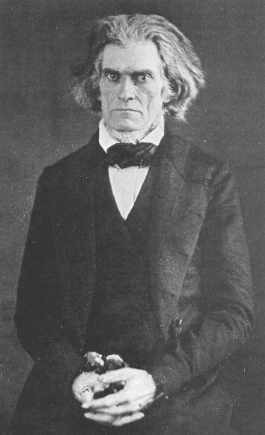 The war party was led on by John C. Calhoun [1782-1850], of South Carolina, who claimed the paternity of the measure, and drove it furiously through both houses of Congress.*
Mr. Clay was
____________
* Mr. Madison, then President, recommended the war in a message to Congress, but his proverbial timidity and caution forbid the idea that he was the author of the measure. Mr. Calhoun, as the leader of the extreme Southern party, was commonly regarded as the real instigator of the war message, and his success in carrying the measure, gave him that decided and controlling influence over the national councils, which he ever afterwards retained, and under all the successive administrations of the government, till the day of his death, a period of thirty-eight years [1812-1850], during which time he seldom fulled of effecting the real, if not the ostensible, objects of his occult evolutions, which were little understood.
Though charged with fickleness [modern term, flip-flopper], he [Calhoun] never swerved from his one original and single aim—the aggrandizement of the South by the discomfiture of the North. He was never more successful than in the moment of complaining loudly of defeat, and appearing to submit, reluctantly, to a compromise. Even the great compromiser, Mr. Clay, appeared to be but an implement in his hands.
He was charged with ambition for the Presidency, but in reality he preferred to govern through eight administrations (and he managed for the most part to do so), rather than rule through the brief period of one. He had the faculty of governing, through their hopes or their fears, the political party from which he seemed to stand aloof, as effectually as he did the party to which for the time being, he seemed to belong. The Slave party was the only party to which he ever really adhered. The skill with which he concocted a new party, by an alliance of the Southern "nullifiers," of whom he had been the leader, with the National Republicans of the North, against whom he had threatened a civil war, yet
-330-
also in favor of the measure. At one stage of the proceedings, early in June, 1812, a motion was made in the Senate to postpone the declaration of war till the opening of the next session of Congress in December, when the policy of the British Government would be developed.* On this question the Senate was understood to be nearly equally divided, and Mr. Calhoun, whose influence was potential in both Houses, exerted himself to defeat the motion.
Then it was that, after an adjournment, a large number of northern members [of Congress], including prominent supporters of the administration, were said to have surrounded Mr. Calhoun in the lobby, imploring him to relent, and allow the country a respite till December. Mr. Calhoun was inexorable, and by extraordinary appliances, one or two members were gained over to his party, and the postponement was defeated in the Senate by a majority of one vote. This decided the question of war, which was declared by a vote of 79 to 49 in the House of Representatives, and of 19 to 13 in the Senate.
In a few weeks, news arrived, as was expected, of the repeal of the British Orders in Council thus removing the chief cause of the war. But the object of the Calhoun party was gained. The nation was plunged into a war, in the midst of the pecuniary embarrassments arising from a general southern bankruptcy, (the North being the creditor) and from the sudden demise of the National Bank. New England, at such a crisis, more than Old England, would be the sufferer by the war, and the North would be burdened with the chief expense of the infliction.
The result of the measure, and especially the manner in
____________
stepping out of his new party before he was fairly seated in it, was mistaken for caprice by those who saw not his object. It enabled him to be either Whig or Democrat, as he pleased, to stand with one foot in each scale, to make cither side preponderate as he chose, and become Secretary of State when he wished, by the acclamations of a Senate whose party was, even then, denouncing him! Whoever would understand American politics from 1812 to 1850, must study the political history of John C. Calhoun.
*A motion, was also made in the House of Representatives to include France in the measure, but the motion failed. The French had no naval force to spare for the coast of America, and could do little for the threatened chastisement of New England.
-331-
which the war was conducted and terminated, were such as to justify, fully, this account of its object and its origin. Two commanders, in sympathy with the administration, Generals Hull and Smythe, the latter a Virginian, were sent, successively, on expeditions of pretended invasion of Canada, but in both instances, the enterprise was abandoned when the Canadas were apparently in their power. General Hull surrendered to the British, to their great astonishment. The whole country accused him of treason, a court-martial sentenced him to death, but he was pardoned by the President.*
[Ed. Note: Due to slavery, the military retreated from the Capitol, leading to its capture and burning.]
General Smythe "suddenly retreated, to the great surprise of his troops." These facts, together with the systematic and even skillful withholding of supplies from the forces under other commanders, afterwards,† made it perfectly evident that the administration not only never intended the conquest of Canada, but took special care that no such acquisition of territory should add to the number of non-slaveholding States.
Had Canada been adjacent to the slave States, and adapted to slave culture, there can be no reasonable doubt that it could have been conquered as expeditiously as were California and New Mexico.
New England, in the mean time, though compelled to furnish largely to the sinews of a war waged, in reality, against herself—New England, in whose cities was the wealth that tempted the enemy, and in whose ports was the shipping that was endangered—New England, whose militia were subjected to drafts for enacting sham invasions of Canada, or massacres of the Indians, and whose seamen were winning victories on the western and northern lakes, and on the Atlantic—New England was systematically left defenseless, while her seaports
____________
*A defense of Gen. Hull was, many years afterwards, published, in which it was claimed that he surrendered for want of supplies, and that his course was in accordance with the secret intentions of the Government that so readily pardoned him.
†As a specimen of these tactics, we notice that Virginian corn was sent in wagons to the forces on the Canada frontier, of which only one bushel to each wagon load was delivered to the army, the balance being consumed by the teams on the journey out and home, while large supplies of northern corn might have been purchased near at hand.
-332-
were blockaded, a vast amount of her shipping destroyed, her eastern borders exposed to hostile incursions, and the port of Castine held in possession of the enemy for many months. When, under these circumstances, and after all remonstrances had proved unavailing, New England statesmen were found who demanded that New England resources and New England militia should be retained by the State authorities for home defense, the cry of treason was raised against them, which has been continued to the present day.*
The threat of humbling New England was thus signally fulfilled. New England cowered under the lash of the slave-driver, and has never since adventured to lift up her head in the national councils. Her most gifted Representatives and Senators find ample scope for their powers in bowing to the behests of slavery, or only make a brief bluster of resistance, to quail the lower at last, or be deserted by their cotton lords at home.
When the war had accomplished its grand objects, when the bankrupt Slave States had regained and more than regained their balance of power with the North by despoiling it of half its remaining wealthy after the previous inflictions of non-intercourse and embargo, when Old England had been successfully employed to chastise and humble New England, when insult had been added to injury, and the loss of honor and reputation conjoined with the loss of wealth and political influence, the slave power was ready to restore peace.
And this was done without a single lisp of "free trade and sailors' rights." Neither the treaty, nor the negotiations, nor the instructions from the Cabinet under which they were conducted,
____________
*The claims of Massachusetts on the Federal Government, for the services of her militia under the State authority, in defending her own coasts, at a time when the Federal Government persisted in leaving them absolutely defenceless, was afterwards contemptuously and insultingly disallowed, and the very act of this self-defense is still pointed at as evidence of "constructive treason!." And thus the State contributing most largely (in proportion to population and territory) to the Federal expenses during the war, was compelled to defend itself by additional exertions, at its own cost, and be branded with the taint of treason to boot! Is it a marvel that the politicians of Massachusetts became servile?
-333-
contained the slightest allusion to the ostensible grounds of the war, or provided or sought the least semblance of any security against similar aggressions in future. Thus ended a war of nearly three years, conducted at an expense of nearly thirty millions per annum, chiefly paid by the free States, the price of their own subjugation and disgrace—a war whose "glory" has given us two Presidents, one of them a slaveholder, the other a native Virginian, and a steady supporter of the slave power—a war that virtually enthroned, from 1812 to 1850, the bitter enemy of northern as well as southern liberty, JOHN C. CALHOUN.*
Free labor, ever buoyant and recuperative, had, however, survived. The hardy yeomanry of the North had earned their own bread with their own hands, had paid all the demands of an oppressive government, and aided by the high war prices of their products, while consuming as little as possible of foreign merchandise, had thriftily maintained their ground. The remnant of surplus capital, in the cities, driven from its own field of enterprise, and encouraged by the scarcity of foreign fabrics, had invested itself in the manufacture of
____________
*The writer is aware that his account of the embargo, non-intercourse, and war of 1812, will be as distasteful to some of the partisans and admirers of Jefferson and Madison, as his account of Washington's administration and the Federal party will be to some of their political opponents.
But history should be impartial; and a writer who has religiously stood aloof from both parties may claim to have seen passing events with his own eyes, and may be permitted to record them as he has apprehended them. In use of the same liberty, he may further say here, once for all, that since the war of 1812, as before, he has found no essential difference, on the whole, between the two parties. The so called Republican or Democratic party, afraid of an aristocracy of Northern capital, has thrown itself into the arms of the slaveholders. The Federal, National Republican, and Whig parties, while they have seen this, have also had their slaveholding allies, whose aid they could not afford to spare, and hence the slave question has never been made an issue by those parties. When in power they have been as servile as their rival.
Neither of them have been anti-slavery parties at any period, nor otherwise (at bottom) than aristocratic parties, being all of them governed by one or the other of the rival aristocracies, Northern or Southern. A truly democratic party has never yet come into power.
The people have been cheated by professions and names. Since the rise of the Cotton power at the North, allied to the Cotton power of the South, the rival aristocracies have been merged in one, and the two political parties are kept up as mere shams, to prevent a united rally of the people against the now united aristocracy of the country, represented by "compromise" legislation and "Union Committees."
-334-
cotton and woollen cloths, of a coarse but substantial texture. But the return of peace brought an influx of foreign goods, and a sudden reduction of prices, ruinous to manufacturers as well as merchants. Years were required to repair these fresh depredations, and the new policy of free commerce, it was thought, precluded the prospect that our infant manufactures could be sustained. No "protective tariff" came to their aid, then. The South, no longer fearing the seductive influences of commerce, had become the champion of "free trade."
The North, by this time, understood her position too well to bring forward any measures of her own. Manufactures were, for the most part, abandoned, the manufacturing villages were deserted, and where absolute bankruptcy did not prevent, the little remnant of capital was invested in foreign commerce.
The merchant who had been compelled by southern policy to turn manufacturer during the embargo, the non-intercourse, the second embargo, and the war, while his shipping was either rotting at his wharf, or had fallen into the hands of the British, was now compelled by the new southern policy to let his factory and village fall to decay, rebuild again his ships, and commence merchant again. In a short time, the settled channel of northern capital and enterprise was again foreign commerce, and a brisk business in that line was again bringing in an influx of wealth.
No sooner was this witnessed or anticipated, than another change came over the political economists of the South. "Free trade" became a political heresy, and the doctrine of the Jeffersonian period, condemnatory of foreign commerce, and in favor of domestic manufactures, was suddenly revived. The South wanted an increasing northern market for her cotton, and northern capital must be forced to become a customer. The South wanted, likewise, a duty on raw foreign cottons that should exclude those imported from South America.
The South wanted, more than all, another opportunity to disarrange and perplex her pecuniary rival, the free laboring North. Not the slightest objection was it, in her eye, that some hundred millions of northern capital, as our northern
-335-
statesmen demonstrated, would have to be sacrificed by the change. The high tariff of 1816 was forced upon the reluctant North by the same John C. Calhoun who had dictated the war of 1812. Northern capitalists demurred. They desired no capricious change. The merchants had rebuilt their ships, and wished for no interference with their "free trade." Of the few remaining manufacturers, some were also merchants, and nearly all of them, with singular unanimity, repudiated the policy of an artificial hot-bed growth of manufactures, predicting, sagaciously, the over production, the reaction, and the fluctuations afterwards realized by such violations of the law of supply and demand. But the North was overruled.
Calhoun again triumphed. The Calcutta trade was annihilated, and our commerce with France and England reduced and shorn of its rich profits, in obedience to the new policy. Factory villages sprung up again like mushrooms. Thousands embarked in the new business. Over competition and over production rained or crippled a large portion of them in four or five years, and instability and uncertainty became inscribed, legibly, upon their edifices and their fabrics. For the dozens who succeeded and amassed wealth, there were to be reckoned hundreds, if not thousands, who were driven into penury and oblivion.
The same memorable era, 1816, was marked by the establishment of a second National Bank, and by the same Slave Power that had dictated the two embargoes, the non-intercourse, the war, and the tariff. It was dictated by the same policy and to subserve the same end—the preservation of the balance of power between free and slave labor, or rather, the ascendency of the latter over the former.
A National Bank was deemed unconstitutional in 1811, but it became constitutional in 1816, for the South, after all her depredations upon the North, now condescended to become a borrower of northern capital! Mr. Madison, in particular, whose constitutional scruples were insuperable, in 1811, overcame them in 1816, and not long afterwards became, it was said, a borrower from the National Bank of a large sum. Other slaveholding states-
-336-
men conferred upon the bank the same honor. But it cost the northern banks and the northern capitalists and merchants a severe money pressure of three or four years to spare sufficient specie to get the new National Bank under way. So that the pecuniary embarrassment of 1819-20, arising from a reaction of the high tariff policy, was increased by the process of re-establishing a National Bank, and both burthens fell at the same time upon the free laboring North.
The general southern bankruptcy of 1824, renewed and aggravated by the southern cotton speculation of 1826, (an infamous process of gambling) trode rapidly upon tlic heels of the former inflictions of the Slave Power. An extensive, not to say general, bankruptcy visited Boston in 1824, and New York in 1826, from these joint causes, but chiefly from the accumulation of southern debts to the estimated amount of upwards of one hundred millions of dollars, of which, (as afterwards, in 1837,) scarcely five cents on the dollar were ever realized.
Precisely at what date the second United States Bank was effectually pillaged and reduced to bankruptcy by its slave-holding customers, is not certainly known, but it must have been at a very early period, probably in 1823, soon after its specie capital had been supplied, and chiefly by the over-confiding North. Its condition was for many years concealed, perhaps in the vain hope of retrieving its fortunes.
At one time, it is said, the directors, having decided on making no more loans to the bankrupt South, adapted the policy of including the solvent North under the same restriction, lest offense should be taken at the invidious distinction, or the fact of southern delinquency at the bank be disclosed. Be this as it may, it proved to have been a rotten concern for years, while the public supposed it solvent.
The Federal Government, as appointing a portion of the directors, comes in for a large share in the blame of this shameful mismanagement. The bank was in the hands of demagogues, a tool of political corruption, and chiefly for the pecuniary and political emolument of the South at the expense and for the man-
-337-
agement and subjugation of the North, purchasing editors if not Senators by its loans. Like its predecessors, it was first robbed and then buried, and all through the action of the Federal Government, at the dictation of the Slave Power. A renewal of its charter was refused in 1832, a fortunate event, as it proved, though its insolvency was not suspected then. It expired by limitation of charter in 1836.
Free labor overcoming all its obstructions, contrived at length to flourish under the tariff system. The manufacturing capitalists became first reconciled and then wedded to the policy. Thriving under it, they sought no essential change.
But northern labor had long been held incompetent to self-direction, and had been accustomed to watch the motions of the slave-driver. It adventured, however, a slight modification of the tariff in 1832, yet not departing from the principle and the policy upon whIch the system was founded, in 1816, by Mr. Calhoun. This temerity was made the pretext for demanding a revolution in the policy of the country.
The principle of a protective tariff became unpopular at the South as soon as it was perceived that the free labor of the North was thriving under it, and the growth of this dissatisfaction was well nigh simultaneous with the desire to inter the second National Bank.
The policy of protection first fastened upon the country by Mr. Calboun, was now discovered by Mr. Calhoun and his party to be an infraction of the constitution, oppressive to the South, the climax of political injustice, and demanding a dissolution of the Union, unless speedily laid aside. After stretching the exercise of the powers of the Federal Government to the highest degree, by embargoes, war, tariff, and National Bank, the South now hoisted again the flag of "State Rights."
A State Convention of South Carolina, under the influence of Mr. Calhoun, declared the tariff acts unconstitutional, null and void, that duties should not be paid, and that if the General Government attempted to enforce the claim, the state would withdraw from the Union. President Jackson could do no less than repel this demand, but through the intervention of Mr.
-338-
Clay, a former champion of the protective policy, a compromise was made, by which the duties were gradually reduced till 1843, when they were to sink to the general level of 20 per cent., which was accounted the revenue standard. In recent debates in the Senate concerning the Mexican war, Mr. Webster of Massachusetts, representing the cotton manufacturers of that state, reminded southern Senators that the expenses of such a war would require an, additional tariff. At this there was no demur,—not even from Mr. Calboun; and it is understood that the prospect of a high tariff reconciled the manufacturing capitalists of New England to that iniquitous war.
Thus Slavery controls all the leading measures of the nation and moulds its political economy,—quite as remarkable for its real and inflexible CONSTANCY as for its apparently capricious CHANGE .
A comparison of dates, as before hinted, will show how exactly all these changes have corresponded and chimed in with the more direct and palpable action of the Federal Government in support of slavery. Whenever such direct action, by the Government or by combinations, has been suspended, a more active control and a more rapid change of general measures has supplied the deficiency. And when the general policy of the country has been for any length. of time undisturbed, it has been because more direct measures in support of slavery have been in progress.
Thus, from 1807, on the explosion of the Southern and Western Conspiracy, till the first armed invasion of Texas, in 1819, the slave interest was sufficiently promoted by embargoes, non-intercourse, war, tariff, the destruction of the first National Bank, and the establishment of the second. So, likewise, from 1836 to 1850, while so much direct action in favor of slavery has been witnessed, the questions of tariffs and banks have been left comparatively undisturbed.
With equal skill and tact has the slave power contrived to keep up two political parties, extending through the North and the South, on the most fallacious and deceptive issues, or upon scarcely any issue at all. By this means she diverts atten-
-339-
tion from the real to the merely nominal issues before the country, while by controlling both parties, she secures her ends through the ascendency of either, makes the one a check upon the other, and manages them through fear or through hope.
THE STATE GOVERNMENTS.
This chapter on the action of the Federal Government in support of slavery, might be appropriately followed by an account of the action of the State Governments, even at the North, in a similar direction Our limits forbid us to enter into these details.
Suffice it to say that most of the free States are disgraced by constitutional or legislative provisions discriminating, invidiously, between white and colored citizens, and depriving the latter of their equal rights of suffrage and eligibility to office Colored citizens of the free States, employed on board ships visiting the South, are subject to seizure and imprisonment, in violation of their constitutional rights. An effort was made by Massachusetts to obtain a legal redress of these grievances in the courts of South Carolina and Louisiana But her Commissioners, Messrs. Hoare and Hubbard, were ejected from Charleston and New Orleans under threats of violence, and Massachusetts submits to the insult.
In Ohio there were laws enacted designed to prevent the settlement of colored citizens in that State. In Connecticut a law was passed prohibiting schools for teaching colored pupils. But these laws of Ohio and Connecticut have been repealed. Both the enactment and the repeal of these two laws—it may be proper to say—took place during the present agitation of the slave question by abolitionists
We have carefully confined ourselves in these chapters (as in the preceding ones concerning "the Position of the Churches") to the course that has been pursued in respect to slavery, disconnected from any controversies about the measures of "modern abolitionists," or statements concerning the opposition raised against them. And we deem it no vain repetition to propound again, here, the inquiry—Is it credible that those who hold such a position m respect to slavery could have been otherwise than annoyed and offended by any earnest efforts for its immediate and unconditional abolition?
Some further light on this question may be afforded in our next chapter, exhibiting a movement in which the prominent actors, in political and ecclesiastical life, combined their forces and commingled their labors.
-340-
CHAPTER XXIX.
COLONIZATION SOCIETY.
Originated with Slaveholders—Object—Discourages emancipation, yet professes to
favor it—Violates its own Constitution, by denying to the people of color their
rights of citizenship—Justifies Slavery—Condemns emancipation—Slanders the
people of color—Justifies oppression—Declares prejudice against color invincible
—Pledged, in advance, to oppose Abolition Societies—The representatives of the
leading political and ecclesiasticil influences of the country—Its leaders in sympathy
with the Fugitive Slave Bill—Meeting at Boston—False pretenses of checking
the African slave trade and evangelizing Africa.
THE American Colonization Society, with its auxiliaries, is sustained by the leading influences in the Church and in the State. The position of these, in respect to American Slavery, has already been shown. It would be strange if the Society should differ widely from the course and policy of those who originated it, and who give shape to its measures.
Its two-fold character of ecclesiastical and political gives it a wide range. It takes its place in the list of our religious anniversaries, is advocated in the pulpit on the Sabbath, is claimed to be a missionary institution, asks patronage and accepts the widow's mite as a benevolent enterprise; yet it proposes to build up an empire in Africa; for many years it superintended. a colonial government in Liberia;* has received indirect aid from Congress, and large funds from State legislatures.
Its friends give a two-fold account of its origin. Sometimes they say it was devised and planned by Rev. Samuel J. Mills, a young minister earnestly intent on evangelizing Africa. Some-
____________
*The Colony has at length become independent of the Society, yet the Society continues, in other respects, its operations.
-341-
(pp 342-345)
Equally and necessarily prescriptive was the same doctrine, against all plans and efforts to procure a general abolition of slavery on the soil, and no other general abolition would be practicable. It might have been predicted, beforehand, that the influence of the Colonization Society would be arrayed against any earnest efforts for the abolition of slavery. It could not be otherwise, while the Society held the language we have quoted, insisting that colonization was the ONLY method of emancipation. And this has involved the Society in the positions hereafter specified.
4. IN VIOLATION OF ITS OWN CONSTITUTION, IT DENIES TO THE FREE PEOPLE OF COLOR THEIR ESSENTIAL RIGHTS OF RESIDENCE IN THE LAND OF THEIR BIRTH, AND IT DENIES THE RIGHT OF THE SLAVE TO EMANCIPATION ON THE SOIL. This is proved by the course of the Maryland and Virginia auxiliaries, and also by the speeches of Dr. Breckenridge and Mr. Brodnax, already quoted. We add another testimony from the highest authority, and of a recent date:
Hon. Henry Clay, in his recent letter to Richard Pindell, (see New York Tribune, March 10th, 1849,) "after full and deliberate consideration of the subject," lays it. down "as an indispensable condition (of emancipation) that the emancipated slaves should be removed from the State to some colony." "The colonization of the free blacks, as they successively arrive, from year to year, at the age entitling them to freedom, I consider a condition absolutely indispensable. Without it I would be opposed to any scheme of emancipation." The expense of this expatriation is, says Mr. Clay, to "be defrayed by a fund to be raised from the labor of each freed slave." The Af. Repository, April, 1849, says, let the North "show unto us a more excellent way," IF THEY CAN.
"In no other way could (can) it (slavery) be removed, than by planting colonies of free colored people on the coast of Africa." Speech of Rev. Dr. Bethune at Col. meeting, Phila., Af. Pep., July, 1846, p. 222.
"He (the colored man) is an exotic that does not and cannot nourish in American soil." Address of Judge Bullock, Ky., commended by editor of Af. Rep., Ap. 1847, p. 103.
"No! There is no place for them in this country. It is not their land, and they never can be made at home here. There are difficulties in the way which no power of man can remove." Af. Rep. Nov., 1846, p. 348.
-346-
5. IT JUSTIFIES SLAVERY.
"We hold their slaves, as we hold their other property, sacred" (Af. Rep. I., 283.) "We know your rights, and we respect them." (Ib. VII., 100.) "It" (the Society) condemns no man because he is a slaveholder." (Ib. VII., 200.) "Acknowledging the necessity by which its (slavery's) present continuance and rigorous provisions for its maintenance, are JUSTIFIED." (Ib. III., 16.) "We believe that there is not the slightest turpitude in holding slaves, under present circumstances." (Ib. IX., 4.)
"You cannot abolish slavery, for God is pledged to sustain it.''—Letters to Hon. George P. Marsh, copied into Maryland Colonization Journal, September 6, 1847, p. 44.
"Slavery in the United States has resulted, and is destined still more to result in the permanent good and advancement of the negro race."—Letter, &c., p. 99.
6. IT NOT ONLY DISCOURAGES BUT CONDEMNS EMANCIPATION.
"Policy, and even the voice of humanity, forbid the progress of manumission." (Af. Rep., IV., 268.) "It would be as humane to throw them from the decks in the middle passage, as to set them free in our country."—Ib. IV., 226.
7. IT SLANDERS THE FREE PEOPLE OF COLOR. Without doing this, and fostering prejudice against them, the scheme of colonizing them would have found little or no favor.
"Free blacks are a greater nuisance than even slaves themselves."—Af. Rep. II., 189.
"This class of persons is a curse and a contagion wherever they reside."—Ib. III., 203.
"A class the most corrupt, depraved, and abandoned."—H. Clay, Ib. 12.
"An anomalous race of beings, the most depraved upon earth."—Ib. VII., 230.
"They constitute a class by themselves, out of which no individual can be elevated, and below which none can be depressed."—Ib. VI., 118.
"With some honorable exceptions, the free negroes are, as a class, indolent, vicious, and dishonest."—Memorial to Leg. of Va., Af. Rep, Am. Col. Soc., Jan., 1846, p. 45.
Speaking of the 60,000 free colored inhabitants of Virginia, the above memorial says, "Worthless and more than worthless."—P. 48.*
____________
*Compare these representations with the following:—Says Mr. Clay, "Each emigrant is a missionary, carrying with him credentials in the holy cause of religion, civilization, and free institutions!" And so Africa is to be evangelized by sending out our nuisance as missionaries!
-347-
8. IT JUSTIFIES THEIR OPPRESSION.
"Severe necessity places them (free negroes) in a class of degraded beings." (Af. Rep., V., 238.) "This law," (by which free negroes are enslaved unless they leave the State,) "odious and unjust as it may, at first view, appear, &c., was doubtless dictated by sound policy, and its repeal would be regarded with none by more unfeigned regret than by the friends of African colonization."—Powhattan Col. Soc.
9. IT DISCOURAGES THEIR EDUCATION AND ELEVATION.
"If the free people of color were generally taught to read, it might be an inducement to them to remain in this country. We would offer them no such inducement."—Southern Religious Telegraph, Presbyterian.
"It must appear evident to all, that every endeavor to divert the attention of the community, or even a portion of the means which the present crisis so imperatively calls for, from the Colonization Society, to measures calculated to bind the colored population to this country, and seeking to raise them to a level with the whites, whether by founding colleges or in any other way, tends directly in proportion that it succeeds, to counteract and thwart the whole plan of colonization."—New Haven, Conn. Religious Intelligencer, Congregational, July, 1831.
This frank avowal discloses the cause of the opposition made in Connecticut, by leading colonizationists, soon after, to the establishment of schools for colored children and youth in Canterbury and New Haven. The writer [born 1792] remembers when colored children were freely admitted to the public schools in Connecticut, and when there were no separate pews for negroes in the village and country churches. The growth of prejudice has kept equal pace with the progress, influence, and popularity of the Colonization Society.
10. IT DECLARES THE PREJUDICE AGAINST THEM INNOCENT AND INCURABLE. This ground is assumed in self-vindication. For if the prejudice be criminal, the Society is a transgressor. And if it be cured, the enterprise of colonization becomes an abortion.
"All the prejudices of society—prejudices which neither refinement, nor argument, nor education, nor religion itself can subdue—mark the people of color, whether bond or free, as the subjects of a degradation inevitable and incurable.—Address Conn. Col. Soc.
"CHRISTIANITY cannot do for them here, what it will do for them in Africa. This is not the fault of the colored man, nor of the white man, but an
-348-
ordination of Providence, and no more to be changed than the laws of nature."—Fifteenth Annual Report, 47.
11. IT WAS PLEDGED IN ADVANCE TO OPPOSE ABOLITION SOCIETIES.
"The Society having declared that it is in no wise allied to any Abolition Society, in America or elsewhere, is ready, when there is need, to PASS A CENSURE upon such Societies in America."—Eleventh Annual Report.
This was in January, 1828, more than four years before the organization of the Massachusetts Anti-Slavery Society, the earliest of the "modern" Societies. There had been no "abolition Societies" in the country, except those formed by Jay, Franklin, &c., soon after the Revolutionary war [1176-1783], and which were now nearly or quite extinct. The possible resuscitation of those Societies, or the organization of similar ones, must have been the contingency in view of which this gratuitous pledge of "censure" was given, in advance of any knowledge of their particular measures. No reference to the future and unforeseen "fanaticism" or "imprudence" of "modern abolitionists," who had not then appeared, can furnish an explanation of this measure. Hostility to any efforts for the abolition of slavery is evident upon the very face of the declaration.
Such was the Colonization Society, such its positions, and such its influence, at the commencement of the present agitation of the slave question. And such they remain still. Philanthropists and friends of the enslaved were, for a long time, deceived and misled by it, regarding it as an instrument for the abolition of slavery, and some such possibly are deceived by it still, though hundreds of thousands have deserted and abjured it.
The Colonization Society has been, and still is, the true representative of the leading men in Church and State, on the subject of slavery. It furnishes the central point of their united efforts on that subject, where the political and ecclesiastical elements controlling the Church and the State (in the manner described in the preceding chapters) are conjoined. The same statesmen who have controlled our Cabinets and
-349-
Senates, the same theologians, professors, and doctors of divinity, who have controlled our General Assemblies, General Associations, General Conferences, Synods, Bible and Tract Societies, and Missionary Boards, have come together and formed and controlled the Colonization Society. The same imposing array of honorable and reverend names are paraded on the various catalogues, and their doings and their policy are the same. Posterity will award to the one the same praise or blame that they do to the other.
After twenty years' discussion, the course and the character of the Colonization Society are not changed. Whatever may be said of other bodies, the increase of light, and the diffusion of intelligence, have made no impression on the Colonization, Society. It represents the class of politicians and ecclesiastics resolutely opposed to liberty and progress. Among its leaders are the advocates and apologists of the new Fugitive Slave Bill—who preach against the paramount claims of "higher law." The infamous slave hunts resulting from the so-called "compromise measures," seem to have infused new life into it, and restored the energy it exhibited during the ascendency of pro-slavery riots, and the attempted legislative suppression of free discussion, from 1834 to 1837, of which some account will appear in the proper place.
The Massachusetts Colonization Society held its Annual Meeting in Boston, May 26, 1852. Rev. Dr. Derby, of Philadelphia, made a speech, in which lie insisted that the colored people can never have their political rights in this country. He "was born in the South, had been nursed by a slave woman, had seen the black man under all circumstances, and in all parts of the United States, and yet he had never seen one that was a man."—"He dwelt at some length on the great blessing American slavery is conferring on the slave, in affording him an opportunity to become acquainted with Christianity, and secure the salvation of his soul." And yet, according to the same speaker, he could never rise in this country, and must therefore be colonized to Africa.
Among the officers and prominent members of the Society present,
-350-
"were many supporters of Mr. Webster and the Fugitive Slave law, and signers of the celebrated letter to him, congratulating him upon his 7th of March speech, in support of that bill of abominations." Among these was Rev. Dr. Woods, who pronounced the benediction, at the close. "These gentlemen, grayheaded Doctors of Divinity, and cotton politicians of Boston, thumped their canes right heartily at the speech" of Dr. Derby. Robert Morris, Esq., a colored lawyer, of Boston, rose modestly, and wished to ask a few questions, but was refused.—Vide N. Y. Daily Tribune, May 28, 1852.
It remains to say that the pretensions of the Colonization Society of doing much to evangelize Africa, and to check and limit the slave trade, have been. found to be [false] in keeping with its other pretensions.
As late as 1833 or '34, Rev. Dr. Spring of New York, at a colonization meeting in that city, lamented that the Society had done nothing for the religious instruction of the emigrants. The remedy he proposed was the employment of missionaries by the managers, acting as a Civil Government, at the expense of the colony, disregarding the objection urged that it would be (as he admitted it would) a "union of Church and State." But his measure was not adopted. J. B. Pinney, who was sent out as a missionary, became Governor of the colony. On. his return, in 1836, he told the writer of this book that nothing was doing for the conversion of the natives. In 1839, Mr. Wilson, the Missionary of the American Board, which is controlled by Colonizationists, affirmed that the neighborhood of the colony was not a proper station for a missionary, and that remoteness from the settlements was far more desirable. (See Missionary Herald, Sept., 1839.)
Rum, gunpowder, and spear-pointed knives, have been among the regular exports from this country to the colony of Liberia. These are sold to the natives, and especially to the slave traders, being the indispensable articles of their traffic, and the causes of the wars that furnish captives to be sold to them as slaves. The slave trade, instead of being repressed, (as had been pretended) has been stimulated and encouraged.
-351-
The colonists have maintained a regular traffic with them, and have visited their stations for that purpose. Shackles have been sold to them at the colonial settlement at Mensurado. The pages even of the African Eepository (the Society's official) bore testimony, in 1828, that the trade was increasing.* In 1837 or '38, Dr. Goheen, agent of the Society, residing at Liberia, wrote in defense of the slave trade, and his letters were published without rebuke in the colonization papers of this country.
Liberia has now become an independent Government. The political control of the Colonization Society over it has terminated, but it continues to busy itself with the task (according to its own account) of supplying it with "nuisances" whom "Christianity can never elevate in this country" for "missionaries" and "statesmen"—to "evangelize the heathen, and build up an empire in Africa!"
____________
*We have not room for the particulars; but if the reader will refer to JAY's INQUIRY [
into the Character and Tendency of the American Colonization and American Anti-Slavery Societies (New York: American Anti-Slavery Society, 1840], pp. 55 to 61 (sixth edition), he will find ample evidence, furnished by the Colonization Society itself, that the boast of suppressing the slave trade was unfounded, and that it was even carried on in the Colony.
-352-
CHAPTER XXX.
ABOLITION OF SLAVERY IN THE BRITISH COLONIES.
Premature triumphs over the supposed abolition of the Slave Trade—Effects of this
illusion from 1807 till 1823—Revival of anti-slavery effort in England—Organization
of a Society on the basis of gradualism—Writings of Elizabeth Heyrick in
favor of Immediatism—Pamphlet of Clarkson on the illegality of Slavery—Change
of views and measures—Increased efficiency—Petitions to Parliament—Commencement
of Anti-Slavery Reporter, 1825—Parliamentary discussions, 1828-9-30—
Anti-Slavery meetings—Eminent Advocates—Methodist Conferences, Rectors and.
Curates, and Doctors of Divinity, enlisted—Dr. Andrew Thomson of Edinbergh,
Bishop of Bath and Wells—Daniel O'Connell, George Thompson and others—
Protest of Clarkson and Wilbcrforce against American Colonization Society—
Other political reforms advanced abolition—Ministry of William IV.—Prominent
statesmen—Influences in the West Indies—Missionaries among the Slaves—
Opposed by the planters—Increased feeling in England—Numerous petitions—
Candidates for Parliament questioned—Treatise of Judge Jeremie—Persecutions of
the Missionaries—Outrages against the negroes, 1831—Trial of Mr. Knibb—His
return to England—Increased, agitation—Memorials of Missionary Societies—
Government orders the demolished chapels to be rebuilt—Orders insolently
disregarded—Committees of Inquiry in Parliament—Pretended preparations for
freedom—Witnesses examined before Parliamentary Committees—Feeble defenses of
the Slave party—Plans of emancipation—Passage of the Act of Abolition—
Apprenticeship—Final Results—Testimonials—Slavery abolislied in the British
East Indies—Lessons of instruction.
THE slave trade and the slavery of this country, during its colonial state, were substantially the same with the slave trade and the slavery of the other British American Colonies, including the British West India Islands. A common, origin, a common character, and a common relation to British law and to the British Government, pertained to them. They grew up together, claiming the shelter of the same royal grants, the same acts of Parliament for regulating the trade to Africa. They claimed the benefit of the same judicial precedents and legal opinions. The friends of liberty in England, for a cen-
-353-
(pp 354-363)
gether and immeasurably worse than any of the abolitionists had ever supposed, or could have imagined. Documentary facts demonstrated that "truth is stranger than fiction," and "the poetry of philanthropy" became stale by the side of the records of jurisprudence.
Judge Jeremie had been strongly prepossessed in favor of the slaveholders, had gone out there with the determination to administer, impartially, the laws of the country, had found the task utterly impracticable, and had returned. There could be no such thing as the reign of impartial law, in a community of slaveholders. One specification, illustrated by a variety of incidents, was this; that, in no case before a court of justice, where the claims of slavery, or the interests of master and slave were involved, was the least reliance to be placed upon the testimony, under oath, of any slaveholder, however exalted his station, or however sanctimonious his professions.
About the same time that these disclosures were made in England, the West India Islands were becoming the theatre of new outrages, the knowledge of which, in England, soon after, could not fail to swell the tide of public indignation against slavery.
"It had long been a trick of West Indian policy, when any measure favorable to negro emancipation, or at all bearing upon it, was in progress, to excite among the slaves some trifling brawl with their managers, which was then dignified with the formidable name of an insurrection, the military forces were called out to suppress it, at a wanton expense of negro blood, and then intelligence was sent home, by way of proving the unfitness of the negroes for emancipation."—Copley's Hist., 371.
"In 1815, when Mr. Wilberforce gave notice of a bill for the registration of all Colonial slaves, a universal clamor was excited in the West Indies;" and sham insurrections were enacted for producing an effect in England. In 1823, the movements in England occasioned similar demonstrations. "Rumors of plots and insurrections were constantly assailing the public ear."—Ib, p. 371-4.
The close of the year 1831, and the beginning of 1832, were signalized by a more general and violent outbreak of slaveholding fury, which proved to be the death struggle of West India slavery. The moderate measures of melioration
-364-
proposed by the British Government, produced the greatest excitement among the planters of Jamaica. They held public meetings, threatening to resist the mother country, and renounce allegiance to the King. This was directly calculated to rouse the slaves, yet they remained quiet, and measures were next resorted to, designed evidently to produce an appearance of disturbance among them.
The term of their usual Christmas holidays was unlawfully abridged, and when they were ordered to their work, before the close of their accustomed recreations, a portion of them refused. This refusal was magnified into an insurrection, and proclamations in the name of the King were solemnly issued, announcing the pretended fact, and spreading consternation and alarm in every direction. The militia were ordered out, attacks were made upon the defenseless negroes, they were shot down in great numbers, and their cane-sheds and houses destroyed. "It does not appear that the negroes attempted the life of any person, but their determined insubordination was very evident." By the testimony of the more moderate among the planters themselves, as well as of the missionaries, afterwards, there was no necessity, for any purposes of self-defense, for this wanton attack upon the negroes.
But the malice of the slaveholders did not exhaust itself thus. The missionaries, Baptists, Wesleyans, and Moravians, shared a large portion of their fury. In their religious instructions, they had abstained, even to a fault, from teaching the slaves the wickedness of slaveholding and the extent and sacredness of their own rights. It does not appear that they had directly admonished the slaveholders of their great sin.
But they had undoubtedly done something for the moral and intellectual improvement of the slaves,—they had treated their converts as brethren in Christ—and this was an unpardonable sin against the slave system! From the beginning of the disturbances already mentioned, they had done all in their power to keep the slaves quiet, and to dissuade them from acts of insubordination and aggression. They had taken pains to disabuse some of them of the mistaken impression
-365-
(pp 366-367)
| collected around his lodgings, vowing they would tar and feather him.” |
By the exertions of the colored people, and the presence of the chief justice, they were deterred from their purpose, on the condition that Mr. B. should leave the island, to which he consented, and a detachment guarded him through the streets to embark. Messrs. Gardner and Knibb were subjected to trial the following week, and the next thing we hear is
| “that this very same William Knibb, who had been treated [by slavers] as an incendiary [a revolutionary], a promoter of rebellion, was employed to examine [question] certain negroes, and find out, if possible, the causes of the rebellion.” |
The result proved that the violent meetings of the slaveholders, already mentioned, at which they threatened to resist the British Government and throw off their allegiance to the King, was the first thing that made the slaves suspect that the British Government and the King had ordered their liberation.
Mr. Knibb was, nevertheless, urgently requested by some of the magistrates to leave the island, and finding it impossible to be longer useful in that field of labor, he consented, in April, 1832, to do so, and was appointed by the other missionaries to represent their case to the people of England.
This act [slavers' anti-missionary policy] sealed the overthrow of slavery in the British West Indies. The revelations of Mr. Knibb, on his return home, convinced the British nation that Slavery and Christianity could not co-exist in the Islands, and the doom of slavery became certain.
Some attempts were, in the meantime, made by the missionaries remaining in Jamaica to resume their labors, but in vain. The further preaching of the Gospel among the slaves awaited the abolition of slavery.
Ed. Note: Slavers were notoriously anti-Gospel preaching, the myth of the "Bible Belt" notwithstanding. See, e.g., Harriet Beecher Stowe, Key (1853), pp 244-250. And see pp 370-371, infra.
The basis for slavers' banning reading by slaves includes the slaver / creationist dogma that blacks were not human but instead a separate species.
|
The Missionary Societies in England, through their committees, represented to [informed] the Colonial Secretary of State, Lord Goderich, the outrages that had been committed in Jamaica.
| “Instructions were accordingly forwarded to Lord Mulgrave, the newly appointed Governor of Jamaica, and by him recommended to the House of Assembly, to provide means for rebuilding the thirteen Baptist and four Wesleyan chapels, so wantonly and illegally destroyed [by slavers].” “These recommenda- |
-368-
| tions were disregarded, or rather, insolently rejected,” |
thus revealing to the British Government the temper [mood, intense hostility] of the slave party. But it was found necessary, for the security of all houses of worship, to enact a law for the future, that if any such building should be injured or destroyed by a mob, the damage should be repaired by the county.
Committees of inquiry were instituted in Parliament respecting these outrages [church burnings, missionary oustings, etc.], and respecting the pretended rebellion on the part of the negroes, and the whole truth of the case, at last, came to light. The pretense of preparing the slaves for freedom, while opposing by violence their instruction, was thoroughly exposed. The meetings of Missionary Societies became anti-slavery meetings. The Anti-Slavery Society took the ground [viewpoint] of immediate and unconditional emancipation, and from every part of the United Kingdom there came up one united demand for the utter abolition of slavery.
| “On the 9th of June, 1832, Lord Goderich addressed a circular to the Governors of the Colonies, announcing to them the formation of a Committee in the House of Commons, in consequence of the numerous petitions for the abolition of slavery, to consider and report what measures it might be expedient to adopt with that view.”—Copley's Hist., 430. |
Ed. Note: The full citation is: Esther Copley, A History of Slavery and Its Abolition (London: Houlston & Stoneman, 1839; reprinted, Henry G. Bohn, 1844).
See also her general slavery history book, A History of Slavery (London: H.G. Bohn, 1852).
Copley also wrote Scripture History for Youth (London: H. Fisher, Son & P. Jackson, 1829) |
A similar committee was appointed in the House of Lords.
A large number of witnesses were examined before both of these committees, and voluminous statistical facts were introduced, particularly by Mr. Buxton, touching the main questions concerning slavery, and the workings of emancipation wherever it had been tried. The slave party did their best to sustain themselves during these investigations, but their efforts only served to establish [corroborate] the positions [evidence] of [by] the abolitionists. Their
| “reluctant admissions and awkward apologies or evasions of adverse witnesses,” says Copley, “only served to confirm and establish the views of all thinking and impartial persons on the other side.” |
The [slavers'] objections
that emancipation would not be safe,
that the liberated slaves would rise against [execute] their masters,
that the Islands would be reduced to a state of anarchy and overrun with idlers and vagabonds—
objections once so powerful as
-369-
to stagger the faith of philanthropists themselves, were now completely overthrown, and all the terrors they had created [alleged] were dispelled, in the light of well attested historical facts.
The “horrors of St. Domingo” [see p 130, supra] were shown to be the horrors of slavery [attempted restoration], and not of freedom.
The history of emancipation was found to be the history of the most beneficial results.
The ancient Romans had tested the policy [shown the benefit] of emancipation, to obtain soldiers in their wars against Hannibal [of Carthage in the Punic Wars]. The testimony of Tiberius Gracchus, confirmed by Cicero, and approved by Montesquieu, assures us of the salutary effects.
Christianity had abolished slavery throughout the Roman Empire witbout disaster. The feudal system had been displaced in modern Europe, and nobody deplored the change.
Ed. Note: See, e.g., Edward C. Rogers, Slavery
Illegality in All Ages and Nations (1855), pp 27-41. |
English slaves liberated, a few centuries ago by their Irish masters, did not cut the throats of their benefactors.
In Chili, every child born after the 10th of October, 1811, was declared free: in Buenos Ayres, after January, 1813.
In Colombia, all slaves bearing arms were emancipated July 19, 1821, and provisions made for emancipating the remainder, amounting to two hundred and eighty thousand.
In Mexico, Sept. 15th, 1829, instantaneous and unconditional emancipation was extended to every slave.
| Ed. Note: This emancipation was a notorious fact, and had a significant role in U.S. history. Pursuant to slaver's expanist goals, Texans objected to emancipation. Texans rebelled against the emancipation law, got pro-slavery U.S. President James K. Polk to launch a war of aggression against Mexico, to conquer and steal not only Texas, but half of Mexico! See, e.g.,
pp 272-305, supra
Sen. Thomas Corwin, "Unjust National Acquistions" (Washington: 11 Feb 1847)
Rev. Parker Pillsbury, Forlorn Hope (1847), pp 58-68
Charles Sumner, The True Grandeur of Nations (1845), pp 8-9, and 16
Rev. Parker Pillsbury, Acts (1883), p 81. |
In Guadaloupe, eighty-five thousand slaves were set free in 1794, when there was a population of only thirteen thousand whites.
At the Cape of Good Hope, thirty thousand Hottentots were emancipated in 1823.
In all these instances, the change [emancipation] had taken place without producing any unhappy results.
Facts, of which these are a specimen, when spread out before the British Government and the British public, prepared the way for a still more signal and illustrioUs exemplification of the safety of doing right!
Matters in Jamaica, in the meantime, were ripening for the final result.
Lord Mulgrave, the new Governor sent from England, in his speech to the Colonial Assembly, had recommended the religious instruction of the slaves. So far from responding to the sentiment, the Assembly [slaver-domninated Legislature] recorded its threats of revolt from the British Government, whereupon the Gov-
-370-
ernor dissolved the Assembly.
| Ed. Note: Slavers were notoriously anti-Gospel preaching, the myth of the "Bible Belt" notwithstanding. See, e.g., Harriet Beecher Stowe, Key (1853), pp 244-250. And see p 368, supra. |
A new election, under the Reform bill, which extended, it seems, to the Colonies, secured an Assembly of more moderate and liberal views.
The first reformed British Parliament assembled about the close of the year 1832. Mr. Buxton soon gave notice of a motion for the abolition of slavery, unless the Government should take the matter into its own hands. Lord Althorpe stated, in reply, that it was the intention of the Government to do so, and that he would shortly bring a bill before the House, which he trusted would be both safe and satisfactory. The nation now waited for this measure in almost breathless suspense.
The 23d of April, 1833, was the day appointed for bringing it forward, and the Anti-Slavery Society improved the interim by holding a public meeting in Exeter Hall, at which speeehes were made by Lord Suffield, Mr. Buxton, Joseph John Gurney, Earl Fitzwilliam, Rev. J. W. Cunningham, G. Strickland, M.P., Rev. J. Burnet, H. Pownall, Esq., Mr. Geo. Stephen, Lord Milton, Dr. Lushington, and others.
| “A still more important meeting was held in the same hall a few days afterwards,” consisting of three hundred and sixty-nine delegates from various parts of the United Kingdom. “More than three hundred of the delegates attended at the house of Earl Grey, to present a memorial [petition], which was read by Mr. Gurney.” |
The deputation had an audience with Lord Althorpe, and with Mr. Stanley, the Colonial Secretary of State. They represented the necessity of immediate and total emancipation, in the full confidence that such an emancipation would be peaceable. These views were embodied in a memorial [petition] to Lord Grey, and exerted, no doubt, a strong influence upon the Government.
The [politician] plan first proposed, however, was unsatisfactory. It contemplated a compensation of £15,000,000 to the planters, which was to be paid out of the earnings of the negroes. It proposed a twelve years' apprenticeship, during which time the compensation money was to be earned.
Abolitionists justly contended that compensation was due,
-371-
if at all, to the slave, and not to the master.
Ed. Note: Yes, reparations are for the crime victim, not the criminal! For the persons whose rights are violated, not for the violators!
Slavery involved crimes including kidnaping and extortion, and denials of rights including of habeas corpus. See our 'slavery unconstitutionality' site, and writings by abolitionists including but not limited to Rev. John G. Fee's Antislavery Manual (1851). |
They [abolitionists] contended that emancipation should be entire and immediate.
The planters [rights-violators, kidnapers, extortioners], on the other hand, petitioned for compensation [for themselves!!!].
While these questions were pending, the friends of emancipation held another meeting, July 20, and protested against the objectionable features of the bill.
The details of the act of emancipation were finally adjusted on this basis, viz:
| 1. The entire extinction of slavery, to take place on the 1st of August, 1834.
2. Field laborers, above six years old, to serve as apprentices for six years, ending 1st of August, 1840.
3. Domestic or house servants to serve as apprentices four years, ending first of August, 1838.
4. Children under six years, to be free, without apprenticeship. Chiidren hereafter born to be free.
5. The slaves to pay no part of their redemption money, but a compensation of £20,000,000 out of the public treasury to be paid to the planters [to the criminals, not their victims!!!], at the close of the apprenticeship. |
Other regulations were specified, for securing the rights of the apprentices and their masters.
The bill passed the House of Commons August 7 [1833], the House of Lords, August 20, and received the royal assent [William IV's] August 28th, 1833.
It remains to record the results of this measure. The first of August, 1834, came and passed peacefully, without the slightest disturbance, in any of the islands. And there has been none since.
Ed. Note: Slavers in opposing emancipation, had
pretended there would be great disturbances! p 369. |
In Antigua and Bermuda, the Colonial Legislatures preferred to dispense with the apprenticeship System, believing immediate and complete emancipation to be safest, and desiring likewise the earlier reception of the compensation money, to which this measure would entitle them. They reaped the double reward of their sagacity, experiencing none of the perplexity occasioned by the apprenticesbip system elsewhere.
In Jamaica, Barbadoes, and the other islands, the apprenticeship went into operation, and worked as well as could
-372-
have been anticipated. But its inconveniences and vexations led to its voluntary abandonment, and the entire freedom of the field laborers, on the first of August, 1838, two years before the time limited [specified] in the statute.
In Barbadoes, with a population of 140,000, only 20,000 were whites. In Jamaica, with a population of 450,000, only 37,000 were whites.
In all the British emancipated colonies, with a population of about 1,125,000, only about 131,000 were whites, being a little more tban one-ninth part. Yet the tranquillity of the inhabitants was not in the slightest degree disturbed. The testimony on this point has never been questioned. The Governor of Jamaica, Sir Lionel Smith, in his speech to the Assembly, October 30, 1838, said:
| “The conduct of the laboring population, who were the objects of your liberal and enlightened policy, entitles them to the highest praise, and proves how well they deserved the boon [benefit] of freedom [emancipation].” “I trust there is every prospect of agricultural prosperity.” |
To this speech the Assembly of Jamaica responded thus:
| “The House join with your Excellency in bearing testimony to the peaceful manner in which the laboring population [ex-slaves] have conducted themselves in a state of freedom.” |
Queen Victoria, in her speech to the British Parliament, February 5, 1839, said:
| “It is with great satisfaction that I am enabled to inform you, that throughout the whole of my West India possessions, the period fixed by law for the complete and final emancipation of the negroes, has been anticipated [expedited two years early] by acts of the colonial legislatures, and that the transition from the temporary system of apprenticeship to entire freedom, has taken place WITHOUT ANY DISTURBANCE OF PUBLIC ORDER AND TRANQUILLITY.” |
The islands, since emancipation took place, have been repeatedly visited by philanthropists well known in both hemispheres, for the purpose of collecting information concerning the workings of freedom. James A. Thome, of Kentucky, (afterwards Professor at Oberlin,) in company with Joseph H. Kimball of New Hampshire, went thither in November, 1836, and returned in June, 1837.
| Ed. Note: Their Report was published: James A. Thome, Joseph Horace Kimball, and Theodore Weld, Emancipation in the West Indies: A Six Months' Tour in Antigua, Barbadoes, and Jamaica, in The Year 1837 (New York: American Anti-Slavery Society, 1838, reprinted New York: Arno Press, 1969) (Context). |
Joseph Sturge and Thomas
-373-
(pp 374-375)
slaves, insomuch that the British Government has been obliged to interfere.
The abolition of slavery in the British West Indies liberated 800,000 slaves. This was followed, in 1843, by the abolition of slavery throughout the British dominions, which liberated more than TWELVE MILLIONS in the East Indies.
The history of British anti-slavery effort and its results, is instructive in more aspects than one.
It shows, in the strong light of practical experiment, the worthlessness of all partial, temporizing efforts, all schemes of preparation, amelioration, and gradualism, in striking contrast with the efficiency, power, safety, and success of efforts for a thorough, uncompromising, and radical removal of the evil.
It shows the utter incompatibility of slavery with a Christianity that earnestly attempts anything for the religious instruction and education of the slaves.
It shows the resistless power of the religious sentiment of a country to mould at its pleasure, to preserve or to overthrow the legislation of a country.
It assures us that whenever the prevailing and recognized religion of America decrees the downfall of American slavery, it will fall.
Ed. Note: This never happened in America. U.S. churches, for the most part, obstinately refused to repent of their vile pro-slavery views.
So Lincoln correctly credited, not the damnable churches, but the trinity of Wm. L. Garrison, the abolitionists, and the Union Army, for ending slavery. |
It reveals to us the power of an enlightened public sentiment over a government less popular than our own. It exhibits to us the fiction of the legality of slavery holding a great nation in fetters until exploded by the kindling lights of religion and freedom. It shows us the power of a right-minded and persevering minority, through the good Providence of God, to overcome mountains* of opposition, and dispel a chaos of error. It demonstrates that the increasing rage and madness of oppressors is the sure presage of hastening deliverance to the oppressed.
____________
*It is a mistake to suppose, as some do, that because the West Indies were remote from Great Britain, the slave power exerted but little influence on the home Government. There was a time when it virtually bribed the courts, controlled Parliament, and stood behind the throne. Statesmen and nobles, not to say monarchs and members of the royal family, were suspected of being secret partners in the African slave trade, or openly held investments in West India plantations. A large portion of the West India proprietors resided in England, and wielded a commanding influence. A large share of the £20,000,000 compensation voted by Parliament,
-376-
CHAPTER XXXI.
DISTINCTIVE FEATURES OF AMERICAN SLAVERY.
Its essential principle—Human Chattelhood—Integral parts of
the system—Its consistency and unity—Agreement of the theory
with the practice—Slavery cannot co-exist with liberty.
FROM the scenes and achievements of British philanthropy, and of West India Emancipation, we come back again to our own land of boasted liberty and cherished human chattelhood,—the land in which about 113,000 slaveholders control TWENTY MILLIONS of human beings,—and where the question still hangs in suspense, whether the yoke can be broken. Before entering upon the history of the present struggle, it may be well to look directly into the face of the monster to be grappled with, and see wherein its strength lies.
WHAT IS SLAVERY?
"The slave is one who is in the power of a master to whom HE BELONGS."—Louisiana Civil Code, Art. 35. "Slaves shall be deemed, sold, taken, reputed, and adjudged in law to be CHATTELS PERSONAL, in the hands of their owners and possessors, and their executors, administrators, and assigns, to all intents, constructions, and purposes, whatsoever."—Law of South Carolina, 2 Brev. Dig. 229, Prince's Dig. 446, &c.
"The cardinal principle of slavery, that the slave is not to be ranked
____________
never went to the West Indies to improve the plantations there; but remained in England, some of it in the hands of dissolute nabobs, some in the hands of merchants and mortgagees, in consequence of the West India estates being deeply involved in debt by the system of slavery. This, with the continued absence of owners from their plantations, partly accounts for the reports which we still hear, of the pecuniary embarrassments and thriftlessness of many West India plantations.
-377-
among sentient beings, but among THINGS, as an article of property, a chattel personal, obtains as undoubted law, in all these [slave] States."—Stroud's Sketch, p. 23.
This, then, is slavery, as it exists in America. God created man in His own image. [Genesis 1:26] He made him a little lower than the angels, crowned him with glory and honor, and gave him dominion over the beasts of the field. [Ps 8:5-9; Hebrews 2:6-8] But slavery reduces him to a thing, a commodity, an article of merchandise!
This is no flourish of rhetoric—no idle abstraction. So far as the power of man can accomplish such a result, it is accomplished by slavery. If it cannot take away the immortal soul of man, it deems, reputes, and adjudges him to have none! It ranks him, not a little lower than the angels, but on a level with the beasts that perish!
The question of slavery or emancipation is not a question of cruel treatment or of kind treatment—of starvation or of full feeding. It is a question whether a man is to be recognized as a man, or as a brute—a person or a, thing—a spiritual, moral being, or a mere lump of matter—a being gifted with volition and clothed with responsibility, or a mere piece of machinery—a being with, or without, RIGHTS, which the laws should PROTECT.
INTEGRAL PARTS OF THE SLAVE SYSTEM.
These are such as are involved, of necessity, in the cardinal principle of slavery, viz.: human chattelhood. We enumerate the following:
1. The unlimited authority of the slave-master or owner.
2. The abrogation of marriage, and the family relation, among slaves.
3. The power to enforce labor without wages.
4. The incapacity of the slave to acquire or hold property.
5. His incapacity to make contracts or bargains.
6. His incapacity to enjoy civil, domestic or political rights.
7. The liability of the slave to be sold, like other chattels, and separated from relatives. The authorized prosecution of the SLAVE TRADE!
-378-
8. The absence of any adequate legal protection for the slave.
9. The power of the master to forbid education and social religious worship, at his own discretion.
10. The power of the legislatures of slave states to prohibit education, even by the masters, and to prohibit or restrict free social worship.
11. The power of the legislatures of slave states to abolish freedom of speech and of the press, in general.
CONSISTENCY AND UNITY OF THE SLAVE SYSTEM.
The theory of American slavery agrees with its practice. The whole system of slave legislation grows legitimately out of the chattel principle upon which slavery is founded. And the most revolting usages and practices to be detected among the incidents and workings of the system are found to be in perfect keeping and harmony, both with the principle of human chattelhood and with the slave code.
1. The very idea of human chattelhood involves the idea of the unlimited control of the master, and the absolute defenselessness of the slave. Habits of tyranny and of servility must follow, of course, with all the insecurity and outrage that grow out of them.
2. The absence of legal marriage, and of the protected family relation, is manifestly essential to the idea of human chattelhood. Chattels are not married, and cannot constitute families. Chattels may be transferred, bought, sold, and used. The promiscuous intercourse of the sexes, especially at the bidding of the master, follows, of course, and is not to be censured by those who consent to the system, or to the practice of slaveholding.
3. Chattels never receive wages, or acquire or hold property. The deep poverty of the slave, and all the effects of that poverty, with the absence of a motive to labor, follow, of course.
4. Chattels can make no contracts, not even the contract of marriage. And this is the law of the slave.
-379-
5. Chattels can have no rights, and hence the slave can have none.
6. Chattels may be bought and sold. Hence the existence of slavery involves, of necessity, the slave trade, as Henry Clay testifies.—Speech in the U. S. Senate, 1839.
7. Chattels can claim no legal protection, and therefore the slave can have none. And all the cruelties of slavery must be tolerated.
8. Chattels are not to be educated, or instructed in religion! The idea is an absurdity. If the slaveholders are right in holding slaves as chattels, they cannot be blamed for withholding education and religious privileges from them. If the government may sanction or permit slaveholding, it must to be consistent with itself, prohibit literary and religious instruction.
9. The same may be said of the laws forbidding freedom of speech and of the press. Such freedom is manifestly impracticable and unsafe in the presence of chattel slavery. The entire South attests this; and thus far the testimony is truthful. If slavery is to be maintained, or even tolerated, then liberty, of course, is to be relinquished. This is self-evident.
The statutes of the slave states abundantly confirm the preceding statements, as will appear by consulting Judge Stroud's "Sketch of the Slave Laws," published at Philadelphia in the year 1827. The "Black Code of the District of Columbia," by W. G. Snethen, Esq., will show that some of the worst features of the system are sanctioned on the national hearthstone, and under "exclusive jurisdiction of Congress." And "Wheeler's Law of Slavery," (a large volume of "Reports") attests that slave enactments are not a dead letter.
It has sometimes been represented that the severe laws of the South, especially those forbidding education and free [unobstructed] religious meetings to slaves and free people of color, are wholly or chiefly owing to the impertinent agitations of abolitionists, whose mischievous efforts, it is said, have made such regulations necessary, or have furnished occasions or pretexts for them. The ready answer to this, is that the enactments in
-380-
question are found in "Stroud's Sketch," published in 1827, five years before the organization of the "modern" anti-slavery societies commenced, four years before the "Liberator" was issued by Mr. Garrison; and that, according to Judge Stroud, the principal acts of that character, cited by him, bear date from 1740 to 1770, long before the organization of the old Anti-slavery Societies, by Jay and Franklin.
So well known is this fact that occasion has sometimes been taken from it, to represent these severe laws as being antiquated, obsolete, and a dead letter! For the refutation of this falsehood, we have only to cite the testimony of the Presbyterian Synods of Kentucky and of South Carolina and Georgia, and the Virginia Revised Code of 1819. A mass of authenticated facts, chiefly sustained by Southern testimony, and showing that the practical workings of the system correspond, at all points, with the statutes defining it, may be found in a volume entitled "American Slavery as it is, by the testimony of a thousand witnesses;"—also in several unimpeachable narratives, and the Southern newspapers of every month in the year.
"No people," says the philosophical and learned Dr. [Joseph] Priestley [1733-1804], "have ever been found to be better than their laws, though many have been known to bo worse."
Such is the system that controls and wields the Government of the United States, as shown in preceding chapters.
Such is the system, sheltered and sanctioned, as we have already seen, in the prominent religious sects in this country,—the system which the Christianity of the country must overthrow,—or to which it must succumb and conform.
Such is the system with which human liberty, in America, is summoned to contend, or to which it must yield.
Who are enlisted in the struggle? What are they doing? What are the prospects before them? These are amongst the questions before us, in the succeeding chapters.
-381-
CHAPTER XXXIL
THE PRESENT ANTI-SLAVERY AGITATION IN AMERICA—ITS
CAUSES, ORIGIN, AND CHARACTER.
Discussions caused by the Missouri Compromise—Rebuke of the dough-faces at the
ballot-box, 1820—Benjamin Lundy, 1821 and afterwards—Missionary enterprise
advocated as the harbinger of universal liberty—Revived doctrine (among active
Christians) of immediate and unconditional repentance—This doctrine antagonistic
to conservatists in the Church, and their Colonization Society—Spirit of
ethical inquiry—Social Reforms—Temperance—Peace—An age of newspapers,
lecturers, lyceums, popular discussions, and voluntary Associations—William
Lloyd Garrison, a printer, a Temperance Editor—Associates with Benjamin Lundy
at Baltimore, l831—Imprisonment, trial, and release, 1830—Established his
"Liberator" at Boston, 1831—Panic caused by insurrection in Virginia—New
England Anti-Slavery Society formed, 1832—Other Journals—Anti-Slavery
tracts issued by Messrs. Tappan and others, New York—N. Y. Emancipator
commenced, 1833—Miss Crandall's School, Connecticut—N. Y. City A. S. Soc.
organized, Oct., 1833—American A. S. Soc. at Philadelphia, Dec., 1833—
Principles and measures of Abolitionists.
IF the reader of the preceding chapters shall have sufficiently pondered the character of American slavery, and the position of the churches and of the Federal Government in respect to it, he will now perhaps be able to form some intelligent opinion concerning the condition and prospects of liberty in America, at the time when the present agitation of the slave question commenced. He will be able to judge whether such an agitation then was unnecessary, impertinent, ill-judged, unfortunate, or ill-timed.
And when he learns, in the perusal of this chapter, the principles, the aims, and the measures of the abolitionists, he may be ready to judge whether, or how far, they offended against the rules of decorum and prudence; and whether the opposition they encountered
-382-
was anything more than might have been expected from the leading men, and the controlling influences, in Church and State, that have already been described, however wise and prudent may have been the persons earnestly and resolutely engaged in the effort against slavery.
It is not easy, perhaps not possible, to trace all the latent causes which, like little rivulets running together, produced the present agitation of the slave question, as other popular agitations are produced. We shall mention such as are within our knowledge, without pretending to enumerate them all.
The year 1820, after a long period of quiet, was distinguished by a pretty general and earnest discussion of slavery, growing out of the debates in Congress concerning the admission of Missouri, and the adjustment of that controversy by the Missouri Compromise. Mr. Clay, the author of that measure, and those who co-operated with him, congratulated themselves with the success of the policy. As lately as 1850, Mr. Clay alluded to it in the Senate, while his "omnibus" compromise was pending, reminding senators of its success, and boastfully assuring them that his second compromise would be equally efficacious in allaying the popular ferment, and restoring peace.
It is undoubtedly true that the Missouri Compromise, like all other compromises between right and wrong, did induce a moral paralysis in those who assented to it, and this is what Mr. Clay denominates peace. But the people did not all hold themselves parties to that compromise, nor participate in its benumbing effects. The spark of liberty was a fire pent up in their bones. Though temporarily baffled, they were not conquered. If the national "Vesuvius was capped" for a few years, it was only that it might burst forth again with fresh vigor. If Henry Clay could but have known how many were made uncompromising abolitionists by their disgust with that unholy compromise, ho would have found less occasion to congratulate himself with the results. The present anti-slavery excitement may be distinctly traced, in part, to the
-383-
earnest debates among the people elicited by that same Missouri Compromise. The "settlement" of the question by Congress was only the signal for its agitation among their constituents.
The Congressional elections of 1820 were extensively affected by the previous votes of the Representatives on the admission of Missouri. The recreants to liberty were regarded as marked men, especially those who had falsified their own previous professions, and richly merited the expressive epithet, "dough-faces,"* then coined and bestowed upon them by the eccentric John Randolph [1773-1833], of Roanoke. In some instances they took the hint of their friends, and quietly withdrew from public life. In other cases, their old associates declined to nominate them. Some were nominated, only to be defeated. Others, who had previously defied all competitors, were subjected to the mortification of being re-elected by a diminished vote, barely escaping defeat, after the most strenuous exertions of their supporters, admonishing them never to hazard the chances again.
This latter was the fate of the very distinguished and highly-gifted Representative from Rhode Island.† The controversy was carried on during the whole summer by newspaper discussions, and public meetings, and debates. Party tactics and party discipline were resorted to, with little effect; party lines, for the time being, were well nigh erased, and the terms "anti-slavery" and "pro-slavery" took the place of Federalist and Republican. The files of newspapers, particularly the Providence Gazette,‡ bear testimony that the discus-
____________
*This term, as now commonly used and understood, expressively characterizes the politician, whose face, as flexible as "dough," and belonging to a head equally soft, may be moulded by others into any shape that best suits them. But it is thought by some that the epithet intended by Mr. Randolph was"doe-faces," in allusion to the timidity of the female deer, who attempts to drink, but starts back at the reflection of its own face m the water. "They saw," said he, "their own doe-faces, and were frightened."
†The late Hon. Samuel Eddy, of Providence. Mr. Hazard, bis associate, a less popular candidate, was dropped from the ticket, on election day, by his own partisans.
‡The Providence Gazette was a Federal paper. Mr. Eddy was supported by the
-384-
sion became as "radical" then, as it is now, and that nearly the same arguments, pro and con, were then in use. Some who commenced writing against slavery and " compromise," then, have not ceased writing against them still. The author may be permitted to record himself among these. Mr. Eddy was elected by a majority of less than one hundred votes.
The anti-slavery agitation of 1820 was not confined to Rhode Island, or even to New England. It extended throughout the non-slaveholding States. By many of the "Friends" and. other opponents of slavery, the "Missouri Compromise" was unsparingly condemned; but the deed was done, and there seemed no political remedy at hand, but the political repudiation of the authors, which, very extensively, took effect.
To this day, we find, in various parts of the country, a remnant of the anti-slavery agitators of that period, and recognize some of the old familiar names in the proceedings of the Anti-slavery and Free Soil conventions of the present times. The late BENJAMIN LUNDY [1789-1839] was probably moved by the Missouri contest and compromise, to engage in his arduous anti-slavery labors. He seems to have entered the field that same year, and commenced the publication of his monthly periodical, the "Genius of Universal Emancipation," the year following, 1821. In an appeal to the public in April, 1830, he says:
"I have, within the period above mentioned, (ten years,) sacrificed several thousand dollars of my own hard earnings, have travelled upwards of five thousand miles on foot, and more than twenty thousand in other ways; have visited nineteen States of this Union, and held more than two hundred public meetings—have performed two voyages to the West Indies, by which means the liberation of a considerable number of slaves has been effected, and, I hope, the way paved for the enlargement of many more."
At Philadelphia, at Baltimore, at Washington City, he successively published his paper. In 1828, while located at Bal-
____________
Democratic papers, as being the nominee of that party. Until his obnoxious vote in Congress, he was so acceptable to both parties, that no opposing nomination was made against him. But now he was deserted by the "rank and file" of both parties, to a great extent.
-385-
timore, he visited various parts of New England, to extend the circulation of his paper, and stir up the friends of the enslaved. He visited Texas twice, and penetrated into Mexico, in search of some better asylum for fugitive and emancipated slaves. Though failing to accomplish this object, he possessed himself of much invaluable information, which afterwards became of the highest importance to the cause in which he was engaged, and to the country at large.
It was chiefly [due] to communications from Benjamin Lundy that John Quincy Adams was indebted for those astounding disclosures concerning the Texas plot with which he so suddenly electrified Congress and the nation, in 1836. A more full account of the particulars was afterwards published by Mr. Lundy himself in a paper issued at Philadelphia for that purpose.
| Ed. Note: Full Citation: Benjamin Lundy, The War in Texas: A Review of the Facts and Circumstances Showing that This is A Crusade against Mexico, Set on Foot and Supported by Slaveholders, Land-Speculators, Etc. In Order to Re-Establish, Extend, and Perpetuate The System of Slavery and the Slaver Trade (Philadelphia: Merrihew and Gunn, 1837). |
This timely information put the friends of liberty upon the track by which, though failing to exclude Texas from the Union, they have succeeded, thus far, in arresting the quiet march of the slave power to the Pacific, thus sending a thrill of alarm and rage through the whole South. Thus does Divine Providence raise up and direct the voluntary instruments of its high designs.
Benjamin Lundy [1789-1839] was a member of the Society of Friends; he was small in stature; of feeble health, afflicted with deafness, less definite than some abolitionists in his anti-slavery ethics and measures, but of indomitable purpose, perseverance, faith, courage, patience, self-denial, endurance, and by dint of these, became a pioneer in the cause. At one time he traversed the free States, lecturing, collecting, obtaining subscribers, writing for his paper, getting it printed, monthly, wherever he could conveniently have it printed, for once, stopping himself to read the "proof," and direct and mail his papers, then travelling on again another month, and carrying in his trunk his "direction book," "column rules" and type "heading," (with the date of "Baltimore,") to facilitate the process. Such are the labors of men who commence moral revolutions, to be completed by others after they have gone off the stage.
Among the early pioneers of the cause, should be mentioned
-386-
the name of Rev. John Rankin [1793-1886], a Presbyterian minister of Kentucky, now of Ripley, Ohio. In 1824 or 1825, he published his Letters on Slavery, maintaining its inherent sinfulness, and enforcing the duty of its present abandonment. Through his influence an anti-slavery society, on the same principle, was formed in. Kentucky, at that early period. It was afterwards, however, "laid asleep" (to use the words of Mr. Rankin,) by the illusive pretensions and seductive influences of the Colonization Society.
There were moral, religious, and social influences at work, preparatory to an unprecedented agitation of the slave question. The missionary enterprise, in its youthful vigor, was an effort for "evangelizing the world." It was deliberately proposed as a work to be done. It was based on a belief that the promises and predictions of the Scriptures afforded a divine guaranty for its accomplishment. Bible, Tract, and Education Societies were commended and patronized as auxiliaries to this magnificent undertaking. The anniversaries of these were enlivened with glowing descriptions of the approaching millennium, when all should know the Lord, from the least to the greatest, and sit under their own vines and fig-trees, secure in their rights. The eloquence of a Beecher, a Rice, a Cornelius, a Summerfield, and a Spring, on such occasions, had sent a thrill through the churches, and the promised day was believed to have already dawned.
The time was set for furnishing every family on the earth with Bibles. The chronology of the prophetic periods was computed, and the close of the present century, it was believed, was to witness the completed work of the "conversion of the world." To be "up and doing" was the watchword, and our American love of liberty, equality, and "free institutions," was gratified with the assurance that all the despotisms of the earth were to crumble at the Prince Emmanuel's approach!
Was all this to be accomplished without Bibles, and education, and marriage, and family sanctities, and liberation for American slaves? Who could believe it? Whatever our missionary and evangelizing orators intended, whatever they
-387-
were thinking of, they were God's instruments for putting into the minds of others "thoughts that burned," for the emancipation of the enslaved. The writer and many others well remember that the tone of our May anniversaries of religious societies, from 1825 to 1832, was such as has been described. And the suddenness with which this tone was changed, when bibles, education, and family sanctities were demanded for slaves, did not escape notice. But the fires kindled could not be extinguished.
The same period was distinguished by "revivals of religion," in which prominence was given to the old doctrine of Hopkins and Edwards, demanding "immediate and unconditional repentance'' of all sin, as the only condition of forgiveness and salvation. This was urged in direct opposition to the vague idea of a gradual amendment, admitting "a more convenient season"—a prospective, dilatory, indefinite breaking off from transgression—an idea that had been settling upon the churches for thirty or forty years previous,—an incubus upon every righteous cause, and every holy endeavor.
It is easy to see the bearing of such religious awakenings upon, the mode of treating the practice of slaveholding, unless it were believed to be righteous. A more perfect antagonism to the ethics and operations of the Colonization Society could not well be imagined. A collision was inevitable, whenever the subject should be introduced, and the Society itself could scarcely avoid introducing it.
Simultaneously with all this, and more or less connected with it, there came over the religious community an increasing spirit of inquiry in respect to Christian ethics, and the bearing of the religious principle upon the social relations and political duties of man. Peace Societies had been formed. Temperance Societies were in progress. The Institution of Free Masonry had been arraigned. The influence of theatres, of lotteries, and the morality of lottery grants by legislatures, were brought under rigorous review. The treatment of the aborigines of our country, especially of the Cherokees, by Georgia and the Federal Government, and the imprisonment
-388-
of the missionaries among the Cherokees, became subjects of earnest attention. Christians began to be reminded that they were citizens, and that Christianity had its claims upon them in their civil relations. The Sabbath Mail question—whether wisely or unwisely managed—became an exciting topic of animadversion from the pulpit and religious press. The ap-lication of the principle may have been a mistaken one, or it may have been unhappily argued and urged; but the principle was, in some fashion, brought into view, that though our institutions secure religious freedom, yet religion and politics are in some way connected, after all, and civil Governments have no right to disobey God.
In short, it was a period of unwonted if not unprecedented moral and political inquiry. Was it possible that the slave question should escape the scrutiny of such an age? Assuredly it did not, and for the obvious reason that there was in progress a new and strong development of the human mind in the direction of such investigations. How short-sighted are those who think that the agitation originated only with a few "fanatics," and that all would be quiet if they could be silenced or crushed!
Along with the new spirit of moral enterprise and inquiry, there came likewise the new and appropriate methods of their manifestation and culture among the masses of the people. Newspapers were no longer confined to party politics and commerce, nor the reading of them to the select few. Religious newspapers were among the novelties of the times. These were followed by papers designed to promote the reforms and discuss the moral questions of the day. Voluntary lecturers and agents of societies were abroad. Promiscuous conventions as well as protracted religious meetings were held, and laymen found they had tongues. To write for the public was no longer the monopoly of professional authors and quarterly and monthly reviewers. Whoever pleased might become an editor of a newspaper, and whoever chose to subscribe for it, at a trifling expense, was introduced into the "republic of letters." Not only did the great masses become readers of public journal, but to a great and grow-
-389-
(pp 390-397)
PRINCIPLES OF ABOLITIONISTS.
These may be briefly and comprehensively stated as follows:
"All men are created equal, and are endowed by their Creator with certain inalienable rights, among which are life, liberty, and the pursuit of happiness." [Declaration of Independence]
Slavery, or more properly, the practice of slaveholding, is a crime against human nature, and a sin against God.
Like all other sins, it should be immediately and unconditionally repented of, and abandoned. It is always safe to leave off doing wrong, and never safe to continue in wrongdoing.
It is the duty of all men to bear testimony against wrongdoing, and consequently, to bear testimony against slaveholding.
Immediate and unconditional emancipation is pre-eminently prudent, safe, and beneficial, to all the parties concerned.*
No compensation is due to the slaveholder for emancipating his slaves; and emancipation creates no necessity for such compensation, because it is, of itself, a pecuniary benefit, not only to the slave, but to the master.
There should be no compromise of moral principle, in legislation, jurisprudence, or the executive action of the Government, any more than in the activities and responsibilities of private life.
No wicked enactments can be morally binding. "There are, at the present time, the highest obligations resting on the people of the free states to remove slavery, by moral and political action, as prescribed in the Constitution of the United States."—Anti-Slavery Declaration of 1833.
THE MEASURES OF ABOLITIONISTS were such as grew out
____________
*The precise date of the adoption of this sentiment by "modern abolitionists^ generally in America, we do not find. Mr. Garrison had not adopted it at the time of his 4th of July discourse at Boston, in 1829, bat it was embodied in the Declaration of the Convention at Philadelphia, in 1833.
-398-
of their principles, and consisted in their promulgation and practice.
Among the publications circulated by them, at an early day, were the Dialogue of Dr. Hopkins, and the Sermon of Dr. Jonathan Edwards, before mentioned, together with Wesley's Thoughts on Slavery. The first two, as we liave seen, had been circulated long before, by the Anti-Slavery Societies, patronized by Stiles, Jay, and Franklin. The latter had been circulated by Methodist preachers, by direction of the Conferences, as late as the year 1804. But in 1831, the circulation of these writings was proscribed as treasonable, and condemned as insurrectionary. No writings of "modern abolitionists" were more severe against slaveholders than these, as an examination of them will show.
-399-
CHAPTER XXXIII
OPPOSITION TO ABOLITIOMSTS—ITS CAUSES—
ITS ELEMENTS—ITS NATURE AND METHODS.
Why abolitionists were opposed—False reasons assigned for it—Elements of the
opposition—Conservatism in the Church—Commercial cupidity—Political rivalry
—Scheme of Colonization—Servility of Literary Institutions—Nature and modes
of opposition—The religious and political press—Mob violence—Early and remarkable
instances—New York, Philadelphia, Worcester (Mass.), Canaan (N.H.),
Boston, Utica (N.Y.), New Haven (Conn), Alton (Ill.)—Murder of Lovejoy—
Burning of Pennsylvania Hall—Three Riots in Cincinnati—Three in Philadelphia—
Similar scenes elsewhere—Fomented by "the higher classes of Society"—
"Gentlemen of property and standing"—the Conservative Clergy, and leading
influences in the Colonization Society.
WHY were abolitionists opposed? And for what? It was for the agitation of the slave question It was for the attempted propagation and practice of their principles, and for nothing else,* that abolitionists were violently assailed and villified.
It was not because they were "fanatics" or "incendiaries," nor because they insisted upon or recommended "amalgamation," or sought to incite the slaves to insurrection and bloodshed. These charges were only the unfounded aspersions of their enemies.
It was not because they had any of them, at that time, assailed either the Churches, the Sabbath, the Bible, the Ministry, the Constitution, the Union, or the political parties. They
____________
*It is admitted that many worthy men, including sincere friends of the enslaved, dissented from the distinctive views of abolitionists, and argued against them Dr. Channing, to some extent, did this, as did many others. But this was no part of the kind of opposition of which we are speaking books.
-400-
had simply assailed slavery, invoking all the powers of the Church and of the State, with their institutions—all religious sects and all political parties in the country—to join with them, in opposition to slavery. They were mostly themselves supporters of the different religious sects and political parties: and so far from anticipating any separation from them, or controversy with them, they fondly expected to secure their cooperation and assistance. To ministers of the gospel, especially, were their appeals confidingly and respectfully addressed.*
It was not because, in the first instance, they opposed, or thought of opposing, the Colonization Society. Mr. Garrison himself addressed, on invitation, a meeting of the Colonization Society, held in the Park street Congregational Church in Boston, on the 4th of July, 1829.†
The Colonization Society was not opposed by abolitionists until it was found to be the opposer of abolition, and the persecutor of the free people of color.
It was the "agitation [raising] of the subject" that was opposed, and not any particular measure or mode of treating it.
ELEMENTS OF THE OPPOSITION.
As the anti-slavery agitation was, primarily, the natural
____________
*The writer accompimed Mr. Garrison, in 1829, in calling upon a number of prominent ministers in Boston, to secure their cooperation in the cause. Our expectations of important assistance from them were, at that time, very sanguine.
†This elaborate and able discourse was published in the National Philanthropist, under the title of "NATIONAL DANGERS," among which the speaker enumerated "infidelity"—"the tyranny of government which compels its servants to desecrate the holy Sabbath"—the "desolations of liquid fire"—the abuse of the elective franchise—the general exclusion of religious men from office—"the profligacy of the press," which attacks every holy enterprise, (e.g. the missionary cause, &c, which was then villified), and finally, the great abomination of slavery. On this latter topic the speaker dilated at length, and said—"I call on the ambassadors of Christ, to make known this proclamation, 'Thus saith the Lord God of the Africans, Let this people go, that they may serve me.' I ask them to 'proclaim liberty to the captive, and the opening of the prison to them that are bound.'" "I call on the churches of the living God TO LEAD in this great ENTERPRISE!"
Had the churches and ministry responded, as they should have done, to this appeal, they would have been spared the trouble of opposing "infidel abolitionism," and the pretext of being repulsed from the anti-slavery enterprise by it.
-401-
(pp 402-407)
CHAPTER XXXIV.
ATTEMPTS TO SILENCE THE DISCUSSION BY AUTHORITY—STATE
LEGISLATURES—FEDERAL EXECUTIVE—U. S. MAILS—GAG
RULES IN CONGRESS—RIGHT OF PETITION.
Presentment of a Grand Jury—Literary and Theological Review—Pamphlet of Hon.
Mr. Sullivan—Rewards offered by Southern Governors for the abduction of Northern
Abolitionists—Violent language of pro-slavery clergy and ecclesiastical bodies
—Southern demands on Northern State Legislatures—Responses of Northern
Governors—Bill reported in Legislature of Rhode Island—Violation of U.S. Mails
—Pillage of Post-office at Charleston—Postmaster General—President's Message
—Accusation against abolitionists—Recommends a prohibition of the circulation
of their papers by mail—Answer of the Anti-Slavery Ex. Com.—Legislature of
Massachusetts—Joint Committee—Interview with Anti-Slavery Committee—Their
defense silenced—Reaction—Prohibitory Legislation defeated— Action in Congress
—Calhoun'a Mail Report—Recommendation of the President defeated—Act to
prevent a violation of the mails—Anti-Slavery Petitions—Various "gags" from
1836 to 1845—John Quincy Adams.
BUT measures of mere riotous, irregular, unauthorized violence against abolitionists, were soon found inadequate to the objects of those who had set them on foot. It was not every day that a popular tumult could be roused. By a reaction which might have been foreseen, the better part of community, touched by sympathy, and excited to reflection and inquiry, were led to protest against these disorderly proceedings.
Some of them became abolitionists themselves, and others who did not, became justly alarmed at the progress of anarchy, and the absence of protecting law. There was danger that the tables might be turned, and mobs against abolitionists be followed by mobs against their opposers. It became important, therefore, to put down abolitionists by the strong arm of civil power.
Intimations in this direction began to manifest themselves
-408-
at an early day, and in close connection with the riotous demonstrations already noticed. About a month before the great mob at Utica, a Grand Jury of that county, (Oneida) comprising a portion of the incipient rioters, or persons in sympathy with them, made a presentment in which they say that those who form abolition societies are guilty of sedition, and of right ought to be punished, and that it is the duty of all citizens friendly to the Constitution of the United States, to destroy all their publications wherever found.
The "Literary and Theological Review," published in the city of New York, conducted by Leonard Woods, Jr., a son of Professor Woods of Andover, Mass., (himself afterwards Professor of a College in Maine) elaborately defended the position that the "radicals" (meaning the abolitionists) were "justly liable to the highest civil penalties and ecclesiastical censures."*
The Review was patronized by prominent clergymen in New York and New England, was approvingly quoted by leading religious journals, without eliciting a word of public dissent, (except from the proscribed abolitionists) either by the school of theologians represented by and in special sympathy with the "Review," or—what is still more remarkable—by the Reviews and Journals of the rival theological party, in the habit of controverting disputed points, against them.
Another specimen of the literature of those times may be found in a widely circulated pamphlet from the press of a popular publishing house in Boston, the same year, from the pen of a titled LL.D.,† the previous author of a "Political Class Book" for schools, that had gone through several editions. The drift of the pamphlet, of 1835, will appear from the following:
"It is to be hoped and expected that Massachusetts will enact laws declaring the printing, publishing, and circulating papers and pamphlets on slavery, and also the holding of meetings to discuss slavery and abolition,
____________
*Literary and Theological Review for Dec., 1835.
†Hon. WILLIAM SULLIVAN.
-409-
(pp 410-423)
abolition of slavery, through an amendment of the Constitution, a proposition which, by-the-by, received no favor either at the North or the South, thus testing the sincerity of those who professed to be opposed to slavery, and in favor of its gradual removal, while they only deprecated the imprudent measures of the immediatists. Mr. Adams was threatened with assassination, with an indictment by a Grand Jury of the District, and with expulsion from the House. A formal effort was made to pass a censure upon him, but it did not succeed.
-424-
CHAPTER XXXV.
OPPOSITION FROM LEADING CLERGY AND ECCLESIASTICAL BODIES.
Recapitulation of Preceding Statements—Theological Seminaries—Ecclesiastical
Bodies—Law of Lane Seminary against discussion (1834)—Conference of Meth.
Epis. Ch., Cincinnati (1836)—Ohio Annual Conference (previous)—New York
Annual Conference, (June, 1836, 1838)—Sentiments of Methodist Ministers—Official
course of Presiding Elders and Bishops—Presbyterian Synod of Philadelphia—
Associations of Congregational Ministers in Connecticut and Massachusetts in
1836—"Pastoral Letters" of 1836, and 1837—Extraordinary claims of Congregational
Pastors—Origin of disaffection towards the Clergy on the part of a class of Abolitionists.
WHILE these efforts were making to put down abolitionists by mob violence, by State legislation, by denunciations from the Federal Executive, by violations of the U.S. Mails, by closing the Post-offices against their publications, by gagging discussion in Congress, and overthrowing the people's right of petition, there was still another power, more potent than all the others, standing behind and sustaining them all, with which abolitionists were called to contend. We mean the prevailing and predominant religious influences of the country, represented by and controlling theological seminaries, religious associations, churches, and ecclesiastical bodies. It is the religion of a country that shapes its political and social manifestations, under all forms of government, more especially under those of a popular character.
The position of the principal religious sects, respecting slavery, was exhibited in former chapters.* It appeared also in their support of the Colonization Society.* The opposition
____________
*Chap. XII. to XVIII.
†Chap. XXIX.
-425-
(pp 426-431)
The Pastoral Letter then dilates upon the appropriate sphere of woman, and the danger of her stepping into the wrong place. Quaker women had long been accustomed to preach in New England, and occasionally in Congregational meeting-houses, without alarming ecclesiastical bodies, but they were now preaching successfully in favor of immediate emancipation, and against the prejudice that fed the Colonization Society;—and the clergy became alarmed.
When it is remembered that "the parochial limits of settled pastors" are intended to cover (if they do sometimes lack a little of it) the entire area of the Commonwealth—every foot of the soil in it—the modesty of the demand becomes as apparent as the condition of a people who should be led to recognize such "sacred and important rights." Whatever the pastor might preach, or omit preaching, his "rights are violated" if any one else is encouraged to lecture or preach! The religious "rights" of the community, if proportionately circumscribed to meet this demand, may be represented by a cypher—they utterly vanish away.
Whether it was too late in the day, or too early, to set up pretensions like these, it was certainly attempted at a very unfortunate moment. A small portion of the "prudence" so much commended, would have withheld the conservative clergy from broaching so exciting a topic. The great are not always wise.
If a portion of abolitionists have come to regard the institutions of Church and Clergy with unreasonable aversion, the reader may now see, as posterity will certainly see, the school in which they have been trained. If Christian institutions, if the Bible, if anything pertaining to true religion falls into temporary disrepute, a fearful weight of responsibility rests on the clerical bodies who have so recklessly and needlessly furnished the occasion. It would be difficult to fasten upon any class of abolitionists the charge of having been disrespectful towards the church and the clergy, until manifestations like these had appeared. Had the pastors manfully discharged their duty
-432-
in reproving the giant sin of the country, instead of waiting for the stones to cry out, they might have magnified their high calling, promoted the cause of religion, delivered their country from thraldom, and their own memories from merited disgrace.
-433-
CHAPTER XXXVI.
PERSECUTIONS OF ABOLITIONISTS.
Ecclesiastical persecutions—La Roy Sunderland—Lewis Tappan—E. W. Goodwin—
Presbyteries and Church Sessions—"Friends"—Charles Marriot. and Isaac T.
Hopper—Other modes of persecution—Principal victims—Benjamin Lundy—
William Lloyd Garrison—Miss Prudence Crandall—Dr. Rreuben Crandall—George
Storrs—Jonathan Walker—Elijah P. Lovejoy—John B. Mahan—Alanson Work
—James E. Burr—George Thompson—Charles T. Torrey—William L. Chaplin—
Messrs. Drayton and Sayres.
NEITHER northern legislative enactments, nor riots, nor personal assaults, could prove of much permanent service in. the work of suppressing free discussion and punishing deeds of mercy to the poor, without other and more permanent instrumentalities. These were furnished by the ecclesiastical machinery of the sects at the North, and the sanguinary slave code of the South. Whenever active abolitionists fell into the hands of either of these, they expected no mercy, or expected only to discover their mistake.
No persecutions of abolitionists have been perhaps so vexatious, so annoying, so exhausting, or, on the whole, so effective, as those suffered by some of the more active among them, in their church or ecclesiastical relations. Not that their anti-slavery principles and measures were, in very many cases, charged directly against them as heresies or crimes. It was not commonly the policy of their persecutors to pursue precisely that course. It -was always easy to harass them with unfounded charges of disorderly or disorganizing conduct, and thus cripple, and harass, and disgrace, and discourage them. The trials of La Roy Sunderland, of Lewis Tappan,
-434-
and of E. W. Goodwin, were but specimens of the persecutions of scores and hundreds, if not thousands, of less prominent, but equally faithful and abused men. The records of Presbyterian Church Sessions and Presbyteries, would alone furnish ample materials for a humiliating but instructive volume of such details, even in a very condensed form. Similar persecutions have been encountered all over the country in the walks of social and domestic life. The "gospel of deliverance to the captives" has "not brought peace upon the earth, but a sword"—"a man's foes have been those of his own household;" and if the "prophets" of emancipation are looking for "honor," it seems not likely to come from those of their "own country and kindred." Even those who are now preparing to "enter into their labors" have already learned the art and policy of disparaging them.
The vast powers wielded by clerical bodies, missionary boards, conventions, and managers and committees of benevolent societies, have been exerted to cripple and crush abolitionists who would persist in agitating [raising] the slave question.
These ecclesiastical annoyances and persecutions have not been confined to the sects whose general associated action has been found recorded on the side of slavery, or whose recognized leaders have labored to press the Bible into its support. Sects claiming the reputation of being decidedly anti-slavery—sects that do not allow slaveholding among their members, nor maintain any ecclesiastical connection with slaveholders, have opposed the agitation [raising] of the subject by anti-slavery societies, and have censured and even excommunicated their members for their activity in them. The Hicksite Friends, for example, in the City and State of New York, disowned two of their most estimable members, Charles Marriot of Athens, and Isaac T. Hopper of New York city, solely for that cause. The only excuse was the sanctimonious plea that "Friends" must not mingle with "the world," nor co-operate with other sects. The real fact was, that "Friends" in general had so "mingled with the world" in its commercial cupidity and its political servility, as to sympathize with
-435-
(pp 436-445)
Federal Executive, for the delivery of Chaplin, to be tried for an assault committed in that State. Having been bailed in the District, in the sum of six thousand dollars, he was immediately conveyed to Maryland, and imprisoned at Rockville, where he remained until the latter part of December, when he was released on the extravagant bail of nineteen thousand dollars, which was raised by his friends in the free states. After all this, there have been intimations that he would be demanded by the Governor of Maryland!
Messrs. DRAYTON and SAYRES, citizens "of the free North," are now, (June, 1852) incarcerated in Washington City, for the alleged crime of assisting 74 or 76 slaves to escape from Maryland in the schooner Pearl, which was seized in the waters of Maryland, in April, 1848. They were convicted on 75 indictments. The prosecution was conducted by Francis S. Key, Esq., who, " in disregard of usage," procured their indictment for "stealing slaves, after having failed to obtain a verdict against them for larceny.—National Era, May 31, 1849.
-446-
CHAPTER XXXVII.
OF THE ELEMENTS AND OCCASIONS OF DIVISION AMONG ABOLITIONISTS.
Unity in measures the result of unity in principles—Complex problem before
American Abolitionists—Their points of agreement and of disagreement—Natural
variety of measures and of organization—Change of views incident to reformatory
experiment—Actual changes in most abolitionists and of opposite schools—Those
changes described—Division naturally followed.
IN common with the Protestant Reformers, and many other earnest men of progress, the abolitionists of America suffer the reproach of being divided among themselves. There may be a great fault in this; but the fault may lie in another direction than is commonly supposed, and in things that seldom fall under censure. It is easy to say that reformers should be united and present an unbroken front to the common enemy. So they should. They should be "perfectly joined together in the same mind and judgment" [1 Cor. 1:10]. They should "all speak the same thing," and do the same work.
In other words, they should harmonize in their principles and their measures. Unless they do harmonize in their principles, they cannot harmonize in their measures—that is, if they are what all reformers should be, earnest, honest, consistent, conscience-controlled, God-fearing men. The harmony that grows out of compromises of principles, is worse than useless, in any moral reform.
Or, if expedients instead of principles be proposed as a basis of co-operation, the result will commonly be a still greater diversity of judgment. Men's sense of right and wrong are less various than their calculations of advantage and
-447-
(pp 448-449)
tionists as to preclude an approving recognition of any civil government operating by physical compulsion, or the sanctions of penal law, a foundation would be laid for a course in respect to political action, widely different from any that could consistently or conscientiously be pursued by those holding to the opposite theory.
Just so of the Church. If the idea of individuality were carried so far by some, as to suggest the inutility and mischiefs of all regularly established church organizations, there would, of necessity, arise corresponding views of reformatory measures in relation to the Church, which men of other theories could not reasonably be expected to patronize.
If the question of slave emancipation be considered (as it commonly is in America) one phase of the broader question of human equality and inalienable rights, it might come to suggest the question of woman's entire equality and identity of position with man, and thus another problem, perhaps an intricate one, might present itself, in respect to which the friends of slave emancipation might differ.
That questions of this nature had more or less to do with divisions among abolitionists, it would be in vain to deny. Equally plain is it that these questions had a strong inherent tendency to produce division, whatever may be said of the possibility of avoiding a rupture.
So far as abolitionists were agreed in their principles, so far, but no farther, could they consistently agree in their measures. It is in vain to anathematize non-conformity, and to call it bigotry, illiberality, and prejudice. No bigotry is more narrow and intolerant than that which would enforce a unity of measures without a unity in the principles upon which they must be founded. The body of men who demand that I shall adopt their creed, are not more arrogant, and are much less unreasonable, than another body that condescendingly permits me to retain my creed, but denounces me as a bigot or a disorganizer because I hesitate to patronize the measures which nothing but the adoption of their own creed could warrant or justify.
-450-
Abolitionists were and still are agreed in respect to
- the inherent criminality of slaveholding,
- the duty and safety of immediate and unconditional emancipation,
- the right of the slave to liberation on the soil, and
- of the free people of color to remain in the land of their birth or of their choice, in the full possession and exercise of their equal rights as men, and as American citizens.
In the promulgation of these sentiments, and in the answering of objections against them, all abolitionists could agree; and for a time they found themselves sufficiently occupied with this labor.
But as assuredly as they made much progress, the time would soon come—and it did come—when the majority of abolitionists felt other work pressing on their hands. When a large body of the people were convinced of the truths abolitionists had taught them, the question arose,
How shall they best be led to
put their principles in practice?
Some of them felt themselves to be, by the act, the ordinance, and the Providence of God, a part and parcel of the State and Nation in which they resided, holding political power themselves, and sharers in the responsibilities thus resting upon them. These had work to do in which those who held opposite views of civil Government could not be expected to co-operate—a work from which others had no right to deter them.
Just so, those who were rnembers of organized churches, and who believed church organizations to be proper and Heaven-appointed institutions for religious activity and culture, found a work before them in which those of other and opposite views could not participate, and could not be supposed to be the best advisers.
It was not enough to say that abolitionists, as individuals, were left at liberty to pursue their own course of political and ecclesiastical action, yet retaining their connection with an anti-slavery society composed of men of all political and religious views, and even administered and directed by those holding to no measures of political or ecclesiastical operation. All this might be plausible, and even possible, in the exercise of great mutual forbearance and candor. But it would still
-451-
(pp 452-456)
something from the statement. It is, perhaps, difficult, for one who has been an earnest actor in such scenes, to write the history of them without some bias. We claim no exemption from such influences, and can only promise our best efforts at impartiality and fairness, consoling ourselves with the thought that no one but an earnest actor would be likely to see clearly all that is to be seen. We must write as we see, and must see with our own eyes,—leaving it with others to judge, and to write, too, if they shall think fit.
-456-
CHAPTER XXXVIII.
DIVISIONS IN 1839-40.
Division in the Massachusetts Anti-Slavery Society, in 1839, at Boston—
Circumstances connected with or preceding it—Division in the Parent
Society in 1840, at New York—Its attendant circumstances and results—
General neutrality of abolitionists in the interior—Distinct origin
(and from other causes) of the Liberty Party.
A division in the Massachusetts Anti-slavery Society took place at Boston, in May, 1839. The Liberty Party was regularly organized by a Convention at Albany, N.Y., April 1, 1840. A division in the American Anti-slavery Society, occurred in New York, in May, 1840.
The division at New York appears to have been connected, more or less, with the division at Boston.
By Mr. Garrison and his associates, the organization of the Liberty Party has been regarded as only one form of the opposition made to their State and National Societies, by those who separated from them.
The writer thinks them mistaken in the general fact, (admitting, perhaps, local exceptions) and that the Liberty Party was projected in the interior of the State of New York, by those who had not entered at all into the dissentions in Boston. and New York. We must briefly notice the prominent facts.
THE DIVISION IN MASSACHUSETTS.
It was in Boston that the Liberator of William Lloyd Garrison was published—for a season as the organ of the Massachusetts Anti-slavery Society—and afterwards (when com-
-457-
(pp 458-467)
CHAPTER XXXIX.
ORGANIZED POLITICAL ACTION—LIBERTY
PARTY—LIBERTY LEAGUE—FREE SOIL PARTY.
Necessity of distinct organization— Early anticipations of this—Garrison, Follen,
Stewart—Convention at Albany, July, 1839—Nominations in Monroe Co., N.Y.—
Myron Holley—Rochester "Freeman"—Convention at Arcade—Liberty Party
organized at Albany, April 1, 1840, and James G. Birncy nominated for President
—Second Nomination, in 1844—Number of votes—Course of other voting
abolitionists—What was accomplished?— Occasions of instability—Tendencies to
re-absorption—Different views of its true policy—Nomination of Gcrrit Smith by "the
Liberty League," and why?—Position taken by the "League"—Unconstitutionality
of Slavery—Other features—Nomination (by the Liberty Party) of John P.
Hale—Rise of the Free Soil Party—Nomination of Mr. Van Buren—Buffalo
Platform—Position of Mr. Van Buren—Various views of that movement and
of its results—Hints for the future—Remnant of the Liberty Party.
THE Liberty party arose from the fact, that, after a protracted experiment, the candidates of the old parties could not, to any extent if at all,—however "questioned" and "pledged "—be depended upon, to do the work which abolitionists demanded of them. When they really intended to do it, their party associates would not suffer them. It would be easy to prove this, if we had room for the details.
Another fact, lying behind this, must not, as we value the impartiality of history, be withheld. Abolitionists themselves, connected with the political parties, and who "questioned the candidates," could not generally be weaned from an undue bias in favor of their political leaders. They too readily persuaded themselves that the candidate of their own party, though but slightly or ambiguously pledged, or even if not pledged at all, would probably do more for the slave, if elected, than the candidate of the opposite party, whatever his
-468-
anti-slavery reputation or his pledges might be. This delusion and its effects began, at length, to afford candidates an excuse for not answering the questions of abolitionists. They said, "It will be of no use, for abolitionists will generally vote for the candidates of their respective parties." The statement was exaggerated. But on many occasions and in many localities, there was enougli of truth in it, to render the "questioning of the candidates" a farce.
It was hoped that by the organization of a distinct political party, this delusion might be dispelled, and abolitionists be led to honor their principles at the polls. Though a minority, they could exhibit a correct example, and thus preserve their integrity, and increase their moral power.
Mr. Garrison had advocated, sometime previous, the forming of a distinct political party, though he was not now in favor of it. His recommendation is, indeed, the earliest that we find on record. In his Liberator, in 1834, he advocated "a Christian party in politics"—with particular reference to the slave question.
Prof. Charles Follen, sometime after, suggested the utility of a new political party of democratic progress, of which one prominent object should be the abolition of slavery. This, if we rightly remember, was as early as 1836.
Alvan Stewart strongly urged upon the Executive Committee of the New York State Anti-Slavery Society, in February 1839, the organization of a distinct party. The Committee were not then prepared for the measure, but some of them saw, clearly, and had long seen, the necessity of strenuous efforts to counteract the partisan tendencies of abolitionists, by inculcating the highest principles of political morality.
At the annual meeting of the Society, at Utica, Sept. 19-21, 1838, a series of Resolutions, twenty-two in number, had been presented, discussed, and adopted, setting forth the principles of political action, and solemnly pledging those who adopted them to vote for no candidates who were not fully pledged to anti-slavery measures.* Though not designed,
____________
*These resolutions, which had been prepared by Wm. Goodell, were reported by
-469-
(pp 470-473)
Such at least were the apprehensions of some active Liberty men, who began as early as 1845, to propose safe-guards against the re-absorption they so much dreaded and feared.
They contended that the Liberty party was originally designed to be a permanent and progressive exponent of human rights, and not a mere temporary expedient—that its foundations were accordingly laid in the first principles of civil government—that its platform was as broad as those of republican institutions and of protecting law—that whatever the State and National Governments ought to do, the Liberty party ought to seek and propose—that while the abolition of chattel slavery was to be the prominent, the paramount measure of the party, it was not to be the only one. They quoted the writings and speeches of Myron Holly and the early resolutions and addresses of the Liberty party, to prove that such were the views with which the Liberty party was formed.
The most that could be said in reply to this representation was, that the sentiments quoted were expressed, for the most part, in general terms.
To supply, then, this alleged deficiency in a party of progress, it was proposed to specify some of the particular measures which the principles and professions of Liberty men required them to espouse, such as free trade, gratuitous distribution of public lands, limitation of land ownership, the inalienable homestead, retrenchment of expenses, free suffrage, and the abolition of all legalized monopolies and castes.
In further support of this policy, it was urged that slavery was only to be overthrown through the destruction of the minor monopolies and aristocracies subsidized by and sustaining it; and that the forces needed at the ballot box to overthrow slavery must consist, to a great extent, of the masses of men who feel that they have wrongs of their own to be redressed, and who could have no confidence in a Liberty party not committed to universal equality and impartial justice to all. They predicted that unless this advice was heeded, the Liberty party would, ere long, be scattered to the winds. They contended that, as civil government is an ordinance of God
-474-
for the protection of all the rights of all men, we have no right to administer it, or to seek to administer it, for any lower or partial ends, and that if an Anti-Slavery Society may confine its attention to one form of oppression and robbery, it does not follow that the functions of CIVIL GOVERNMENT may be thus circumscribed.
LIBERTY LEAGUE.
A State Convention was held at Port Byron, (N.Y.) June 25th and 26th, 1845, at which an address was presented, embracing the preceding views. It was not adopted by the Convention, but was printed and circulated, and gained adherents. By a number of Liberty men embracing its sentiment, a nominating Convention was called, which was held at Macedon Locke, Wayne Co., N.Y., June 8th, 9th, and 10th, 1847; at which Gerrit Smith and Elihu Burritt were nominated for President and Vice-President of the United States. Mr. Burritt having declined, the name of Charles C. Foote was afterwards placed on the ticket, by another Convention, at Rochester. The Macedon Convention sent forth an address which was widely circulated, and elicited much debate. The Convention separated itself from the Liberty party, and took the name of the Liberty League.
These measures were adopted in the confident anticipation of the speedy absorption of the Liberty party in some other organization holding a. receding instead of an advanced position, in respect to slavery itself, to say nothing of kindred reforms. Unequivocal indications of this, were believed to have appeared.*
UNCONSTITUTIONALITY OF SLAVERY.
It should be mentioned in this place that the doctrine of the unconstitutionality of American Slavery had, before this time [the 1845-1847 period],
____________
*Among these was the proposal to defer making a Presidential nomination in 1847, leaving it till the next year, to see what course would be taken by prominent men in the other parties. It was commonly understood that the nomination of Gerrit Smith by the Macedon Convention, induced a majority of the National Committee to call the Buffalo Convention. A minority still dissented from that course. Four years previous, there had been some similar tendencies.
-475-
gained a strong foothold in the Liberty Party, and was coming to be embraced by many in the old political parties.
- Rev. Samuel J. May, an abolitionist of the Garrison school, had written an argument to prove that the Federal Constitution is not pro-slavery, which appeared in the Quarterly Anti-Slavery Magazine for October, 1836 and May, 1837. [Ed. Note: Rev. May attended the 1855 anti-slavery convention.]
- The late Nathaniel P. Rogers, Esq., a lawyer of New Hampshire, an abolitionist of the same school, writing [pp. 145-153] in the same magazine, for January, 1837, took the same ground. He even challenged the proof that slavery had ever been legalized in Carolina. He affirmed that a rising of the slaves would be no "insurrection;" and intimated that the "guaranty to every State in this Union of a republican form of government," was a guaranty against slavery.
- An anonymous writer over the signature of "Seventy Six," in the Emancipator of January 4, 1838, threw out hints which put many of the friends of liberty on the track of further investigation.
- Alvan Stewart prepared an argument, based on the "due process of law," [Amendments, art. v.] which was presented to the annual meeting of the N. Y. State A. S. Society in September, 1837, and of the American A. S. Society in May, 1838. [Ed. Note: And in an 1845 court case presentation].
- In 1844 appeared a pamphlet on the subject, entitled "Views of American Constitutional Law, in its Bearing upon American Slavery," by William Goodell.*
- This was followed, soon after, by another, "The Unconstitutionality of Slavery," by Lysander Spooner, Esq., a gentleman never connected with the Liberty Party.
|
The subject now elicited general inquiry. Discussions and public debates were held. Prominent lawyers, of the old parties, declined the solicitations of their political associates, to combat, in public debate, the new doctrine, declaring that the printed arguments in its favor were impregnable. Others, having entered the lists, admitted, afterwards, that they had been baffled. Promiscuous audiences, not distinctively abolitionists, having heard the question debated, voted, by strong majorities, the unconstitutionality of slavery. The doctrine was espoused by Liberty Party editors,
____________
*Upwards of 13,000 copies of this (in two editions) were soon circulated.
-476-
was affirmed by a State Convention of the Massachusetts Liberty Party, by other State Conventions, and at large Liberty Conventions all over the State of New York, and at the West. The Liberty Party of the country, if remaining in the field, and active, was expected to have affirmed the doctrine, ere long, in its National Conventions. But most of its leaders were apparently marking out for it a course which would require that such a doctrine should be abandoned, or held in abeyance. It was however made prominent, and strongly insisted upon by the Liberty League.
OBJECTIONS AGAINST THE LIBERTY LEAGUE.
Among objections against the Liberty League, one was, that it would divert attention from the Slave Question by the introduction of other topics. The call of the Macedon Convention had stated the views of the signers in nineteen distinct propositions, nearly one half of them affirming abstract propositions which no republican denies, and some of the rest expressing sentiments frequently embodied in the resolutions of anti-slavery Conventions. Occasion was nevertheless taken from this, to satirize the League, as having put forth a creed of nineteen articles, and as having set up nineteen new measures as tests.*
The truth was, the number of its proposed measures of government did not exceed those often professed before by the old political parties, and by the "Free Soil" party since. Yet a party with so wide a platform was, in this case, pronounced impracticable, and abolitionists were warned to adhere strictly to their "one idea," as the only antidote against apostacy from primitive abolitionism.
THE "FREE SOIL" PARTY.
In the midst of these exhortations, the National Convention of the Liberty Party assembled at Buffalo, October 20th, 1847. Gerrit Smith, still a member of the Liberty party, was propo-.
____________
*Some of the measures objectod against, have since been claimed by other political parties, including the Free Soil party, and have been rapidly gaining public favor.
-477-
(pp 478-485)
tent, held loosely. At one time, there were indications of a division in both of them, by the organization of a new "Union" or Slavery party, to maintain the fugitive slave bill.
On one point, the Free Soil party, if it exists, is now in unity with the remnant of the Liberty party, and the platform of the late Liberty League. It repudiates the "one idea" policy, insisted upon, in 1847-8.* This bone of contention is now removed.
If the members of the Free Soil party perceive that the time (if there ever was one) for a rally on the low ground of the "Buffalo platform" has now passed away—if they feel that the name "Free Soil"—indicating non-extension, is too narrow to describe their present position, as friends of liberty, they would do well to study the constitutional question, and the measures of political economy that harmonize with the principle of equal rights. Such a course, on their parts, might result in a re-union of all the friends of political action against slavery.
____________
*See editorial in National Era, March 4, 1852.
-486-
CHAPTER XL.
ANTI-SLAVERY CHURCH AGITATION—NEW
ANTI-SLAVERY CHURCHES AND MISSIONARY BODIES.
Consideration, among abolitionists, of their Church relations—Consultations at
Albany, in July, 1839—Previous "Anti-Slavery Conference and Prayer Meetings"
—"Christian Anti-Slavery Conventions," 1840 and onward—Paper devoted to
the subject—Organization of Independent Anti-Slavery Churches—"Wesleyan
Church," a secession from the Meth E. Church—"Free Presbyerian Church"
—"Free Missions"—Several early Missionary organizations—"Union Missionary
Soc "—"W. India Committee"—"Amistad Committee"—" Western Miss. Asso."
—Merged (1846) in "Am. Miss. Association"—Church agitation at the West—
Large Conventions at Cincinnati and Chicago—Papers devoted to these movements
—Church agitation among Baptists—Correspondence with English Baptists—
Mission of Cox and Hoby—Organization of a "Baptist Anti-Slavery Convention"
(as a permanent body), in 1840—Panic among Southern Baptists—Renewed
opposition by Northern Baptists—Records of pro-slavery action among them—
"Compromise Article"—Expulsion of Elon Galusha and others fiom the
Missionary Board, in obedience to Southern demands—Baptist "Free Miss.
Soc." organized 1843, by abolitionists—Old Boards, Slaveholding Missionaries—
"Triennial Convention" dissolved—A new "Baptist Miss. Union" succeeds it—
Its character—Its anti-slavery professions examined; also other Baptist organizations
—Missions of the "Am. Bap. Free Mission Soc."—N.Y. Central College.
IT would be interesting to trace the history of anti-slavery CHURCH agitation, for the last sixteen years. The items lie so scattered among different sects, and in various localities, that it would be a great task to collect, to classify, and to present them. There are materials sufficient for volumes, but we have room for only a few pages.
It was seen by many, at an early day, that the same principle that required political secession, required, in like cases, ecclesiastical secession; and the more especially as the Church is naturally expected to be purer than the State, and to constitute the guide and teacher, by which, on great moral questions, the legislation of a country must be moulded.
-487-
This was seen and felt by many who attended the National Anti-Slavery Convention for political discussion at Albany, commencing July 31, 1839. A large portion of those in that Convention who were church members, and who were then looking forward, though vaguely, to some new modes of political action, assembled each morning before breakfast, during that Convention, for mutual prayer, and for a free consideration of their ecclesiastical relations.*
The result was a general determination among those present to push the slave question in the churches, to "abolitionize" them if possible, and if not, secede from them. A resolution was adopted and afterwards published, recommending "Christian Anti-slavery Conventions" for this end. Even before this date, something of the kind had been done on a limited scale in the region of central New York, where "Anti-slavery Conferences and prayer meetings" had been frequently held, attended by abolitionists from a few adjoining towns.
The same connection was perceived by some at the Albany Convention just mentioned, who were opposed to political secession, and who urged, as an objection against an anti-slavery party in politics, that it would lead to similar schisms and difficulties in the Church. The right course, we were told, was to "abolitionize" all the sects and all the parties in religion and politics, and then the work would be done. The question, nevertheless, recurred, "What shall we do when we find it impossible to reform them? Shall we continue to sustain them, to be corrupted, perhaps, by them, and to become a partaker of their sins?"
"CHRISTIAN ANTI-SLAVERY CONVENTIONS" were accordingly notified and held at various points in the State of New York,—at Auburn, Penn Yan, Clinton, Syracuse, and a large number of other places,—beginning soon after the rise of the Liberty party. They were attended by many of those who
____________
*The prominent exceptions to this statement, should we specify them, would be found to be those who nre not now (1852) in the ranks of the Liberty party nor active in political efforts against slavery.
-488-
have been active in the Liberty party,—Smith, Birney, Stewart, Green, Chaplin, Torrey, Goodell, and others,—and were, some of them, among the largest and most interesting anti-slavery conventions ever held in the State.*
A little paper, conducted by Wm. Goodell, devoted mainly to this object, was commenced in 1841, and was published occasionally till the beginning of 1848, then monthly till the summer of 1848. It was circulated in all the free and some of the slave States, and was supported mainly by members of the Liberty party.
INDEPENDENT CHURCHES.
As a result of all this, a large number of local independent Churches have been gathered by secession from the old Churches of several different sects, and holding no ecclesiastical connection with them. This movement is chiefly in the State of New York and farther west.
WESLEYAN METHODIST CHURCH.
From an early period of the present anti-slavery discussion, there has been an efficient body of Methodist abolitionists, the denomination has been extensively agitated [informed], and the result has been a secession from the M. E. Church and the organization of a new ecclesiastical connection, known as the "Wesleyan Methodist Church."
In the latter part of the year 1834, a number of ministers and members of the New England and New Hampshire Conferences, addressed an appeal to their brethren on behalf of the anti-slavery cause. This drew forth a "counter-appeal," signed by the late Pres. Fisk and others. Earnest discussions and debates followed. The cause of anti-slavery made progress, and an anti-slavery delegation from the above conferences to the General Conference (with exception of one dele-
____________
*A pamphlet, entitled "The American Churches: the Bulwarks of American Slavery" (the first publication of the kind that we know of), was published by James G. Birney, the Presidential candidate of tho Liberty party, while in England, where he attended the "World's Anti-Slavery Convention." lts republication and circulation in America did much to forward the church agitation of the slave question.
-489-
gate) was secured. The opposition was however so strong, even at the North, and the course of the General Conference was such, that a secession was deemed unavoidable. Local secessions commenced in Michigan in 1839. Three ministers —Jotham Horton, Orange Scott, and La Roy Sunderland,—signed an act of withdrawal from the M. E. Church, dated at Providence, R.I., Nov. 8, 1842.
At a Convention held for the purpose, at Utica, N.Y., May 31, 1843, the Wesleyan Methodist Church was regularly organized. Its polity is not Episcopal, but provides for an itinerancy under a modified supervision of conferences, recognizing the rights of congregations, and the participancy of laymen. At the South and West, E. Smith has been an effective pioneer in the enterprise.
TheWesleyans have made an inroad into North Carolina, and gained a promising foothold, though some of their ministers have been ejected. The connection now (1852) embraces "twelve annual conferences." The "General Conference, which is the rule-making body, meets once in four years, and is composed of an equal number of ministers and laymen." Churches may elect their own pastors.—Vide "Grounds of Secession"—Matlack's History—and MSS. by Luther Lee.
FREE PRESBYTERIAN CHURCH.
This church was organized, a few years ago, during the sittings of the General Assembly at Cincinnati. It embraces Presbyterians of both the Old and New School in Theology, who agree in respect to the necessity of separation from slaveholders. Among the pioneers of this movement is the Rev. John Rankin, of Ripley, Ohio, formerly of Kentucky, who wrote and published in favor of immediate emancipation, in 1824 or '25, before the commencement of Mr. Garrison's labors. In the connection there are about fifty Churches, and three Presbyteries, extending through portions of Pennsylvania, Ohio, Indiania, and Illinois, the whole composing the "Free Synod of Cincinnati."
-490-
FRIENDS.
A division among the Society of Friends in Indiana, has grown out of the slave question, and the manner in which active abolitionists in the Society had been treated in their yearly and annual meetings.
Except the Wesleyan secession, there has been but little Church secession and re-organization in New England, but abolitionists of the Congregational sect in that quarter, extend a pretty liberal support to the new "American Missionary Association," in preference to the "American Board."
FREE MISSIONS.
An Anti-slavery Missionary Committee was organized at Boston at an early day, in principal reference, we believe, to operations in the British West Indies. The "Amistad Committee," having in charge the captives taken in that vessel, provided missionaries to accompany them home, and established a mission among them.
A "Union Missionary Society" was formed by a number of white and colored ministers and others, in New York and Connecticut. The Western Missionary Association, at Oberlin, Ohio, was also of an anti-slavery character. All these were afterwards merged in the "American Missionary Association," which was formed by a Convention of delegates at Albany in the autumn of 1846, on a new and broader basis, encouraging the local efforts of Churches and auxiliaries to sustain and superintend their own missionaries.
The Executive Committee, instead of being a "close corporation," like the American Board, is chosen annually by the contributing constituency; they exercise limited functions, and their proceedings are subject to examination and revision at the annual meetings of their constituents, the members of the association. The association has missions in Africa, in Siam, in the West Indies, among the Ojibue Indians, at the Sandwich Islands, and in Canada. It also occupies, to a considerable extent, the field of Home Missions,
-491-
(pp 492-507)
welcomes accomplished colored Professors, as well as students. It originated with the founders of the Free Mission Society, as a part of their movement.
Whether Baptist abolitionists will be able to maintain these free movements without separating from pro-slavery influences in local churches and in associations, remains to be seen. But they deserve much credit for their efficient labors, hitherto, in the cause of Free Missions. If the other Baptist Missions should ever be divorced from slavery, it will be in consequence of their efforts, and especially of their persevering support of the Free Mission Society.
____________
AT OBERLIN, but the Institution is of too long standing to need a particular notice. ONEIDA INSTITUTE, at Whitesboro, N.Y., while it existed, and under the Presidency of Beriah Green, was thoroughly anti-slavery in its character.
-508-
CHAPTER XLI.
THE ANTI-SLAVERY SOCIETIES—THEIR RELATION
TO POLITICAL AND CHURCH ACTION.
Limited, yet appropriate labor of the National Anti-Slavery Societies—Reasons why
their operations became more circumscribed—AMERICAN AND FOREIGN A. S.
SOCIETY—Its course and policy—AMERICAN ANTI-SLAVERY SOCIETY since the
division in 1840—Its exclusive claims and proscription of other organizations—
Early indications of its policy, political and ecclesiastical—Albany Convention
of 1839—Tone of the Liberator in Jan., 1840—Of the National Anti-Slavery
Standard, after the division—Solution of an enigma.
WHILE these political and ecclesiastical agitations were in progress, it will readily be seen—as might have been anticipated beforehand—that the two Anti-Slavery Societies and their auxiliaries could occupy, in respect to those agitations, only a subordinate position. Each political and each ecclesiastical movement would be carried on by those more immediately interested in it, while the Societies, as such, were not prepared to recommend, nor adapted to carry forward, any particular measures of political or church action.
And yet, they were not left altogether without a field of appropriate and beneficial action. Though moral considerations were by no means out of place, in a political movement, (as politics should be founded on ethics) and though the moral bearings of slavery would, of course, come directly under review in a discussion of the Church question, yet an appeal having no direct reference cither to the religious sects or to the political parties, would be of great service, and be well adapted to exert an influence on many minds unduly sensitive when the course of their sects or parties is called in question. The Anti-slavery Societies, therefore, in the measure of their
-509-
(pp 510-515)
abolitionists that they should act in accordance with his principles concerning politics and religion, by virtually withdrawing from the Church and the State.
Here, according to the 'Standard,' "is the true issue on which division in our ranks is made up," or its language has, to us, no intelligible meaning.
-516-
CHAPTER XLII.
THE AMERICAN ANTI-SLAVERY SOCIETY—ITS
FURTHER COURSE ON POLITICAL ACTION.
Political element in the division of the Societies—Facts in illustration—Position of
"Non-Resistants"—Position of abolitionists in the old parties remaining with the
Society—Course of Mr. Garrison—"Moral suasion" abolitionists—Resolutions at
Worcester and Springfield.—Presidential election of 1840—Subsequent developments
—Opposition to the Liberty Party—State Election in New York—Political ethics.
TWO resolutions of the Quarterly Meeting of the Old Massachusetts Anti-Slavery Society, some time beforehand, were understood to portend a revolution of some sort in the American Anti-Slavery Society, in, May, 1840. The previous annual meeting had decided in favor of women's voting, yet the officers had not resigned, and the business of the Society was going on as usual. What elements then, or what indications of a revolution, were foreseen?
At the World's Anti-Slavery Convention in London, soon after the division in America, the question of admitting women to participate in the proceedings, was introduced by some of the American delegation. The proposition, being accounted an innovation on [was different than] the [male-oriented] customs of British abolitionists, including "Friends,"* did not succeed, whereupon Mr. Garrison and some others declined taking seats.
Ed. Note: Examples of British Abolitionists
include but are not limited to
Anthony Benezet (1713-1784)
Sir Thomas Fowell Buxton (1786-1845)
Thomas Clarkson (1760-1846)
William Cowper (1731-1800)
Ottobah Cugoano (fl. 1788)
Thomas Day (1748-1789)
Olaudah Equiano (c.1745-1797)
Francis Hargrave (c.1741-1821)
Joseph Jekyll (c.1753-1837)
Harriet Martineau (1802-1876)
Zachary Macaulay (1768-1838)
Sir Charles Middleton (1726-1813)
Hannah More (1745-1833)
John Newton (1725-1807)
Peter Peckard (c.1718-1797)
Beilby Porteus (1731-1809)
James Ramsay (1733-1789)
Ignatius Sancho (1729-1780)
Granville Sharp (1735-1813)
Joseph Soul (1805-1881)
James Stephen (1758-1832)
Joseph Sturge (1793-1859)
Henry Thornton (1760-1815)
John Wesley (1703-1791)
William Wilberforce (1759-1833)
Ann Yearsley (1752-1806) |
During the discussion of the question, Wendell Phillips,
____________
*It will be remembered, that "Friends," both in America and England, transact their ecclesiastical business in separate meetings of males and females—not by organizing them together. This usage probably gave rise to the separate organization of male and female Anti-Slavery Societies in both hemispheres.
-517-
(pp 518-525)
CHAPTER XLIII.
SECOND REVOLUTION IN THE POSITION AND POLICY OF
THE AMERICAN ANTI-SLAVERY SOCIETY, IN 1844.
"No Union with Slaveholders"—The Federal Constitution "a covenant
with death and an agreement with hell''—Import of the "No Union" motto
—Some advantages of this new position—Its origin and history.
PASSING over an intervening space of about one year and a half, we find the American Anti-Slavery Society, at its annual meeting in May, 1844, raising the flag of "No Union with Slaveholders,"* demanding a dissolution of the Union,
____________
*It has not always been easy for other abolitionists to understand precisely what, and how much, is included by Mr. Garrison, and his associates, under the phruse, "No union with slaveholders." If they mean only a separation of the non-slaveholding States from the slave States, the meaning would be sufficiently clear, and the proposal deserves attention. But such a separation would not be a separation between the pro-slavery and the anti-slavery portions of the nation. It would leave the slaves, free colored people of the South, and many of their white friends on the South side of the line; while many of the most despotic statesmen and servile voters would remain on the North side. It would leave the "black law" legislation of the free States in full force. Neither morally nor politically would the geographical line of division describe the true separation. Appeals sonietimes made in favor of "no union with slaveholders," seem to overlook this.
It seems to have been assumed that the relation of a common citizenship between a slaveholder and a friend of liberty is, per se, a sinful relation—that it is wicked to sit in the same Congress where a slaveholder sits, or to go to the same ballot-box with him. This idea would accord with the theory of no civil government. Its adoption would render civil government impossible, so long as there remained a wicked lawless man in the nation; in other words, so long as a civil government, to repress crime, is needed. This idea also assumes that civil government is merely a voluntary association, into which the citizen may enter, or not, as lie pleases. This too accords with the non-government theory, and its advocates doubtless understand themselves as holding no political connection, either with slaveholders, or with any body else. The separation, on their part, involves no self denial, and consists in no new or discriminative act. To those of other views, who hold themselves in fact, whether
-526-
denouncing the Federal Constitution as pro-slavery, "a covenant with death, and an agreement with hell," under which no abolitionist can consistently hold office, or vote for another to hold office. This was a memorable revolution in the Society and its policy.
In many respects there was an advantage gained by the Society in taking this new ground. The favorite policy of not voting could now be placed on an anti-slavery basis, and openly urged "on the anti-slavery platform," with the aid of anti-slavery funds, instead of depending upon the still moderate number of "Non-Resistants," who were consistent enough to abandon the polls. The experiment of keeping other abolitionists away from the polls had proved, thus far, a manifest failure.*
The anti-slavery reputation of the Society, as well as the interests of the cause, had suffered severely, and the lost ground must be regained. The startling doctrines and measures thus propounded would arrest attention and excite discussion. Instead of lagging behind the Liberty party, and hanging on to the skirts of the old pro-slavery parties and their slaveholding candidates, they could now claim to outstrip them in the march of separation from slaveholders, and retort upon them the charge of inconsistency in their political associations.†
How far, or whether at all, these considerations had weight, we pretend not to say. They naturally suggest themselves on a review of the history. The reader will judge.
____________
they will or no, a part of the nation they reside in, some of their appeals have therefore no force. But when they urge the duty of dissolving the Union between the free and slave States, on the ground that the Union upholds slavery, they propound a serious and intelligible question, and one that comes home to the conscience and interests of every northern citizen.
*So well known and almost universal was the desire to vote, that Stephen S. Foster and some others, it is understood, proposed among their associates some mode of anti-slavery voting, distinct from the obnoxious Liberty party. But either the proposal was overruled, or no other platform of anti-slavery voting could be devised.
†In October, 1842, a Liberty Party Convention at Syracuse, N. Y., had issued a circular describing the political influence of the American Anti-Slavery Society, which was not to be conveniently answered till the course of the Society was changed.
-527-
So radical a change could not have been effected in a moment. A strong under-current must have been at work during the enactment of the scenes before described. The particulars are not fully before us, and we have little space for them.
We are told that Wendell Phillips, Esq., first affirmed the pro-slavery character of the Federal Constitution and the inconsistency of voting under it, at a Convention in Dover, N. H., in October, 1841.* Mr. Garrison is said to have expressed in conversation, at that time, his dissent. It is believed that he once held the anti-slavery character of the Constitution, along with N. P. Rogers and S. J. May.
But at the next anniversary of the Society in New York, May, 1842, the proposition was brought forward by Mr. Garrison himself. His annunciation of it beforehand, caused some excitement, and the Executive Committee in New York were alarmed. A note of disavowal was sent by them to the pro-slavery editor of the N. Y. Courier and Enquirer, stating that the committee did not approve the annunciation—that Mr. Garrison was not the Society, &c., or words of that import.
Two years afterwards, May, 1844, after an earnest debate, a majority of those present at the annual meeting adopted the new policy, and many withdrew from the Society.† The change in the course of the Society thenceforward was strongly marked, and the tone of the National Anti-Slavery Standard," under the charge of other editors, also changed.
The political history of the Society, however, does not end here. But we must digress a little at this point to notice another schism in the Society.
____________
*We are not quite certain of the accuracy of some of these dates, but think them sufficiently early.
†Whether it was on this occasion, or before, or afterwards, we cannot say, but at one period two or more lecturers of the Society found it difficult to pronounce the new shibboleth of a " pro-slavery Constitution," having been so long accustomed to promulgate the contrary doctrine, as learned from N. P. Rogers and Samuel J. May, in 1836. The Federal Courts were cited on the other side, but theirs was interested testimony, and ought not to have been received.
-528-
CHAPTER XLIV.
FURTHER DIFFICULTIES IN THE
AMERICAN ANTI-SLAVERY SOCIETY.
Natural working of the new theories concerning Church and State—
N. P. Rogers—His inflexible adherence to his theory—The Collision.
THE particulars that follow may illustrate the effects of excessive exclusiveness among reformers. They may also throw light on that phase of attempted reformation that seems to look in the direction of displacing all organized control in human society.
Some of the leading minds in the American Anti-Slavery Society, after the division of 1840, were understood to repudiate the ideas commonly expressed by the term "Church," and the term "Slate," as regularly constituted organizations. It seemed to many, however, that their cherished organizations, the Non-Resistant Society and the Anti-Slavery Society, together or separate, constituted, to them, both a Church and a State,—the union of Church and State being of the most intimate kind, amounting to identity; the discipline and polity being of the most rigorous and stringent character—the anathema tremendous—the infliction precipitate and unsparing. The absence of any other Church or any other State, would naturally tend to concentrate and vitalize, at this central point, whatever of the governing propensity in human nature (if there be any) that remained in them. This was believed to be the case.
If it were so, the fact would be likely to develop itself among the subjects of this government. Attracted within its
-529-
jurisdiction by perhaps an excessive dread of subordination, they would be likely to feel it the more keenly, if it should ever happen to be exercised upon themselves. The contingency was not long lingering.
Nathaniel P. Rogers, Esq., of New Hampshire, was a man of genius—of strong mental powers—an original and rapid thinker—a racy and vigorous writer—a non-resistant—and an abolitionist of the Garrison school. For a time he edited the National Anti-Slavery Standard, New York, then again the Herald of Freedom at Concord, N. H. In energy of purpose and weight of talent, he was second to no man among his associates, except Mr. Garrison—perhaps not second to him. He held himself subordinate to no man. There may have been a latent and unconscious rivalry between the two. Together, and with the concurrence perhaps of one other, a lady, the Society was easily managed. Pitted against each other, Greek against Greek, there must be schism.
With N. P. Rogers, his phase of abolition and bis theory of non-government were no empty abstractions. At least he could not consent to be governed. He had not abjured the Church, to recognize a Bishop, nor the State, to bow before a Throne, or to any power, male or female, behind it. He spurned, as instinctively, and as indignantly, the rules of order observed in Anti-slavery Conventions and annual meetings, as he would those of Senates or Synods. When he spoke, as he often did with great power, he would not confine himself to reported resolutions. In Executive Committees he saw Sanhedrims, in Presidents of Societies, Popes, in recorded minutes, precedents, in Constitutions of voluntary associations, forms of government. These, as a consistent Non-Resistant and lover of liberty, he abjured. He became "a disorganizer" in the view of some who had been stigmatized as disorganizers themselves. In meetings of the Society, these points became matters of earnest debate. On one occasion of the kind, at Concord, in 1841, we were incidentally a witness, while Stephen S. Foster maintained against Rogers the claims of order, organization, and official prerogative.
-530-
The same sentiment forbade that Mr. Rogers should recognize the supervision of his "Herald of Freedom" by the Executive Committee of the New Hampshire Anti-Slavery Society, that claimed it as their organ. " I have to edit the Herald," said he, "and what I have to do, nobody else is to do or direct for me."
A dispute arose concerning the control and the proprietorship of the paper. The merits of the case we do not know; but both sides had their warm partisans. The controversy was carried to Boston. Mr. Garrison was among those who took sides against Mr. Rogers. The paper went out of his hands, but he started another of the same name, and maintained a controversy while he lived, for his health declined and he died, but not until the breach had extended beyond the boundaries of New England. Whereever there were supporters of the American Anti-Slavery Society in central and western New York, there were found some who sympathized with Rogers.
The denunciations of his opponents against him were quite as severe as anything that had ever been fulminated against the "new organization" and the Liberty party. How the breach in the Society was healed—if it be healed—we cannot exactly say, but the penalty of insubordination and "schism," under the administration of the American Anti-Slavery Society, ig now well understood. Its governors have evinced their capacity to bear rule.
-531-
CHAPTER XLV.
POLITICAL COURSE OF THE AMERICAN ANTI-SLAVERY
SOCIETY SINCE ITS REVOLUTION OF 1844.
The Society not wholly composed of "Non-Resistants"—Position of its politicians—
Welcomed as members of the Society—Commonly connected with the old political
parties—Consequent standard of their political action, as compared with the
Liberty party, or with the motto of "No Union with Slaveholders"—On a level
with the mere "Wilmot Proviso" politicians, or the platform of the Free Soil
party—Their reception of the nomination of Mr. Van Buren, in 1848—Charges of
apostacy against those Liberty Party men who came into the same measure—
Relation of "Non-Resistants" in the Society to this political standard of their
associates—Their policy read in the light of their theory—Facts in confirmation—
Embarrassments of political abolitionists in consequence of this opposition.
IT may, perhaps, be inferred, from the features of the revolution of 1844, that the American Anti-Slavery Society was afterwards or is now composed wholly of abolitionists who decline political voting—some on the principles of the Non-Resistance Society, and some or all on the ground of "no union with slaveholders," and the "pro-slavery Constitution of the United States."
Such a conclusion would be wide of the mark. The society that, on the ground of these features, (so recently acquired,) claims to be and to have been, since 1840, the only true Anti-Slavery organization in America, contains political voting members still. How numerous they are, or what proportion of the entire body, we say not, now:—but it contains them.
It welcomes them. It chooses to retain them. By its agents it invites the co-operation of such, assuring them that the "anti-slavery platform is as broad as ever—broad enough to
-532-
receive those who vote under the Federal Constitution as well as those who decline doing so."*
And this is not all. It has no rules and it desires none, for excluding those who vote for slavery, and even for slaveholders. We have the authority of Mr. Garrison in his Liberator, for saying this, although he declared, in his Springfield and Worcester Resolutions, in 1840—before cited—that such a voter "has no title to the name of an abolitionist."
When reminded by a Liberty League correspondent that the American Anti-Slavery Society, as well as other anti-slavery societies, contained pro-slavery voters and members of pro-slavery churches, he denied not the fact, and pleaded that the original Constitution of the Society, which remained unchanged, did not exclude them, but only excluded slaveholders. He went further, and vindicated the policy, even at that late day, maintaining, in substance, that assent to the anti-slavery principles of the Society was the proper test of membership, and that each member must be left free to judge whether or no he honored his principles in his practice, so long as he did not become a slaveholder. He might vote for slaveholders, and hold religious fellowship with them, and remain in the Society.
In the light of this avowal, the exclusive claims of the American Anti-Slavery Society to purity of membership may be tested. The relation of the Society to politics, since 1844, may also be understood.
The Society is not a Society of self-disfranchised non-voters, after all, as the "Covenanters" are. While some of its members hold that position, others of them do not. In the matter of membership, it is not a test. To the merits of that position, whatever they may be, the Society, as such, has no valid claim.
Still further, the test of membership in that Society—as in
____________
*This language was lately held, in our hearing, at Rochester, by Mr. S. S. Foster, agent of the Society, who was laboring to persuade an Anti-Slavery Society then organizing, and composed chiefly of political voters, to become auxiliary to the American A. S. Society.
-533-
(pp 534-539)
principles and measures. If they understand themselves, they will not follow the political advice of those who do not seek the compulsory suppression of slaveholding. For refusing such advisers, they do not deserve to be denounced as untrue to the slave; nor denied the honorable name of abolitionists because they do really seek the abolition of slavery,* and not merely the emancipation of the slaves.
Among the obstacles which political abolitionists in America have been called to encounter, one of the most formidable and perplexing (because, by many, unperceived) has been the influence of political advisers, earnest emancipationists, who have believed it wicked to suppress slaveholding by a government wielding physical force. Had they always and steadily exhibited the ethical foundations of their political advice, that advice would have been understood, and there would have been no occasion for complaint.
If the boast, already begun by lecturing agents of the American Anti-Slavery Society, Non-Resistants, that they have broken down the Liberty party, should prove well-founded or prophetic, the reader will see how, on what principles, by what methods, and with what auxiliaries, the work was, or will have been, accomplished. And posterity will judge how much the exploit facilitated the abolition of American slavery, or vindicated the claims of the victors to the title of "the only true abolitionists in the country."
Those who would understand the history of political abolitionism in America—its origin—its nature—its objects—its obstacles—its future prospects—will find no occasion to complain that we have detained them too long on this topic. Its study will furnish them with a key to many intricacies otherwise inexplicable.
____________
*The phrase "abolition of slaverty," in strictness of speech, as well as in popular usage, expresses the act of repealing the slave code, and suppressing the practice of slaveholding. This was the "abolition of slavery" in the British West Indies. If all the slaveholders in America should emancipate all their slaves to-day, that would not be the abolition of American slavery. Slaves might be held again to-morrow. Non-Resistants opposed to slavery, are properly emancipationists. We will call them abolitionists, if they prefer it, but in doing ao we must use the word in a new and accommodated signification.
-540-
CHAPTER XLVI.
COURSE OF MR. GARRISON, AND THE AMERICAN
ANTI-SLAVERY SOCIETY AND ITS MEMBERS, SINCE THE DIVISION
IN 1840, IN RESPECT TO ANTI-SLAVERY CHURCH ACTION.
Sympathizers with the "Clerical Appeal"—an inconsiderable and local minority of
the Liberty party—Unhappy ecclesiastical connections (nevertheless), of a majority
of its members—Same iuconsiatency found in the American A. S. Society—
Anti-Slavery Church agitations, extensive, but overlooked by the Journalists of the
Society—Anti-Slavery Church and Missionary re-organization little noticed by
them—Position of the Amer. Society—Of its members who desire no Church
relations—Causes which repulsed many Church members from that Society—
Ecclesiastical position of those members of the Society who do sustain Church
relations. Connection with pro-slavery bodies—Few Anti-Slavery
re-organizations, or agitations to that end—Other side of the picture—
Anti-Slavery Universalists—Testimony of Mr. Garrison.
WE have seen that Mr. Garrison and his associates in the American Anti-Slavery Society, at an early day, discountenanced withdrawal from pro-slavery parties and churches, with a view to the organizing of new ones;—that they nevertheless, at the same time, favored and raised the cry, to "come out," of pro-slavery churches—that then, and since, to the present time, they have perseveringly charged upon the American and Foreign Anti-Slavery Society (with which they connect the Liberty party), "that it sprung into existence for the protection of pro-slavery churches"—claiming for themselves and their Society the exclusive credit of fidelity to the slave, in this particular.
Here are claims to be scrutinized, charges to be examined, apparent discrepancies to be reconciled, or accounted for.
The facts of the case must be impartially presented. In no other way can these problems be solved, or posterity put in
-541-
(pp 542-553)
general writings on the subject; as well as by his rebukes of the "new organization." What was "apostacy" and "hypocrisy" in the one case, could not be less than "inconsistency" in the other, and as such it has been mildly censured.
The "Society as such"—whatever may have been the position of some of its officers and leading members—bore a similar testimony. Its resolutions and the speeches of its lecturers, were in conformity with the language of Mr. Garrison. The question remains whether either the Society or Mr. Garrison were consistent or just in making so wide a distinction between the supporters of pro-slavery churches in their own Society and those in other organizations—whether there has ever been, or now is, any proper foundation for their exclusive and extraordinary claims of being the only true and efficient Anti-Slavery Society, the only Society true on the Church question, while the other Society is to be spurned as "apostate" for its "protection of pro-slavery churches." With the preceding statements of facts before him, the reader will judge.
-554-
CHAPTER XLVII.
GENERAL ESTIMATE OF THE AMERICAN ANTI-SLAVERY
SOCIETY AND ITS LABORS, SINCE 1840.
The Society an earnest and active organization against Slavery—Energy, talents, and
perseverance of its leading members-—On some points censured unjustly—No
heresy in placing Justice and Liberty above human "compacts" and the "Union"
—Their orthodoxy to be distinguished from their heresy—Orthodox truth not to
be abjured because promulgated by them—Pro-slavery Churches and Ministers
responsible for their aberrations—An unfaithful church and ministry
must reap the fruits of their unfaithfulness.
DISMISSING the history of "the only" true Anti-Slavery Society in America we will proceed to consider the American Anti-Slavery Society as an earnest and active organization against slavery. As such, the Society (apart from its connection with other topics, its exclusive claims, and its injustice to the Liberty party, and to the American and Foreign Anti-Slavery Society,) deserves honorable mention.
Except in the instances and the particulars already recorded, and in which its exclusiveness betrayed it into unworthy associations, or its false theories withheld it from efficient political action, it has been doing good service to the cause of freedom. It has been one among several organized instrumentalities which Divine Providence has been wielding against slavery. Its leading members have been persevering and untiring. They have exhibited a fixedness of purpose, and an energy of resolution that challenge admiration. With talents of a high order, and a hearty hatred of slavery, they have struck heavy blows which have taken effect, in despite of all their mistakes.
Of William Lloyd Garrison, it is needless to say much. As a writer, he will take a high rank among the strong men of the
-555-
age. As a speaker, (though less celebrated in that department) he has a simple, sober, solemn, straightforward earnestness that, with many minds, outweighs all charms of elocution and arts of rhetoric. Wendell Phillips is among the most accomplished orators of New England. Charles C. Burleigh is little behind him. In power and tact he may sometimes go beyond him. Edmund Quincy has a sharp pen and a ready tongue. When he is fortunate enough to direct his artillery against the enemies instead of the friends of the cause he loves, he is sure to do good execution.
It would be pleasant to mention others, and to draw parallels between them and such men as Gerrit Smith, Beriah Green, Alvan Stewart, Myron Holly, Samuel R. Ward, William L. Chaplin, and others, of whose powers we might have spoken in our account of the Liberty party—and Frederick Douglass and others who have made a trial of both platforms. But we must desist. Prominent abolitionists have been too much villified and too much praised. They have too much lauded and too much censured each other. Mutual flattery (so seemingly necessary in the ranks of the persecuted) erects hierarchies, and these occasion schisms, and beget confusion of tongues. Divine Providence, in the meantime, vindicates its own claims to superintendency, and to the glory of every reformatory achievement.
On some points, respecting which Mr. Garrison has been much censured, even among earnest friends of freedom, we cannot, ourselves, join in the censure.
Though he may have erred in swerving from our own "orthodox" estimate of the divine inspiration of the Hebrew prophets, we cannot see that he has sinned against orthodoxy or the Bible, in repeating and in emulating the terrible denunciations of the Hebrew prophets and of Christ himself, against a priesthood that strikes hands with oppressors.
Though (misled by the Federal Courts, the Federal Administration, and the prevailing public sentiment,) be may have misinterpreted the Federal Constitution, as we think he has, we cannot say that he has erred in declaring such a constitu-
-556-
tion, as thus construed, in the strong language of scripture, "a covenant with death and an agreement with hell." We should feel that we were putting the Constitution above the Bible, and above humanity, and above conscience, and above God, should we say otherwise.
He may have erred in demanding, in unqualified terms, the immediate dissolution of the Union, as a means of abolishing slavery. It may be that the Union furnishes the best occasions of agitation, the best means of abolition, with a constitution rightly construed. It may be that our relations to the slave forbid our virtual desertion of him, by a dissolution of the Union. Here are things to be considered—perhaps to be determined by coming events.
So far as Mr. [William Lloyd] Garrison and his associates, and their Society, have contributed to bring this great problem before the people, so far as they have rebuked the servility that dares not "calculate the value of the Union" at a time when the Federal Administration declares the price to be the surrendry of freedom; so far as they have helped to expose the atheism that, in the name of religion, and from the pulpit, and by perversions of the Bible, has attempted to deify "the Union" in rivalry and in defiance of Jehovah, bidding us disobey Him by obeying the Fugitive Slave Bill, (by which it is said the Union is to be preserved) so far they have deserved well of their country, have done service to the cause of freedom, and have vindicated the first principles of true religion.
It is said that some of these men have become infidels. If it be so, under what influences have they become such? If it be so, what is the proper cure of such infidelity? If it be so, shall we repudiate the truths they utter because they have uttered them? Should a Witherspoon withhold or blot his signature from the Declaration of "self-evident truths" because penned by a Jefferson, or vindicated by a Paine? That must be a sickly, purblind, faint-hearted, half-doubting "orthodoxy," that fails to recognize or fears to honor the essentials of its own creed, on the lips of a heretic. Heresy lives upon its retained orthodox truths. It drives its most brisk
-557-
and most lucrative business upon its capital of such truths, cast aside, forgotten, or unwisely relinquished to them, by the conservators of orthodoxy. The orthodox should learn to discriminate between the truths and the heresies of Mr. Garrison and his associates.
There is no cause for alarm. Their orthodoxy will stand. Their heresy will fall. The Bible is in no danger. The Sabbath, the Church, the Ministry, the ordinances of the gospel, and civil government, are in no danger. They will come brighter out of the ordeal. They will be better understood and more highly valued, though those who have perverted them may be less esteemed, and held mainly responsible for their temporary disrepute.
When the Church and the Ministry—Heaven's own appointed organizations for promoting human progress—lag behind the necessities of a progressive age: when they do worse than this, and throw themselves as blocks under the chariot wheels of the Messiah, they must, of necessity, reap the fruits of their unfaithfulness. The work of human redemption, if "orthodoxy" be true, must go on, in despite of them, and, though it crushes them. The sublime truths of their creed, in their practical form and extended social applications, must find utterance. And "if these hold their peace, the stones of the street" shall find tongues for the task, and "shall cry out" [Luke 19:40].
We hold it altogether and distinctively "orthodox" to say this, and to add that "the eternal purpose of redeeming mercy" requires the chastisement, and, if not thus reclaimed, the removal of a church and ministry that cannot "open their mouths for the dumb" [Prov. 31:8]. The true Church and the true ministry, not yet extinct, (and already striking deep their roots) will survive.
The same principle applies to abolitionists themselves. If untrue to their task, they must be displaced by a better instructed and more stable generation, who will come after them.
-558-
CHAPTER XLVIII.
REVIEW OF THESE DIVISIONS AND THIER RESULTS.
No body of abolitionists free from mistakes—Natural tendencies to division in an
age of progress—Overruling Providence of God—Good resulting from evil—
Tendency of the division to reach, with anti-slavery truth, opposite classes—An
antidote to the fear of centralized power—Democratic phase of development—
No escape from abolitionism of some phase—Objection against auti-slavery
"measures" becoming obsolete—A sufficient variety of measures to accommodate
all earnest men—The main question, now, a question of measures—This
question rapidly narrowing down—A great work to complete the enterprise,
but an impossibility to undo what has been done—An indefinite amount
of half-developed, abolitionism needing guidance.
IN a review of the divisions among abolitionists, we may see much to rebuke human pride, and much to exalt the superintending Providence of God—much to admonish, and much to inspire hope.
No class or organization of abolitionists can claim exemption from mistakes. None of them have been free from blemishes, inconsistencies and defects. To pretend it, would be to give evidence of partiality. If one of the societies has crippled itself by erratic progression—if the other has failed to make all the progress that the crisis demanded—if the Liberty party, except a handful, lost its hold upon its "one idea" by refusing to apply it in every direction, in the Church and in the State—if Liberty League men attempted a political organization without the previous preparation and selection of materials—if the Free Soil party sought strength and comprehensiveness in numbers, rather than in a high tone of political ethics—there was nothing, in all this, out of the ordinary range of diversity, in times of revolution and progress.
Whenever a mighty truth, vitalized and glowing, is thrown into a
-559-
community, like a mass of melted metal into running water, the commotion tends to separate the disturbing force into shapeless fragments. But the principle of unity is not thus destroyed. The parts may afterwards come together and adhere. The unity of truth, will, in the end, be revealed.
Under the good Providence of God, the dissensions among abolitionists, however humiliating to them, and however mischievous in some respects, have been over-ruled, in other respects, for good. Abolitionism, before the division, was a powerful elixir, in the phial of one anti-slavery organization, corked up tight, and carried about for exhibition. By the division, the phial was broken and the contents spilled over the whole surface of society, where it has been. working as a leaven, ever since, till the mass is beginning to upheave.
Had abolitionists remained in one compact and well defined body, with a uniform mode of action, the whole mass of the community might not have been as soon reached, and as thoroughly permeated by them. A powerful and growing National Anti-Slavery Society, before the division, with its affiliated auxiliaries, and its central committee, was already exciting jealousy against the cause. It was matter of fear among its friends. Dr. Channing was not alone nor singular in this feeling. It was more operative in the mass of the community than most abolitionists supposed.
Had the Society remained united, and had its means and operations increased, this element of resistance would have soon made itself felt. By the division of the great National Society, and the consequent dwarfing of the two rival divisions, this central point of dreaded influence was rendered almost invisible. Divided further and cut up by state, county, city, town, and village Committees, the work was going on, everywhere, without presenting an alarming concentration of power anywhere.
The democratic principle in abolitionism underwent a democratic phase of development; and propagated itself as Christianity did, when the disciples, that were scattered abroad, went everywhere, preaching the word. Yet the element of power, whatever it might be, in the principle of episcopal supervision, had
-560-
its medium left, for those who chose to employ it, and they could look for this, to the centre of spiritual unity most congenial to them. The division between Rome and Byzantium did not destroy Christianity or the Church.
With the rise of the distinct political party, there were manifested other phases of development. There was
moral suasion abolitionism and
political abolitionism.
Then came also Church Reform abolitionism—Missionary abolitionism—Methodist, Baptist, Congregational, Independent, and Presbyterian abolitionism.
Politicians were careful to supply a Whig and a Democratic abolitionism.
No man knew where to go to escape the infection. He could not elude it in the religious sect, nor in the political party. If he cried out against abolitionism as "bigotry, priestcraft, and Puritanism," behold! there was the most rampant abolitionism, at his elbow, railing lustily against "bigotry, priestcraft Puritanism, and pro-slaveryism"—placing them all in a row.
If one sought, in view of this, to disparage abolitionism as heretical and infidel, behold! the gathering of an anti-slavery conference and prayer meeting met his vision, and on his ears came quotations from Isaiah, and Hopkins, and Wesley, and Edwards. The simpleton who had but just learned from his political editor to curse the abolitionists, was puzzled to find the same editor, or perhaps his Congressional candidate, professing to be as good an abolitionist as anybody.
And when earnest and even acrimonious debates among abolitionists themselves, arrested the attention of the community, displacing the controversy between abolitionists and. their opposers, a remarkable effect was produced. Thousands now heard or read them for the first time. The issue before the public mind was soon changed.
The question was not whether slavery ought to be abolished, nor when it should be—but, by what methods and motives should the people be brought up to the work.
The previous question was taken for granted, as not needing debate. A community could not long listen to able debates on such a question without unconsciously sliding into the idea that, in some way, the work was
-561-
to be done. The "duty and safety of immediate and unconditional emancipation" had been settled, among intelligent men, by "the West India experiment."
With all the varied modes of proposed and attempted anti-slavery agitation and action, arising out of these divisions and discussions, another objection against abolitionists has become obsolete—"We do not approve of your measures!"—"Which of them?" might be the inquiry in return. It might be difficult to conceive of any measure, which some class of professed abolitionists have not proposed. And no small progress has been made towards a disposal of the rival claims thus presented.
It may be a great work to carry the enterprise forward to its consummation. But it would be a more difficult, nay, an impossible task, to carry it back to where it stood twenty years ago. There is an indefinite amount of latent, half-developed, incipient abolitionism, in the country, needing guidance, that is not now embraced under any existing organization. It seems waiting fur the solution of a few remaining problems, of which we shall treat in the next chapter.
-562-
CHAPTER XLIX.
DIFFERENT VIEWS OF THE CONSTITUTION,
AND OF THE LEGALITY OF SLAVERY.
Vital importance of the questions—Alternatives presented hy them—Almost the
only questions remaining to be settled—All public business involving the Slave
question must be transacted on some theory of the Constitution, and of the legality
of slavery—All anti-slavery action must assume some theory—Three General Views
of the Constitution—1. The ultra Southern or Calhoun theory—2. The prevalent
theory of the "Compromises"—3. The construction in favor of Liberty—Previous
question of the legality of slavery—References to the preceding history—Principles
of interpretation—Features of the Constitution—Comparison of the three theories—Results.
THE relation of the Federal Constitution to slavery must have an important bearing on the Slavery Question in America.
Whether an oath to support the Constitution be an oath to support slavery, is only one of the many important questions involved in it.
If the Constitution requires us to support slavery, then the Constitution requires us to overthrow our own liberties, to declare war against universal humanity, to rebel against God, and incur his displeasure.
If the Constitution does this, it is to be either amended, or overthrown. Otherwise, we must submit to be slaves to one portion of our fellow-men, while assisting to make slaves of another portion of them—we must throw off our allegiance to God, for the sake of maintaining allegiance to the deadly enemy of ourselves, our country, and our race.
But if the Constitution be in favor of liberty and against slavery, then it is our duty and interest to wield it for the overthrow of slavery and the redemption of our country from the heel of the slave power.
-563-
(pp 564-569)
before. The two theories already described, do not include such an idea. The most ultra of the Southern expositors of the Constitution would most indignantly spurn it.
And the theory of "compromises" supposes something already existing to be the subject of the compromise.
If there was no legal slavery to be compromised or guarantied, then the Constitution, however constructed or designed must have failed to effect any such purpose. Had the document recognized a certain river as a Western boundary, which was afterwards found to be only an imaginary one, so much of the instrument must have become obsolete and inoperative of course. Just so of any supposed State laws or institutions which should afterwards be found to have had no valid existence.*
The very first question, then, (as some contend) is, whether there was any legal slavery in the States when the Constitution was formed. The fact of existing slavery is not to be confounded with its legality. The fact may have been only an usurpation, an abuse, a crime. The fact of slavery existed a long time in England, and the courts held it to be legal. But it was afterwards ascertained and decided that it never had been.†
It has lately come to light that leading lawyers and statesmen at the South are apprehensive that their slavery is not legal—that they are unwilling to have its legality tested in the courts—that this is the ground of their objection to a jury trial for fugitives—and that the Senate of the United States, participating in the same apprehensions, has shaped its legislation accordingly.‡
____________
*This principle is thus recognized by the Supreme Court of the United States. "A legislative act, founded upon a mistaken opinion of what was law, does not change the actual state of the law, as to pre-existing cases."—1 Crunch 1, Peters' Digest, 578. [Ed Note: Talbot v Seamans, 5 US 1, 35; 2 L Ed 15, 26 (1801)]
†See Chapter VI.
‡In the recent debate in the U. S. Senate, on the Fugitive Slave bill, Mr. Mason, of Virginia, objected to the amendment of Mr. Dayton, providing for a jury trial, because, said he: "A trial by jury necessarily carries with it a trial of the whole right, and A TRIAL
-570-
If slavery was legal at the time when the Federal Constitution was adopted, when did it become so? When, how, where, and by whom, was it legalized?
It will not be said, except by the ultra slave party, that the right to hold slaves is a natural right, the same as the right to own oxen. If it were a natural right, then it would be inherent in all men, black and white, slaves and slaveholders. The confusion consequent on this assumption, sets it aside.
The best writers on common law affirm that slavery is so evidently contrary to the paramount law of nature, to justice, to fundamental morality, and the law of God, that it never
____________
OF THE RIGHT TO SERVICE will be gone into, according to all the forms of the Court, in determining upon any other fact."
And where would be the hardship of this? Why should not the investigation take place? Mr. Mason had told the Senate why.
"Then, again, it is proposed, as a part of the proof to be adduced at the hearing, after the fugitive has been re-captured, that evidence shall be brought by the claimant to show that slavery is established in the State from which the fugitive has absconded. Now this very thing, in a recent case in the city of New York, was required by one of the judges of that State, which case attracted the attention of the authorities of Maryland, and against which they protested," &c. "In that case the State judge went so far as to say that the only mode of proving it was by reference to the Statute book. Such proof is required in the senator's amendment; and if he means by this that proof shall be brought that slavery is established by existing laws, it is impossible to comply with the requisition, FOR NO SUCH LAW CAN BE PRODUCED, I apprehend, IN ANY OF THE SLAVE STATES. I am not aware that there is A SINGLE STATE in which the institution is established by positive law. On a former occasion, and on a different topic, it was my duty to attempt to show to the Senate that no such law was necessary for its establishment; CERTAINLY NONE COULD BE FOUND, and none was required in any of the States of the Union."— Liberator, Sept. 6, 1850, copied from the Washington Union. [From the Congressional Globe, 31st Cong, I Sess, App, 1583-4 (19 Aug 1850)].
The pretence set up by Mr. Mason, that slavery can exist under common law, without positive law, is contradicted by numerous legal authorities and decisions. Once, at least, in Louisiana, it was decided that a slave carried to Europe by his master, and returned, was free, because he had been carried out of the jurisdiction of the local laws of Louisiana.
Mr. Mason enlarged on the topic, and said distinctly that he was not willing to trust the question with the Courts in the free States. The Senate evidently partook of his apprehensions. They struck out Mr. Dayton's amendment, lest it should be decided by the Courts that there was no legal slavery in the Southern States. Hence, also, the peculiar structure of the infamous Fugitive Slave bill, allowing no litigation, no counter evidence, no habeas corpus, no "due process of law." If slavery were believed by the slaveholders to be legal, would they fear to have the question litigated in the Courts?
-571-
was, and never can be, legalized; and that no legislature nor monarch possesses the power to make it legal.
But, not to insist on this, and coming down to the lowest possible standard of legality that can be made intelligible, that of positive enactment, we inquire—When was American slavery made legal, and by whom?
Was it legalized by the permit of Queen Elizabeth to John Hawkins to import negroes with their own free consent? By the laws regulating the trade to Africa, but forbidding the forcible or fraudulent exportation of the natives?
Was it legalized by the British Constitution? By the common law of England? By the Colonial Charters which restricted colonial legislation to a conformity with English common law? The very reverse of all this was the fact.
Was it legalized by the acts of the colonial legislatures in direct opposition to the Colonial Charters? Or, are there any such enactments (whether authorized by the Colonial Charters or otherwise) creating the relation of slavery? If neither Mr. Mason nor Mr. Bayly could find any,—and if the whole course of southern argument concerning slavery in Mexico, unites in the testimony that there are none—may we not pretty confidently conclude that none exist?*
Does not the decision of Lord Mansfield, in the Somerset case, (in 1772,) as clearly prove that there was, then, no legal slavery in these Colonies as that there was none in England?
____________
*During the long debates of 1850, in Congress, it was abundantly insisted by Mr. Bayly, Mr. Mason and others, that slaves might now be held legally in the territory conquered from Mexico, though there were no positive enactments there creating the relation. And in proof they urged the fact that slavery existed in our own slave States without any such enactments. The lame link of the logic was the monstrous assumption, that slavery can LEGALLYexist without positive law, that is on the foundation of natural right! After his return home to Virginia, Mr. Bayly addressed a circular to his constituents repeating the argument, in which he said:
"We all know that slavery was introduced into the British Colonies of America in ABSENCE OF A STATUTE, and solely under the [assumed] protection of the Common law."
How the "Common law" protects slavery may be seen in the decision of Lord Mansfield in the case of Somerset. [Ed. Note: The Common Law is anti-slavery.]
But these Southern testimonies to the fact that slavery in America was introduced in the absence of any statute creating it, may be considered conclusive on that point, and so of the whole question.
-572-
If, as he decided, slavery could not legally exist in England, without positive enactment, how could it exist in these Colonies, under the same jurisdiction, and the same common law, without positive enactment?
| Ed. Note: Exactly correct. Somerset impacted America "because the precedent had become part of American common law."—William M. Wiecek, "Somerset's Case," Encyclopedia of the American Constitution, Leonard W. Levy and Kenneth L. Karst, eds. (New York: Macmillan Reference USA, 2000), Vol 5, pp 2451-2452. |
Was Slavery legalized by the Declaration of American Independence, proclaiming that "all men are created equal?" On the contrary, if there had been any legal slavery then existing in the Colonies, would not that unanimous Declaration of the Colonies have abolished it?
Was Slavery legalized by the State Constitutions that were framed soon after the Declaration of Independence, and repeating the same "self-evident truths"—in Maryland and other Southern States—the same as in Massachusetts, where the Courts decided that the Declaration had ABOLISHED Slavery? "Not one of them RECOGNIZED Slavery," nor was there, in one of them, any authority conferred on the legislature to enslave any body.
Was Slavery legalized by the Articles of Confederation, that made no manner of allusion to it?
If Slavery was not legalized, at that time, how has it become legal, since?
And if not legal, how can it have become Constitutional? Can it be Constitutional while it is illegal?
The Constitution must either receive a strict literal construction, or else it must be construed by the living spirit that pervades the instrument—its main design, its grand leading object.
If construed strictly and literally, what becomes of its "compromises" and "guaranties?" What does it say of "slavery "—of "slaves"—or of "property in man?" What could be made, even of the clause concerning "persons held to service and labor," from whom service is "due?" Is there any proper description of a slave in this clause? Can any thing be "due" from one who cannot even make a contract? The laws of the Slave States do not admit that a slave is "a person." How then can a "person held to service and labor" be a slave?
-573-
"Where rights are infringed, where fundamental principles are overthrown, where the general system of laws is departed from, the legislative intention must be expressed with IRRESISTIBLE CLEARNESS to induce a Court of Justice to suppose a design to effect such objects."—Rule of Supreme Court of U. S., case United States vs. Fisher and others. 2 Cranch, 390 [6 US 358, 390; 2 L Ed 304, 314 (1804).
The "intentions of the framers" (on this principle of strict construction) is to be gathered only by their words, strictly construed. Besides, "the framers," as they are called, did not make the Constitution. They only proposed it. They sat with closed doors, and the people knew their intentions only by their words. It was the people, and not the Convention, that formed the Constitution, when they ratified it.*
If, departing from this "strict construction," we take the spirit, grand design, scope, aim, and object, of the Constitution, then we are driven to the Preamble, to the Declaration of Independence, and to the literature of the times, the writings of Jefferson, the doings of Franklin, the Ordinance of 1787, &c., for a rule of interpretation. How much the claims of legal and Constitutional Slavery would gain by this process, the reader of the preceding history can inquire at his leisure.
The Declaration of Independence, by-the-by, has never been repealed. It was, for years, the only Constitutional law of the United States, and it is no less Constitutional law now, than formerly. Can there be either legal or Constitutional Slavery under such an organic law? Were the Courts in Massachusetts mistaken, when they decided otherwise?
The first act of our nation (the Declaration of Independence) being a solemn recognition of the liberty and equality of ALL MEN, and that the rights of liberty and happiness are inalienable—was the corner-stone of our Confederacy, and is ABOVE ALL CONSTITUTIONS and all laws."—John C. Spencer.
The United States shall guaranty to every State in the Union a republican form of government."—Constitution, Art. IV., Sect. 4.
This is the only "guaranty" in the Constitution.
____________
*The language of the Constitution shows this—"We, the people of the United States," "do ordain," &c.
-574-
And what is a republican form of government?
"The true foundation of republican government is the equal rights of EVERY CITIZEN in his person, and property, and in their management."—Jefferson.
Mr. Jefferson repeatedly speaks of the slaves as "citizens."—Vide Notes on Virginia.
"No State shall pass any bill of ATTAINDER," or "laws impairing the obligation of CONTRACTS," or "grant any title of NOBILITY." The citizens of each State shall be entitled to all the privileges and immunities of citizens in the several States."
How can Slavery in the States consist with all these prohibitions, describing its essential arrangements?
Does Congress possess the powers requisite to enforce all such salutary restrictions upon the States?
"Congress shall have power to make all laws which shall be necessary and proper for carrying into execution the foregoing powers, and all other powers vested by this Constitution in the government of the United States, or in any department or officer thereof."—Art. 1, Sec. 8, Clause 17.
This Constitution, and the laws of the United States which shall be made in pursuance thereof, and all treaties made, or which shall be made, under authority of the United States, shall be the SUPREME LAW OF THE LAND, and the judges in every State shall be bound thereby, ANYTHING IN THE CONSTITUTION OR LAWS OF ANY STATE TO THE CONTRARY NOTWITHSTANDING."—Art. VI., 2.
If this be not sufficient to make the Constitution, as originally framed and adopted, an Anti-slavery document, there is an amendment, afterwards added, which seems sufficiently decisive. Let it be borne in mind that an amendment to a Constitution, like a codicil to a will, overrules, controls, and annuls whatever in the original instrument is inconsistent with it.
"No person shall be deprived of life, LIBERTY, or property, without due process of law."—Amendments V.
"Due process of law" includes an indictment, trial by jury,
-575-
and judgment rendered in open court.* What slave has ever been "deprived of liberty" in this manner?
Admitting that the original Constitution contained all the "compromises and guaranties" ever attributed to it, does not this amendment sweep them all away by prohibiting Slavery?
Slaves are either citizens of the United States or they are aliens. If citizens, they are entitled to the rights and privileges of citizens, and these are incompatible with slavery. But if they are aliens, then Congress, under the Constitution, has the power, by naturalization, to make them citizens of the United States.
"Congress shall have power to establish a uniform system of naturalization."—Constitution, Art. I. Sec. 3, Clause 4.
If the States may reduce to slavery the citizens of the Uni-
____________
*JUDGE STORY, in his Commentaries upon the Constitution of the United States, speaking of this provision of the instrument, says:
"The other part of the clause is but an enlargement of the language of Magna Charta, nec super eum ibimus, nec super eum mittimus, nisi per legale judicium parium suorum vel per legem terræ—neither will we pass upon him or condemn him, but by the lawful judgment of his peers, or by the law of the land. LORD COKE says that the latter words, 'per legem terræ' (by the law of the land,) mean 'by due process of law,' that is, due presentment or indictment, and being brought in, to answer thereto by 'due process of law.' So that this clause, in effect, affirms THE RIGHT OF TRIAL, according to process and proceedings of Common law."
It has, however, been alleged that "Due process of law is process sanctioned by law; as when a juror is fined by the Court for non-attendance, a spectator imprisoned for contempt, land and money taken by tax-gatherers and assessors, and a soldier shot by order of a court martial.''
It may be answered that customs and usages do not define or create law, but should be controlled by it. Convenience, in small matters, or where gross injustice is seldom perpetrated, may tolerate customs not strictly legal. More than this: Gross outrages, in open defiance of Magna Charta and Common law, have been continued through entire generations. Thus, in England, the practice of home impressment of merchant seamen for the Royal Navy—is an admitted violation of English law. Martial law supersedes Civil law, and hence the latter cannot be defined by the former. The Turkish Sultan's order to behead any subject in his dominions may be "sanctioned by law," and the same Congress and President that enacted the Fugitive Slave bill might have conferred upon the President the prerogatives of the Turkish Sultan, with as much reason, or equal legality.
The people insisted upon this provision in "Amendment V." for the purpose of securing themselves against such aggressions. But the precaution would avail them nothing, if the inhibition is to be construed in conformity with usages, instead of bringing usages to the test of inhibitions. If this Amendment cannot protect us from slavery, what can it protect us from? Or, of what use is it?
-576-
ted States, then they may abolish the Federal Government, by depriving it of citizens. If a State may reduce one man, under its jurisdiction, to slavery, it may reduce all men, under its jurisdiction, to slavery, and thus nullify the Federal Government, so far as the State is concerned.
The organization of the Militia, of the Postoffice, and Mail, and Custom-house establishments, pertain, under the Constitution, to the Federal Government, in its various departments. In these, as in all other Federal appointments, no restriction is imposed, as to the persons to be organized, appointed, or employed.
If the States, by their legislation, (or if the citizens of the States, sustained by State authority,) may designate the persons whom the Federal Government may not organize as militia, nor employ in the Custom-house, Postoffice, and Mail establishments, or appoint to other offices, then the States, (or citizens of the States) may cripple if not abrogate the power and action of the National Government, in all these departments! If they may withdraw one-fourth or one-half of the people from their allegiance and subjection to the Federal Government, and from their liability or capacity for military or other services under it, then they can withdraw three-fourths, nine-tenths, or ninety-nine one-hundredths, in the same manner, and thus overthrow the national government* in those States.
Such is an outline of the theory that denies the "compromises and guaranties of the Constitution" in favor of slavery.
Those who hold this view, believe that every slave in the United States is entitled to the privileges of the writ of habeas corpus, and to the benefits of a judicial decision in favor of his freedom. And they believe that Congress and the Federal
____________
*In many of the slave States the militia is of no value to the Federal Government from this cause, and is scarcely sufficient to keep the slaves in subjection in time of peace. Has the Federal Government no remedy for this? John Quincy Adams declared a truth in Congress when he said that "the war power of Congress" was adequate to the abolition of slavery. But is this the whole of the truth? If Congress has any "war power," may it not put the country in a state of preparation for defense?
-577-
(pp 578-581)
whether we have strength and resolution to cut the cords, or whether we will submit to be slaves, with our posterity, forever. But if we have in our hands the Charter of Freedom, let us understand its use, and the responsibilities with which it invests us.
-582-
CHAPTER L.
THE SLAVERY QUESTION IN AMERICA AND
THE CRISIS.—WHAT SHALL BE DONE?
Effects of Compromise thus far—Shall it be repeated or continued?—The Slavery
question, as it now stands, stated—Must be settled by the Church and in the
State—A question for the people—Can the Church and the State be reformed,
and wielded against Slavery?—Questions behind these—What is the organic
structure of the Church and the State?—Fallacy of the idea that the Federal
Government can occupy a neutral position, divorced from the support of Slavery,
yet not wielded effectively against it—Fallacy of the idea that the peculiar
structure of our Government relieves us from responsibility in respect to Slavery—
Suggestions concerning what might be done. The Church—Can the politics of a
people, or of reformers, rise above the level of their religion?—Responsibility of
the Church and its constituent members.
THE reader of the preceding pages will, by this time, comprehend something of the magnitude of the pending slave question in America. Though, primarily a question concerning the liberation of the enslaved, there is involved in it the question of the civil and political liberties of the nominally free. And the crisis seems to have arrived, predicted by one of our prominent statesmen, at the time our present Federal Government was organized.
"I have no hope that the stream of general liberty will forever flow unpolluted through the mire of partial bondage, or that they who have been habituated to lord it over others, will not, in time, become base enough to let others lord it over them. If they resist, it will be the struggle of pride and selfishness, not of principle."—Wm. Pinckney's Speech in the House of Delegates of Maryland, 1789.
The North has submitted to compromise on this subject till one of her own Senators taunts her with infidelity to her constitutional engagements, if she insists upon any legal securities
-583-
for the personal liberties of her own citizens, the Senator himself not excepted;* and he exhorts her to conquer her "prejudices" in favor of LIBERTY, for the sake of preserving "the Union!"
The Slavery Question in America is the question whether liberty shall be relinquished, for the security of slavery, or whether slavery shall be overthrown by the spirit of liberty. It is the question whether civil government shall secure and protect human rights, or whether a ruthless despotism, displacing civil government, (properly so called,) shall be wielded by the Slave Power for the subjugation of freemen. It is the question whether the Federal Government .shall be thus wielded by a petty oligarchy of one or two hundred thousand slaveholders, over twenty millions of people, (one person controlling one hundred,) or whether it shall be a republican government, amenable to all, and administered for the protection of all.
It is, moreover, the question whether Christianity in America shall overthrow heathenism in America, or be corrupted or exterminated by it. It is the question whether the Bible, the Church, and the ministry, shall suffer the disgrace of being accounted the handmaids of oppression, or whether they shall be hailed as the deliverers of the captives, proclaiming the Jubilee of the Lord.
This great question is to be decided, mainly, by the concurrent action of the two great social institutions of the country, the Church, and the State, the ecclesiastical and the civil power.
It is for THE PEOPLE of the non-slaveholding States to say whether these two social institutions shall be redeemed from the foul embraces of slavery, and wielded for their heaven-appointed ends, or whether they shall remain, as at present, in the hands of their enemies.
And the question whether THE PEOPLE will ever effect
____________
*If Daniel Webster were seized as a slave, he could have no legal redress under the Fugitive Slave bill, to which he urges our submission.
-584-
the requisite reformation in the Church and the State will depend, very much, on the ideas they attach, to the organic structure of the Church and the State, and of their own participancy in the administration of their powers.
If the Christians of the Free States conceive of the Church as a mysterious something in the hands of the priesthood, above the control of the brotherhood, to which they are religiously bound to adhere, right or wrong, and go wherever it carries them, it is evident that there will be no reformation in the Church.
If the voting citizens of the Free States conceive of ft the Government" as something distinct from themselves, and to which their allegiance is unchangeably due,—if they conceive of the "Constitution" as pledged, to "compromises and guaranties" in favor of slavery, and yet hold themselves bound to fulfil those unrighteous compromises and guaranties, thus elevating the Constitution (though conceded to be criminal) 'above all that is called God or is worshiped'—it is evident that there will be no reformation in the State.
And if there is to be no reformation in the Church or the State, it is evident that the sun of American liberty must go down in. darkness, or be subjected to a baptism in blood.
The questions arise—"What shall be done?" And "How shall it be done?"
The field may be narrowed, by first inquiring, in the light of the past, and on the stand-point of the present, what ought not to be done?
May we not clearly detect some of the main fallacies by which the friends of liberty have been, misled, and by which they have been foiled?
Expedients—compromises—gradualisms—postponements—ameliorations—have not the friends of liberty been baffled sufficiently by confiding implicitly in these?
Attempts to overthrow slavery merely by localizing it—preventing its expansion—prohibiting the slave trade, or the transportation of slaves—excluding slavery from new territories—Is it not time to understand that the work of abolishing
-585-
slavery is not to be accomplished by directing attention and effort chiefly to enterprises of this character?
Every opportunity should, doubtless, be improved, to do, in the use of proper measures, whatever presents itself to be done in these directions. But is it wise, as a matter of policy—can it be right, as a question of morals, to postpone or compromise the main question of abolishing slavery, in order to concentrate strength or enlist numbers, on points of secondary importance? May we consent to one crime for the sake of repressing another? Especially where the greater is indulged that the smaller may be abolished? May we—or may civil government—consent to regulate and thus authorize crime, for the purpose of curtailing its mischiefs?
Is there not a fallacy in the idea that the Federal Government can be divorced from the support of slavery without being enlisted against it, and so enlisted as to treat it as illegal and criminal?
How shall the Federal Government be thus divorced without so exerting itself as to overthrow slavery?
In organizing the militia, in providing for the collection of the revenue, (whether through the Custom-house or by direct taxation,) in providing for the transportation of the mails, in appointing Post-masters and all other officers of Government in making enlistments for the army and navy, in naturalizing or in refusing to naturalize all elapses of aliens—in making or refusing to make compensation to slaveholders for losses of slaves in the public service—must not the Federal Government take sides, one way or the other, on the question of the legality of slavery, and of the right of the slaves to their freedom?
And is not the practical decision of the Federal Government, in either case, entirely conclusive of the whole matter? Could the condition of slavery be continued, if the practice of the Federal Government did not acknowledge its legality? And while acknowledging its legality, can it be said to be divorced from the support of slavery? Can it be neutral on that question, taking neither the one side or the
-586-
other? Or, (however constituted,) has it any moral right to be neutral, were it possible to be so?
Can the United States "guaranty to every State in this Union a republican form of Government" without abolishing Slavery? Or can they neglect doing this without sustaining and being responsible for Slavery ?
Is there not a fallacy in the common assumption (admitted by some of the friends of liberty) that the peculiar structure of our Federal Government, with its delegated powers, its limitations, and the reserved rights of the States, relieves the Government and the people of the free States from their responsibilities in respect to slavery in the slave States, provided the Federal Government prohibits it elsewhere?
Can man by his skill, or by bis want of skill, in the construction of a Constitution of Government, relieve that Government of the essential duties devolving upon all civil Governments, in the nature of things, in the nature of civil Government itself, and by the express appointment of God?
Can there be a civil Government not invested with the prerogative, and charged with the duty, of protecting human rights, and "executing justice between a man and his neighbor?" If the Bible or the Declaration of Independence be resorted to for an answer, will they not unitedly respond, No? Is there any intelligible theory of civil Government that will not require at its hands thus much? Does the Constitution of the United States, in its Preamble, profess less? Can it claim the allegiance, or deserve the confidence of the people, if it performs less? Have the Sovereign People, who are responsible for the organic structure as well as for the administration of their Government, any moral right to construct and continue an arrangement which contemplates less? Or can their liberties be secure under such an arrangement?
The Federal Constitution either describes a civil Government or it does not.* If it does, then that Government is
____________
*The great problem of 1787, was the formation of a National Government that should supersede the "Confederation,'' and yet leave the State Governments in
-587-
charged with the essential duties of a civil Government. If it does not describe a civil Government, then we are without any National Government. We are reduced to a mere confederacy of the States. And if we have only a confederacy of States, may it not be dissolved at the option of either of the parties? And are not the free States doubly inexcusable for remaining perpetually in a confederacy that binds them to restore fugitives and assist in suppressing an insurrection of slaves?*
The questions again recur—What shall be done? And how shall it be done?
Without presuming to dogmatize, may we adventure a few farther suggestions?
The powers of the Federal Government—the legality or the illegality of slavery—its agreement or disagreement with the Constitution—present, evidently, questions of the first magnitude, and of vital importance in disposing of the problem—"What shall be done?"
Would it not be the part of wisdom, in the friends of liberty, in the first place, to examine thoroughly, and settle definitely, those questions? Can there be efficient and united political action against slavery till these questions are settled?
If it be found that slavery is illegal, that it is unconstitutional, that the Federal Government has full power over it, the course of action becomes plain. The Federal Courts, sus-
____________
existence. After great labor, the paradox was supposed to have been solved. It remains to be seen whether the exultation was not premature. The common theory, according to one of its ablest advocates, concedes that "the Federal Government is not a complete civil Government"—but nevertheless adds: "It does not follow, and it is not true, that we have no National Government."
The concession then is, that we have only, in part, a National Government,—an incomplete Government. And the precise point in respect to which its incompleteuess is conceded, is the point in which it falls "to secure the blessings of liberty" for "the people of the United States"—and some other little things of that character. A somewhat significant incompleteness—like the performance of "the Drama of Hamlet, with the part of Hamlet left out, by particular request."
*"United Stated forces were used to suppress the Southampton insurrection of negroes in 1831. And, more recently, they were employed to capture a company of Maryland slaves who were marching off in pursuit of freedom. And every execution of the Fugitive Slave bill is of the same character.
-588-
tained by Congress and the Executive, are adequate to administer the remedy. And the power is in the hands of the non-slaveholding States.
The investigation itself might be carried on, to a great extent, by bringing questions, involving the rights of slaves and others, for decision before the Federal Courts, after the example, and with the untiring perseverance of Granville Sharp.
If it comes to be conceded, after a fair investigation, that the Constitution is in favor of slavery, and that it provides no remedy against it, the question returns again—"What shall be done?"
An amendment of the Constitution might be proposed, but it requires the concurrence of [three-fourths] of the States to carry it into effect. There seems little prospect of a remedy in that direction.
Revolution or disunion appear to be the only direct political remedies that remain. We may conceive of a revolution that should carry with it, or bring after it, the abolition of slavery. The ground of disunion would then be removed. But the mind shudders at the thought of a revolution by violence.
Might there not be effected a peaceful separation, between the slaveholding and non-slaveholding States? If a majority of the citizens at the North and at the South should concur, why could it not be done? If the Constitution makes no provision for such an emergency, does it follow that an Administration is bound to enforce union by the sword? Or why might not a vote of two-thirds of the States (Northern and Southern) unite in an amendment of the Constitution for that end?
The Union has its value, but is it anything more than that of a means to an end? And what is that end worth, if it does not include justice, security, freedom, and the right to obey God?
What other alternative remains but the loss of the main objects for which the independence of the country was achieved, and the Constitution and the Union established?
-589-
Is anything to be gained by clinging to that which was designed to be the means, if, in doing it, we must sacrifice the end?
The general and public discussion, of these questions would arrest the attention of all classes of citizens, Northern and Southern. If any other alternatives exist, they would be discovered and presented. If the South loved slavery more than the Union, she would say so. If the North loved the Union more than liberty, she would say so. The issue would be presented to every citizen, and it would have to be met at the ballot-box and decided.
If the friends of liberty at the North were left in the minority, and the country ruined under the avenging hand of divine justice, they would then be clear of the blame.
But would the impartial award of posterity acquit them, if, adhering to a Constitution, of "compromises and guaranties" in favor of slavery, they bartered their principles, their consciences, and the liberties of their country, for an idolized "union" with oppressors? Would it acquit the entire generation of northern citizens who, in full view of the crisis, should consign themselves and their posterity to the degradation of vassalage? Would not their own Declaration of self-evident truths, and of the rights and responsibilities of freemen, upbraid them?
| "We hold these truths to be self-evident, that ALL MEN are created equal; that they are endowed by their Creator with certain inalienable rights, among which are life, liberty, and the pursuit of happiness. That, TO SECURE THESE RIGHTS, GOVERNMENTS ARE INSTITUTED AMONG MEN, deriving their just powers from the consent of the governed; THAT WHENEVER ANY FORM OF GOVERNMENT BECOMES DESTRUCTIVE OF THESE ENDS, IT IS THE RIGHT OF THE PEOPLE TO ALTER OR ABOLISH IT, and to institute a new Government, laying its foundation on such principles, and organizing its powers in such form, as to them shall seem most likely to effect their safety and happiness." |
Whatever sentiments may mould the answers that shall be returned to these questions, the issue to be met and disposed of will remain, if we mistake not, very much as has been stated already. That is to say: If the Constitution contains the "compromises and guaranties" commonly attributed to it;
-590-
if there is no prospect of its being amended, or of the speedy abolition of slavery by the States; then. the free States have no remedy but revolution or disunion. Rejecting this, they must continue to participate in the guilt of slavery, and to suffer its evils, including their own subjugation by the petty oligarchy of slaveholders. But if the Constitution contains no such "compromises and guaranties," then they hold the power in their own hands, and may readily redeem themselves and their country if they will, by the proper administration of the Government.
This view presents what we understand to be the Slavery Question in America, so far as the prospect of its abolition by the action of civil government and the political action of the North are concerned.
The Church question, is still more comprehensive, more vital, and more solemn. If the religion of a country controls, of necessity, the legislation of a country, then the Church, to the full extent to which it moulds or represents the religion of a country, or is able to mould and represent it, is responsible for its political morality. Is it not so?
Can the political morality of a people rise higher than the religion of a people? Can the political morality of reformers rise higher than the religion of reformers? Can their religion rise, permanently, above the religion of the Churches to which they adhere, and of the ministry in whom they confide for religious instruction? Will they be likely to demand of their political parties, or to secure in the management and direction of them a higher tone of morality than they require of their Churches, or than actually prevails in them? Does the history of past experiments warrant the belief that it can be so? Or would it be honorable to religion and religious institutions, to believe that such could be the fact, and that the world should be the teacher and exemplar of the Church?
The friends of liberty and pure religion, to a considerable extent, have been impressed with the importance of so directing their missionary efforts, as to send none but a pure and liberty loving religion to the heathen. They are contributing
-591-
their missionary benefactions accordingly. But, are they, in all cases, sustaining and confiding in no other religion at home? Are they supporting by their contributions and by their approving attendance, no teachers of religion whom they would not entrust with the work of carrying the gospel to the heathen? Is it probable that they will consistently and perseveringly insist on exporting a better religion for the acceptance of the heathen abroad, than that which they cherish and confide in for their own edification and the benefit of their families at home?
Or, will it be practicable, to any extent, or for any great length of time, to find missionaries of liberty to send abroad, who have been nurtured in the bosom of pro-slavery churches at home,—churches that remain in fellowship with oppressors, that cherish the arrangements of caste, that set up in the sanctuary of prayer the negro pew, and that welcome to their communion, without remonstrance, the politicians whose votes rivet the fetters of the slave?
Or is it to be believed that the peaceful abolition of slavery is to be effected by the labors of those who thus contribute to its support? Can the consciences of the slaveholders be thus reached? Can Christian missionaries be sustained in the slave States to build up churches there, having no fellowship with slavery (for this is one department of our "Free Missions") by Christians at the North who remain in churches holding fellowship with slavery, and who support its apologists as religious teachers?
Are the Choctaw and Cherokee Churches to be disowned and abandoned for retaining slave-holders in their communion, by Christians at the North remaining in ecclesiastical connection with the slaveholders of the South, or holding fraternal ecclesiastical correspondence with them? Or, retaining religious fellowship with the corrupt and servile northern demagogues who are more guilty than the slaveholders themselves?
Can the friends of liberty and pure religion continue long to remonstrate with churches in fellowship with slavery, while their own position is such as has been described? If the churches have any responsibility in respect to slavery, is there no inconsistency in the position
-592-
of such? What is the responsibility of churches aside from the responsibilities of the members of which the Church is composed? And how can the individual member urge upon the body a position which he is not ready to take himself?
"There is no power out of the Church," says Albert Barnes, "that could sustain slavery an hour, if it were not sustained in it." To this we may add the inquiry—How long would slavery be sustained in the churches, if churches sustaining slavery were not sustained by those who complain of their position? If a solemn responsibility rests on the churches, is it not shared by those in the churches whose support contributes to sustain them?
There is still another view of the subject. Suppose it were not true that the position of the Church could decide the fate of American slavery? Suppose it were certain that, notwithstanding all that could be done by the Church and ministry to overthrow slavery, it would still live and thrive? Would the responsibility of the Church and ministry then cease? Would it not still be their duty to bear their testimony in the midst of a perverse people? How else can they shine as lights in the world? How else can they honor their God and their Savior? How else can they teach and exemplify pure religion? How else can they call sinners to repentance? How else can they preserve a pure seed to survive the terrible overthrow of the nation, or its dark night of disgrace and servility, to take root and germinate and bear fruit in a more genial age?
And if it be true, as we have seen, that the Federal Government cannot hold a neutral position—that it cannot be divorced from the support of slavery without being wielded against it—if its peculiar structure—fashioned by man—cannot absolve it nor its constituent members from the responsi-bilities involved in the very nature of the institution itself— how much more clearly and more forcibly do these considerations apply to the Church, established by Christ himself, to be "the salt of the earth," and "the light of the world!"
-593-
[In interim, pending completion of this site,
you can obtain this book via your local library.]
Other Books by Rev. William Goodell
The Friend of Man (Utica, N.Y.: Published for the New York State Anti-Slavery Society by J.P. Bishop, 1836 and 1842)
Views of American Constitutional Law in its Bearing upon American Slavery (Utica, N.Y. : Lawson & Chaplin, 1845)
Come-outerism: The Duty of Secession from a Corrupt Church (Boston: 1845)
Address of the Macedon Convention (Albany: S.W. Green, 1847)
The American Slave Code in Theory and Practice: Its Distinctive Features Shown by the Statutes, Judicial Decisions, and Illustrative Facts (New York: Amer. and Foreign Anti-Slavery Soc., 1853; reprinted, Arno Press, 1969) (UM PDF Version)
American Jubilee (New York: William Goodell, 1854 and 1855) [Examples from His Newspaper of That Name, e.g., March 1854; recommended by the Abolitionist Convention, 1855, p 63]
Exposition of the Constitutional Duty of the Federal Government to Abolish American Slavery (New York, 26-28 June 1855)
Radical Abolitionist (New York: Central Abolition Committee, 1855 and 1858) (Background)
The Kansas Struggle of 1856 in Congress, and in the Presidential Campaign with Suggestions for the Future (New York: American Abolition Society, 1857)
Our National Charters: For the Millions. With Notes, Showing their Bearing on Slavery and the Relative Powers of the State and National Governments. I. II. III. IV. The Federal Constitution of 1788-9. The Articles of Confederation, 1778. The Declaration of Independence, 1776. The Articles of Association, 1774 (New York: American Abolition Society, 1858)
The Gerrit Smith Banner (New York: William Goodell, 1858)
|
FOR FURTHER READING
| Goodell's daughter Lavinia, absorbed his message of equal rights. Decades later, moved to Wisconsin, she became a lawyer, and sought admission to practice before the Wisconsin Supreme Court. She was rejected, as a female! In re Goodell, 30 Wis 232 (1875). She thereupon lobbied the Wisconsin Legislature to ban such discrimination against women. In 1877, it ordered women allowed admission to practice law as she had requested, and she was thereupon admitted to do so. See discussion by Jane M. Friedman, Prof., Wayne State Univ., America's First Woman Lawyer (Buffalo, NY: Promethus, 1993), pp 146-150. |
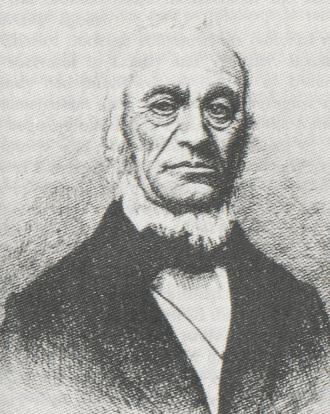 Welcome to the 1852 book, Slavery and Anti-Slavery: A History of the Great Struggle In Both Hemispheres; With A View of The Slavery Question In The United States, by Rev. William Goodell (1792-1878).

 [Rev.] John Wesley [1703-1791], the founder of Methodism, who had witnessed the workings of slavery in our North American colonies and in the West Indies, declared "