GOVERNMENTAL PRO-DRUG ACTIVITY,
TARGETING OF MINORITIES,
PERJURY PREVALENCE,
AND BRIBERY OF OFFICIALS:
A SHORT BIBLIOGRAPHY
AUTHOR LIST
SUGGESTED BACKGROUND SITES TO READ
PRIOR TO READING THE REMAINDER OF THIS WEBSITE
Legal Definitions
Medical Research
Prevent Crime
Prevent Drug Abuse
Prison Building
The Budzyn-Nevers Case
Dillow, Gordon L., "Thank You For Not Smoking," 32 American Heritage 94-107 (February-March 1981). Although the article includes some pro-tobacco disinformation, its page 103 admits bribery of officials by the tobacco lobby.
Fillmore, Charles M., The Tobacco Taboo (Indianapolis, IN: Meigs Publishing Co, 1930) (Already observing that "Tobacco is becoming increasingly allied with politics of the baser sort. . . . States are beginning to collect revenue from tobacco just as the Federal Government does. This is an indirect and insidious form of political bribery." He'd likely point to the recent State Attorney General sponsored tobacco deal in such terms as well.)
The Surgeon General Report (1998) "sends an urgent alarm" that "shows tobacco's increasing grip on racial and ethnic minorities."
| Tobacco pushers sell illegal cigarettes to minority children in particular, as shown by Elizabeth A. Klonoff, et al., "An Experimental Analysis of Sociocultural Variables in Sales of Cigarettes to Minors," 87 Am J Pub Health (#5) 823-826 (May 1997). Illegal sales are MORE to minority youth, than to white youth.
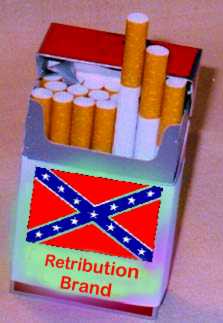
See also details by Meg Gallogly, "Tobacco Company Marketing to African-Americans" (5 January 2006). And see tobacco company evidence such as R.J. Reynolds' "Salem Black Initiative Program Brand Team Ideation Session (3 August 1989), a marketing report on pusher brainstorming, exploring ways to increase sales of Salem cigarettes to African Americans. This planned behavior by tobacco pushers targeting minority youth is intentional, a part of long-term anti-U.S. revenge, racism underlying DWB aided and abetted by unconstitutional speed limits allowing for massive ticketing increasing opportunities for DWB incidents. Cigarettes are a confederate product dating from the slavery era. Michigan was an abolitionist state, and abolitionists included anti-tobacco activities among their efforts. Targeting of minority youth to begin the drug lifestyle by initiating them into the starter drug delivery agent, cigarettes, is part of the long-established pattern of unreconstructed southerners to re-enslave blacks via the prison system, and to injure the North's people via crime, and the North's economy via health costs and the post-Civil War en masse establishment of a vast prison gulag and criminal justice system of enormous cost, due to the massively increased amount of crime which the joint confederate/organized crime/tobacco cartel have set in process, aided and abetted by confederates-in-attitude government officials and legislators. |
Tate, Cassandra, "In the 1800's, antismoking was a burning issue," 20 Smithsonian 107-117 (July 1989). Although the article includes some pro-tobacco disinformation, its page 115 admits bribery of officials (legislators) by the tobacco lobby.
United States v Sheriff Goins, 593 F2d 88 (CA 8, 1979) (has the official court-written narrative of the criminal prosecution and conviction of a sheriff for taking bribes to not enforce cigarette-related law. See also U. S. v Frumento, 409 F Supp 136 (ED Pa, 1976), affd 563 F2d 1083 (CA 3, Pa, 1977) cert den 434 US 1072; 98 S Ct 1256; 55 L Ed 2d 775, 46 U.S.L.W. 1042 (20 Sep 1977) cert den 434 US 1072; 98 S Ct 1258; 55 L Ed 2d 776 (State agency charged with responsibility of enforcing tax laws on interstate industry engaged in importing cigarettes from points outside state is an "enterprise" within this chapter; and indictment charged employee of Bureau with acceptance of bribes as part of cigarette-smuggling conspiracy.)
No ignorance plea allowed: as long ago as 1914, Thomas Edison cited one of the many factors/chemicals causing cigarettes' deleteriousness—acrolein (though he understated the problem, emphasizing boys whereas the harm is across-the-board, and he thought the problem was the cigarette paper vs the cigarettes themselves, but he saw the brain damage effect well enough to note that it was occurring).
Pre-1930's judges used to denounce the cigarette role in crime. Then they went silent 1940's on, then the massive judge bribery scandals of 1970's-on came about, e.g., the 'Operation Greylord' situation. For information on the gateway drug delivery agent, cigarettes, which are the typical means of initiating children into the drug life style, the starter drug, click here. That site has data on Michigan's gateway drug—cigarette—crime prevention act.
The above materials concern judges and officials who were caught taking bribes and/or doing other corrupt activities! When one person is caught speeding, hundreds of others are not caught. Might this be true of judges and other officials as well?!
From a jobs point of view, far more judges, prosecutors, and police are hired when the gateway drug delivery agent, cigarettes, is left uncontrolled by the Controlled Substances Act. This makes such officals available in large numbers for targeting whatever minority may be disfavored at any particular time (blacks one day, union strikers another day, etc. 'An injury to one is an injury to all.').
Obviously, due to Michigan's role as an abolitionist state opposing the Confederate product tobacco, drug prevention meant in 1909, eliminating the starter drug the unrepentant, unreconstructed Confederates were producing en masse. (And adulterating with coumarin, for rat poison, as a revenge measure "because the North stole their slaves"). However, due to the Confederate influence in government, as you suspect, that 1909 law is never enforced. Laws against public cursing can be enforced, but not the law that'd prevent mass killing of thousands of Michigan residents!! The web writer has been told by one officer just recently that he fears to enforce the cigarette control law lest his boss forthwith fire him.
The role of cigarettes in initiating vulnerable people into the drug lifestyle, alcoholism, and crime has been known since at least the 1850's. That's how the Confederate Army—often tobacco producers—after the war knew to use tobacco as a revenge measure against the North. Naturally, our Michigan abolitionist ancestors who knew the Confederate's vile mindset, tried to ban the starter drug delivery agent, cigarettes, that the unreconstructed South was producing and rat poisoning en masse.
The widespread refusal of Michigan government officials to enforce the anti-cigarette law has the obvious effect. What the law intended to prevent, is not being prevented, so we have an epidemic of cigarette effects as a "natural and probable consequence" and deaths at a level above the holocaust and genocide level of World War II. Hitler killed 6-10 million people worldwide. Tobacco is killing 37 million people in the U.S. alone. The Royal College of Physicians, in its book Smoking and Health Now (London: Pitman Medical and Scientific Pub Co, 1971), p 9, called cigarettes' then body count ("annual death toll of some 27,500"), the new "holocaust." Murder case precedents and legal definitions corroborate that analysis.
We see what are in essence Confederates in the police force willing to beat black post-gateway drug users to death, while continously ignoring the ommission of tobacco from the Controlled Substances Act, and for 90 years refusing to enforce the gateway-drug ban that would prevent such situations. See our website on the Budzyn-Nevers situation; our testimony against Detroit cigarette billboards; our prior testimony against Warren cigarette billboards; our testimony to increase the penalty for cigarette selling; and our testimony in favor of prevention instead of more lucrative prison building.
Tobacco is a Confederate product; tobacco farmers were lawless before the Civil War. Slavery was illegal and unconstitutional. Their lawlessness then went unpunished. There was no deterrent, and their descendants continue producing tobacco, and for revenge, began shortly after the Civil War, adding the adulterant coumarin (otherwise used, for example, for rat poison). The government should be protecting us, and the media should be warning us, but we see from the above writings, and from our own experience, that neither is doing so.
|
Bribery of officials (examples 1,
2, 3, 4, and 5 above) is not a new phenomenon. The U.S. Supreme Court case of Fletcher v Peck, 10 US 87; 3 L Ed 162 (February Term 1810), came about due to wholesale bribery of the entire Georgia legislature. The bribers wanted "special interest legislation" to get legislators to pass a law to contract to sell vast acreage of valuable state land (35,000,000 acres) to the bribers, at 1½¢ per acre. They used bribery. (That era was before the modern refined term of "campaign contribution"!) Around 1795, the Legislature passed the land sale bill as the bribers wanted, and the contracting for sale occurred.
When the voters learned what the bribed legislators had done, they voted them out of office, and put in new ones. The new Legislature repealed the bribe-induced law and sought to revoke the bribe-tainted contracting process!! The bribers sued to keep the ill-gotten gain (the Yazoo land grant). They argued that the Constitution's contract clause, Article I § 10 forbids repeal of a bribe-induced contract. Question: Did they WIN or LOSE at the Supreme Court? Don't look below yet. Ponder for a while.
Answer: The bribers won. Once bribers have succeeded and gotten the goodies, the bribe-induced grant sticks, and cannot be recovered!! It is unconstitutional [violates the Constitution's contract clause!] to deprive them, said the Supreme Court. Wherefore bribers can keep their ill-gotten gain!! Bank robbers should have it so good!! Having received judicial support at the highest level, 1810 to present, it is no wonder that bribers continue to bribe!! The voters could get rid of the bribed legislators, but they could not get rid of the pro-bribery judges. Those bribed legislators are now long gone, but a Supreme Court decision is forever. The pro-bribery decision of Fletcher v Peck remains the law of the land!! (and is available at any law library). 'Once bribed, always bribed!!' The bribery was extensive, "notorious bribery involving virtually every member of the Georgia legislature, two U.S. senators, and many state and federal judges (including Justice James Wilson of the Supreme Court)," says Kermit L. Hall, ed., The Oxford Guide to the United States Supreme Court Decisions (New York: 1999), p 93. For more on the bribery and corrupt aspects of the case, see the book by Univ of California-San Diego Prof. Peter H. Irons, Ph.D., J.D., A People's History of the Supreme Court (New York: Viking, 1999), pp 112-115 and 121. Re Justice Wilson, his "land speculations also landed him in prison," p 113. By 1849, the U.S. Supreme Court was recognized as the world's worst court. In the case of Swan v Indianola, 142 lowa 731; 121 NW 547 (1909), the Iowa Supreme Court took the opposite view than the U.S. Supreme Court. Iowa's honest court, rejected the Fletcher "don't check" notion, and instead upheld checking, in a contract situation, politician motive, to verify whether fraud had occurred. The Supreme Court currently allows additional abuses, e.g., manipulating laws so as to be able to jail disfavored minorities such as blacks disproportionately. The manipulation the Court allows has led to this effect: "More than 90% of the persons sentenced in 1994 for crack cocaine trafficking were black." See United States v Armstrong, 517 US 456; 116 S Ct 1480; 134 L Ed 2d 687, 701 (1996) The Supreme Court also allows the use of perjury to convict people, see Briscoe v LaHue, 460 US 325; 103 S Ct 1108; 75 L Ed 2d 96 (7 March 1983). The pro-perjury vote was 6-3 (the three including Justice Marshall who voted "no" are now deceased, replaced). Lower courts confirm a perjury victim's lack of redress, e.g., Advantor Capital Corp v Yeary, 136 F3d 1259, 1263 (CA 10, 1998); Morgan v Graham, 228 F2d 625, 627 (CA 10, 1956). Click to see example (cartoon). Justice Marshall's dissent cited "the apparent prevalence of police perjury," pursuant to the following references:
Police perjury is especially serious in view of the massive disenfranchisement process altering election results by cancelling people's (espeically minorities) right to vote when they have been supposedly convicted of crime -- including crimes they didn't commit but re which perjury was used to secure conviction. |
Are you shocked to think that governmental officials might promote drugs?! Don't be. Here's an example. The government of Great Britain literally forced China in 1839 and thereafter, to accept opium, despite China's intense efforts to end the problem, having banned it in 1800. Britain went to war with China to force it to accept opium. (Click here for a current identification of details, and here for a source written at the time.)
Politicians and lawyers have a record of disproportionate tobacco-using.—The Use of Tobacco, by Chemistry Professor John I. D. Hinds, Ph.D. (Nashville, Tenn: Cumberland Presbyterian Publishing House, 1882), p 63. For details on resultant brain damage, click here.
It is not deemed professional misconduct for a law school to admit people with "a history of mental instability that [law] school officials knew about."—Assoc. Press, "Three dead in shooting rampage," The Macomb Daily, p 5A (17 Jan 2002). The public learns of this law school policy of admitting the mentally ill, to potentially become our future judges!, typically if and only if, while in law school, the insane law student goes on a shooting rampage and kills, in that case, the law school dean, a professor, and fellow student!
Such behavior disregards early 19th century precedent, an official, a federal judge, was deemed insane by court staff and colleagues, later impeached and then removed for alcoholism noted after attaining office!! For example, see the case of the Impeachment of Judge John Pickering. Standards have certainly fallen!! Now it is deemed a joke! no bar to even beginning holding office!! The Pickering Impeachment for alcoholism and unlawful rulings is reported in The History of the Supreme Court of the United States: The Oliver Wendell Holmes Devise, Vol. 2, Foundations of Power, John Marshall, 1801-1815, by George Lee Haskins; General Editor Paul A. Freund (New York: Macmillan Publishing Co, Inc., 1981), pp 211-215 and 234-238. The constitutional clause on holding office during "good behavior" was held to preclude alcoholism. The same would apply to mental disorder.
1. First, remember what your mother taught you. A stitch in time saves nine. Solve the small problem early, so that it does not become huge later.
2. Next, for background, read the 'prevent crime' website and at least eight others of the following:
Cancer Data - 1925
Cigarette Ads Are Illegal
Coumarin in Tobacco
Legal Definitions | |||
Medical Research Technique
Michigan Law
Officials for Extraditing
Prevent Abortion | |||
Prevent AIDS
Prevent Alcoholism
Prevent Alzheimer's
Prevent Birth Defects | |||
Prevent Crime
Prevent Drug Abuse
Prevent Heart Disease
Prevent Lung Cancer | |||
Prevent Mental Disorder
Prevent SIDS
Tobacco Genocide
Tobacco Murder |
3. You'll then understand how the "stitch in time" analogy applies. Dealing with tobacco = the stitch in time. Not dealing with it and then having to deal with the various (nine+) tobacco effects = not doing the stitch in time. Notice that many people, including judges, in the past century and the first half of this one, tried to get society to deal with the gateway drug delivery agent, cigarettes, as a crime prevention measure. When society's reaction was contempt for prevention, naturally judges realize that! Society is not serious about crime prevention before-the-fact. Society tolerates a bribed Congress exempting tobacco from the Controlled Substances Act! Society has overwhelmingly expressed its preference for crime to happen, then have sadomasochistic punishment-after-the-fact. Why not make money off it?
4. Notice that instead of action directed towards preventing the underlying factor in crime (tobacco induced brain damage, the 90% factor), fraudulent approaches are used. These scam approaches follow three main patterns:
(a) Denunciations of some of (i) the stimuli to which the brain damaged person is over-reacting (e.g., violent movies, pornography) or (ii) the current means used (swords in the past, guns now) or the behaviors (e.g., wearing trench coats, making threats). Why? So as to get large contributions from their gullible adherents, though themselves knowing that the problem of smoker brain damage leading to these reactions and often to crime existed long prior;
(b) Punishment advocacy though obviously inapplicable to, and ineffective with, brain damage. Why? For the purpose of creating jobs for vast numbers of prosecutors, judges, police, guards, and prison builders (who provide campaign contributions); and
(c) Treatment, rehabilitation, and drug testing advocacy, though knowing and repeatedly observing that brain damage is an anatomy matter not responsive to normal punitive/counseling techniques, and that fighting post-gateway drugs is pointless when the gateway drug is not first eliminated. Again, the goal is making money off suffering, not prevention of the initial problem, the 90% smoking factor in crime.
5. One of the current scams is to establish post-gateway drug courts!! and drug testing. Our honest ancestors of 1909 who banned cigarettes, the gateway drug, would be stunned!! They thought they had gotten rid of the gateway drug!! and protected their descendants (us) from the problem even existing! If they could see the mass systemic corruption of today, how disappointed they would be.
6. Notice your legislators. How many of them can you PROVE—under oath, in court—are NOT the 1790's Georgia-type? Notice them wildly reacting to individual incidents reported in the media, feigning concern, while brazenly disregarding the vast body of knowledge developed over the centuries on tobacco-induced brain damage, and the vast number of smoker incidents. This is written on a day (1 June 1999) that a bribed area legislator is announcing plans to criminalize yet another over-reaction to a stimulus, while ignoring the typical tobacco cause of that over-reaction. (I can say "bribed legislator" because bribery is systemic. That statement is on the order of, for example, saying, 'the pope is Catholic'—a truism, beyond refuting).
7. When you see lobbyists and legislators reacting to individual isolated incidents, rather than acting to prevent the 90% factor in crime (smoking, as reported 1850's to present), you are observing corruption and bribery in action. It is systemic.
8. When you see no enforcement of, for example, Michigan's safe cigarettes law, don't assume that no police officer wants to enforce it. Bear in mind that when an officer enforces a law, e.g., arrests someone who turns out to be a supervisor, mayor or senator's son, the officer may then shortly thereafter be fired! Such retaliation has a chilling effect on others. Ask yourself, perhaps someone tried to enforce the cigarette law, and was retaliated against?
| “When you see that trading is done, not by consent, but by compulsion — when you see that in order to produce, you need to obtain permission from men who produce nothing — when you see that money is flowing to those who deal, not in goods, but in favors — when you see that men get richer by graft and by pull than by work, and your laws don't protect you against them, but protect them against you — when you see corruption being rewarded and honesty becoming a self-sacrifice — you may know that your society is doomed.”—Ayn Rand (1905-1982), Atlas Shrugged (1957), in Paragraph 16 of Francisco d'Aconia's “Money Speech,” p 387.
Note the analyst “. . . who maintained that laws were like cobwebs; strong enough to detain only the weak, and too weak to hold the strong.”—Anacharsis, 6th century. B.C. In a study of corruption in U.S. states, here is one analysis: "Louisiana Most Corrupt State in the Nation, Mississippi Second, Illinois Sixth, New Jersey Ninth," says vol. 21, Corporate Crime Reporter, p 40 (8 October 2007). See also David Critchley, The Origin of Organized Crime in America: The New York City Mafia, 1891-1931 (New York: Routledge, 2009) and Jeffrey S. Adler. Review of Critchley, David, The Origin of Organized Crime in America: The New York City Mafia, 1891-1931. H-Law, H-Net Reviews. July, 2010. URL: http://www.h-net.org/reviews/showrev.php?id=30433. . |
On the record, former Governor John Engler and staff were paper supportive of cigarette control, for example, see
| Exec Order 1992-3 | Pro-Law Letter # 1 | Cigarette Smuggling Memo | Pro-Law Letter # 2 | E-Mail Overview |
Please encourage Michigan officials to take action to enforce MCL § 750.27, MSA § 28.216. Please pick a subject, and send him a letter asking for enforcement. (Of course, it is hoped that you will send additional letters to others pursuant to the multiple samples provided, and encourage others to do likewise).
| Abortion | AIDS | Alcoholism | Alzheimer's Disease |
| Birth Defects | Crime | Drug Abuse | Heart Disease |
| Cancer | Mental Disorder | The Seat Belt Issue | SIDS |
Please pick a subject(s), then write. The life you save may be your own!
Suggestions for adding to the above bibliography are welcome at Email@TCPG.
| Please Join Our Discussion Group |
Please visit our tobacco background website.
Copyright © 1998, 1999 TCPG