with your own consent to prefix your name to our publication. I call it ours—for no other reason than my obvious connection with it and cordial approbation of it; and certainly not to deprive the Reverend Mr. Lane of his due honors as the author and the producer of a work so learned, eloquent and worthy, and at the same time so seasonable and so needed in our menaced community. I trust also, Honored Sir, that it will meet your own high approbation, and that before you leave us in your venerable age, you will recommend to your countrymen a full and honest consideration of its contents; nay, a prompt and principled compliance with its luminous and friendly inculcations.
and admiring posterity respect all you said, and wrote, and did, for the benefit of our common country, and, indeed, for the good of universal man with a filial and high esteem—of which we may not now attempt to graduate the attitude or the influence.
There is much pseudo-affection for man abroad in our age, that ought rather to be branded as lycanthropy than philanthropy; since its short-sightedness is so idiotic and unworthy the functions of a rational mind. What is genuine seeks the true interests of man, even at the hazard of displeasing him for a moment.
solace in any event that we have done right, and endeavored to benefit our fellow-creatures. When the non-descript prodigy of the WOODEN HORSE stood before the open gates of the wondering Trojans, it looked as innocent and friendly, and desirable, on the whole, to them, as TOBACCO ever does to our Americans. They were deceived by appearances, and the advice of the silly and fashionable Thymœtes was followed, against the unpalatable warnings of Capys and Laocoon. The words of the latter remind us of the faithful appeals of our author, though he, I trust, will not so vainly tell the truth to his countrymen. Let us recall them—
- Et procul; 0 miseri, quæ tanta insania, cives?
Creditis avectos hostes? aut ulla putatis
Dona carere dolis Danaûm? sic notus Ulysses?
Aut hoc inclusi ligno occultantur Achivi;
Aut hæc in nostros fabricata est machina muros,
Inspectura domos, venturaque desuper urbi;
Aut aliquis latet error; equo ne credite, Teucri.
Quicquid id est, timeo Danaos et dona ferentes.
Which we thus accommodate—
- What madness this, with thundering voice he cries,
0 citizens, your welfare to despise?
- Trust ye the monster is indeed a friend?
Or think these dainties may no poison blend?
Judge ye this gift is all it would appear?
And know ye not the death that slumbers here?
Or foes insidious in this fabric lurk,
Or wanton on their way our doom to work.
A pest contrived to desolate our homes,
And change our cities into pompous tombs.
Or some untold and horrid mischief lies
Deceptive there our dotage to surprise.
Trust not the fallacy! I dread a foe
Much more with smiles of goodness on his brow.
Be safe—be clear—be clean; you'll die full soon
Without the fate disguised in such a boon.
prove much, in the estimate of a Christian or a philosopher, in favor of tobacco. Is it proved—fairly proved, by such a monstrosity?
_____
patient and attentive near him; and through all the well-cooked courses and dainties he was sparing and abstemious, waiting,—for a cigar. All that series of various excellence, preceding his favorite luxury, he valued only as a tolerably tedious turn-pike road to the pleasures of fumation. Presently, some fine yellow Spaniards were served—when the Doctor recovering his spirits, reached prompt and far to secure one, not unobserved by Mr. Morris. The consciously awkward action occasioned a mutual glance, when the following dialogue ensued, to the no small interest of the arrested circle.
The reproof was felt by more than the Doctor. The cigars were not patronized.
- For antidote against all care,
Give me, ye gods, a good cigar.
It is very plain that wherever smokers, or chewers, or snuffers are, and abound, it were well for all proximate persons to "have old clothes on;" since such exposure to a vicious and offensive ptyalism, must defile their garments, even if it did not nau-
scate their refinement. Hence in every rail-car, or steamer, "abaft the wheel," GENTLEMEN are "NOT ALLOWED" to smoke; though it has been well observed, that such an inhibition were in terms superfluous—since GENTLEMEN are not the ones that need to be reminded or forbidden. We recommend that their public announcements should rather read—
GENTLEMEN NEVER SMOKE, ESPECIALLY IN THE COMPANY OF LADIES
OR STRANGERS; AND ALL OTHERS ARE WARNED AGAINST THE NUISANCE
AND ITS PENALTIES.
monstrous succession'—retrocession—on the other sex, excepted!
among parents, companions, and neighborhoods, that luxuriate in the practice, at births, marriages, funerals, and all other occasions.
wet—or so dry—or else so indescribably threatening, or peculiar, or of no particular character, and therefore they must take—alcohol, or—tobacco!
| |SMOKING| | ||
| Modern | {CHEWING| | vulgar modes of self-defile- |
| |SNUFFING| |
ment are we most disagreeable to real gentlemen, true ladies, and genuine philosophers? I answer it may be difficult and useless to determine. Enough that it is all wrong—that every man is better without it—that its practice is hurtful and injurious, without any real benefit or mark of wisdom in it.
How much in a year, often increasingly, is the amount of money paid by some persons for this luxury! It is almost incredible—as often its sum is purposely unknown. If all Christians paid as much for evangelical missions, it would soon revolution the world.
Your voice is injured, if you snuff. If you chew, only think of the incongruity! If you smoke, your error is not to be concealed. If you are addicted to it in any way, you are degraded, and your odor follows you everywhere. Its offences are many, and they adhere to your persons. Pernoctant nobiscum, peregrinantur, rusticantur—dice aperte, nos, nos, consules desumus.*
_____
legitimate and proper use, according to the excellent will of God.
equaling the self-productiveness of sin. One aberration from propriety, or one false principle or error, may in its train corrupt a world, explode a universe, and astound eternity. All the methods of luxuriating in tobacco tend to social wantonness, with aspects and associations not of good report. Many a clergyman has disgusted a congregation, lost a good settlement and injured the best of causes, by his ignominious indulgences of this sort. Many truly elevated and refined persons object to hearing in the pulpit a notorious man of tobacco—their feelings are so revolted at the thought and sometimes at the sight, of the nuisance.
asked, in London, a distinguished friend of the Temperance Reformation, What good does it? the reply was, The good it does, my Lord, is chronicled, ascertained, reported, and accredited by all who are acquainted with the facts. Will your Lordship be good enough to tell me what evil it does? whom it injures, or makes worse, or reasonably at all offends? What harm is it?
What is the fact to the eye of calm and considerate observation? Look at the ways of revelry and voluptuous infatuation in our thronged cities. Look at our theatre-goers, our ball-frequenters, our gambling-house loafers; and mark all the tributary rills of influence that come to a fearful confluence in the great ocean of profligacy and perdition—and say, if the dirty vice of tobacco-mongering, in all its forms, degrees, and stages, of dishonor, is not congenial, powerful, and even essential in the formidable result as well as the stealthy process. The genius of tobacco is properly bacchanalian, sensual and deleterious to all the dignity of man, in low life of savages and boors not only.
| In courts and palaces he also reigns,
And in luxurious cities, where the noise Of riot ascends above their loftiest towers, And injury and outrage; and when night Darkens the streets, then wander forth the sons Of Belial, flown with insolence and wine. * * * * * * * * Tobacco's curling fumes, or covert quid, Or pungent dust, assists them in their course, |
| Congenial with ebriety and noise,
The prompter of profaneness, folly, crime.* |
_____
ficiently vulnerable and sufficiently mortal; they are transient and fleeting and vanishing like vapor in their life; and why not abstain from all the causes which debilitate the body; enervate the faculties; and accelerate the catastrophe of death? This abstinence is the dictate equally of philosophy and duty.
tably often do they CHEW, SNUFF, and SPIT*, to the grand annoyance of all the cleanly, and all the devout, who have to witness the shameful profanation! These abominations, we are credibly assured, are observed—not frequently, yet sometimes—even at the communion table!! Here indeed it becomes horrible, and worthy of the disciplinary animadversion of ecclesiastical authority! I must abhor it and pronounce it plainly impious. An indulgence so filthy, so indolent, so reckless and irreverent, in the very house and the holy presence of God! may it NEVER be repeated, if it ever was perpetrated! Let a man think—have a little forecast—look ahead—and remember how sinful it is towards Him, who says,
YE SHALL KEEP MY SABBATHS AND REVERENCE MY SANCTUARY; I AM JEHOVAH.
_____
have formally vetoed the practice in their domain, and even made a public monument of their decree in the vestibule of the sanctuary, in these or similar words:
And many a worthy officer of a congregation, whose usefulness is more felt than seen, we mean the unappreciated sexton, has reason to sound a trump of accusation against a set of GENTLEMEN, well known to him, whose filthy salivations so mark and desecrate the sacred places of the sanctuary, as to offend him especially, whose labors are execrably enhanced as the result! And should he publish the names of these gentlemen—sat sapienti, non stulto! sed—compressis venis, pituitae impetum cohibe.THE TRUSTEES POSITIVELY FORBID THE USE OF TOBACCO, WITH
ITS FILTHY RESULTS, IN THIS SANCTUARY OF GOD, AND ESPECIALLY
DURING DIVINE SERVICE, UNDER PENALTY OF THE LAW.
sured terms against street-smoking in New York. We learn that the Native American candidates for the next councils are to be pledged to abate, among many others, this crying nuisance." * * *
dred hhds. of tobacco, valued at $100,000. This is the first entire cargo of tobacco ever shipped from tlie United States to Russia."
Quæ de causa, pro mea consuetudine, beviter et simpliciter dixi, judices, ea confido probata esse omnibus; quæ non fori, neque judiciali [seu clerica] consuetudine, et de hominis ingenio [perverso] et communiter de ipsius studio [trupissimo] locutus sum, ea, judices, a vobis spero esse in bonam partem accepta; ab eo, qui judicium exercet, certe scio.
and inserted in this Introduction—and I wish I could show to all men the original! The chirography of the writer now, I think in his 79th year, is a commentary and a eulogium on those habits of temperance in all things, of which he is such a rare and impressive example. The envelope, for the sake of the autograph, has been begged away from me by a friend, to whom I reluctantly resigned it—mainly on account of the seal, with its beautiful device and motto, of which I must tell the reader and so preserve the memory. An acorn, decorated with two oak leaves; neither guardant, nor rampant, nor couchant; but simply extant and verdant; surmounted with the circular motto, ALTERI SECULO. This I view as very happy; as showing a republican independence of all the beggarly barbarism of heraldic symbols and inscriptions, so often badly usurped, and imitated, and perpetuated in our own free country, whose affinities and honors are neither feudal nor monarchical, but properly of another and a higher character. It also shows modesty, forecast, the estimate of posterity anticipated, and an original wisdom of sentiment worthy alike of the philosopher,
the republican, and the man—meaning, FOR A FUTURE AGE, or ANOTHER AGE; the acorn fairly prospective of the noble oak it makes in other days; though humble now, and unobtrusive, and unseen, yet to become the tall monarch of the wood, beneath whose giant branches and frequent foliage, protection and refreshment may be yielded grateful to many a weary traveller in other days and years. How worthy were such sentiment of our statesmen, our patriots, and our countrymen! especially if, with revelation's light, far-sighted, and by faith, their estimates were amplified and crowned with the hope of heaven, and their ALTERI SECULO justly construed to mean, HEREAFTER, IN ETERNITY, IS MY REWARD.
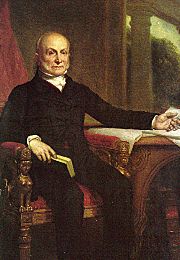
Quincy, Massachusetts, 19 Aug. 1845.
DEAR SIR,—
to me of your introduction to the proposed publication of the Reverend B. I. Lane's work on TOBACCO AND ITS MYSTERIES. In my early youth I was addicted to the use of tobacco in two of its mysteries, smoking and chewing. I was warned by a medical friend of the pernicious operation of this habit upon the stomach and the nerves; and the advice of the physician was fortified by the results of my own experience. More than thirty years have passed away since I deliberately renounced the use of tobacco in all its forms; and although the resolution was not carried into execution without a struggle of vitiated nature, I never yielded to its impulses; and in the space of three or four months of self-denial, they lost their stimulating power, and I have never since felt it as a privation.
wheat-field, and add five years of longevity to the average of human life.
- Your friend and Christian brother,
- JOHN QUINCY ADAMS.
Reverend Samuel H. Cox, D.D. Brooklyn, N, Y.
as an oracle, plurimum in parvo, against this insidious and hypocritical ravager, this dirty depredator on the interests and the hopes of improved society in our noble Republic. And as to health, you have touched the very point! the stomach and the nerves are its proximate victims. The stomach, that wondrous laboratory of all the pabulum of life, that central, and primary, and all-controlling organ of our wonderfully compounded being in this world, first "gives signs of woe" and then the nerves, the glands with their secretions, the muscles and functions of the entire system, respond to the shock, and reel under its deleterious power; according to that grand apothegm of the medical schools, so worthy and so true, ventriculo languido omnia languent; when the stomach is disordered, the total system droops m sympathetic weakness. Yes! the mind included—and I believe that, when tobacco makes the morbid languor the moral powers are debilitated, their sense blunted, the very conscience injured and corrosive, as the consequence.
ences of the grace of God; and, through the accomplished and eternal mediation of ONE, the Son of God and the Son of man, whom all saints apprehend and trust as their ineffably glorious Redeemer and inheritance, that you may be well prepared for that great change sublime, which death will soon realize to the best, and prove at last and for ever the vision, the fruition, and the perfection, of the divine glory, with all the saved, in the presence of God Almighty and the Lamb!
- Your friend and servant for Jesus' sake,
- SAMUEL H. COX.
[Preface]
clouds would be showered on our path. Then how grateful and how pleasing,
Such service would harmonize with the spirit of the times. But smiles and blessings we cannot purchase at such a price. We must not bear false witness to save or condemn either friend or foe. We have too deeply felt the lash of the tyrant to become his eulogist; and we purpose to show you some of the wounds and scars which he is ever inflicting with his whip of scorpions."To sing the praises of that glorious weed—
Dear to mankind, whatever his race, his creed,
Condition, color, dwelling, or degree!
From Zembla's snows to parched Arabia's sands,
Loved by all lips, and common to all hands!
Hail, sole cosmopolite, tobacco, hail!
Shag, long-cut, short-cut, pig-tail, quid or roll,
Dark negro-head, or Orinooka pale,
In every form congenial to the soul."
reformation, and little success has attended them. The sober light of reason and the scorching fire of invective, have been spent upon this evil practice in vain. In vain has chemistry developed the poisonous quality of the article; in vain has experience taught us that misery, disease, and death follow in its train. The deceptive pleasure of its use, like the charm of a serpent has held us captive, and none have been fully aware of its nature, until its poisonous fangs have been felt.
heal or alleviate the distress. Arsenic appears with a lowering brow, and the compressed lip of madness, and the naked dirk;—it does its work quick, and is known to be an enemy. Not so with tobacco: it has a smiling face, its tread is light, some of its movements pleasing, and though it inflicts more pain and misery than arsenic, it does its work slowly and disguisedly; and hence the food we eat, the water we drink, and the air we breathe, are too often charged with the evils which itself inflicts.
It will be bad enough to say the truth of it. Othello like, it stabs its lovers, and stabs them while reposing in security."Speak of it as it is: nothing extenuate,
Nor set down aught in malice."
THE NATURE OF TOBACCO.
"The broad-leaved tobacco furnishes from its juices the following constituents.1. A large quantity of animal mat-
- ter, of an albuminous nature.
- 2. Malate of lime with an excess of acid.
- 3. Acetic acid.
- 4. Nitrate and muriate of potash in observable quantities.
- 5. A red matter soluble in alcohol and water, which swells and boils in the fire, its nature undetermined.
- 6. Muriate of ammonia.
- 7. A peculiar acrid, volatile, colorless substance, soluble in water and alcohol, and which appears different from any thing known in the vegetable kingdom. It is this principle which gives to prepared tobacco its peculiar character, and it is perhaps not to be found in any other species of plant. Its medicinal activity is supposed to reside in this volatile portion, which is the "essential oil."
|
Instruction sur la Combustion des Végétaux, la Fabrication du Salin, de la Cendre Gravelée, et sur la Manière de Saturer les Eaux Salpêtrées (Tours: Impr. d'Auguste Vauquer et Lhéritier, 1794)
Instrucçào sobre a Combustaõ dos Vegetaes: para a Factura do Alkali vegetal, das Cinzas Gravelladas (Lisboa: S. T. Ferreira, 1798) Expériences sur les sèves des végétaux (Paris: Quillau, 1799) Manuel de l'essayeur (Paris: Chez le citoyen Bernard, 1799) Handbuch der Probirkunst (Königsberg: F. Nicolovius, 1800 ) Analyse de la Matière Cerebrale de l'Homme et de Quelques Animaux (Paris: 1811) Manuel de l'essayeur (Paris: J. Klostermann, 1812) Sur le Parc aux Huitres du Havre: Rapport Fait a la Faculté de Médecine de Paris (Paris, 1820) Dictionary of Chemistry, Containing the Principles and Modern Theories of the Science, with its Application to the Arts, Manufactures, and Medicine Tr. from Le dictionnaire de Chimie Including the Most Recent Discoveries and Doctrines of the Science, with Additions and Notes (New York: G. & C. & H. Carvill, 1830) Mémoire sur la Nature des Terres qui sans Culture et sans Engrais sont plus ou Moins Favorables à la Nourriture et à la Croissance des Végétaux ... lu à la Société Royale et Centrale d'agriculture le 3 Février 1830 (Paris: impr. Mme Huzard, 1830) Manuel Complet de l'Essayeur (Paris: Librairie Encyclopédique de Roret, 1836) To see Dr. Depierris's 1876 summary of Vauquelin's tobacco analysis, in French, click here. |
0.72; silica 0.09; woody matter 4.97; and water 86.84= 100.00. During the fermentation of the leaves there is always a formation of ammoniacal salts."
|
Économie Rurale Considérée dans ses Rapports avec la Chimie, la Physique et la Météorologie (Paris: Béchet 1843)
Rural Economy in its Relation with Chemistry, Physics and Meteorology, or Chemistry Applied to Agriculture (New York: O. Judd; New York: D. Appleton & Co; and Philadelphia: G. S. Appleton, 1845) Rural Economy, in its Relations with Chemistry, Physics, and Meteorology, or, An Application of the Principles of Chemistry and Hysiology to the Details of Practical Farming (London: H. Bailliere, 1845) Rural Economy in its Relation with Chemistry, Physics and Meteorology, or Chemistry Applied to Agriculture (New York: D. Appleton, 1848) Viajes Científicos a los Andes Ecuatoriales; ó Coleccion de Memorias sobre Física, Química é Historia Natural de la Nueva Granada, Ecuador y Venezuela (Paris, Lasserre, 1849) Rural Economy in its Relation with Chemistry, Physics and Meteorology, or Chemistry Applied to Agriculture (New York: D. Appleton, 1850) Mémoire sur la composition de l'Air Confiné dans la Terre Végétale (Paris: Bachelier, 1853) Mémoires de Chimie Agricole et de Physiologie (Paris: Mallet-Bachelier, gendre et successeur de Bachelier, 1854) Rural Economy in its Relations with Chemistry, Physics and Meteorology, or Chemistry Applied to Agriculture (New York, C.M. Saxton, 1856) Rural Economy in its Relations with Chemistry, Physics and Meteorology, or Chemistry Applied to Agriculture (New York, C.M. Saxton, 1857) La Fosse a Fumier: Leçon Professée au Conservatoire Impérial des Arts et Métiers (Paris: Béchet jeune, 1858) |
1. "I made," says he, "a small incision in a pigeon's leg, and applied to it the oil of tobacco. In two minutes it lost the use of its foot. 2. I repeated this experiment on another pigeon, and the event was exactly the same. 3. I made a small wound in the pectoral muscles of a pigeon and applied the oil to it; in three minutes the animal could no longer support itself on the left foot. 4. This experiment repeated on another pigeon, resulted in the same way. 5. I introduced into the pectoral muscles of a pigeon a small bit of wool covered with this oil; the pigeon in a few seconds fell insensible. 6. Two other pigeons to whose muscles I applied this oil, vomited several times. 7. Two others with empty stomachs, treated in the same mode, made every effort to vomit."
destroy life, at once finds tobacco too powerful for his use; and in those cases where it is most clearly required only makes it a last resort." As an emetic, it is said to exceed all others in its promptness, violence, and permanence of impression. In some instances it has been used with success in expelling other poisons from the stomach on account of the promptness and violence with which it acts. It can be applied as well externally in the form of a poultice to the stomach as internally, and with the same effect.
of the most active class. The great prostration, excessive giddiness, fainting and violent affections of the alimentary canal, which often attend its internal use, make it proper that so potent a drug should be resorted to by medical men, only in restricted doses, and on occasions of magnitude."
| Pharmacologia; or the History of Medicinal Substances, with a View to Establish the Art of Prescribing and of Composing Extemporaneous Formulae upon Fixed and Scientific Principles; Illustrated by Formulae, in Which the Intention of Each Element is Designated by Key Letters (New York: F. & R. Lockwood, 1822) |
every quid and cigar does not produce complete prostration or death is, that nature puts forth her best efforts to resist its influence; and, as if mad at the offence given her; either spits it out, or otherwise ejects it from the system. But tlie constant application of it from year to year; will, in the course of time; so wear out her energies, that she will sink under the reiterated assaults.
hibiting the sale of them under severe penalties. Why then is tobacco so generally used; and why are so few efforts made to save the world from its deadly influence? Why? Because of its intoxicating property,—the appetite and habit is so strong that the grave must open to make a man throw away his pipe or his quid. Men are held captive by it, in the same way that they are held captive by alcohol. It does not, so generally, it is true, make men stagger like alcohol, but it as really blinds and deceives. Few of those who use alcohol apprehend any injurious results. And just so it is with those who use tobacco; some of both classes have at times awful convictions that its use is injurious; and will bring them through a wilderness of woes, prematurely to the grave; but the cup in the one case, and the pipe or quid in the other; lulls their fears.
all these, and numerous other ills. To take tobacco for a cold and watery stomach would be like taking a portion of corrosive sublimate to antidote the corrosions of a dose of arsenic. To take tobacco to purify the breath would be like turning a current of air from a common sewer into our parlors to sweeten them. And as to headache, and weak eyes, we promise the inveterate user of tobacco that as soon as he can get his system delivered from its influence, the aches of his head and the weakness of his eyes will leave him. But some will say, "We have been afflicted with these ills, and tobacco has given us relief." So says the spirit drinker. But we positively know, from personal experience, that all these ills have been produced by tobacco; and a very little knowledge of the nature of the article is sufficient to convince any man that its direct tendency is to produce them, unless it be employed to counteract the influence of other poisons already in the system.
CHAPTER II.
THE INFLUENCE OF TOBACCO UPON THE BODY.
passes through the body. But it could not with any safety be retained in the stomach, and if taken into the system by being mixed with the food, the consequence would be quickly fatal (See note A.) No man, in health, can make a daily use of it, to gratify his appetite, without certain injury to his constitution. He may not perceive the injurious effects for years, on account of the immediate exhilaration, but complicated chronic complaints will, after a time, creep upon him, making life a burden, and ending in premature dissolution, though he may impute his sufferings to other causes, and even die folded, in unsuspicious confidence, in the arms of his murderer.
and as I watched the smoke ascend in clouds above my head, I decided to persevere, until my pipe was out, notwithstanding I began to feel queer, and it made my tongue smart sorely; however, I rued my determination, for long ere I had done puffing my head began to ache, and just when my pipe was out, a cold sweat came over me, and then a shivering fit, and at last, nature, offended with the trick I had played her, by a fit of sickness, threw off some of the effects of the tobacco smoke."
sight; it creates thirst and loss of appetite, and, in this, and other ways, often lays the foundation for intemperance.
foundeth the senses with sudden astonishment and stupidity of the whole body."
his quid, or sucks his pipe, or suffocates himself with tobacco dust, but instead of light, behold darkness and the shadow of death come upon him. We speak what we do know, and testify what we have seen;—would that we knew less.
seventeen years of age, of a pulmonary consumption, whose disorder was brought on by the intemperate use of cigars."
its nauseous taste, and stimulant property, excite and keep up a profuse discharge from the mucous fallicles and salivary glands. The great increase of this just before and after eating, and the large quantities swallowed about that time, is unequivocal evidence of its importance to the digestive economy. What then must be the state of that man's digestion, who, until seated at table, keeps his quid in his mouth, and immediately returns it thither after rising from his meal? And when we reflect that large quantities of saliva strongly impregnated with this poison, and even particles of the substance itself, are frequently swallowed, what, again I ask, is the probable condition of such a person's digestive organs?"
the philosophy of causes and their effects. A writer in the Journal of Health says, "Experiments on animals show, that if a decoction of opium or tobacco be applied to the brain or spinal marrow, there is at first increased excitation of the heart, and ready contraction of the muscles: but after a time the circulation becomes more languid, and the muscles refuse to contract under any irritant even directly applied to them.
complexion losing its freshness, is of a turbid hue, or decidedly jaundiced."
it! At last she abandoned the snuff-box; the muscles re-acquired their proper tone; and in a short time after she was entirely cured of her disorder, which was occasioned solely by her attachment to her snuff-box, and to which she had nearly fallen a martyr."
| A Dissertation on the Use and Abuse of Tobacco Wherein the Advantages and Disadvantages Attending the Consumption of that Entertaining Weed are Particularly Considered: Humbly Addressed to all the Tobacco-Consumers in Great Britain and Ireland, But Especially to Those Among Religious People (London: G. Whitfield, 1797; London, G. Whitfield, 1798; Liverpool: J. Nuttall, 1805; Newburyport [Mass]: Thomas & Whipple, 1812; Salem: Henry Whipple, 1812; Burlington, N.J.: David Allinson & Co., 1812; London, 1814; New York: C. S. Van Winkle, 1819; New York : M'Elrath and Bangs, 1829; Baltimore: Sherwood & Co., 1845; London, W. Tegg & Co., 1857; Newburyport: Thomas & Whipple, 1900 and 1983; London: Whitfield, 1900 and 1983; New York: Van Winkle, 1900 and 1983; and Burlington, N.J.: Allinson & Co., 1900 and 1983) |
consumption brought on by the immoderate use of this powder." We were well acquainted with one aged gentleman, occupying a high station in society, who was ever complaining of coldness and distresses in his head, to find relief from which he took a variety of medicines, never thinking that his difficulties were occasioned altogether by the use of snuff. He, however, continued the practice, and fell a victim.
snuff, may be applied to the tender internal surface of the nose, it may be proper to inquire; for if the oil of tobacco is a mortal poison when applied to the open vessels of a wound, surely this plant, when taken in substance as snuff, must be injurious. From the infinite number of nerves diffused over the mucous membrane of the nose, it is endowed with exquisite feeling, and the better to preserve the sense of smelling, those nerves are continually lubricated with moisture. By the almost caustic acrimony of snuff this moisture is dried up, and those fine delicate nerves, the organs of smelling are rendered useless and almost insensible. To this self-evident bad effect, may be added the narcotic, or stupefying power of tobacco, by which not only the brain and nerves are injured, but also the eyes, depending upon their influence."
in little scirrous intumescences, which, if kept easy and free from everything of an irritating character, will continue harmless, but which the use of snuff sometimes frets into incurable ulcers and cancers. By the use of snuff, tumors are also generated in and around the throat which obstruct deglutition, and even destroy life. Dr. [John] Hill saw a female die of hunger, who could swallow no nourishment, because of a polypus which closed up the stomach, the formation of which was attributed to snuff. The drain of the juices by tobacco has a tendency to injure the muscles of the face, to render them flaccid, to furrow and corrugate the skin, and to give a gaunt, withered, and jaundiced appearance to the human face.
tion he remained till I brought a person who gave him several pinches, and he then informed us that he had commenced his journey that morning, supposing he had his snuff-box with him, but found very soon he had started without it; that he had travelled as long as he was able, till at last, overcome by distress, he found it impossible to proceed any further, and without my timely succor he would certainly have perished."
"To such a height with some is fashion grown,
They feed their very nostrils with a spoon;—
One, and but one degree is wanting yet
To make their senseless luxury complete,
Some choice regale, useless as snuff and dear,
To feed the mazy windings of the ear."
stomach resumed its wonted tone, his muscles acquired their former elasticity, and his speaking was no more annoyed by a relaxation of the azygus uvulæ. Another man, who used tobacco very sparingly, became affected with loss of appetite, sickness at the stomach, emaciation, and melancholy. From a conviction that even the small quantity he chewed was the source of his trouble, he entirely left it off, and very soon recovered.
continued long and obstinate, he has nearly or quite recovered his former health. And he has never doubted that the use of tobacco was the cause of all his suffering from this disagreeable disease."
CHAPTER III.
THE INFLUENCE OF TOBACCO UPON THE MIND.
"although," says Dr. [William] Alcott, "many people of real intelligence become addicted to this practice, as is the case especially among the learned in Germany, yet it cannot be denied that, in general, those individuals and nations, whose mental powers are the weakest, are, (in proportion to their means of acquiring it,) most enslaved to it."Zimmerman says, "The Gypsies suspended their predatory excursions, and on an appointed night in every week assembled to enjoy their guilty spoils in the
fumes of strong waters, and tobacco." The censure of Chesterfield upon snuff taking is rather severe, although it applies equally to smoking and chewing. After characterizing the use of tobacco in any form as both vulgar and filthy, he adds, "Besides, snuff takers are generally very dull and shallow people, and have recourse to it merely as a fillip to the brain; by all means, therefore, avoid the filthy custom."
ness, confusion of ideas, violent pain in the stomach, vomiting, convulsions, and even death."
because in proportion as the mind is weakened it is incapable of knowing or describing the process by which it has become so.
the power of expression sluggish. The abandonment of tobacco will, in the course of time, be the restoration of the intellect to its wonted vigor; if its elasticity be not completely destroyed by the withering influence of this strong narcotic.
been known, like alcohol to issue in delirium tremens. (See note C.) Why should it not? Its nature is adapted to produce it. It has often stupefied and discouraged the student, bewildered the philosopher, and confused and darkened the divine. Many a splendid sermon has it enveloped in smoke. 0, that some of its victims would speak out,—that some of those gigantic powers which it has prostrated could lift up their notes of warning; they would send a thrill of anguish through the bones and marrow of every man who possesses the least spark of humanity or religion.
tion, his flesh increased, and he soon regained his health."
insanity as alcohol. Why should it not? What is the nature of tobacco? It contains as its basis a most powerful narcotic poison, possessing properties of the kind that opium does, with this addition, that it is more immediately irritating to the tissues of the body to which it is applied. Though for a season the system rejects and expels the nicotine, the most deadly of its properties, yet parts of its deleterious qualities without doubt mix with the chyle, which is to form part of the mass of blood, and is carried with it into the circulation, and courses through every vessel and is exhaled at every pore. Few articles more powerfully affect the nervous system. No wonder that it impairs the memory of those who use it, weakens all their intellectual powers, and sends down its influence to posterity, so that the children of those who use it to excess are more liable to insanity.
in the most perfect manner a healthy action? There is none. What gland can extract from it the least portion of nutriment or any thing which can contribute to healthy or be in any way useful in the animal economy? There is none. The anatomist, the physiologist, the chemist, and the physician examine with the minutest care every part throughout the whole body, and they can find none. GOD has made none, and there is none.
territory. Never, till vital power is prostrated, can the enemy have a lodgment. And if through decay of organic vigor, by the mighty force of the intruder by the long continuance of the war, and by perpetual successions of new recruits, it cannot be expelled, the work of death is done;—the last citadel of life surrenders, and the banner of universal ruin waves over all. Thousands of such conquests are made every year; conquests of territories more valuable than all the material wealth of creation. Before, the prospect was like Eden,—-afterward, like a land of sepulchres, with the shrivelled carcasses of tobacco consumers, sending up in clouds their poisonous exhalations, wafting contagion and death through the land.
hoped that the time is not far distant, when it will be understood what the matter is! The use of tobacco tends to derange healthy mental action in another way,—by its irritating effect on the nerves. This leads in many cases to total insanity; as, we believe, the records of every lunatic asylum in Christendom would testify if an accurate examination and discovery could be made.
being, no injurious effects are perceived. Give him now a small portion of opium, and you lay him in a gentle sleep. Now administer a small quantity of tobacco, and mark its effects: presently he turns pale, then a.cold sweat comes over him, a general lassitude, and a nausea, deadly, and painful in the extreme. Judging from the effects, which now of these poisons is the most fearful?
CHAPTER IV.
THE INFLUENCE OF TOBACCO ON THE MORALS.
farther adds as his belief that the tobacco plant was the true Indian conquest for which the jolly god has been so celebrated. He, moreover intimates that the Thyrsus of that deity was afterwards ornamented with leaves of tobacco, instead of ivy.
"For even the derivation of the name
Seems to allude and to include the same
Tobacco as IT %"PPT (To Bakcho) one would say
To cup-god Bacchus dedicated ay."
| "As in the night, imagining some fear,
How easy is a bush supposed a bear." |
| Ed. Note: As a result of their brain's tobacco-induced delusional or paranoiac notions, such smokers become abulic, "dépossédés du sens humain . . . par une impulsion qu'on ne peut qualifier que de folie . . . désordre . . . comme les bêtes fauves . . . . dégradation narcotique les abaisse . . . rage . . . déchirent, ils mutilent sans nécessité, par instinct féroce."—Dr. Hippolyte A. Dépierris, Physiologie Sociale: Le Tabac (Paris: Dentu, 1876), p 342. See also the analysis by Vernon H. Mark, M.D., and Frank R. Ervin, M.D., Violence and the Brain (New York: Harper & Row, 1970). |
| Ed. Note: See 1572 massacre background by Dr. Depierris, Physiologie Sociale, p 41; and a similar subsequent tobacco-related massacre in 1871, p 334. |
therefore, are inebriating: and those who habitually indulge in it may with propriety be denominated drunkards." [Ed. Note: modern term, addicts.]
followed by a general use of brandy and water as a common drink, more especially by that class of citizens who have not been in the habit of drinking wine or malt liquors. One of the greatest sots I ever knew, acquired a love for ardent spirits by swallowing cuds of tobacco, which he did to escape detection in the use of it; for he had contracted the habit of chewing, contrary to the advice and commands of his father. He died of a dropsy under my care in the year 1780."
into his present wretched and miserable condition. Without any desire for ardent spirits, he first sipped a little gin and water, to allay the disagreeable sensation brought on by smoking, as water was altogether too insipid to answer the purpose. Thus he went on from year to year, increasing his stimulus from one degree to another until he lost all control over himself, and now he stands as a beacon,.warning others to avoid the same road to destruction."
use tobacco, often use alcoholic drinks without violating their pledge; for their pledge allows them to take it as a medicine; and under the thousand various ills occasioned by tobacco, they feel the need of some alcoholic stimulant to restore them, and it is often prescribed by their physician. But let them throw aside their tobacco and they will need none; nature will move onward in her own strength, and find her own enjoyment. As long also as temperance men use their tobacco, others will plead it as a justification for using their occasional glass. That tobacco possesses an inebriating quality peculiarly its own, no man who has carefully examined its nature and effects, will presume to deny. It is as rational then to expect that the cause of temperance will triumph in China while they continue their opium, as to expect its final triumph in America, while we continue our tobacco. (See note D.)
of intemperance are lost to the influence of motives, of arguments, and of facts." It certainly would seem as if motives dissuading from this habit were heard in every voice, and wafted on every breeze. They are presented in the shrivelled aspect, in the nasal twang, in the fœtid breathe, in the sallow complexion, in the filthy habits, and in the numerous diseases occasioned by tobacco. They are thundered in our ears by the immoral companionship, the irreligious tendencies, the useless expense, and the suicidal nature of this habit. Yet all these are often found too feeble to induce even a professor of religion to break off a habit which he is ashamed to own has much power over him, and for the continuance of which he cannot give one substantial reason.
a dark and dingy hue. She re-examined herself in the glass, and could not but observe that her complexion, which was formerly clear and beautiful, was extremely sallow. She threw her snuff-box in the fire, and it was but a short time before her friends, without knowing the cause, had occasion to congratulate her on her improved appearance.
well aware, will be thought strong language to use in reference to tobacco, although it would not be thought too strong in relation to alcohol. Let the following question then be seriously considered,
How can a mind be prepared profitably to receive and entertain religious truth, so much under the influence of a powerful narcotic, that the absence of it produces general uneasiness, a kind of vacancy of thought and, in some instances, distraction?It is in vain for those who use it to say that they cannot perceive any sensible impression from it. So says the spirit drinker when he has taken but one or two glasses. Take away the man's tobacco, and you put him to the torture. Has it then no influence upon him? Strange that men should deny what is so perfectly obvious to those who have gained the conquest over their appetite. "0 that men should put an enemy in their mouth to steal away their brains!"
the habit of using tobacco. So strong is its power over a man, that those addicted to it have no confidence in the final success of any attempt to leave it off. If one speaks unfavorably of its use, the question is, "How long since you quit the practice?" "Six months," perhaps is the reply. "Don't boast then," is the rejoinder, "before the year expires you will be as deep in guilt as ever." A man must have quit it for years before any confidence will be felt that his victory is complete. It is like a right eye or a right hand, and how much soever it may cause us to offend [I Mark 9:42-47], few have the strength of purpose to separate themselves from it forever.
petite and passion. It weakens the motives to good, and strengthens the motives to evil. In direct and palpable violation of what the Saviour teaches us as the proper daily petition of every soul under heaven; it leads men into temptation, and delivers them to evil. Taking "day by day," not "daily bread," but a poison of a most deceitful and malignant kind, that divine agent, who loathes it and all its effects as an utter abomination, and who would otherwise illuminate, and purify, and save with an everlasting salvation, is grieved away.
CHAPTER V.
THE ILLUSORY INFLUENCE OF TOBACCO.
"Harriot enlarges much on the virtues of this herb, concluding his eulogium with the remark; that those who employ it are not only freed from all kinds of obstructions in the system, but are, in
addition, cured of those which they might chance to have, even though the complaint be of long standing. Master Harriot would seem, however, to have taken a spite towards tobacco subsequently, for in his Journal quoted by Knickerbocker he says, of the Susquehanocks—"Their tobacco pipes were three quarters of a yard long, carved at the great end witli a bird, bear, or other device, sufficient to beat out the brains of a horse!' (and how many asses' brains are beaten out, or rather men's brains smoked out, and asses' brains haled in, by our lesser pipes at home!")
under its influence often have, for a moment, most horrible convictions that it is deeply injuring them, but even then the very next instant they will resort to its use, and persuade themselves that it is a comfort and a blessing. Out of the same mouth proceedeth blessing and cursing [I James 3:10] on this stupefying, blinding weed.
"Stinking'st of the stinking kind,
Filth of the mouth and fog of the mind,
Africa that brags her foyson,
Breeds no such prodigious poison;
Henbane, night-shade, both together
Hemlock, aconite—Plant divine of rarest virtue; —Nay, rather,
Blisters on the tongue would hurt you;
Twas but in a sort I blamed thee,
None e'er prospered who defamed thee."
the cross. First let me observe that the Cardina Santa Croce first introduced tobacco into Italy. His ancestors had the reputation of having brought into the same country the wood of the true cross. Thus speaks Bayle as translated by M. de Maizeaux:
Sore eyes relieves, and healeth wounds; the same
Discusses the king's evil, and removes
Cancers and boils; a remedy it proves
For burns and scalds, repels the nauseous itch,
And straight recovers from convulsion fits,
It cleanses, dries, binds up, and maketh warm:
The headache, tooth-ache, colic like a charm
It ceaseth soon; an ancient cough relieves,
And to the veins, and milt, and stomach give
Quick riddance from the pains which each endures;
Next the dire wounds of poisoned arrows cures;
All bruises heals, and when the gums are sore,
It makes them sound and healthy as before.
Sleep it procures, our anxious sorrows lays,
And with new flesh the naked bone arrays.
No herb hath greater power to rectify
All the disorders in the breast that lie,
Or in the lungs. Herb of immortal fame!
Which hither first by Santa Croce came,
When he (his time of nunciature expired)
Back from the Court of Portugal retired;
Even as his predecessors, great and good,
Brought home the Cross, whose consecrated wood,
All Christendom now with its presence blesses;
And still the illustrious family possesses
The name of Santa Croce, rightly given,
Since they in all respects resembling Heaven,
Procure as much as mortal men can do,
The welfare of our soul and bodies too."
weed to one of his prime agents, Bacchus, might impair its wide-spread, deadly influence, he made an effort to give it another name, and call it after John Nicot, who first introduced it into France. He succeeded, however, in affixing it, nicotiana, only as its botanical surname. To us, however, it seems exceedingly proper that it should take part of the name of Nicot. "Old Nic," would be an appropriate name—it would foil tlie devil in his device—and might help some to understand its nature. As it is employed in his service, let it bear his name.
course of future events. Their physicians also got inebriated with this smoke, and pretended that while under the influence of this intoxication, they were admitted to the council of the gods, who revealed to them the event of diseases."
"The smoker," says Macnish, in his Anatomy of Drunkenness, "while engaged in his occupation, is even a happier man than the snuffer. An air of peculiar satisfaction beams upon his countenance; and as he puffs forth volumes of fragrance, he seems to dwell in an atmosphere of contented happiness. His illusions have not the elevated and magnificent character of those brought on by opium or wine. There is nothing of Raphael or Michael Angelo in their composition—nothing of the Roman or Venitian schools—nothing of Milton's sublimity or Areosto's dazzling romance; but there is something equally delightful and in its way equally perfect. There is an air of delightful homeliness about them. He does not let his imagination run riot in the clouds, but restrains it to the lower sphere of earth, and meditates delightfully in this less elevated region. If his fancy be unusually brilliant or somewhat heated by previous drinking, he may see thousands of strange forms floating in the tobacco smoke. He may people it according to his temperature with
agreeable or revolting images—with flowers and gems springing up as in dreams before him—or with reptiles, serpents, and the whole host of diablerie skimming like motes in the sunshine, amid its curling wreaths."
cessive tobacco consumers are ever complaining of disagreeable feelings, and yet so deceived are they that they are ever resorting to the cause of their ills to find relief. To hear them enumerate the ills with which they are afflicted, you would suppose them the greatest of valetudinarians; and no doubt many of them are, and have become so by the use of the very plant which they think such a sovereign remedy for all their diseases.
that he could not agree with us in our views of tobacco, for he had used it twenty years, and it had never injured him; but with almost the same breath, he said, it often made him feel bad, and he was obliged to moderate his dose for a time.
minds. Perhaps they have never understood that tobacco has done the mischief.
"False as the smooth, deceitful sea,
And mischievous as hell."
CHAPTER VI.
THE FILTHINESS OF TOBACCO.
point disputed, which clearly indicates all modes to be nearly at par with each other. Of snuffing, says Macnish,
"If it were attended with no other inconvenience, the black loathsome discharge from the nose, and the swelling and rubicundity of this organ, with other circumstances equally disagreeable, ought to deter every man from becoming a snuffer."Says a writer in the Methodist Quarterly,
"Whether the rock goat or the tobacco-worm first taught imitative man to masticate tobacco, we are ignorant. One thing, however, is most certain, that of all modes of using it, chewing seems most vulgar and ungentlemanlike; and it is worthy of particular remark that in our country it is more used in this manner, among the better classes of society, than in any other part of the world."
| Ed. Note: Others citing
rock goats' tobacco use: George Trask (1860) Meta Lander (1882) But see Dr. Alcott's denial. |
"Smoking is indecent, filthy, and rude, and to many individuals highly offensive. When first introduced into Europe, in the sixteenth century, its use was prohibited under very severe penalties, which in some countries amounted even to cutting off the nose. And how much better is the practice of vol-
untarily burning up our noses by making a chimney of them."The effects of smoking upon the clothes and breathe and indeed upon the whole body, are most offensive. What is more overpowering than the stale smell remaining in a room where several persons have been smoking? King James does not forget to note this habit as a breach of good manners. "It is," says he, "a great vanitie and uncleannesse." One thing is certain, that between smokers, snuff takers, and chewers, boasting is excluded. To each of the practices is awarded by different judges, the infamy of being the most injurious and uncleanly.
"the merchants frequently lay it in bog houses, to the end that becoming impregnated with the volatile salts of the excrements, it may be rendered brisker, stronger and more fœtid."
"A dealer in this article once acknowledged to me," says Dr. Clarke, " that he sprinkled his rolls and leaf
frequently with stale urine to keep them moist and to preserve the flavor. A friend of mine whose curiosity led him to see tobacco spinning, observed that the boys who opened out the dry plants, had a vessel of urine by them with which they moistened the leaves to prepare them for the spinner!"This practice may be discontinued in some places, but the possibility of obtaining such an article we should suppose would be an additional motive to deter from its use. It is, we believe, a very general practice among cigar makers to take water into their mouths, and spurt it upon the leaves to moisten them.
"Mr. Editor:—Do you chew tobacco? I did till last Sunday, when I put my veto on the practice. The why and the wherefore I send you, hoping that if you are guilty of using the Indian
weed, a leaf from my diary may be the means of reforming you.Saturday, Oct. 19, 1833. Took my hat for a walk; wife, as wives are apt to, began to load me with messages, upon seeing me ready to go out. Asked me to call at cousin M—'s, and borrow for her the "Sorrows of Werter."—Hate to have a wife read such namby, pamby stuff—but must humor her whims, and concluded that I had rather she should take pleasure over "Werter's Sorrows" than employ her tongue in making sorrows for your humble servant. Got to cousin M—'s door. Now cousin M. is an old maid, and a dreadful tidy woman.—Like tidy women well enough, but can't bear your dreadful tidy ones, because I am always in dread while on their premises, lest I should offend their superlative neatness by a bit of gravel on the soles of my boot, or such matter. Walked in—delivered my message, and seated myself in one of her new cane-bottomed chairs,
while she rumaged the book-case. Forgot to take out my Cavendish before I entered, and while she hunted, felt the tide rising. No spit-box in the room. Windows closed. Floor carpeted. Stove varnished. Looked to the fireplace—full of flowers, and hearth newly daubed with Spanish brown. Here was a fix.. Felt the flood of the essence of Cavendish accumulating.—Began to reason with myself whether it were better, as a last alternative, to drown the flowers, redaub the hearth, or flood the carpet.—Mouth in the mean time pretty well filled.To add to my misery, she began to ask questions. "Did you ever read this book, Mr. —?" "Yes, ma'am," said I, in a voice like a frog in the bottom of a well, while I wished book, aunt, and all, were with Pharaoh's host in the Red Sea. "How did you like it?" continued the indefatigable querist. I threw my head on the back of the chair, mouth upwards, to prevent an overflow. "Pretty well," said I. She at last found the "Sorrows of Werter," and came towards me.—"Oh dear, cousin Oliver, don't put your head on the back of the chair, now don't, you'll grease it, and take off the gilding." I could not answer her,
having now lost the power of speech entirely, and my cheeks were distended like those of a toad under a mushroom. "Why, Oliver," said my persevering tormentor, unconscious of the reason of my appearance, "you are sick, I know you are, your face is dreadfully swelled!" and before I could prevent her, her hartshorn was clapped to my distended nostrils. As my mouth was closed imperturbably, the orifices in my nasal organ were at that time my only breathing places. Judge, then, what a commotion a full snuff of hartshorn created among my olfactories!I bolted for the door; and a hearty a-chee-he hee relieved my proboscis; and tobacco, saliva, &c., "all at once disgorged" from my mouth, restored me the faculty of speech. Her eyes followed me in astonishment and I returned, and relieved my embarrassment by putting a load on my conscience. I told her I had been trying to relieve the toothache by the temporary use of tobacco, while, truth to tell, I never had an aching fang in my head. I went home mortified.
Sunday forenoon. Friend A— invited myself and wife to take a seat with him, to hear the celebrated Mr. — preach. Conducted by neighbor A. to his pew. Mouth, as usual, full of tobacco! and, horror of horrors, found the pew elegantly carpeted, white and green, two or three mahogany crickets, and a hat stand; but no spit-box!! The service commenced; every peal on the organ was answered by an internal appeal from my mouth for a liberation from its contents; but the thing was impossible. I thought of using my hat for a spit-box; then of turning one of the crickets over; but I could do nothing unperceived. I took out my handkerchief, but found that in the plenitude of her officiousness, my wife had placed one of her white cambricks in my pocket, instead of my bandanna. Here was a dilemma. By the time the preacher had named his text, my cheeks had reached their utmost tension, and I must spit or die. I arose, seized my hat, and made for the door. My wife (confound these women, how they dog one about!), imagining me unwell (she might have known better), got up and followed me. "Are you unwell Oliver?" said she, as the door
closed after us. I answered her by putting out the eyes of an unlucky dog with a flood of expressed essence of Cavendish. "I wish," said she, "Mr. A—-— had a spit-box in his pew." "So do I." We footed it home in moody silence. I was sorry my wife had lost the sermon, but how could I help it? These women are so affectionate—confound them—no, I don't mean so. But she might have known what ailed me, and kept her seat.Tobacco! oh Tobacco! But the deeds of that day are not all told yet. After the conclusion of service along came Farmer Ploughshare. He had seen me go out of church, and stopped at the open window where I sat. "Sick to-day, Mr. —— ?" "Rather unwell." answered I, and there was another lie to place to the account of tobacco. "We had powerful preaching, Mr. ——: powerful preaching; sorry you had to go out." My wife asked him in, and in he came—she might have known he would, but women must be so polite. But she was the sufferer by it.—Compliments over, I gave him my chair at the open window. Down he sat, and fumbling in his pocket, drew forth a for-
midable plug of tobacco, and commenced untwisting it. "Then you use tobacco," said I. "A little occasionally," said he, "as he deposited from three to four inches in his cheeks. "A neat fence that of yourn," as flood after flood from his mouth bespattered a newly painted white fence near the window. —"Yes," said I, "but I like a darker color." "So do I," answered Ploughshare, and "yaller suits my notion: it don't show dirt." And he moistened my carpet with his favorite color. Good, thought I, wife will ask him in again, I guess. We were now summoned to dinner. Farmer Ploughshare seated himself. I saw his long fingers in that particular position in which a tobacco chewer knows how to put his digits when about to unlade. He then drew them across his mouth—I trembled for the consequences, should he throw such a load upon the hearth or floor. But he had no intention thus to waste his quid, and—shocking to relate—deposited it beside his plate, on my wife's damask cloth!This was too much. I plead sickness and rose. There was no lie in the assertion now, I was sick.
I retired from the table, but my departure did not discompose Farmer Ploughshare, who was unconscious of having done wrong. I returned in season to see Farmer Ploughshare replace his quid in his mouth to undergo a second mastication; and the church bell opportunely ringing, called him away before he could use his plate for a spit-box; for such I am persuaded would have been his next movement.I went up stairs, and throwing myself on the bed, fell asleep. Dreams of inundations; floods and fires harassed me. I thought I was burning and smoked like a cigar. I then thought the Merimack had burst its banks, and was about to overflow me with its waters. I could not escape—the water had reached my chin—I tasted it—it was like tobacco juice. I coughed and screamed, and awakening found I had been asleep with a quid in my mouth. My wife entering at the moment, I threw away the filthy weed. "Huz, if I were you I would not use that stuff any more!" "I won't," said I. Since Sunday I have kept my word. Neitheir fig; nor twist; pig-tail nor Cavendish; have passed my lips; nor ever shall they again."
Even in our rail-road cars, and aboard our steamboats, which sometimes appear as if mangled and scarred by tobacco, public testimony is borne to the indecency and ungentlemanliness of the practice, in the notices which, in glaring capitals, meet the eye:
-119-
"NO SMOKING ABAFT THE WHEELS."
any other feelings than those of abhorrence, the black drop on the nose, or the dirty lip of the snuffer, the fœtid, sickening breath of the smoker, the filthy mouth, yellow teeth, and nauseous puddle of the chewer? It is surprising that all tobacco users are not cured by the sight of one another.
you with their filthy breath. Even the children in our Sabbath schools have been known to complain that the breath of their teacher was so offensive, they could not endure his presence.
CHAPTER VII.
THE EXPENSIVENESS OF TOBACCO.
years. But there are a very large number whose cigars cost them more than seventy dollars a year—Here then is a fortune smoked away in a few years. When a young man is seen with a cigar in his mouth it would be well to raise the alarm by the cry of fire! fire! fire! Put out his cigars and you may save him a splendid house, and a life beside. If you see a little smoke issuing from a crevice of your neighbors building, you give the note of alarm, and yet perhaps there is not half the danger,—not near the amount of damage would accrue, were the whole to be consumed, that may result from that young man's smoking.
contention—"leave it off before it be meddled with."
be found suffering from want. Yet this habit prevails extensively among the poor. There are many who subsist upon the bounty of others, who nevertheless consume a daily supply of tobacco. A considerable portion of the scanty pittance they can command is thus thrown away. This ought to receive the attention of benevolent societies, and individuals, and no person should be aided by public or private charity who will not abandon this pernicious habit.
"A pious clergymen," says Dr. [Adam] Clarke, "lately told me that he had a number of very poor persons in his parish immoderately attached to the use of tobacco. He plainly saw that a large portion of their daily earnings was destroyed in this way. He warned them in private, and preached in public against it, but few of them had resolution enough to lay it aside. The expense of one very poor family in snuff and tobacco he calculated, and found it to amount to nearly one third part of their yearly earnings."In estimating its expense, we must not confine ourselves to the bare amount expended to procure it, but we must take into the account the cost of the necessary utensils for using it, and the time
spent in consuming it, which in value will be found to exceed by far the article itself.
"Every professed inveterate snuff taker, at a moderate computation, takes one pinch in ten minutes. Every pinch with the agreeable ceremony of wiping and blowing the nose, and other incidental circumstances, consumes a minute and a half. One minute and a half out of every ten, allowing sixteen hours to a snuff-taking day, amounts to two hours and twenty-four minutes out of every natural day, or one day out of ten. One day out of every ten amounts to thirty-six days and a half in a year. Hence if we suppose the practice persisted in forty years, two entire years of the snuff takers life will be dedicated to tickling his nose, and two more to blowing it. The expense of snuff, and snuff-boxes, and handkerchiefs, will be the subject of a second essay," he says, "in which it will appear that this luxury encroaches as much on the income of the snuff taker as it does on his time; and that by a proper application of the time and money thus lost to the
public, a fund might be constituted for the payment of the national debt."
"In a debate in the British House of Commons, HUNT told the ministers:—Their change of resolution respecting the duty on tobacco—that most filthy, disgusting, abominable weed—he had not the least doubt would be very generally approved of. Who would pretend to say that this odious plant was held in England a necessary of life? or who take it upon him to say that the execrable, beastly habit of chewing tobacco was a rational custom, or a wholesome comfort? Besides, no one can now-a-days hope to walk in the public thoroughfares without having to endure continual whiffs of noisome effluvia from half-burnt cigars, smoked by ambulatory, whiskered dandies—he would not call them gentlemen—who puffed their smoke, and spat their saliva, in the most offensive manner imaginable,
on every side around them, in both streets and stage-coaches at noon-day."
"This plague, like the Egyptian plague of frogs, is felt every where and in every thing. It poisons the streets, the clubs, and the coffee houses;—furniture, clothes, equipage, persons are redolent of the abomination. It makes even the dulness of the newspapers doubly narcotic: every eatable and drinkable, all that can be seen, heard, felt, or understood, is saturated with tobacco;—the very air we breathe is but a conveyance for this poison into the lungs; and every man, woman, and child, rapidly acquires the complexion of a boiled chicken. From the hour of their waking, if nine tenths of their population can be said to awake at all, to the hour of their lying down, the pipe is never out of their mouths. One mighty fumigation reigns, and human nature is smoked dry by tens of thousands of square miles. The German physiologists compute, that of twenty deaths between eighteen and thirty-five years, ten originate in the waste of the constitution by smoking."Look at that! Ten out of twenty deaths caused by smoking! The number seems incredible. But the physicians of Germany who have examined the subject ought to be informed. It is the opinion of some of the
best physicians in our country, that more than twenty thousand die annually in the United States by reason of the use of tobacco!! O the truth in relation to this subject is not known. The world is asleep on this subject. The church is asleep. The friends of temperance are asleep. The enemy is laughing to scorn our feeble attempts to destroy intemperance, while we leave untouched one of its principal sources.
of the land is going up as the smoke of a furnace, and if nothing is done to arrest it, it will issue in a tremendous earthquake, that will shake and overthrow our altars and our liberties, and destroy our lives. Say not I exaggerate: " Behold how great a matter a little fire kindleth," especially when that fire sends forth a smoke intoxicating, bewitching, spell-binding.
harbor such an enemy? Will you countenance him and lend him your influence?
But tobacco does injure you. It is weaving your winding sheet—it is digging your grave. But though it is fitting the grave for you, it is not fitting you for the grave. Will you then take warning? If you will not, my soul shall weep in secret places for you.
"my lord, my nose is not hungry." Nature is never hungry for tobacco.
est friends of temperance," it is said, "use tobacco, and very freely too." So, likewise, many of the loudest and warmest friends of temperance formerly used their wine daily. But what now would be thought of the professed friend of temperance who should daily sip his wine? As killing a friend of temperance will the smoker or cbewer be thought, when the same flood of light is poured upon tobacco, that is now poured upon the wine cask.
together with rum, it should make a man whip his wife. Then, again, we have no doubt, if some good-natured wives should speak out, and tell the truth, they would say that their husbands have whipped them a good many times by the filthiness, fœtid smell, and undeanliness of tobacco.
and quit yourself like a man. Say not, "I can't." What can you do? (See note F.)
NOTE A.
as soon as it was known that he had committed the infamous transaction. Whether any farther notice will be taken of it, we know not, but certainly if there is any punishment that can reach him, he should not be permitted to escape "unwhipt of justice."—New York Express.
Letter from Rev. William A. Hallock.
REV. MR. LANE,
each with a long pipe, pleasing themselves with the curling smoke; he believed they were forming an injurious habit, and that duty to them and their parents required him to arrest it; but how could he do it while he smoked himself! He said to them, "Now, all quit smoking, and I will." It was done, and done effectually. A few months after this, on returning home, I found he had quit chewing also. I asked him if it was not more self-denial than was necessary, at his years, and remarked that the aged often seemed to enjoy the moderate use of tobacco. "I will have no such habit that I cannot master," was his reply. I think the Temperance principle of total abstinence had naturally led his mind to this state; and to the age of almost fourscore to which he was spared, he touched neither tobacco, nor intoxicating drink. It was parental influence, early exerted, tliat, under God, guarded me from all these habits. I pity the slave of any one of them, and beg you to call on parents to guard their children against these evil habits.
NOTE C.
REV. AND DEAR SIR,
after I came to Ct. I received the particulars of his death by Rev. Mr. H—, then pastor of that church. He made no use of alcoholic drink—was a distinguished friend of the Temperance Reformation. He had some trials in the misconduct of an adopted son whom he loved. I think he had no children of his own. I believe he made no use of tobacco, except for smoking, and for two or three years that was incessant. He would smoke till he came to the meeting-house steps, and then light his pipe on the steps after service. I was told that for the last few months he shut himself in his room, and mourned and smoked without cessation.
MY DEAR SIR,
upon the human constitution, and the pecuniary loss in various ways it occasions the people of this country.
plate will call attention to this important question. There can be no doubt that the use of tobacco is greatly on the increase. It is time that its deleterious qualities should be fully developed, and the question agitated throughout the land. When the whole truth shall be developed in regard to the poisonous qualities of this plant, the use of it must terminate with Christian people.
EDWARD G. DELAVAN.
Letter from Dr. Edwards to the
Editor of the Temperance Journal.
not believe that while our young men and boys are trained in such extravagant habits of smoking, we can effectually fasten upon the nation the temperance reformation. And if this be so, will not temperance men, for the good of the cause, themselves renounce entirely the filthy weed?"
tion, to poison the atmosphere which other men must breathe, and set an example, which, if followed by children and youth, will tend to injure and destroy them? Is it not plain, that all the animal gratifications which men can safely enjoy, or which they have a right to seek, can be found in the proper gratification of the natural appetites and passions which God has given them; and that the formation of a new, artificial, unnatural appetite for tobacco, alcohol, or other poisons, for the sake of increased animal gratification, is a violation of a moral principle, and that the consequences must prove, "the way of transgressors to be hard?" Perhaps you may find it convenient, from time to time, to publish in your very useful paper some of the principles and facts contained in the above-mentioned pamphlets; and thus promote the cause of abstinence from the ordinary use of all poisons as well as that of Alcohol.
-148-
REV. MR. LANE,
cases, a valuable medicine [Ed. Note: drug], is, therefore, an argument against, and not in favor of, its habitual use. I believe it to be in its nature, what is termed a sedative, that is, a substance which lessens vital action directly, and tends to extinguish life. This appears from its promptly reducing the normal action of the digestive organs, as well as by its lessening the inflammatory action of any particular part to which it is applied, and by its producing death without the intervention of inflammation, when taken in sufficient quantity.
wise good and correct habits, and her excellent constitution, I could impute her fatal disease to no other cause than her excessive use of snuff.
this point, the well known facts in relation to the two Silesian brothers, mentioned by the celebrated Tissot, are not irrelevant. They were smoking for a wager, and both fell down and died in an apoplectic fit, the one in smoking his 17th, and the other his 18th pipe. But as such experiments must and ought to be rare, it may be proper to institute the inquiry, whether a more moderate use of the pipe has a tendency to produce the above-named disease.
proved. But the symptoms of this form of apoplexy as given by a modern standard writer* are the following: "alarming vertigo; a feeling of faintness; sickness at stomach and vomiting; disturbance of the senses, especially of sight; loss of memory; partial loss of sense, consciousness, and voluntary motion; weak, irregular and sometimes quick pulse, with more or less of sleepiness." Now, the question of the similarity of these symptoms to those produced by tobacco smoking, may be submitted to the memory and experience of those who have some time or other been made sick by smoking tobacco. On those who have never had this experience, my argument is lost, unless they will try the experiment.
____________
in it, we should expect to find cases where smoking as well as snuffing has preceded a paralytic attack. Accordingly, we do find that such cases are more numerous than those of apoplexy. The influence of snuffing in aggravating the symptoms of nervous disease which have been of increased frequency within the last ten or twelve years, especially among females, will be readily admitted by medical men, as I have often proposed the omission of the habit with very obvious and successful results.
tal anxiety. 7th. Fits of passion. 8th. External heat. 9th. The use of tobacco.
When reduced to a very low condition, he informed his physician that he had been in the habit of chewing tobacco and swallowing the saliva, but his information was communicated too late, and he shortly after died.
spreading and destroying the coats of the blood-vessels, until repeated hemorrhages entirely exhausted him.
in less than three years, an enormous size, involving one of the kidneys, and a portion of the liver, and filling one side of the abdomen, and preventing him, for many months before death, from lying in a horizontal posture.
rhous stomach. The scirrhous portion of the stomach, extended from near the lower orifice, over a surface from 2 to 3 inches in width, entirely around the stomach, the inner surface of which was already in an ulcerated or cancerous state. That the diseased condition above described bore the relation to tobacco of an effect to a cause, may not admit of positive certainty, inasmuch as the predisposing and efficient causes of cancerous disease cannot [in 1845] in most cases be known, yet it is difficult to avoid the belief in this case that tobacco had an important agency either in inducing or aggravating the disease.
nutritive process—that the lymph which exudes through the capillary vessels in the ordinary course of nutrition or some accidental inflammation, appears to have its vitality perverted—so that instead of forming in itself the normal cells out of which the proper tissues of the body are developed, it forms the irregular abnormal cells constituting a malignant tissue.
the alleged cause cannot be more satisfactorily made out by the indirect or reversed mode of comparison. If, then, it can be shown that when a person in the daily use of tobacco is laboring under the above symptoms, they mostly disappear soon after omitting the use of tobacco, the cause of such symptoms is clearly made out.
cal writers, accords with the above views. Dr. Druitt, an approved modern surgeon, directs "that before resorting to extirpation, the general health should be improved by a tonic course, or an alterative plan of treatment." The same course should be pursued, even if extirpation should be impracticable. But we have seen above that the general health is more speedily improved, in the case of those who use tobacco, by omitting its use, than by any other means. This, then, in the case of one using the drug, would naturally form one of those means recommended. But if the disuse of a thing would aid in removing a disease, it is reasonable to infer that its use would have a tendency to aggravate, if not to produce it.
the stomach. It may be recollected by many that this opinion was given by the attending physician of the celebrated Dr. Holyoke, who made a post mortem examination of his body. He testified before the legislature of Massachusetts, when about passing the nine-gallon law, that the cause of his death was a scirrhous state of the stomach, a result often witnessed in the case of those who were in the daily and regular or moderate use of tobacco and rum.
| Ed. Note: More First
Time Use Examples: Dr. Jackson (1826) Dr. Titus Coan (1850) Diocletian Lewis (1882) Neal Dow (1882) Dr. Schroff (1882) Blatin (1882) Higley & Frech (1916). |
in, he has a two-fold difficulty to contend with,—in fact; I have in several instances seen the most prominent symptoms of delirium tremens take place from suddenly leaving off chewing tobacco—as also in the commencement of the habit.
- I remain, my dear sir,
- JAMES THORN, Jr.
timonies of men of worth and standing in community, and too well known to need any commendation from our pen.
REV. MR. LANE,
DEAR SIR,
to discover its poisonous effects upon me I cannot precisely state, as I suffered in many ways and for a long time, before ever suspecting the cause or causes. I very soon was made sensible that the use of the vile stuff had destroyed my appetite; but what of that,—had I not acquired another, and one to my vain youthful mind more manly than eating food to satisfy nature's claims? It is now in my painful remembrance, that for years I did not eat food with that relish which God and Nature designed for me. As a natural consequence, when I succeeded in destroying the healthy tone of the stomach, dyspepsy, with its legion train of evils, set in upon me. I regarded myself as unfortunate in the loss of my health and vigor at so early an age, and was ready to blame for my misfortune every body and every thing, sooner than myself and my tobacco.
dered that any minister should ever be found willing to assume a parochial charge in a city. My pulpit preparations, always difficult enough under the most favorable circumstances, became a burden too hard to be endured. I went into my study like the prisoner to his cell. It was a painful labor to collect my thoughts, and still more difficult to concentrate them upon a subject.
and not again to be entangled in the yoke of bondage." [Gal.5:1]
- Affectionately yours in the Gospel
Of our common Lord, JAMES L. HODGE,
Pastor of 1st Baptist Church, Brooklyn.
DEAR SIR,
retching. During the balance of the 27 years I was frequently troubled in the same manner say once every 10 or 12 days.
which I had no feeling of sickness of the stomach, for at least some 20 or thirty minutes. Most of the time I endured it till it passed off,—if at home, a ittle brandy settled the stomach,—if out, a small piece of calamus answered the purpose. During almost the whole of the 27 years, I believed this frequent recurrence of nausea was common to every one, (as all complained from time to time of not feeling well,) and was at least not inclined to believe it was occasioned by the tobacco, concluding that the use of it for many years must have so conformed me to it, that it could have no deleterious effect, at least it could certainly not so seriously affect me after so many years constant use of it.
quently in great agony by an affection of the heart, which my physician said would some day take me off as suddenly as a candle is snuffed. At first these spells returned as often as once a week, then every third or fourth day, and shortly, before I quitted the use of it, as frequently as once a day; sometimes when depressed, from business or sickness in my family, I would have returns of it three or four times in the course of twenty-four hours, generally at night when the bustle of the day was over.
heart on the left side, very similar to two or three stitches, as they are commonly called; that is, a sharp flying pain, as though the place was pierced hy a needle; this was succeeded by a dead, heavy pain, as though a lever were affixed horizontally across my breast almost pressing it in, the fulcrum being on the left side on the heart. This was accompanied by a fluttering, as well as contracting and swelling of the heart, as though it first lost its rotundity, and became perfectly flattened and pulseless; then after two or three minutes it would flutter and expand as though it would burst its bounds, and again, in a minute or two, seem to lose its pulsation. During these spasmodic attacks, which mostly continued violent about half an hour, I was extremely feeble, pale, and sick at the stomach, a little clear brandy nearly always set all going right again, but when I refrained from this cure it would hang on some two or three hours, and gradually pass away.
sometimes caused a slight tremor of the voice in talking, and made me feel it to be a great exertion to retain an erect position.—In fact, I was often reminded of my position, being like an empty bag attempting to stand upright.
to break from the habit, and had given up the struggle as hopeless, knowing he must soon die a martyr to tobacco. A few months after, he left a wife and young family to struggle with the world, because he could not break from the pernicious habit.
-179-
- New York, July 15th, 1845.
DEAR SIR,
riously injured me physically, morally, and intellectually.
- Your labor of love entitles you to,
I am, sir, respectfully yours, - K. E. G.
Troy, June 16, 1845.
DEAR SIR,
arousing some of the slaves to this vile weed to see the dangerous habit which they are cherishing.
in, with the hope of making myself sick, but did not succeed. The next morning I felt like a drunkard the morning after a debauch, very dry about the mouth, and as soon as out of bed started for my box, found it empty, thought of my resolve and put it away, dressed me and went about my business as usual, and used none for more than three years.
three years I was in conversation with a friend, when I took off a leaf from some tobacco near, and put it into my mouth and chewed for a short time, when I felt its effects in every nerve, winch seemed to vibrate like the strings of a harp: I immediately spit it out, but the hankering returned with such power that I was obliged to go on, and was unable to stop until the use brought me almost to the grave, when I succeeded in breaking the chain at tlie same time of the year, and became, I hope and trust, a free man forever.
causing a rush of blood to the head, which several times almost produced a fit of apoplexy. I have known a number of cases of this kind: one person in this place told me that he dropped down in a state of insensibility in his shop; his wife came in and found him, and got assistance and got him into the house, his physician told him it was produced by the use of tobacco; he quit, and has recovered entirely.
-185-
| Responses on the Use of Tobacco (New York: Wiley and Putnam, 1846). |
Series of Tobacco-Related Writings
|
Evils of Using Tobacco, and the Necessity of Immediate and Entire Reformation, by Rev. Orin S. Fowler (1833) The Use and Abuse of Tobacco, by Dr. John Lizars (1859) Tobacco and Its Effect upon the Health and Character Of Those Who Use It, by James C. Jackson, M.D. (1879) Tobacco and Its Effects: Report to the Wisconsin Board of Health by G. F. Witter, M.D. (1881) Iowa's Cigarette Ban Law (1897) The Case Against the Little White Slaver, by Henry Ford (1914) Tobaccoism, or, How Tobacco Kills, by John H. Kellogg, M.D., LL.D., F.A.C.S. (1922) Click Here for Titles of Additional Books |
| Homepage |